About Ebykr
Ebykr celebrates classic and vintage lightweight bicycles through provocative imagery and opinion. Ride along with us.
About Ebykr
Ebykr celebrates classic and vintage lightweight bicycles through provocative imagery and opinion. Ride along with us.

Source: Gallica (Bibliothèque nationale de France), L'Officiel du cycle, du motocycle et du camping, 18 October 1952, 62e Année, pages 5 and 7; ark:/12148/bd6t541820745. Source gallica.bnf.fr / BnF.
| Type | Review |
|---|---|
| Year | 1952 |
| Publisher | L'Officiel du cycle |
| Country | France |
| Language | French |
| Pages | 2 |
| Source | Gallica (Bibliothèque nationale de France), L'Officiel du cycle, du motocycle et du camping, 18 October 1952, 62e Année, pages 5 and 7; ark:/12148/bd6t541820745. Source gallica.bnf.fr / BnF. |
| Credit | Ebykr archive; Bibliothèque nationale de France |
| Identifier | Gallica (BnF) ark:/12148/bd6t541820745/f5 |
| Transcription | Headings and specifications transcribed; article text summarized |
Reference
"Ce qu'il faut savoir sur les brevets cyclistes routiers." L'Officiel du cycle, 18 October 1952. Ebykr, https://ebykr.com/library/lofficiel-du-cycle-1952-10-05-brevets-cyclistes-routiers-ffc/.
Wikipedia
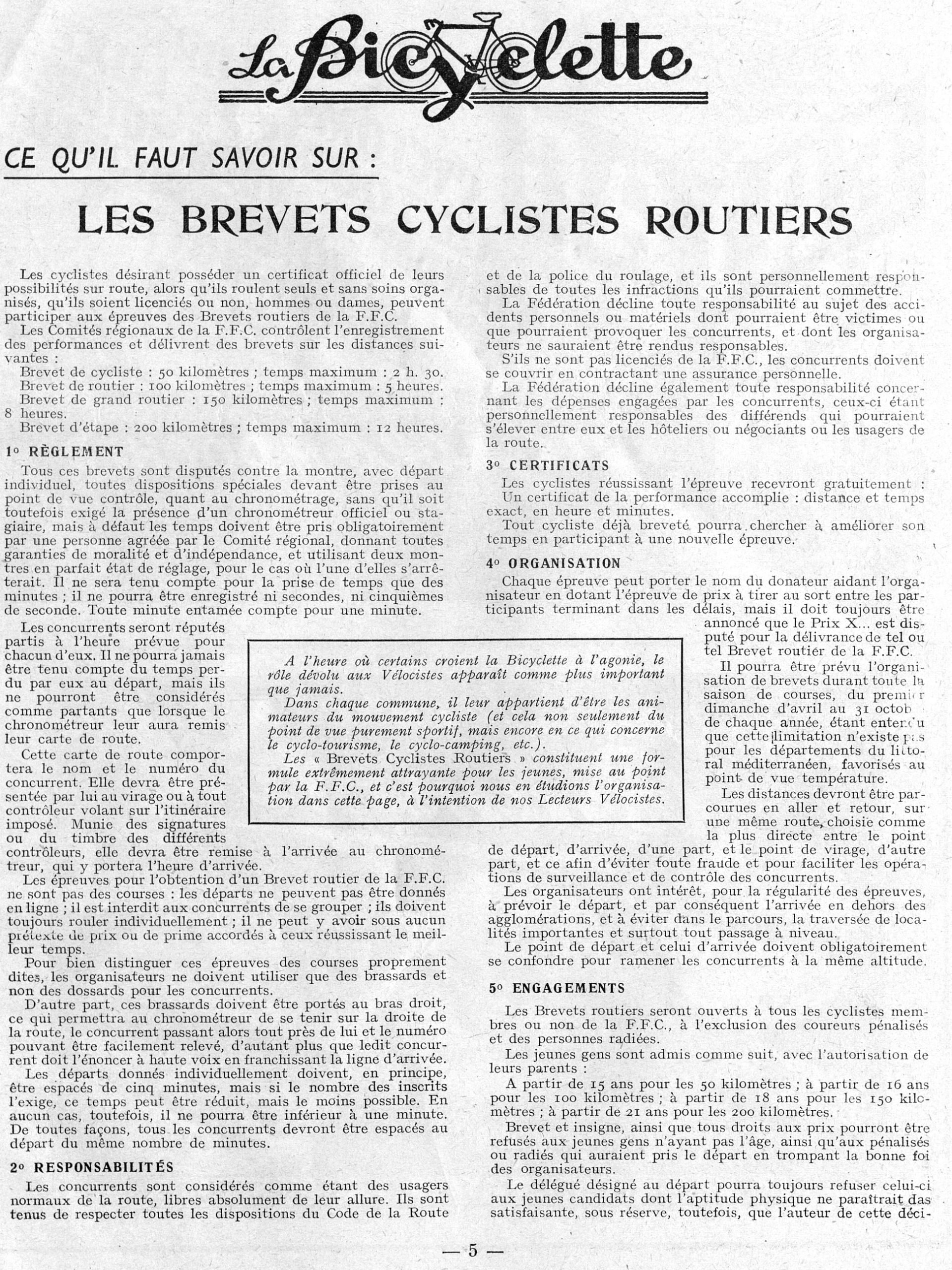
{{cite magazine |title=Ce qu'il faut savoir sur les brevets cyclistes routiers |magazine=L'Officiel du cycle |date=18 October 1952 |language=French |url=https://ebykr.com/library/lofficiel-du-cycle-1952-10-05-brevets-cyclistes-routiers-ffc/ |via=Ebykr |access-date=}}La Bicyclette CE QU'IL FAUT SAVOIR SUR : LES BREVETS CYCLISTES ROUTIERS Brevet de cycliste : 50 kilomètres ; temps maximum : 2 h. 30. Brevet de routier : 100 kilomètres ; temps maximum : 5 heures. Brevet de grand routier : 150 kilomètres ; temps maximum : 8 heures. Brevet d'étape : 200 kilomètres …
This is a magazine article, so its running text is summarized here rather than reproduced; the headline, byline, specifications and scores are transcribed as printed.
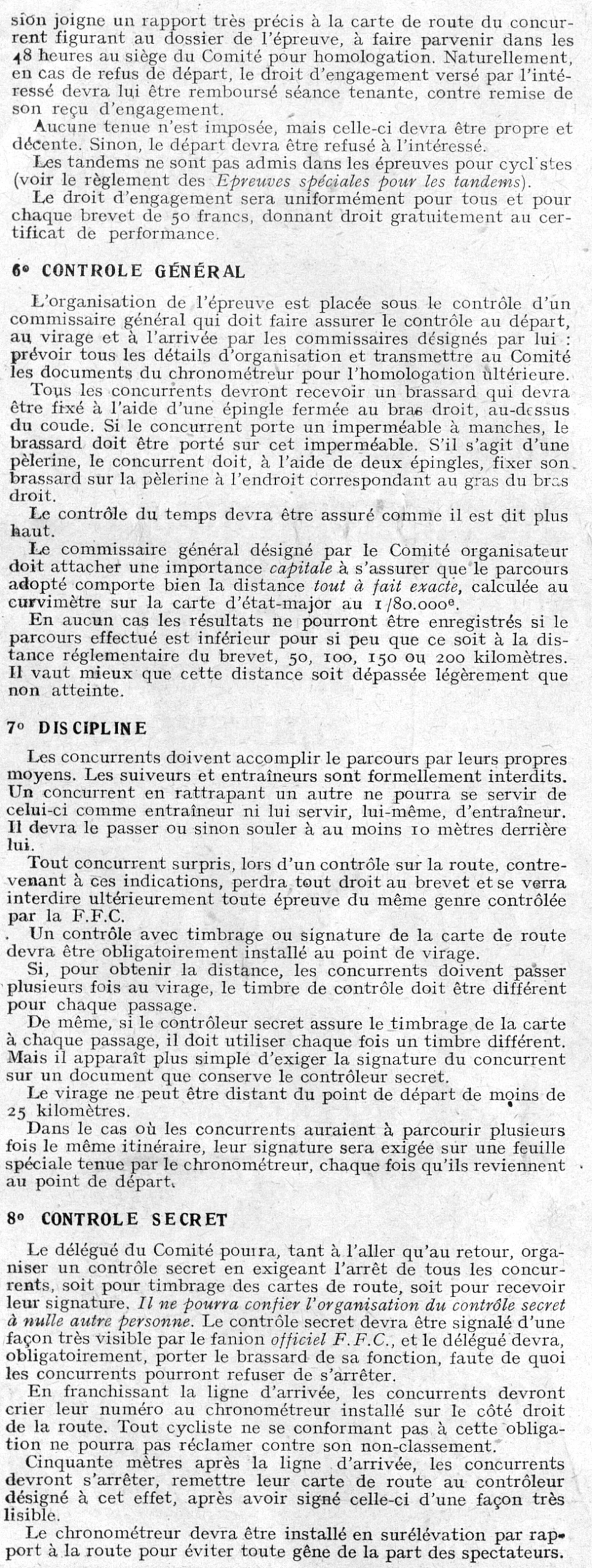
From L’Officiel du cycle, du motocycle et du camping, 18 October 1952, pages 5 and 7: article under the heading La Bicyclette: “Ce qu’il faut savoir sur : Les brevets cyclistes routiers”, F.F.C. road cycling certificates at 50, 100, 150 and 200 km with time limits; rules 1 to 5 (règlement, responsabilités, certificats, organisation, engagements); boxed note on the role of the bicycle and the cyclist. The title, headings, captions and lists are transcribed as printed; the text is summarized in Ebykr’s words, and the page images carry it in full.
— Page 1 —
La Bicyclette
CE QU’IL FAUT SAVOIR SUR :
LES BREVETS CYCLISTES ROUTIERS
[Ebykr summary; the article’s text is not reproduced. Cyclists who want an official certificate of their road ability, riding alone and without organized support, licensed or not, men or women, may enter the road certificate tests of the F.F.C. The regional committees of the F.F.C. check the recording of performances and issue certificates over the following distances.]
Brevet de cycliste : 50 kilomètres ; temps maximum : 2 h. 30.
Brevet de routier : 100 kilomètres ; temps maximum : 5 heures.
Brevet de grand routier : 150 kilomètres ; temps maximum : 8 heures.
Brevet d’étape : 200 kilomètres ; temps maximum : 12 heures.
1° RÈGLEMENT
[Ebykr summary; the article’s text is not reproduced. All the certificates are contested against the watch with an individual start. An official or probationary timekeeper is not required, but failing one the times must be taken by a person approved by the regional committee who offers every guarantee of morality and independence and uses two watches in perfect order. Only whole minutes count, with no seconds or fifths of a second, and any minute begun counts as a full minute. Riders are deemed to have started at the time set for each of them, and time lost at the start is never allowed for, but they count as starters only once the timekeeper has handed over their route card. The card bears the rider’s name and number, is shown at the turning point or to any roving controller on the set route, and, carrying the signatures or stamps of the various controllers, is handed to the timekeeper at the finish, who writes on it the arrival time. The tests are not races: starts may not be given in line, riders may not group and must ride individually, and no prize or bonus may be given for the best time. To keep them distinct from races the organizers use armbands, worn on the right arm, rather than back numbers, so that the timekeeper standing on the right of the road can read the number, which the rider must also call out aloud when crossing the finish line. Individual starts should in principle be spaced five minutes apart, a gap that may be reduced if the number of entries requires it but never below one minute, and all riders must be spaced by the same number of minutes.]
[Ebykr summary; the article’s text is not reproduced. A framed italic note set across the gutter of the page observes that, at a time when some believe the bicycle to be dying, the role of the bicycle dealers (Vélocistes) appears more important than ever. In each commune it falls to them to be the leaders of the cycling movement, not only for sport but also for cycle touring, cycle camping and the like. The note describes the “Brevets Cyclistes Routiers” as an extremely attractive formula for young people, worked out by the F.F.C., and says the magazine is therefore studying their organization on this page for the benefit of its dealer readers (Lecteurs Vélocistes).]
2° RESPONSABILITÉS
[Ebykr summary; the article’s text is not reproduced. Competitors count as ordinary road users, free to choose their own pace, and must observe the Highway Code and the road police regulations, being personally liable for any offenses they commit. The Federation declines all responsibility for personal or material accidents suffered or caused by competitors, for which the organizers cannot be held liable. Riders who are not F.F.C. licensees must cover themselves with personal insurance. The Federation also declines responsibility for expenses incurred by competitors, who are personally liable for disputes with hoteliers, tradesmen or other road users.]
3° CERTIFICATS
[Ebykr summary; the article’s text is not reproduced. Riders who complete the test receive free of charge a certificate of the performance achieved, giving the distance and the exact time in hours and minutes. A cyclist who already holds a certificate may try to improve his time by entering a new test.]
4° ORGANISATION
[Ebykr summary; the article’s text is not reproduced. Each test may bear the name of a donor who helps the organizer by providing prizes to be drawn by lot among the finishers within the time limits, but it must always be announced that the “Prix X…” is contested for the award of a given F.F.C. road certificate. Certificate tests may be organized throughout the racing season, from the first Sunday of April to 31 October each year, a limit that does not apply to the departments of the Mediterranean coast, favored by the climate. The distances must be covered out and back over one and the same route, chosen as the most direct between the start and finish point on one side and the turning point on the other, to prevent fraud and ease supervision and control. Organizers do well to plan the start and so the finish outside built-up areas and to avoid large towns and above all any level crossing on the course. The start and finish points must be the same, so that riders return to the same altitude.]
5° ENGAGEMENTS
[Ebykr summary; the article’s text is not reproduced. The road certificates are open to all cyclists, members of the F.F.C. or not, except penalized riders and persons struck off. Young people are admitted with parental permission, from the ages listed below.]
A partir de 15 ans pour les 50 kilomètres ; à partir de 16 ans pour les 100 kilomètres ; à partir de 18 ans pour les 150 kilomètres ; à partir de 21 ans pour les 200 kilomètres.
[Ebykr summary; the article’s text is not reproduced. Certificate, badge and all rights to prizes may be refused to young people below the age and to penalized or struck-off riders who started by deceiving the organizers. The delegate appointed at the start may always refuse a start to young candidates whose physical fitness seems unsatisfactory, provided that the person making the decision (the sentence breaks off at the foot of the page)]
[A magazine article page set in two justified columns of roman text, headed by the masthead “La Bicyclette” in large black script lettering with a line drawing of a bicycle in profile, saddle and handlebars at the top and two wheels, drawn through the letters and with three horizontal rules running beneath the lettering. Beneath it “CE QU’IL FAUT SAVOIR SUR :” is set in italic sans-serif capitals with an underline, and the title “LES BREVETS CYCLISTES ROUTIERS” in large heavy roman capitals. The four certificate rows are indented lines of body type. Numbered section headings (“1° RÈGLEMENT” through “5° ENGAGEMENTS”) are set in bold spaced capitals. A rectangular box ruled in heavy black lines, holding italic type, sits across the gutter between the two columns with the text wrapping around it. A printed page number sits at the foot. No drawing other than the masthead, no signature and no agency mark appears.]
— Page 2 —
[Ebykr summary; the article’s text is not reproduced, and this page opens in the middle of a sentence carried over from the previous image. The person who refuses a start must attach to the competitor’s route card in the file of the test a very precise report, to reach the committee headquarters for approval within 48 hours. If a start is refused the entry fee paid is refunded on the spot against return of the entry receipt. No dress is imposed but it must be clean and decent, or the start is refused. Tandems are not admitted to these tests (see the rules for special tandem events, “Epreuves spéciales pour les tandems”). The entry fee is uniform for all and set at 50 francs for each certificate, giving a free right to the certificate of performance.]
6° CONTROLE GÉNÉRAL
[Ebykr summary; the article’s text is not reproduced. The test is placed under a general commissioner who must have controls carried out at the start, at the turning point and at the finish by commissioners he appoints, plan every detail of the organization and send the timekeeper’s documents to the committee for later approval. Every competitor must receive an armband, fixed with a closed safety pin on the right arm above the elbow; it is worn over a raincoat with sleeves, and on a cape it is pinned in two places at the point matching the fat of the right arm. Timing is controlled as stated above. The general commissioner appointed by the organizing committee must treat as of capital importance that the course adopted has the exact distance, measured with a curvimeter on the 1/80.000e staff map. No result may be recorded if the distance covered falls short, however slightly, of the set 50, 100, 150 or 200 kilometers; it is better to exceed the distance slightly than to fall short of it.]
7° DISCIPLINE
[Ebykr summary; the article’s text is not reproduced. Competitors must cover the course under their own power. Pacers and followers are strictly forbidden, and a rider who catches another may neither use him as a pacer nor serve as pacer to him, and must pass him or drop back at least 10 meters. Any competitor caught breaking these rules in a road check loses all right to the certificate and is barred from any later test of the same kind under F.F.C. control. A control with a stamp or signature on the route card must be installed at the turning point; if riders must pass the turning point several times to make up the distance, the control stamp must differ for each passage, and a secret controller who stamps the card at each passage must likewise use a different stamp each time, although it seems simpler to require the rider’s signature on a document the secret controller keeps. The turning point may not be less than 25 kilometers from the start. Where riders must cover the same route several times, their signature is required on a special sheet kept by the timekeeper each time they return to the start point.]
8° CONTROLE SECRET
[Ebykr summary; the article’s text is not reproduced. The committee’s delegate may organize a secret control, on the outward and return legs, stopping all competitors for stamping of route cards or for their signature, and may entrust its organization to no one else. It must be signaled very visibly by the official F.F.C. pennant, and the delegate must wear the armband of his office, failing which competitors may refuse to stop. On crossing the finish line competitors must call out their number to the timekeeper placed on the right side of the road, and a rider who does not do so may not protest his non-classification. Fifty meters beyond the finish line they must stop and hand their route card, signed very legibly, to the controller appointed for the purpose. The timekeeper must be placed on a raised position above the road to avoid any hindrance from spectators.]
[A page of article text in a single wide justified column of roman type with indented paragraph openings, set in plain text with a few words in italic for emphasis. Three numbered section headings (“6° CONTROLE GÉNÉRAL”, “7° DISCIPLINE” and “8° CONTROLE SECRET”) are set in bold spaced capitals with a generous space above and below each. The first line is the tail of a sentence begun on the previous image. No drawing, box, signature or agency mark appears.]
Ebykr presents this material for research and education. If you hold rights to it or notice an ownership issue, please contact us and we will respond promptly.
The Ebykr Digest
New articles, timelines, catalog finds and registry activity — assembled from the archive once a month. Your address is never shared.
Double opt-in. One email per month. Unsubscribe at any time with one click.