About Ebykr
Ebykr celebrates classic and vintage lightweight bicycles through provocative imagery and opinion. Ride along with us.
About Ebykr
Ebykr celebrates classic and vintage lightweight bicycles through provocative imagery and opinion. Ride along with us.

Source: L'Officiel du cycle, du motocycle et du camping, N° 37, 3 November 1951, page 13; scan of the issue from Cycle Memory (Mémoire du Cycle), Collection privée F.
| Type | Review |
|---|---|
| Year | 1951 |
| Publisher | L'Officiel du cycle |
| Country | France |
| Language | French |
| Pages | 1 |
| Source | L'Officiel du cycle, du motocycle et du camping, N° 37, 3 November 1951, page 13; scan of the issue from Cycle Memory (Mémoire du Cycle), Collection privée F. |
| Credit | Ebykr archive |
| Identifier | Permalink https://cyclememory.org/fr/search-coll-list.php?collectionID=325&docID=B-1-0000001003 |
| Transcription | Headings and specifications transcribed; article text summarized |
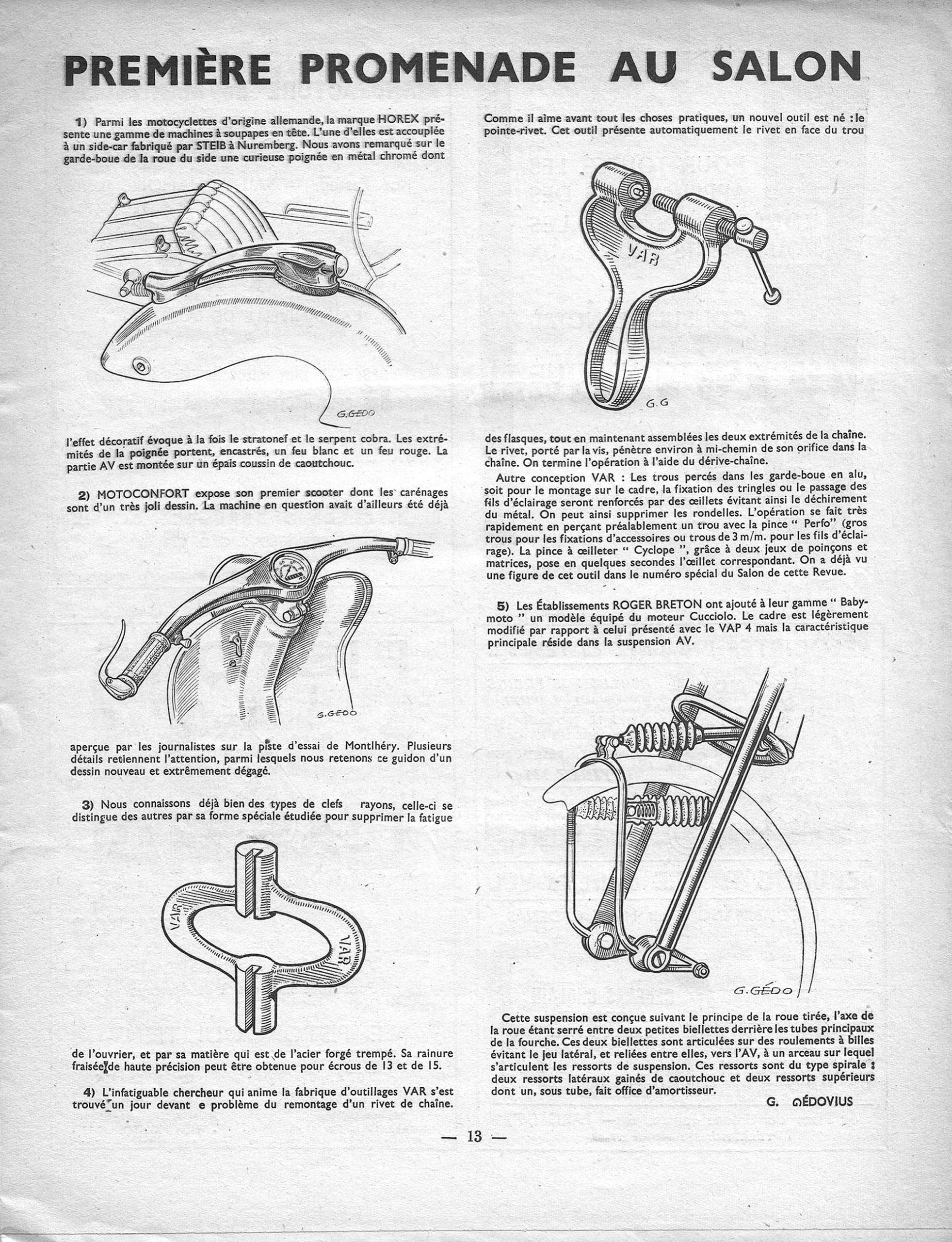
PREMIÈRE PROMENADE AU SALON 1) 2) 3) 4) 5) G. GÉDOVIUS — 13 —
This is a magazine article, so its running text is summarized here rather than reproduced; the headline, byline, specifications and scores are transcribed as printed.
G. Gédovius’s “Première promenade au Salon” in L’Officiel du cycle, du motocycle et du camping, 3 November 1951: novelties from the 1951 Paris Salon, among them a Horex side-car grab handle with built-in lamps, the Motoconfort scooter’s handlebar, the front suspension of Roger Breton’s Cucciolo-engined Baby-moto and three VAR tools (a spoke wrench, a chain-rivet tool and eyelet pliers), with his signed drawings. The title, item numbers and signature are transcribed as printed; the text is summarized in Ebykr’s words, and the page image carries it in full.
— Page 1 —
PREMIÈRE PROMENADE AU SALON
1)
2)
3)
4)
5)
G. GÉDOVIUS
[Ebykr summary; the article’s text is not reproduced. A first walk around the Salon in five numbered notes. 1) Among the German motorcycles, HOREX shows a range of overhead-valve machines, one of them coupled to a side-car built by STEIB at Nuremberg; the writer singles out an unusual chromed metal grab handle on the side-car’s wheel mudguard, whose ornamental shape he likens both to the stratonef (the stratospheric balloon) and to a cobra, with a white light and a red light set into its two ends and its front end mounted on a thick rubber cushion. 2) MOTOCONFORT exhibits its first scooter, with handsomely drawn fairings; the machine had already been seen by the press on the Montlhéry test track, and the writer picks out its new, very clean handlebar. 3) A spoke wrench (from VAR, whose name is on the drawing) stands out among the many spoke keys by a special shape meant to spare the mechanic fatigue and by its hardened forged steel; its precision-milled slot can be had for nuts of 13 and of 15. 4) The tireless designer behind the VAR tool works, faced with refitting a chain rivet, has produced a new tool, the pointe-rivet, which presents the rivet automatically in front of the hole in the side plates while holding the two chain ends together; the screw drives the rivet about halfway into its hole and the job is finished with the dérive-chaîne. A second VAR idea reinforces the holes drilled in aluminum mudguards (for frame mounting, the stays or the lighting wires) with eyelets that keep the metal from tearing and make washers unnecessary: the hole is first made with the “Perfo” pliers (large holes for accessory fittings, or 3 m/m holes for lighting wires), then the “Cyclope” eyeleting pliers, with two sets of punches and dies, set the matching eyelet in seconds; the writer recalls that this tool was illustrated in the magazine’s special Salon issue. 5) Les Établissements ROGER BRETON have added to their “Baby-moto” range a model powered by the Cucciolo engine; the frame is slightly altered from the one shown with the VAP 4, but the main feature is the front suspension, built on the pulled-wheel principle, in which the axle is clamped between two short links behind the main fork tubes; the links pivot on ball bearings that prevent side play and are joined at the front to a hoop on which the spiral suspension springs pivot: two side springs sheathed in rubber and two upper springs, one of which, under a tube, acts as a damper.]
[Five pen drawings, set between the paragraphs. 1) In the left column under item 1, the chromed grab handle curving along a side-car mudguard, with its mounting bolt and a lamp at its end, the side-car body behind it; signed “G.GEDO” at lower right, beside the mudguard’s trailing edge. 2) Under item 2, the scooter’s handlebar with a round speedometer set in its center, a hand grip and lever at the left end and the front apron below; signed “G.GEDO” at lower right. 3) Under item 3, the spoke wrench: an oval forged ring with two slotted round bosses, lettered on the ring; no signature or monogram is visible on it. 4) In the right column under item 4, the pointe-rivet: a C-shaped body with a looped handle, a threaded screw and a tommy bar, lettered on the body; signed with the monogram “G.G” at lower right, below the handle’s loop. 5) Under item 5, the Baby-moto front fork with its pulled links, rubber-gaitered springs, upper hoop, mudguard and part of the wheel; signed “G.GÉDO” at lower right, inside the arc of the tire. Four drawings are signed or initialed in all.]
— 13 —
Ebykr presents this material for research and education. If you hold rights to it or notice an ownership issue, please contact us and we will respond promptly.
The Ebykr Digest
New articles, timelines, catalog finds and registry activity — assembled from the archive once a month. Your address is never shared.
Double opt-in. One email per month. Unsubscribe at any time with one click.