About Ebykr
Ebykr celebrates classic and vintage lightweight bicycles through provocative imagery and opinion. Ride along with us.
About Ebykr
Ebykr celebrates classic and vintage lightweight bicycles through provocative imagery and opinion. Ride along with us.

Source: Gallica (Bibliothèque nationale de France), L'Officiel du cycle, du motocycle et du camping, 6 October 1951, Numéro spécial du Salon 1951, pages 23, 25 and 27; ark:/12148/bd6t541928909. Source gallica.bnf.fr / BnF.
| Type | Review |
|---|---|
| Year | 1951 |
| Publisher | L'Officiel du cycle |
| Country | France |
| Language | French |
| Pages | 3 |
| Source | Gallica (Bibliothèque nationale de France), L'Officiel du cycle, du motocycle et du camping, 6 October 1951, Numéro spécial du Salon 1951, pages 23, 25 and 27; ark:/12148/bd6t541928909. Source gallica.bnf.fr / BnF. |
| Credit | Ebykr archive; Bibliothèque nationale de France |
| Identifier | Gallica (BnF) ark:/12148/bd6t541928909/f22 |
| Transcription | Headings and specifications transcribed; article text summarized |
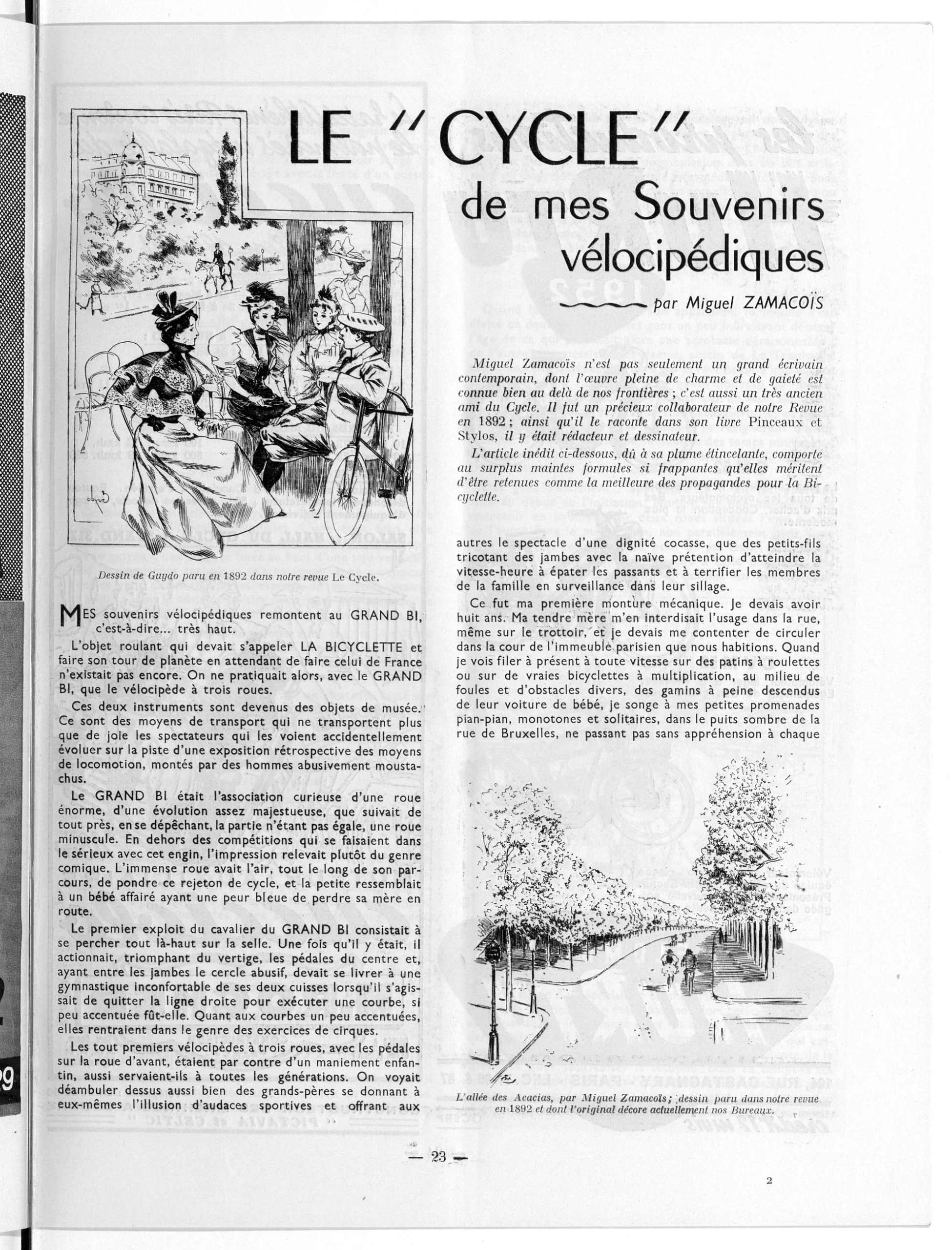
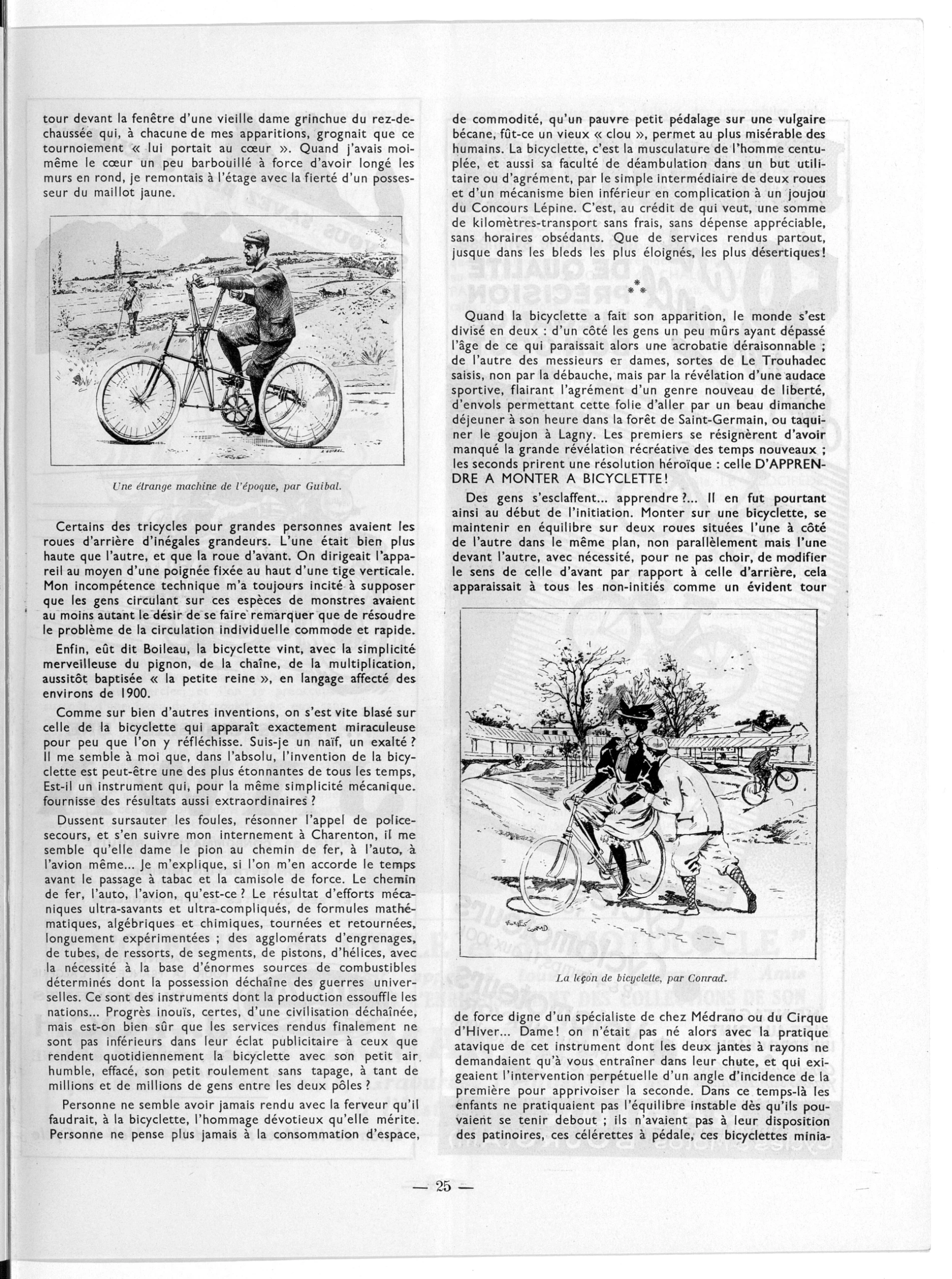
LE "CYCLE" de mes Souvenirs vélocipédiques par Miguel ZAMACOÏS Dessin de Guydo paru en 1892 dans notre revue Le Cycle. L'allée des Acacias, par Miguel Zamacoïs ; dessin paru dans notre revue en 1892 et dont l'original décore actuellement nos Bureaux. Une étrange machine de l'époque, par Guibal. La leçon de bicyclette, par Conrad. Miguel …
This is a magazine article, so its running text is summarized here rather than reproduced; the headline, byline, specifications and scores are transcribed as printed.
From L’Officiel du cycle, du motocycle et du camping, 6 October 1951, the paper’s special number for the 1951 Paris Salon du Cycle et du Motocycle and its 60th anniversary, pages 23, 25 and 27: Miguel Zamacoïs’s memoir of the bicycle in the Paris of the 1890s, with drawings. The title, headings, captions and lists are transcribed as printed; the text is summarized in Ebykr’s words, and the page images carry it in full.
— Page 1 —
LE “CYCLE”
de mes Souvenirs
vélocipédiques
par Miguel ZAMACOÏS
[Ebykr summary; the article’s text is not reproduced. An italic editorial note introduces Miguel Zamacoïs as a leading contemporary writer, known well beyond France for work full of charm and gaiety, and a very old friend of the paper: in 1892, as he tells in his book « Pinceaux et Stylos », he was both an editor and an illustrator of the paper. The note presents the article as unpublished and full of phrases that make the best propaganda for the bicycle.]
[Ebykr summary, continued. Zamacoïs says his cycling memories go back to the « GRAND BI », the high-wheeler, at a time when the bicycle proper did not yet exist and the only alternatives were the high-wheeler and the three-wheeled velocipede, both now museum pieces that amuse spectators when abusively mustached men ride them at retrospective exhibitions of transport. He describes the high-wheeler as a huge wheel followed by a tiny one, comic outside serious racing, the big wheel seeming to lay the little one like an egg; the first feat was climbing up to the saddle, the next pedaling the central cranks and wrestling the wheel round any bend, curves belonging to the circus. The first three-wheelers, with pedals on the front wheel, were child’s play and were ridden by every generation, grandfathers and grandsons alike. A tricycle was his own first mount, at about eight; his mother forbade him the street and even the pavement, so he rode alone round the courtyard of the family’s Paris apartment building in the rue de Bruxelles, which he contrasts with today’s children speeding through crowds on roller skates and geared bicycles. The text continues on the next page.]
Dessin de Guydo paru en 1892 dans notre revue Le Cycle.
L’allée des Acacias, par Miguel Zamacoïs ; dessin paru dans notre revue en 1892 et dont l’original décore actuellement nos Bureaux.
[Two line drawings reproduced from the paper of 1892. At the upper left, in a frame with a stepped top corner, Guydo’s drawing shows a fashionable group in a Paris park: a woman in a lace cape and plumed hat seated on a bentwood chair, two young women in puffed sleeves and a young man in a striped boater leaning on a safety bicycle, with a rider on horseback, a park keeper and a domed building behind; signed “Guydo” in script, set vertically at the lower left inside the frame. At the lower right, unframed, Zamacoïs’s own pen drawing of the Allée des Acacias shows an avenue of trees with lampposts and two cyclists riding away down the path; a small pen monogram with an underline flourish sits at the lower left, possibly “Za” [?]. The headline’s opening letters “LE” in large sans-serif capitals sit beside the top of the first drawing; the article starts with a drop capital “M”.]
— Page 2 —
Une étrange machine de l’époque, par Guibal.
La leçon de bicyclette, par Conrad.
[Ebykr summary; the article’s text is not reproduced. Zamacoïs finishes the courtyard story: a grumpy old lady on the ground floor complained at every lap that his circling turned her stomach, and he went back upstairs, a little dizzy himself, as proud as the wearer of the yellow jersey. He recalls adult tricycles with two rear wheels of unequal size, steered by a handle on top of a vertical rod, whose riders he suspects wanted to be noticed as much as to travel. Then, as Boileau might have said, came the bicycle, with the marvelous simplicity of sprocket, chain and gearing, soon nicknamed « la petite reine » in the affected language of about 1900. He calls the bicycle perhaps the most astonishing invention of all time for the results it gives from so simple a mechanism, and, at the risk of being committed to Charenton, ranks it above the railway, the car and the airplane, products of ultra-complicated engineering and of fuels whose possession unleashes world wars, against the bicycle’s humble, quiet service to millions between the two poles. No one, he says, pays it due homage: it multiplies a man’s muscles a hundredfold and gives free transport, without timetables, to the remotest places, through a mechanism simpler than a toy from the Concours Lépine.]
[Ebykr summary, continued, after a three-star break. When the bicycle appeared, the world split in two: older people who thought it an unreasonable acrobatics, and ladies and gentlemen, like so many Le Trouhadecs, seized by a new sporting daring and the freedom to lunch in the forest of Saint-Germain on a fine Sunday or to fish for gudgeon at Lagny. The first resigned themselves to missing the great recreation of the new age; the second made the heroic decision to LEARN TO RIDE A BICYCLE. Keeping balance on two wheels set one behind the other, steering the front against the rear, seemed to the uninitiated a feat worthy of the Médrano or the Cirque d’Hiver: nobody then was born with the instinct, and children did not grow up on rinks, pedal « célérettes » and miniature bicycles. The text continues on the next page.]
[Two line drawings of the period, each in a ruled frame. At the upper left, Guibal’s drawing shows a bearded man in a cap and knickerbockers riding a tall, oddly built cycle with a long vertical steering post along a country road, a farm worker and a distant cart behind; signed “A GUIBAL” in small capitals at the lower right, under the ground line. At the lower right, Conrad’s drawing shows a cycling lesson on a riding track: a young woman in a plumed hat and a short skirt is held upright on a safety bicycle by an instructor in a cap, knickerbockers and checked stockings, while another cyclist rides in the background past a long covered stand with a sign reading « BUFFET » [?]; signed “GEORGES CONRAD” in two lines of stylized capitals at the lower left inside the frame.]
— Page 3 —
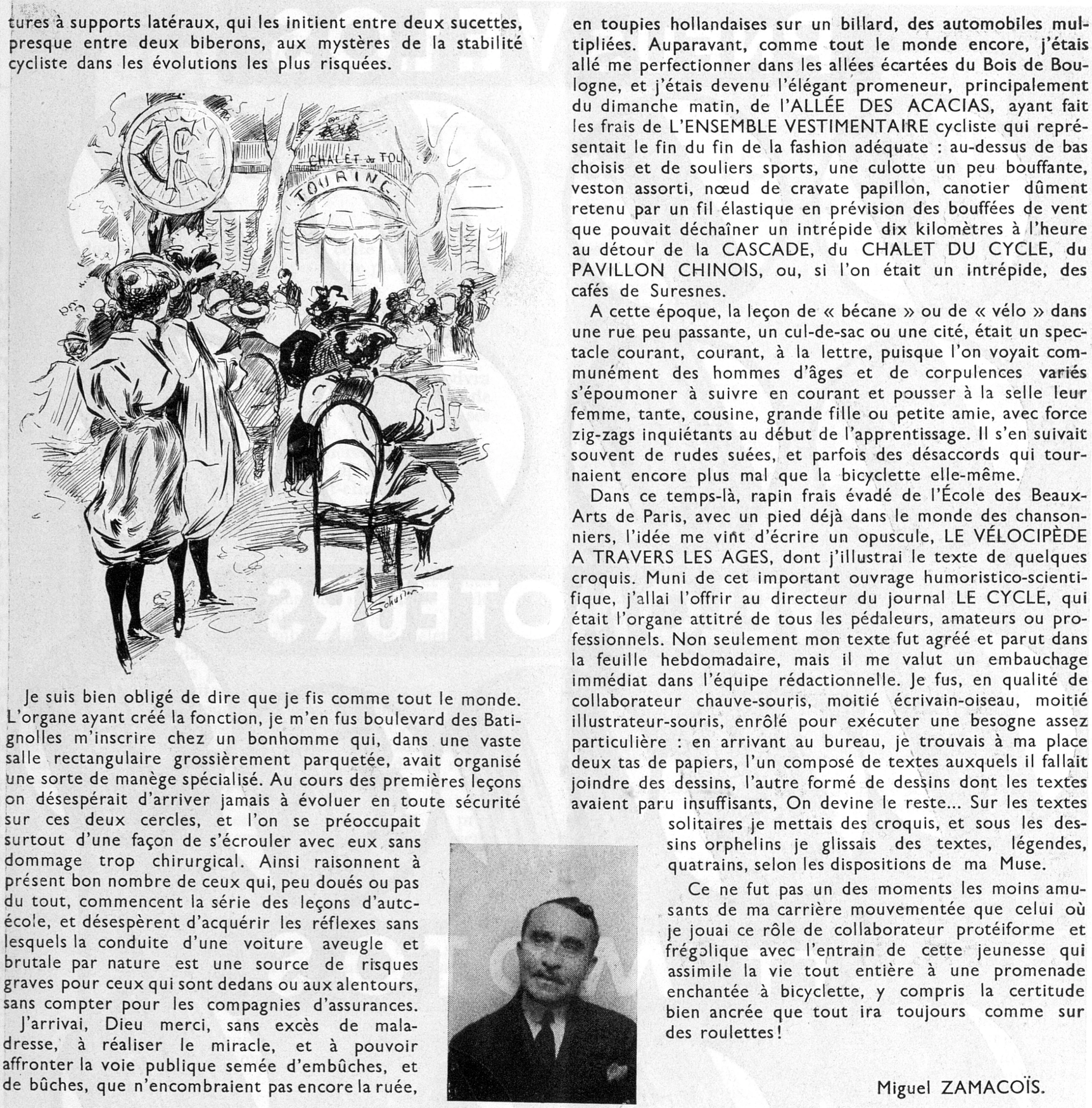
[Ebykr summary; the article’s text is not reproduced. Zamacoïs ends the thought on the children of today, initiated into cycling balance on miniature bicycles with side supports almost between two baby bottles. Like everyone, he says, he took lessons: on the boulevard des Batignolles a man had set up a kind of riding school in a large, roughly floored rectangular hall, where the first concern of beginners was how to fall without surgical damage, as many learner drivers at the auto-école worry today. He managed the miracle without undue clumsiness and faced the public road, not yet crowded with automobiles spinning like Dutch tops on a billiard table. Before that, like everyone, he had practiced in the quiet alleys of the Bois de Boulogne and became an elegant Sunday-morning rider of the ALLÉE DES ACACIAS, in the full cycling outfit of the day (chosen stockings, sports shoes, slightly baggy breeches, matching jacket, bow tie and a boater held on by an elastic cord against the gusts of an intrepid 10 km an hour) on the way to the CASCADE, the CHALET DU CYCLE, the PAVILLON CHINOIS or, for the bold, the cafés of Suresnes. The « bécane » or « vélo » lesson in a quiet street or cul-de-sac was then a common sight: men of every age and build running behind wife, aunt, cousin, daughter or girlfriend, pushing the saddle through the first worrying zigzags, with much sweat and sometimes quarrels that went worse than the bicycle. In those days, a young art student just out of the École des Beaux-Arts de Paris with one foot among the chansonniers, he wrote a little humorous book, LE VÉLOCIPÈDE A TRAVERS LES AGES, illustrated with his own sketches, and offered it to the director of the paper LE CYCLE, the official organ of all riders, amateur or professional. The text was accepted and printed in the weekly and won him an immediate place on the editorial staff, as a « bat » contributor, half writer-bird and half illustrator-mouse: each morning he found two piles of papers on his desk, texts needing drawings and drawings needing texts, and supplied sketches for the one and captions or quatrains for the other. He counts this protean role among the most amusing moments of a busy career, played with the energy of youth, which sees all of life as an enchanted bicycle ride sure to go on as if on wheels.]
Miguel ZAMACOÏS.
[Two pictures, both without captions. At the upper left, a pen drawing shows a crowded outdoor café under trees outside a pavilion lettered “CHALET du TOU” and “TOURING”, with a large wheel-shaped emblem with an interlaced monogram, apparently “TCF” [?], hung at the upper left (the lettering “CHALET du TOU” is partly hidden by a tree trunk); in the foreground two women cyclists in puffed blouses and baggy bloomers stand among the seated customers on bentwood chairs; signed “Schuster.” in script, wrapped in a looped flourish at the lower right. At the lower center, set into the text, a halftone portrait photograph shows a man, presumably Miguel Zamacoïs at the time of writing, head and shoulders, in a dark suit and tie with a handkerchief in the breast pocket.]
Ebykr presents this material for research and education. If you hold rights to it or notice an ownership issue, please contact us and we will respond promptly.
The Ebykr Digest
New articles, timelines, catalog finds and registry activity — assembled from the archive once a month. Your address is never shared.
Double opt-in. One email per month. Unsubscribe at any time with one click.