About Ebykr
Ebykr celebrates classic and vintage lightweight bicycles through provocative imagery and opinion. Ride along with us.
About Ebykr
Ebykr celebrates classic and vintage lightweight bicycles through provocative imagery and opinion. Ride along with us.

Source: Gallica (Bibliothèque nationale de France), L'Officiel du cycle, du motocycle et du camping, 6 October 1951, Numéro spécial du Salon 1951, pages 15 and 17; ark:/12148/bd6t541928909. Source gallica.bnf.fr / BnF.
| Type | Review |
|---|---|
| Year | 1951 |
| Publisher | L'Officiel du cycle |
| Country | France |
| Language | French |
| Pages | 2 |
| Source | Gallica (Bibliothèque nationale de France), L'Officiel du cycle, du motocycle et du camping, 6 October 1951, Numéro spécial du Salon 1951, pages 15 and 17; ark:/12148/bd6t541928909. Source gallica.bnf.fr / BnF. |
| Credit | Ebykr archive; Bibliothèque nationale de France |
| Identifier | Gallica (BnF) ark:/12148/bd6t541928909/f14 |
| Transcription | Headings and specifications transcribed; article text summarized |
LE SALON DU CYCLE C'était en 1894... LES ORIGINES ET LES DÉVELOPPEMENTS DES SALONS DU CYCLE Il y a 80 ans Le Stanley Show ... La bicyclette détrône le légendaire " Grand bi " — 15 — Revenons en France Le cycle contre l'auto Victor BREYER. Le cycle contre l'auto... ... La réconciliation... — 17 …
This is a magazine article, so its running text is summarized here rather than reproduced; the headline, byline, specifications and scores are transcribed as printed.
From L’Officiel du cycle, du motocycle et du camping, 6 October 1951, the paper’s special number for the 1951 Paris Salon du Cycle et du Motocycle and its 60th anniversary, pages 15 and 17: Victor Breyer’s history of the Paris cycle shows from the Stanley Show and the Salon of 1894 onward. The title, headings, captions and lists are transcribed as printed; the text is summarized in Ebykr’s words, and the page images carry it in full.
— Page 1 —
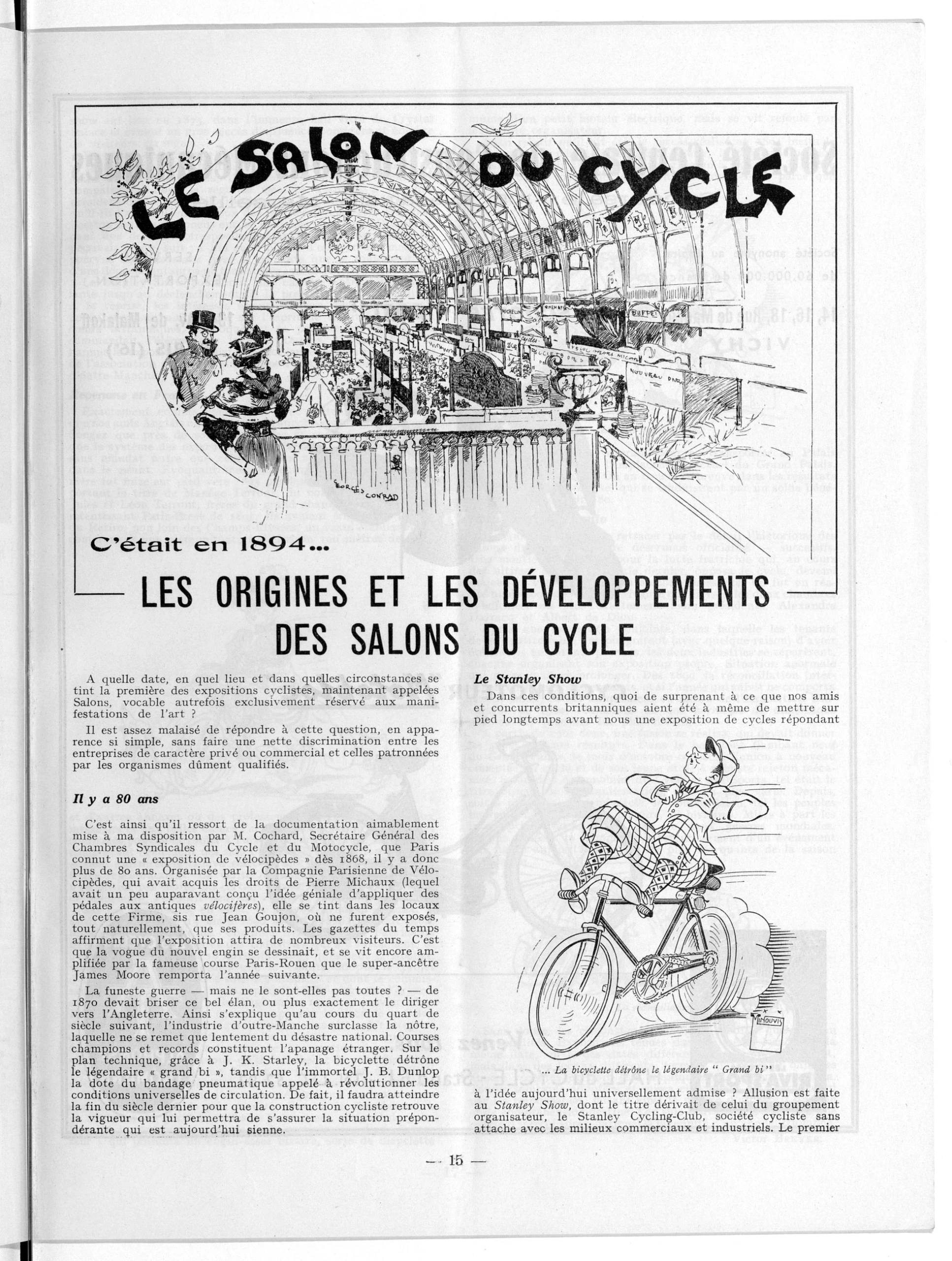
LE SALON DU CYCLE
C’était en 1894…
LES ORIGINES ET LES DÉVELOPPEMENTS
DES SALONS DU CYCLE
[Ebykr summary; the article’s text is not reproduced. The author asks when, where and in what circumstances the first cycle exhibition was held, now called a « Salon », a word once reserved for art shows, and notes that the answer depends on separating private or commercial ventures from those sponsored by qualified bodies.]
Il y a 80 ans
[Ebykr summary. From documents lent by M. Cochard, Secretary General of the Chambres Syndicales du Cycle et du Motocycle, Paris had an « exposition de vélocipèdes » as early as 1868, 80 years before, organized by the Compagnie Parisienne de Vélocipèdes, which had acquired the rights of Pierre Michaux (who had shortly before conceived the idea of fitting pedals to the old vélocifères); it was held at the firm’s premises in the rue Jean Goujon and showed only its own products, but drew many visitors, and the craze grew with the Paris-Rouen race won the next year by James Moore. The war of 1870 broke this impetus and turned it toward England: for a quarter century the British industry outclassed the French, with racing, champions and records a foreign preserve, J. K. Starley’s bicycle dethroning the high-wheeler and J. B. Dunlop’s pneumatic tire transforming cycling. Only at the end of the 19th century did French construction recover the vigor that gave it its present leading position.]
Le Stanley Show
[Ebykr summary. It was no surprise, then, that the British staged a cycle exhibition long before the French: the Stanley Show, named for its organizer, the Stanley Cycling-Club, a cycling society with no ties to trade or industry. The section continues on the next page of the record.]
… La bicyclette détrône le légendaire ” Grand bi ”
— 15 —
[Two pen drawings. The title drawing, boxed across the top of the page, shows the 1894 Salon du Cycle under the iron and glass vault of an exhibition hall: stands with signs (“MICHELIN”, “Cycles”, “BUFFET”, “NOUVEAU PNEU”, “SOCIETE DES PN…” and “VELOCIPEDES MICHA…” [?], partly legible), a large urn, palms and crowds below, seen from a balustraded gallery where a gentleman in a top hat and a lady in a leg-of-mutton-sleeved dress and plumed hat look on in the foreground at the left; the title “LE SALON DU CYCLE” is lettered in heavy freehand capitals across the vault with sprays of leaves, and “C’était en 1894…” is set in bold type at the lower left of the box. Signed “GEORGES CONRAD” in small capitals running along a curve below the balustrade, lower left of center. The second drawing, at the right of the text, is a cartoon of a beaming cyclist in a cap, checked plus-fours and diamond-patterned stockings, leaning back with his thumbs in his waistcoat as he speeds along with his feet up on the handlebar of a diamond-frame safety bicycle, dust clouds behind; signed “MINOUVIS” in a small box at the lower right, with two small crosses above it, and captioned in italic beneath. The main title is in condensed sans-serif capitals between rules. Matter printed on the reverse of the sheet (a Société Centrale advertisement with a Vichy address, a Riva-Sport panel and text) shows through faintly across the page; it is not printed on this page. No library stamp.]
— Page 2 —
[Ebykr summary; the article’s text is not reproduced. The first Stanley Show was held in 1875 in the great glazed hall of the Crystal Palace and drew many visitors, foreigners among them. In 1889 and 1890 the author, then living in London as the representative of the weekly « Véloce-Sport », which had a stand at the « Palace », welcomed many compatriots, among them the late Georges Thomas, then president of the Union Vélocipédique de France, who bought two of the famous Humber-Beeston bicycles fitted with pneumatic tires still unknown in France; shortly afterward, in a dispatch to « V.-S. » of 15 February 1890, the author reported trying a machine on « pneumatic tyres » and finding it smoother than any other anti-vibration system. The Stanley Show ran brilliantly until the First World War; after it, the British trade association of manufacturers took over the annual London cycle show.]
Revenons en France
[Ebykr summary. France followed the same course, only later. Nearly 60 years earlier the era of shows run by self-appointed individuals ended; the last, the author recalls, was mounted about 1893 by the Manège Terront, run by Jules and Léon Terront, brothers of the champion who won the Paris-Brest of 1891, in the cité du Retiro near the Champs-Élysées: a large hall with a miniature track of about 100 meters a lap, rooms where instructors taught ladies and gentlemen to ride, a wet-weather track for experienced riders and salesrooms, its much-advertised exhibition confined to the makes the brothers represented; it had some success but no sequel. The trade body was then formed: constituted on 13 March 1890 under the name now borne by the Chambre Syndicale des Fabricants de Bicycles et Tricycles et des Industries qui s’y rattachent, it adopted at its meeting of 18 November 1893 (president L. Rochet, vice-president A. Peugeot) the plan for an exhibition under its auspices, with M. Bivort, a specialist in such events, as commissioner general. It was held at the salle Wagram from 10 to 22 January 1894, the first use of the term « Salon du Cycle », though only as a subtitle: 207 exhibitors and 613 machines; visitor numbers are not recorded, but the show, expected to run at a loss, closed with a net profit of 1.330 francs 15 centimes. The author recalls the admission of 50 centimes, raised to one franc on the Friday gala day, and the dispute over an « inventor » who presented an odd bicycle with a small electric motor and was turned away by the committee. The 1894 success led the trade body to repeat the show, raising the stand rent from 20 to 25 francs the square meter and leaving the too-small salle Wagram for the Palais de l’Industrie, on the site of the present Grand Palais; attendance was large and the books showed a profit of 8.627 fr. 80.]
Le cycle contre l’auto
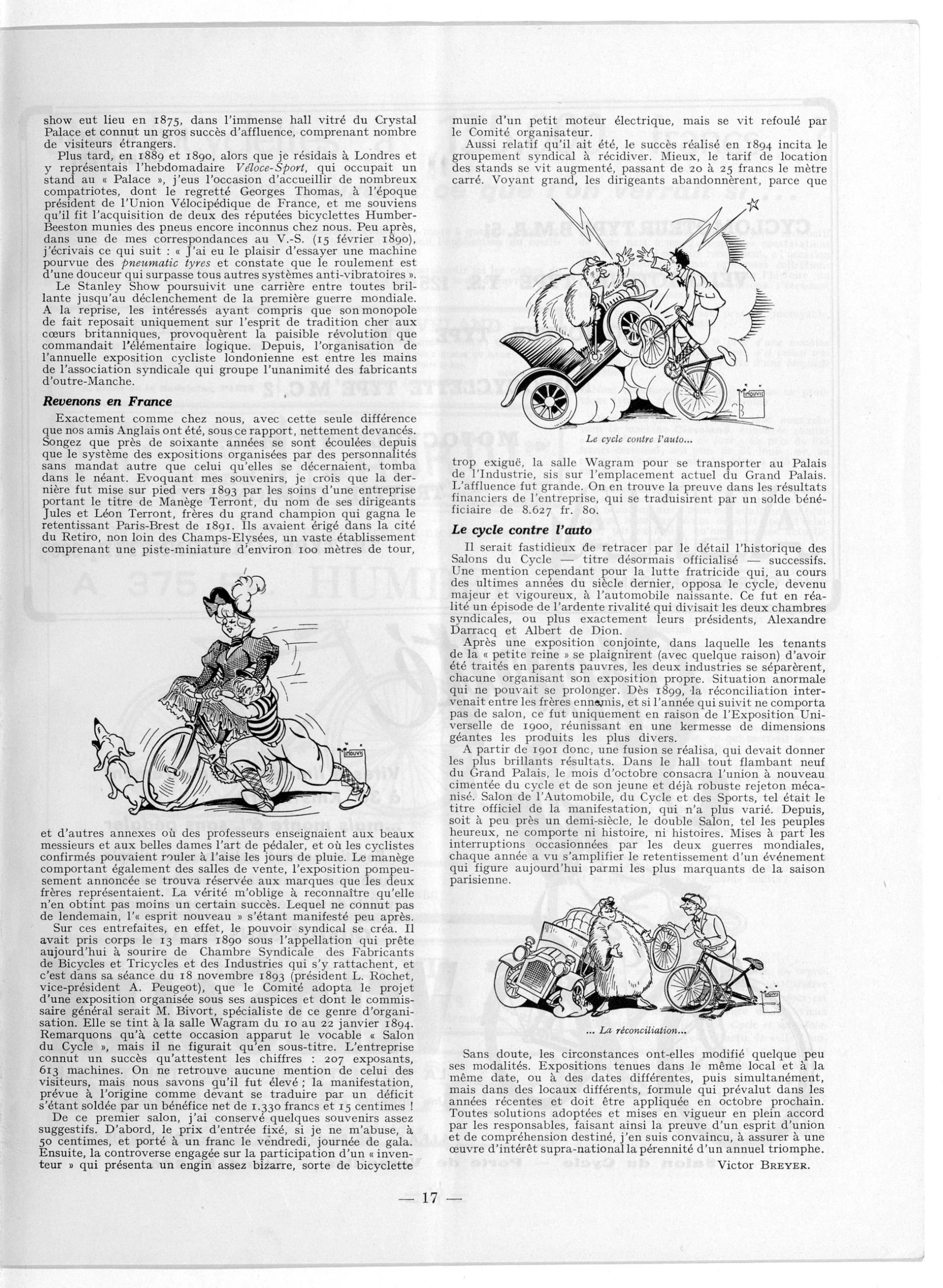
[Ebykr summary. The author passes over the history of the successive Salons du Cycle, now the official title, except for the fratricidal struggle of the last years of the century between the mature cycle and the newborn automobile, in fact a rivalry between the two trade bodies, or rather their presidents, Alexandre Darracq and Albert de Dion. After a joint exhibition in which the cycle people felt treated as poor relations, the two industries held separate shows, until a reconciliation in 1899; there was no Salon in 1900 only because of the Exposition Universelle. From 1901 the two were merged in the brand-new Grand Palais each October under the official title Salon de l’Automobile, du Cycle et des Sports, unchanged since; for about half a century the double Salon has gone on without incident, apart from the interruptions of the two world wars, and is now one of the leading events of the Paris season. Its formula has varied (one hall and one date, different dates, then simultaneous shows in separate halls, as in recent years and in the coming October), all adopted by agreement, which the author trusts will ensure an annual triumph of supra-national interest.]
Victor BREYER.
Le cycle contre l’auto…
… La réconciliation…
— 17 —
[Three pen cartoons, each signed “MINOUVIS” in a small box (the first two at the lower right of the drawing, the third at the lower right beside the bicycle). At the lower left of the page, without caption, a stout lady of the 1890s in a plumed hat and leg-of-mutton sleeves rides a bicycle while a small man in a striped jersey and checked stockings, presumably her instructor, clings to it and pushes, a small dog barking at the left. At the upper right, captioned “Le cycle contre l’auto…”, an early motorcar driven by a bearded, fur-coated motorist collides head-on with a cyclist in a cap and plus-fours, lightning bolts and a star above them and dust clouds around. At the lower right, captioned “… La réconciliation…”, the same fur-coated motorist, now in goggles, stands beside his car shaking hands with the cyclist, who holds his bicycle. Matter printed on the reverse of the sheet (an advertisement with “CYCLOMOTEUR TYPE B.M.A.”, “MOTOCYCLETTE TYPE M.C. 2”, “A 375 …” and “HUMBER” in large letters) shows through faintly across the page; it is not printed on this page. No library stamp.]
Ebykr presents this material for research and education. If you hold rights to it or notice an ownership issue, please contact us and we will respond promptly.
The Ebykr Digest
New articles, timelines, catalog finds and registry activity — assembled from the archive once a month. Your address is never shared.
Double opt-in. One email per month. Unsubscribe at any time with one click.