About Ebykr
Ebykr celebrates classic and vintage lightweight bicycles through provocative imagery and opinion. Ride along with us.
About Ebykr
Ebykr celebrates classic and vintage lightweight bicycles through provocative imagery and opinion. Ride along with us.

Source: Gallica (Bibliothèque nationale de France), L'Officiel du cycle, du motocycle et du camping, 6 October 1951, Numéro spécial du Salon 1951, pages 29, 30 and 33; ark:/12148/bd6t541928909. Source gallica.bnf.fr / BnF.
| Type | Review |
|---|---|
| Year | 1951 |
| Publisher | L'Officiel du cycle |
| Country | France |
| Language | French |
| Pages | 4 |
| Source | Gallica (Bibliothèque nationale de France), L'Officiel du cycle, du motocycle et du camping, 6 October 1951, Numéro spécial du Salon 1951, pages 29, 30 and 33; ark:/12148/bd6t541928909. Source gallica.bnf.fr / BnF. |
| Credit | Ebykr archive; Bibliothèque nationale de France |
| Identifier | Gallica (BnF) ark:/12148/bd6t541928909/f28 |
| Transcription | Headings and specifications transcribed; article text summarized |
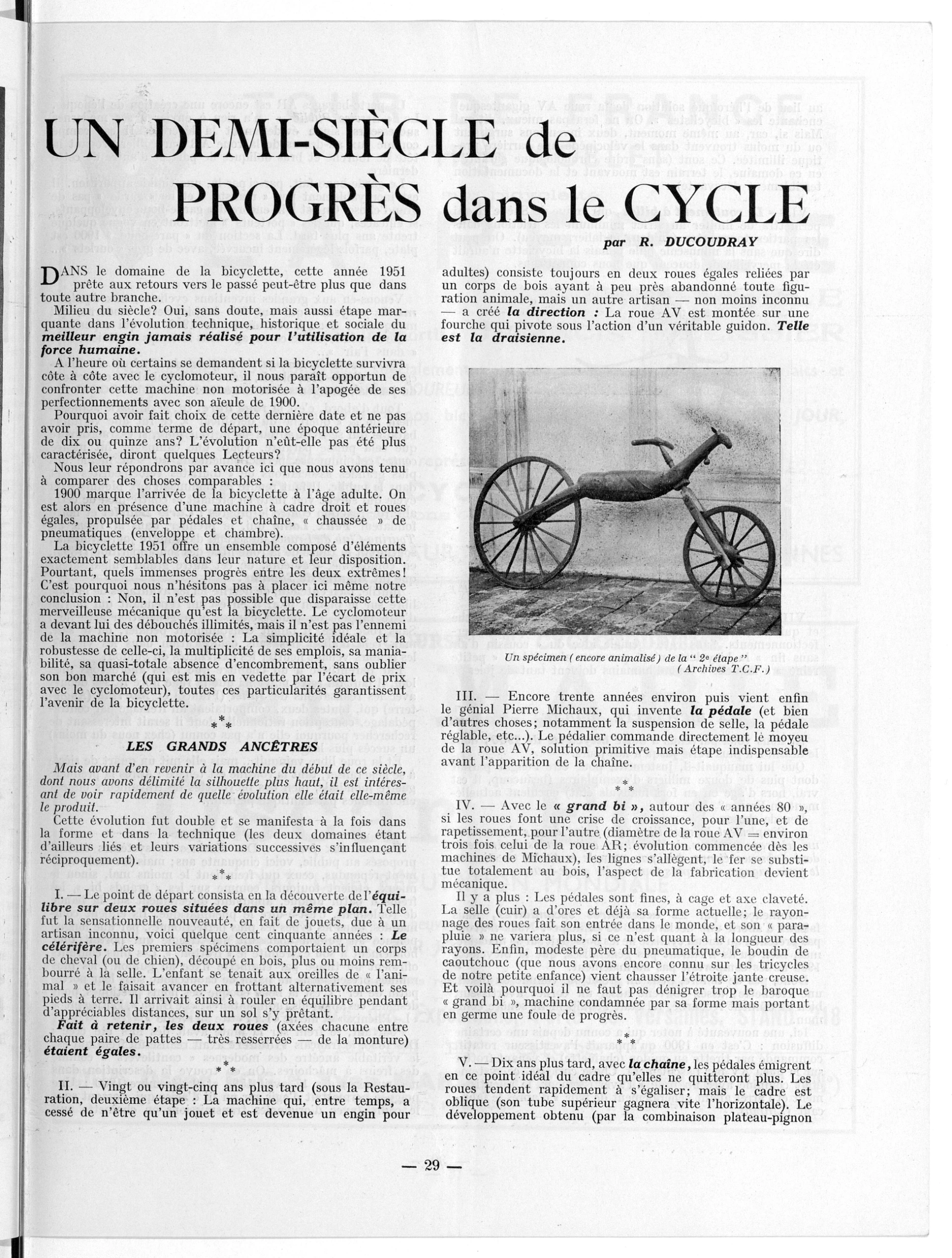
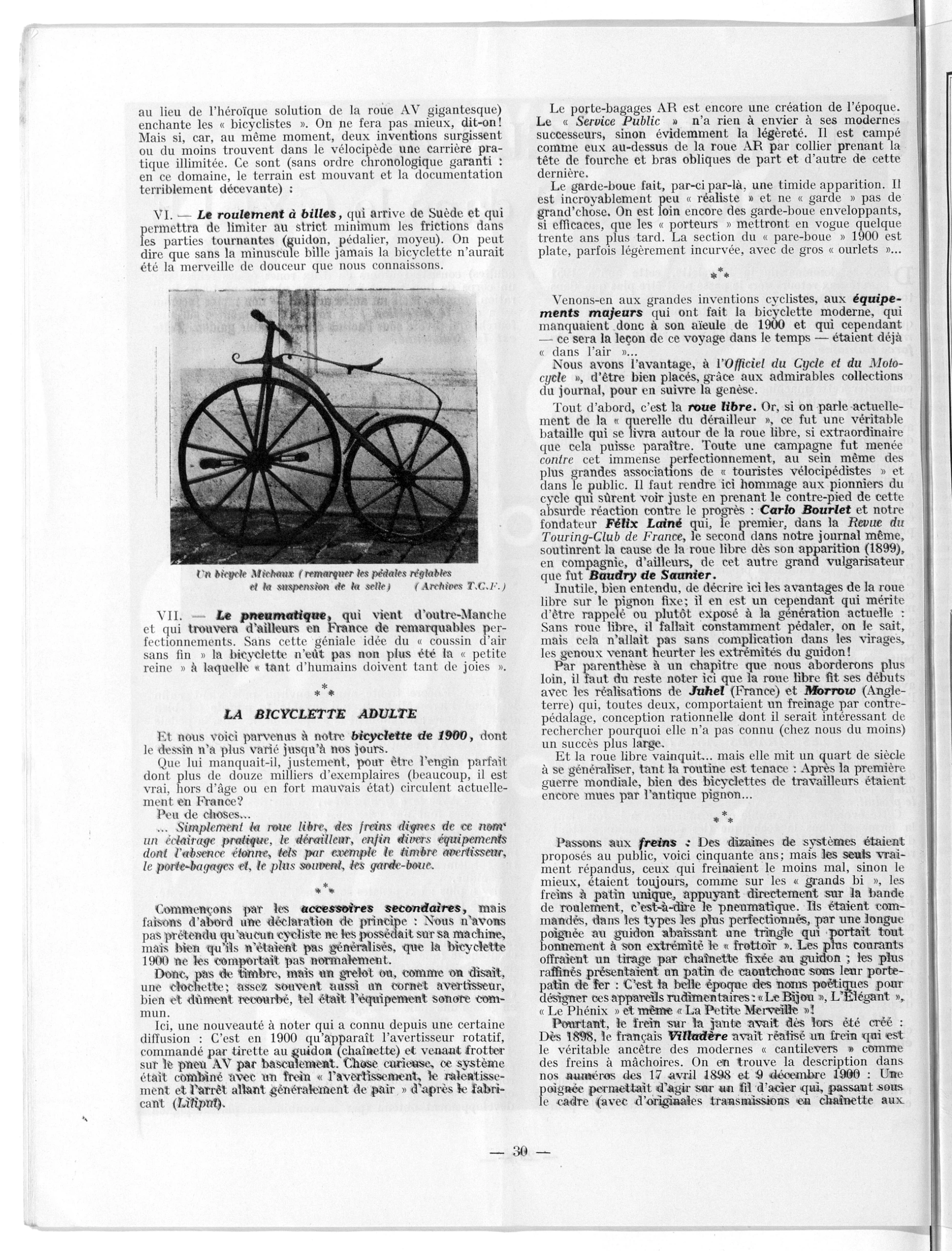
UN DEMI-SIÈCLE de PROGRÈS dans le CYCLE par R. DUCOUDRAY LES GRANDS ANCÊTRES I. — II. — III. — IV. — V. — Un spécimen (encore animalisé) de la " 2e étape " (Archives T.C.F.) VI. — VII. — LA BICYCLETTE ADULTE Un bicycle Michaux (remarquer les pédales réglables et la suspension de la selle) …
This is a magazine article, so its running text is summarized here rather than reproduced; the headline, byline, specifications and scores are transcribed as printed.
From L’Officiel du cycle, du motocycle et du camping, 6 October 1951, the paper’s special number for the 1951 Paris Salon du Cycle et du Motocycle and its 60th anniversary, pages 29, 30 and 33: R. Ducoudray’s survey of fifty years of progress in the bicycle, from the draisienne to the derailleur. The title, headings, captions and lists are transcribed as printed; the text is summarized in Ebykr’s words, and the page images carry it in full.
— Page 1 —
UN DEMI-SIÈCLE de
PROGRÈS dans le CYCLE
par R. DUCOUDRAY
[Ebykr summary; the article’s text is not reproduced. Ducoudray says the year 1951, the middle of the century, invites a look back at the technical, historical and social evolution of what he calls the best machine ever made for using human power. With some wondering whether the bicycle will survive beside the cyclomoteur, he sets the unmotorized machine at the height of its refinement against its ancestor of 1900. He chose 1900 rather than an earlier date to compare like with like: 1900 marks the bicycle’s coming of age, a machine with a straight frame and equal wheels, driven by pedals and chain and shod with pneumatic tires (cover and inner tube), and the bicycle of 1951 is made of the same elements in the same arrangement, yet with immense progress between the two. His conclusion, stated at once: the bicycle cannot disappear. The cyclomoteur has unlimited outlets but is no enemy of the unmotorized machine, whose simplicity, strength, many uses, handiness, small bulk and low price (underlined by the price gap with the cyclomoteur) guarantee its future.]
LES GRANDS ANCÊTRES
[Ebykr summary. An italic paragraph proposes to trace quickly how the machine of 1900 itself evolved; the evolution was double, in form and in technique, the two influencing each other.]
I. — [The starting point was the discovery of balance on two wheels set in one plane, a sensational novelty in toys due to an unknown craftsman some 150 years ago: « Le célérifère ». The first examples had a horse’s (or dog’s) body cut from wood, more or less padded at the saddle; the child held the « animal » by the ears and pushed it along with alternate feet on the ground, rolling in balance for appreciable distances on suitable ground. The author stresses that the two wheels, each set between a pair of closely spaced legs, were equal.]
II. — [Twenty or twenty-five years later, under the Restoration, the second stage: the toy has become a machine for adults, still two equal wheels joined by a wooden body that has almost dropped the animal form, but another unknown craftsman has created steering: the front wheel is mounted in a fork pivoted by a true handlebar. « Telle est la draisienne ».]
III. — [About thirty years later came « le génial Pierre Michaux », who invented the pedal (and much else, notably the saddle spring and the adjustable pedal). The cranks drove the front hub directly, a primitive solution but an indispensable stage before the chain.]
IV. — [With the « grand bi », around the « années 80 », the wheels grew on one side and shrank on the other (the front wheel about three times the diameter of the rear, a trend begun with Michaux’s machines); the lines lightened, iron wholly replaced wood and manufacture became mechanical. The pedals were fine, with cage and keyed axle; the leather saddle already had its present form; wire spoking arrived, its « parapluie » pattern changing afterward only in spoke length; and the solid rubber tire, the modest father of the pneumatic (still known on the tricycles of the author’s childhood), was fitted to the narrow hollow rim. So the baroque « grand bi », condemned by its form, carried the seed of many advances.]
V. — [Ten years later, with the chain, the pedals moved to the ideal point in the frame they would never leave. The wheels quickly became equal, but the frame was sloping (its top tube would soon become horizontal). The text continues on the next page.]
Un spécimen (encore animalisé) de la ” 2e étape ”
(Archives T.C.F.)
[One halftone photograph, right column: an early wooden two-wheeler of the draisienne type, its long body still carved in animal form with a curved neck and a handlebar at the head, spoked wooden wheels, standing on a paved floor against a pale wall. The credit “Archives T.C.F.” is printed in the caption; no signature. Section breaks are marked with three stars.]
— Page 2 —
[Ebykr summary; the article’s text is not reproduced. Section V concludes: the gearing obtained from chainwheel and sprocket, in place of the heroic giant front wheel, delights the « bicyclistes », and it seemed nothing could be better; but at the same moment two inventions arrived, or at least found an unlimited career in the velocipede (the author warns that the order is not guaranteed to be chronological, the documentation being very disappointing).]
VI. — [The ball bearing, which came from Sweden and cut friction in the turning parts (steering, bottom bracket, hub) to the strict minimum; without the tiny ball, he says, the bicycle would never have been the marvel of smoothness it is.]
VII. — [The pneumatic tire, which came from across the Channel and was much improved in France; without this « coussin d’air sans fin » the bicycle would not have become the « petite reine ».]
LA BICYCLETTE ADULTE
[Ebykr summary. So to the bicycle of 1900, whose design has not changed since. What did it lack to be the perfect machine, of which more than « douze milliers » are said to be in use in France today, many old or in poor condition? Very little: the freewheel, brakes worthy of the name, practical lighting, the derailleur and various items whose absence surprises, such as the bell, the carrier and, most often, the mudguards.]
[Ebykr summary, after a three-star break. Secondary accessories first, with the caution that the author does not claim no rider had them, only that they were not general and the 1900 bicycle did not normally carry them. Instead of a bell, a « grelot » or « clochette », and fairly often a curved horn. A novelty of 1900 that spread afterward was the rotary warning bell, worked by a chain pull at the handlebar and tilted to rub on the front tire; curiously, it was combined with a brake, warning, slowing and stopping going together, according to its maker (Liliput). The rear carrier was also a creation of the period: the « Service Public » carrier, lacking only the lightness of its modern successors, sat over the rear wheel like them, fixed by a collar at the fork crown and by stays on each side. The mudguard made a timid appearance here and there, of little use; the enveloping mudguards made fashionable by the « porteurs » some thirty years later were far off, and the 1900 « pare-boue » was flat or slightly curved, with heavy rolled edges.]
[Ebykr summary, after a three-star break. Then the major equipment that made the modern bicycle, missing from the 1900 machine yet already « dans l’air », whose genesis the paper’s collections allow it to follow. First, the freewheel (roue libre): as with today’s « querelle du dérailleur », a real battle was fought over it, with a campaign against it inside the largest associations of « touristes vélocipédistes » and among the public. The author pays tribute to the pioneers who saw clearly: Carlo Bourlet in the Revue du Touring-Club de France and the paper’s founder Félix Lainé in its own pages defended it from its appearance (1899), together with the great popularizer Baudry de Saunier. Without a freewheel one had to pedal constantly, which made corners awkward, the knees hitting the handlebar ends. The freewheel began with the designs of Juhel (France) and Morrow (England), both with a back-pedal brake, a rational idea whose limited success, in France at least, he finds worth investigating. The freewheel won, but took a quarter of a century to become general: after the First World War many workers’ bicycles still had the old fixed sprocket.]
[Ebykr summary, after a three-star break. Brakes: dozens of systems were offered fifty years ago, but the only widespread ones, as on the « grands bi », were single-shoe brakes pressing directly on the tread of the tire, worked in the best types by a long lever at the handlebar pushing down a rod carrying the « frottoir »; the commonest used a chain pull fixed to the handlebar, and the most refined had a rubber block in an iron shoe holder, with poetic names such as « Le Bijou », « L’Élégant », « Le Phénix » and even « La Petite Merveille ». Yet the rim brake already existed: from 1898 the Frenchman Villadère had made a brake that was the true ancestor of modern « cantilevers » and caliper brakes, described in the paper’s numbers of 17 April 1898 and 9 December 1900, in which a lever acted on a steel wire running under the frame. The text continues on the next page.]
Un bicycle Michaux (remarquer les pédales réglables et la suspension de la selle) (Archives T.C.F.)
[One halftone photograph, left column: a Michaux-type velocipede standing against a wall on a paved floor, with a large spoked wooden front wheel carrying the pedal cranks, a smaller rear wheel, a curved iron backbone and a long sprung saddle, the handlebar at the top of the steering column. The credit “Archives T.C.F.” is printed in the caption; no signature. The lower half of the left column and parts of the right column are printed with a blurred double impression on this copy.]
— Page 3 —
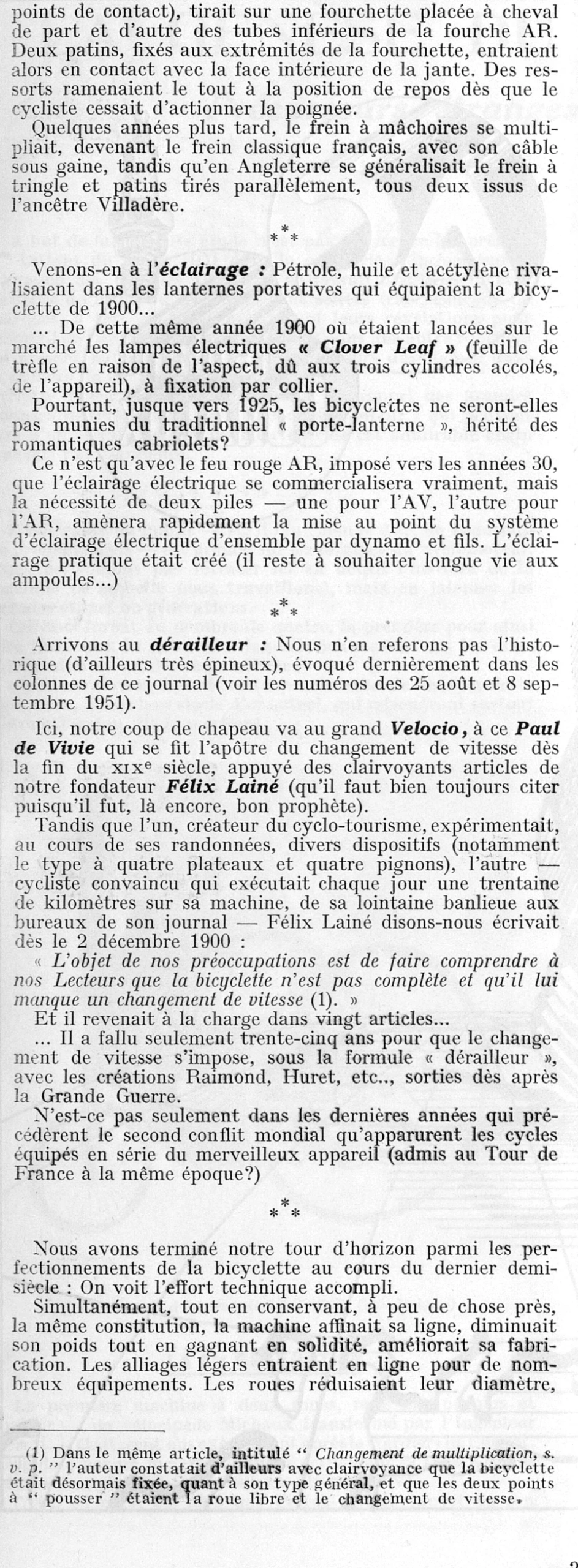
[Ebykr summary; the article’s text is not reproduced. The description of Villadère’s brake ends: the wire, with chain transmissions at its contact points, pulled a fork straddling the rear chainstays, whose two shoes then pressed on the inner face of the rim, and springs returned everything to rest when the rider let go of the lever. A few years later the caliper brake (« frein à mâchoires ») spread and became the classic French brake, with its cable in a housing, while in England the rod brake with parallel-pulled shoes became general, both descended from Villadère’s.]
[Ebykr summary, after a three-star break. Lighting: petroleum, oil and acetylene competed in the portable lanterns of the 1900 bicycle, though in that same year the « Clover Leaf » electric lamps came on the market, named for their three joined cylinders and fixed by a collar. Yet until about 1925 bicycles still carried the traditional « porte-lanterne » inherited from the cabriolet. Only with the rear red light, made compulsory around the 1930s, did electric lighting really sell, and the need for two batteries, front and rear, quickly brought the complete system of dynamo and wires. Practical lighting was born (it remains, he jokes, to wish the bulbs a long life).]
[Ebykr summary, after a three-star break. The derailleur: the author does not repeat its thorny history, covered recently in the paper (numbers of 25 August and 8 September 1951). He salutes « le grand Velocio », Paul de Vivie, apostle of the variable gear from the end of the 19th century, supported by the articles of the paper’s founder Félix Lainé. Velocio, creator of cyclotouring, tried various devices on his rides (notably a type with four chainrings and four sprockets), while Lainé, who rode some 30 km a day from his distant suburb to the paper’s offices, wrote as early as 2 December 1900 that the bicycle was not complete without a change of speed, a short italic passage marked with the footnote call (1), and returned to the charge in twenty articles. It took only thirty-five years for the variable gear to prevail in the form of the derailleur, with the creations of Raimond, Huret and others that appeared after the Great War, and only in the last years before the Second World War did bicycles come fitted with it as standard (admitted to the Tour de France at about the same time?).]
[Ebykr summary, after a three-star break. The survey of half a century of improvements is complete and shows the technical effort accomplished. At the same time, while keeping almost the same layout, the machine refined its line, lost weight while gaining strength and was better made; light alloys came into use for much of its equipment, and the wheels became smaller in diameter. The text continues in the next column.]
(1) Dans le même article, intitulé ” Changement de multiplication, s. v. p. ” l’auteur constatait d’ailleurs avec clairvoyance que la bicyclette était désormais fixée, quant à son type général, et que les deux points à ” pousser ” étaient la roue libre et le changement de vitesse.
[No drawings or photographs on this image. Section breaks are marked with three stars; the footnote is set below a short rule at the foot of the column.]
— Page 4 —
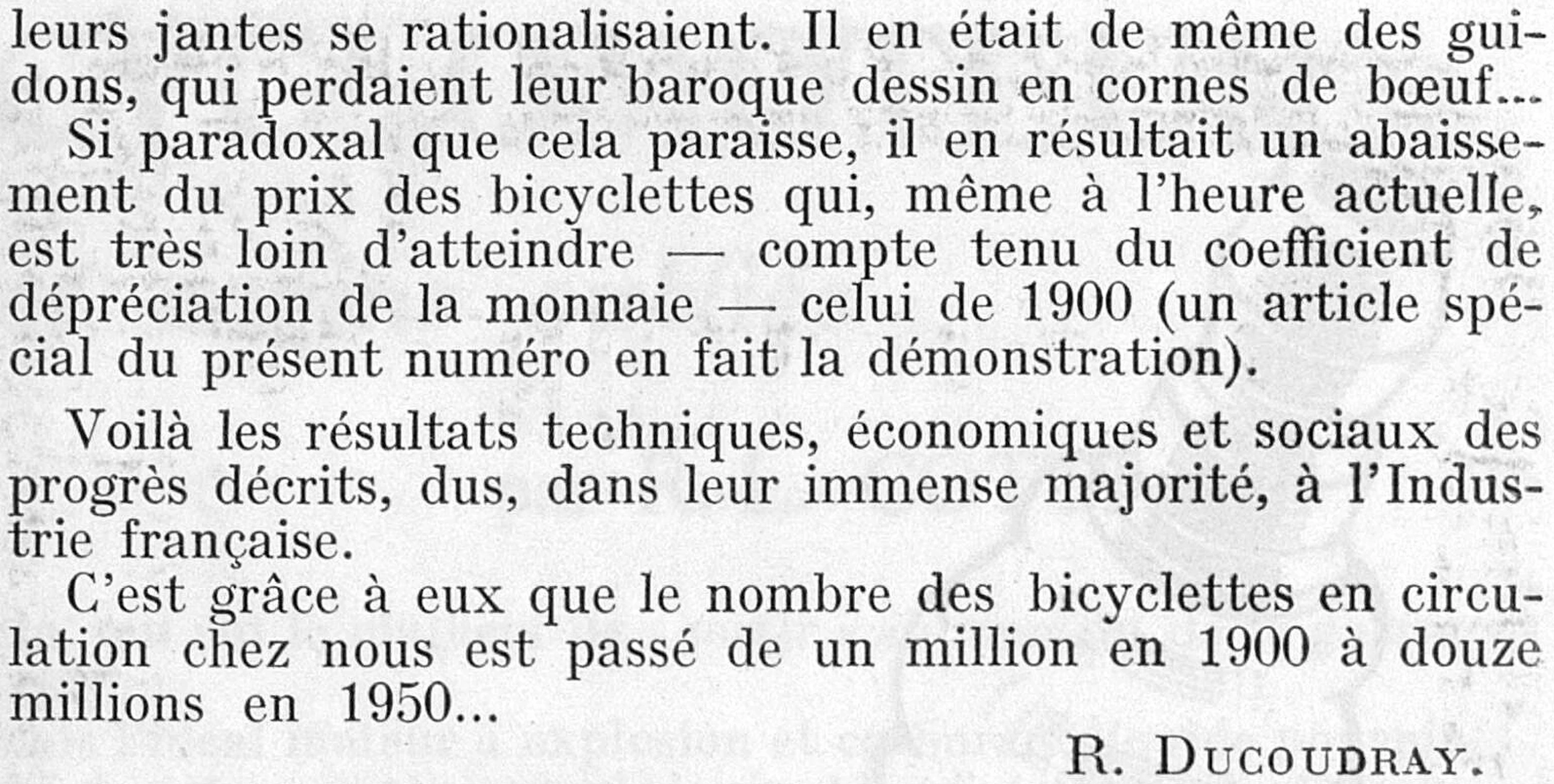
[Ebykr summary; the article’s text is not reproduced. The machine’s rims were rationalized, and so were its handlebars, which lost their baroque cow-horn shape. Paradoxically, the result was a fall in the price of bicycles which even now, allowing for the depreciation of the currency, is far from reaching that of 1900 (as another article in the same number demonstrates). These technical, economic and social results of progress are due, in their immense majority, to French industry, and thanks to them the number of bicycles in use in France rose from one million in 1900 to twelve million in 1950.]
R. DUCOUDRAY.
[No drawings or photographs on this image. The signature line closes the article.]
Ebykr presents this material for research and education. If you hold rights to it or notice an ownership issue, please contact us and we will respond promptly.
The Ebykr Digest
New articles, timelines, catalog finds and registry activity — assembled from the archive once a month. Your address is never shared.
Double opt-in. One email per month. Unsubscribe at any time with one click.