About Ebykr
Ebykr celebrates classic and vintage lightweight bicycles through provocative imagery and opinion. Ride along with us.
About Ebykr
Ebykr celebrates classic and vintage lightweight bicycles through provocative imagery and opinion. Ride along with us.

Source: Gallica (Bibliothèque nationale de France), L'Officiel du cycle, du motocycle et du camping, 6 October 1951, Numéro spécial du Salon 1951, page 7; ark:/12148/bd6t541928909. Source gallica.bnf.fr / BnF.
| Type | Review |
|---|---|
| Year | 1951 |
| Publisher | L'Officiel du cycle |
| Artist | G. Gédovius |
| Country | France |
| Language | French |
| Pages | 1 |
| Source | Gallica (Bibliothèque nationale de France), L'Officiel du cycle, du motocycle et du camping, 6 October 1951, Numéro spécial du Salon 1951, page 7; ark:/12148/bd6t541928909. Source gallica.bnf.fr / BnF. |
| Credit | Ebykr archive; Bibliothèque nationale de France |
| Identifier | Gallica (BnF) ark:/12148/bd6t541928909/f6 |
| Transcription | Headings and specifications transcribed; article text summarized |
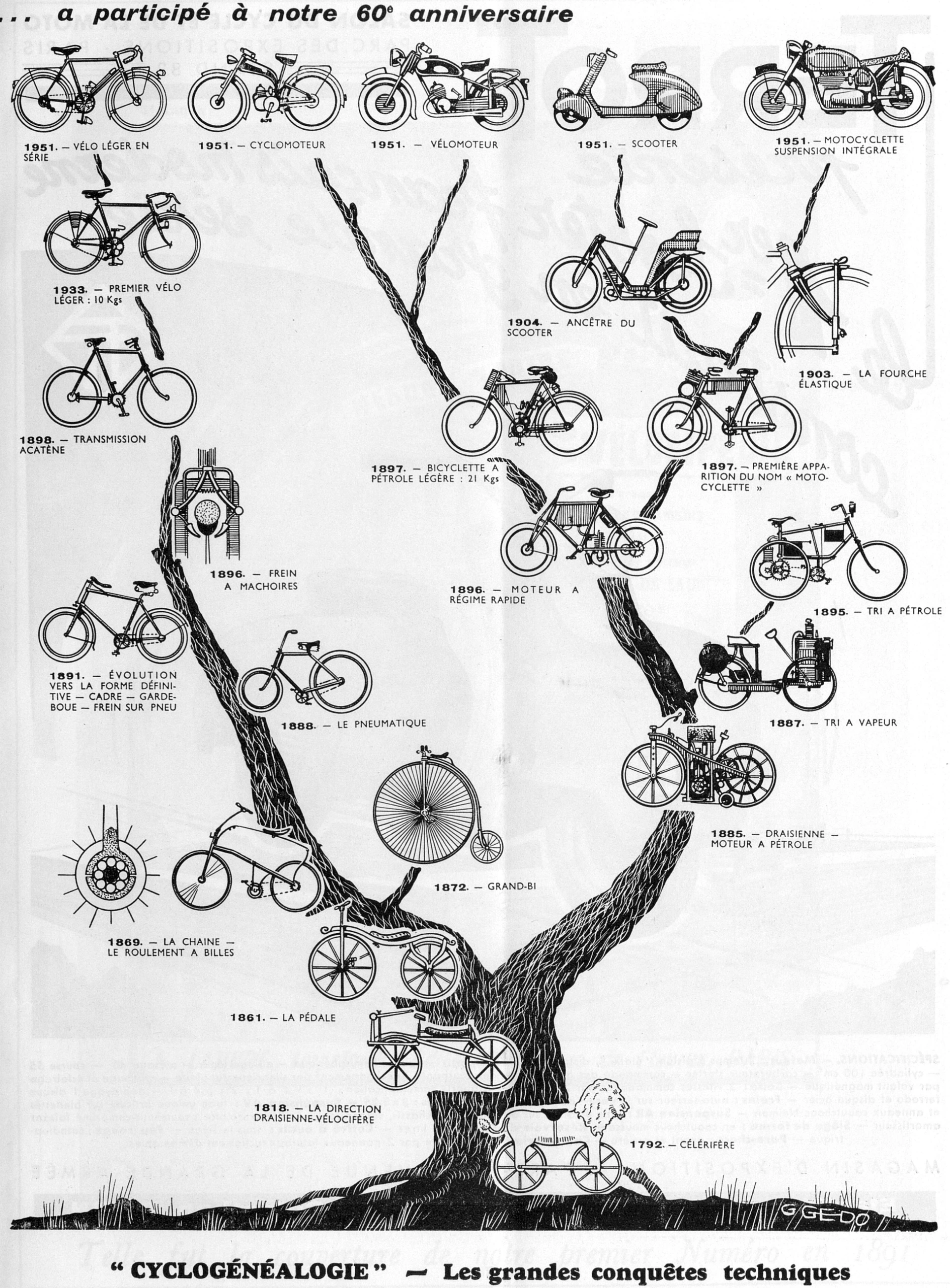
... a participé à notre 60e anniversaire 1951. — VÉLO LÉGER EN SÉRIE 1951. — CYCLOMOTEUR 1951. — VÉLOMOTEUR 1951. — SCOOTER 1951. — MOTOCYCLETTE SUSPENSION INTÉGRALE 1933. — PREMIER VÉLO LÉGER : 10 Kgs 1904. — ANCÊTRE DU SCOOTER 1903. — LA FOURCHE ÉLASTIQUE 1898. — TRANSMISSION ACATÈNE 1897. — BICYCLETTE A PÉTROLE LÉGÈRE …
This is a magazine article, so its running text is summarized here rather than reproduced; the headline, byline, specifications and scores are transcribed as printed.
From L’Officiel du cycle, du motocycle et du camping, 6 October 1951, the paper’s special number for the 1951 Paris Salon du Cycle et du Motocycle and its 60th anniversary, page 7: G. Gédovius’s family tree of the cycle’s great technical conquests from the célérifère of 1792 to the light bicycle, cyclomoteur, vélomoteur, scooter and motorcycle of 1951, every drawing captioned. The heading, captions and dates are transcribed as printed.
— Page 1 —
… a participé à notre 60e anniversaire
1951. — VÉLO LÉGER EN SÉRIE
1951. — CYCLOMOTEUR
1951. — VÉLOMOTEUR
1951. — SCOOTER
1951. — MOTOCYCLETTE SUSPENSION INTÉGRALE
1933. — PREMIER VÉLO LÉGER : 10 Kgs
1904. — ANCÊTRE DU SCOOTER
1903. — LA FOURCHE ÉLASTIQUE
1898. — TRANSMISSION ACATÈNE
1897. — BICYCLETTE A PÉTROLE LÉGÈRE : 21 Kgs
1897. — PREMIÈRE APPARITION DU NOM « MOTOCYCLETTE »
1896. — FREIN A MACHOIRES
1896. — MOTEUR A RÉGIME RAPIDE
1895. — TRI A PÉTROLE
1891. — ÉVOLUTION VERS LA FORME DÉFINITIVE — CADRE — GARDE-BOUE — FREIN SUR PNEU
1888. — LE PNEUMATIQUE
1887. — TRI A VAPEUR
1885. — DRAISIENNE — MOTEUR A PÉTROLE
1872. — GRAND-BI
1869. — LA CHAINE — LE ROULEMENT A BILLES
1861. — LA PÉDALE
1818. — LA DIRECTION DRAISIENNE-VÉLOCIFÈRE
1792. — CÉLÉRIFÈRE
” CYCLOGÉNÉALOGIE ” — Les grandes conquêtes techniques
[Ebykr summary; there is no running text. The plate is a genealogical tree of the cycle’s technical conquests from 1792 to 1951, the right-hand of the two anniversary plates announced on page 5 (its headline continues the facing Autogénéalogie plate’s line, here beginning with points of suspension). The labels are listed above from the top of the tree down, as printed beside each drawing. From the célérifère of 1792 at the root the trunk rises through the 1818 draisienne-vélocifère, the 1861 pedal, the 1869 chain and ball bearing and the 1872 grand-bi, then divides. The left branch carries the pedal bicycle: the 1888 pneumatic, the 1891 safety with frame, mudguards and tire brake, the 1896 caliper (“à machoires”) brake, the 1898 chainless transmission, the 1933 first light bicycle at 10 kg and the 1951 series-built light bicycle. The right branch carries the motorized line: the 1885 petrol-engined draisienne, the 1887 steam tricycle, the 1895 petrol tricycle, the 1896 high-speed engine, the two 1897 machines (the 21 kg light petrol bicycle and the first use of the name « motocyclette »), the 1903 sprung fork and the 1904 ancestor of the scooter, ending in the 1951 cyclomoteur, vélomoteur, scooter and fully sprung motorcycle.]
[A full-page pen drawing: a gnarled tree in solid black with white bark strokes, rising from a black ground with tufts of grass, its trunk and branches carrying 23 small line drawings of machines and components, each with a dated caption in sans-serif capitals; the 1951 machines form a row across the top, linked to the tree by twisting twigs. The célérifère at the root is drawn as a wooden hobbyhorse with a lion’s head and tail. Notable details: the 1951 light bicycle is a randonneur with drop bars, derailleur and mudguards; the 1898 chainless machine shows a shaft drive; the 1896 brake is drawn as a separate caliper detail; the 1869 entry shows a ball-bearing hub in section with spokes radiating; the 1885 entry is the wooden-framed Daimler-type motor draisienne. Signed “G.GEDO” in white letters cut into the black ground at the lower right, beneath the grass. The headline runs in bold italic sans-serif across the top and the title in bold serif across the foot. Matter printed on the reverse of the sheet (an advertisement with “SPECIFICATIONS”, “MAGASIN D’EXPOSITION” and a Salon address, and the caption “Telle fut la couverture de notre premier Numéro en 1891”) shows through faintly in mirror image; it is not printed on this page. No library stamp.]
Ebykr presents this material for research and education. If you hold rights to it or notice an ownership issue, please contact us and we will respond promptly.
The Ebykr Digest
New articles, timelines, catalog finds and registry activity — assembled from the archive once a month. Your address is never shared.
Double opt-in. One email per month. Unsubscribe at any time with one click.