About Ebykr
Ebykr celebrates classic and vintage lightweight bicycles through provocative imagery and opinion. Ride along with us.
About Ebykr
Ebykr celebrates classic and vintage lightweight bicycles through provocative imagery and opinion. Ride along with us.

Source: Gallica (Bibliothèque nationale de France), L'Officiel du cycle, du motocycle et du camping, 6 October 1951, Numéro spécial du Salon 1951, pages 61, 63, 65, 67, 69, 71, 73, 75, 76, 79, 81 and 83; ark:/12148/bd6t541928909. Source gallica.bnf.fr / BnF.
| Type | Review |
|---|---|
| Year | 1951 |
| Publisher | L'Officiel du cycle |
| Country | France |
| Language | French |
| Pages | 12 |
| Source | Gallica (Bibliothèque nationale de France), L'Officiel du cycle, du motocycle et du camping, 6 October 1951, Numéro spécial du Salon 1951, pages 61, 63, 65, 67, 69, 71, 73, 75, 76, 79, 81 and 83; ark:/12148/bd6t541928909. Source gallica.bnf.fr / BnF. |
| Credit | Ebykr archive; Bibliothèque nationale de France |
| Identifier | Gallica (BnF) ark:/12148/bd6t541928909/f60 |
| Transcription | Headings and specifications transcribed; article text summarized |
PREMIER COUP D'ŒIL sur la CONSTRUCTION 1951-52 Cyclomoteurs et Scooters A. G. F. Motocyclettes ASPE, DUMONT ET Cie Cyclomoteurs et Scooters BABYMOTO Scooters BERNARDET Le nouveau BERNARDET D 51 Cycles et cyclomoteurs « Le CHEMINEAU » Cycles André BERTIN Vue d'un atelier des Éts A. BERTIN Cycles et motocycles COLOMB ET BIANCHI Moteurs auxiliaires CUCCIOLO …
This is a magazine article, so its running text is summarized here rather than reproduced; the headline, byline, specifications and scores are transcribed as printed.
From L’Officiel du cycle, du motocycle et du camping, 6 October 1951, the paper’s special number for the 1951 Paris Salon du Cycle et du Motocycle and its 60th anniversary, pages 61 to 83: the magazine’s first look at the 1952 production at the Salon, firm by firm. The title, headings, captions and lists are transcribed as printed; the text is summarized in Ebykr’s words, and the page images carry it in full.
— Page 1 —
PREMIER COUP D’ŒIL
sur la CONSTRUCTION 1951-52
[Ebykr summary; the article’s text is not reproduced. An italic introduction says that, as every year, the paper offers a first look at the 1951-1952 production of plain bicycles, cyclomoteurs, vélomoteurs and motorcycles; the report on the 38th Salon in a later number will add objective notes on the most interesting exhibits it could not cover here for want of sufficient detail from the makers. The survey is wide and, if not every model, reviews every aspect of present French construction.]
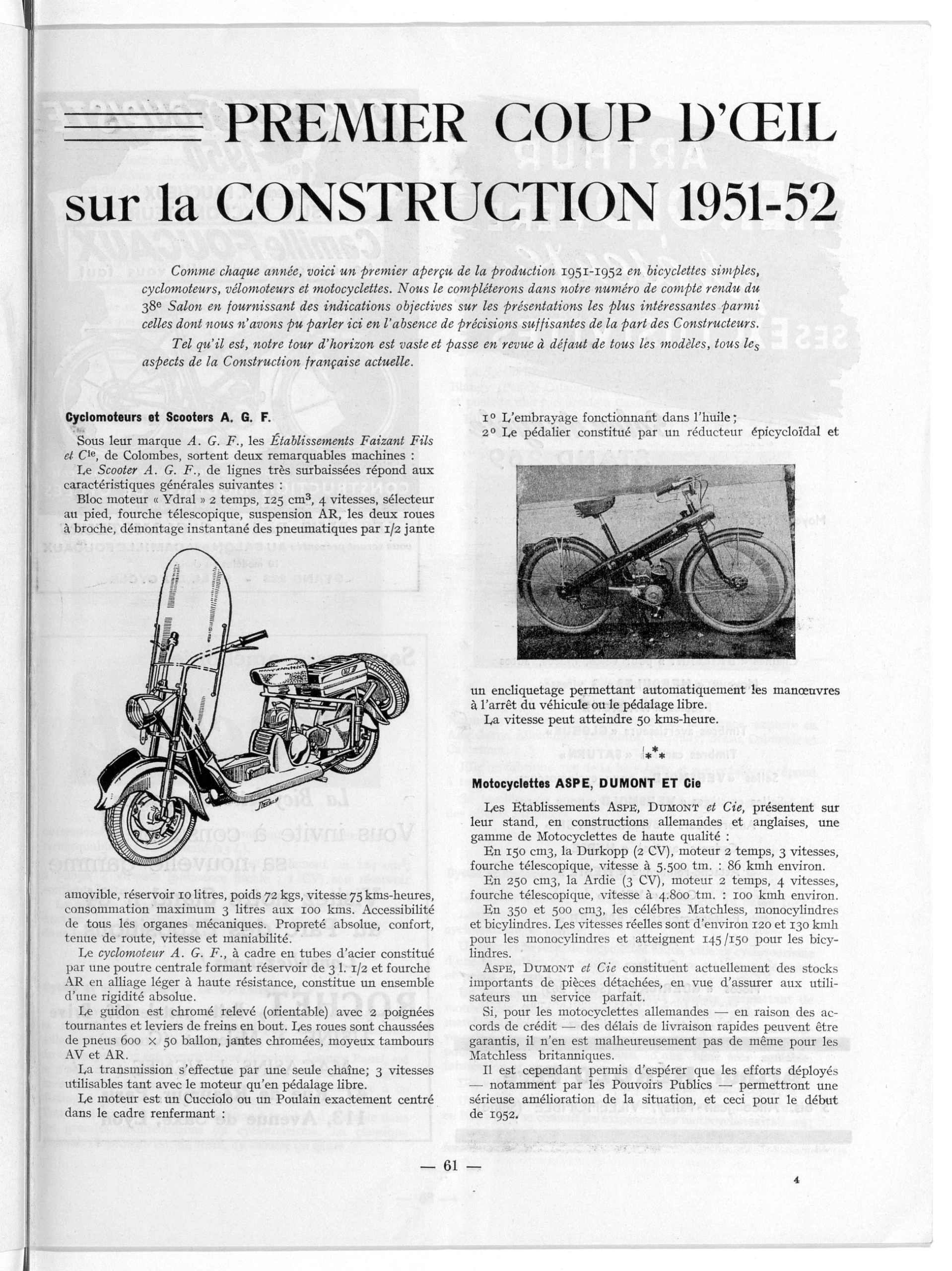
Cyclomoteurs et Scooters A. G. F.
[Ebykr summary; the article’s text is not reproduced. Under the A. G. F. mark the Établissements Faizant Fils et Cie of Colombes show two machines. The very low A. G. F. scooter has a « Ydral » 2-stroke 125 cm3 engine unit with 4 speeds and foot selector, telescopic fork, rear suspension, both wheels on spindles with instant tire removal by a detachable half rim, a 10-liter tank, a weight of 72 kg, a speed of 75 km an hour and a maximum consumption of 3 liters per 100 km. The A. G. F. cyclomoteur has a steel-tube frame built on a central beam that forms a 3 1/2-liter tank and a rear fork in high-strength light alloy; a chromed, raised and adjustable handlebar with 2 twist grips and lever ends; 600 x 50 balloon tires on chromed rims with drum hubs front and rear; transmission by a single chain with 3 speeds usable both under power and pedaling. The engine is a Cucciolo or a Poulain centered in the frame, with (1) the clutch running in oil and (2) a bottom bracket built as an epicyclic reduction gear with a ratchet that allows stops or free pedaling automatically. Top speed is 50 km an hour.]
Motocyclettes ASPE, DUMONT ET Cie
[Ebykr summary; the article’s text is not reproduced. The Établissements Aspe, Dumont et Cie show German and British motorcycles: in 150 cm3 the Durkopp (2 CV), 2-stroke, 3 speeds, telescopic fork, 86 km/h at 5,500 rpm; in 250 cm3 the Ardie (3 CV), 2-stroke, 4 speeds, telescopic fork, 100 km/h at 4,800 rpm; in 350 and 500 cm3 the Matchless singles and twins, at about 120 and 130 km/h for the singles and 145/150 for the twins. The firm is building large stocks of spare parts. Credit agreements allow quick delivery of the German machines but not of the British Matchless; the paper hopes the efforts of the public authorities will improve matters by early 1952.]
[A line drawing at the left shows the A. G. F. scooter in three-quarter front view, with a tall windscreen, headlamp, spare wheel behind the seat and the A. G. F. badge on the tank; it is signed in script on the footboard, at the lower right of the drawing, reading about “J Pecard” [?]. A halftone photograph in the right column shows the A. G. F. cyclomoteur in side view against a wall. Three asterisks separate the two sections. The mirrored lettering showing through the thin paper is print from the other side of the leaf, not part of this page.]
— Page 2 —
Cyclomoteurs et Scooters BABYMOTO
[Ebykr summary; the article’s text is not reproduced. The paper congratulates M. Roger Breton, who in his new installation in the rue de l’Égalerie, Saint-Étienne, builds the Babymotos with particular care. His machines with VAP 4 and Cucciolo auxiliary engines and his scooter are praised for elegance, finish, tuning and proven strength; Babymoto is called a great name among small-capacity machines with a large and loyal clientele, and readers are invited to its stand.]
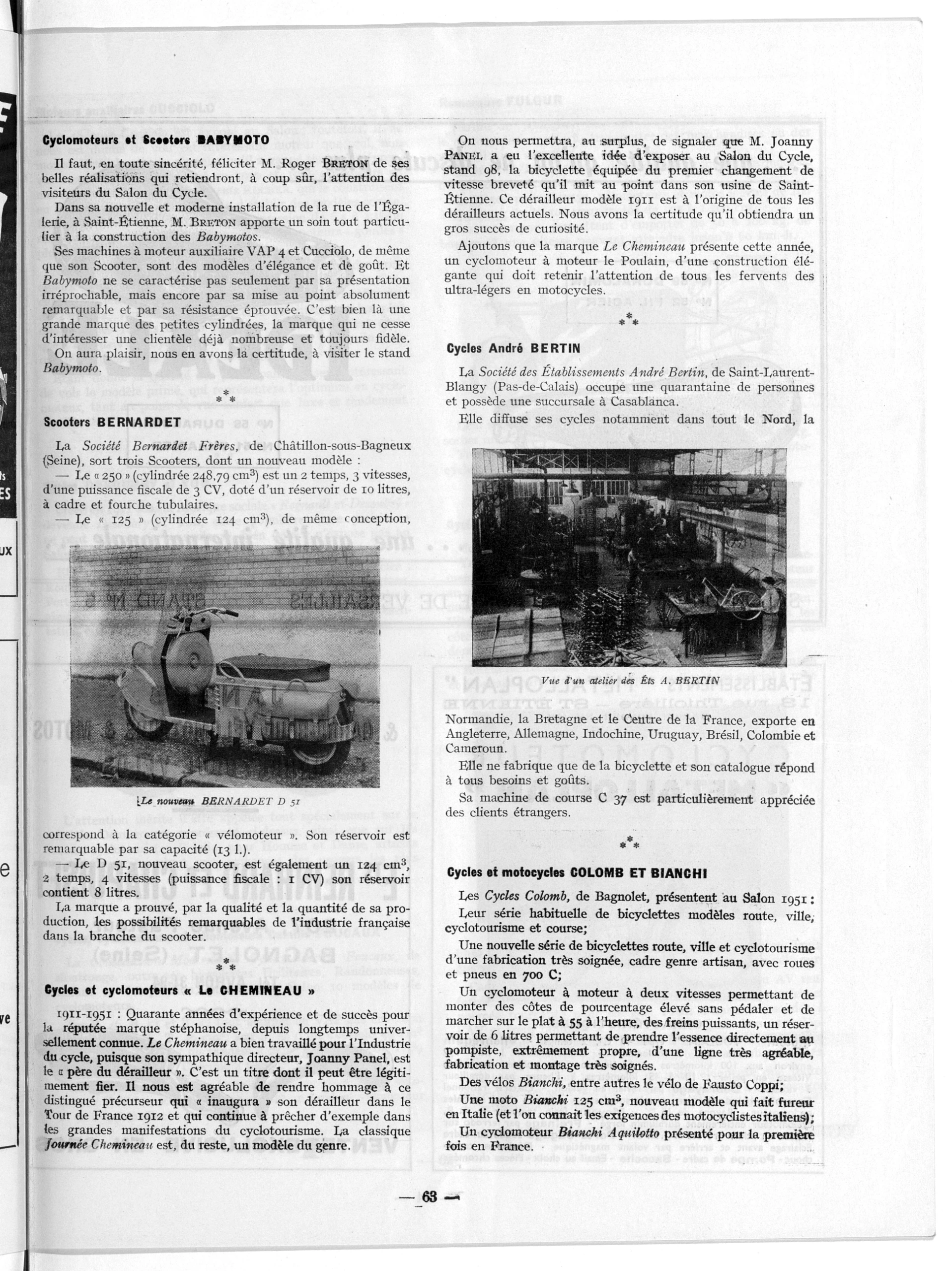
Scooters BERNARDET
[Ebykr summary; the article’s text is not reproduced. The Société Bernardet Frères of Châtillon-sous-Bagneux (Seine) show three scooters, one of them new: the « 250 » (248.79 cm3), 2-stroke, 3 speeds, 3 CV fiscal rating, 10-liter tank, tubular frame and fork; the « 125 » (124 cm3), of the same design, in the « vélomoteur » class, with a large 13-liter tank; and the new D 51 scooter, also 124 cm3, 2-stroke, 4 speeds, 1 CV fiscal rating, with an 8-liter tank. The make is said to show the capacity of French industry in scooters.]
Le nouveau BERNARDET D 51
Cycles et cyclomoteurs « Le CHEMINEAU »
[Ebykr summary; the article’s text is not reproduced. Under the heading « 1911-1951 » the paper marks forty years of the Saint-Étienne make Le Chemineau, whose director Joanny Panel is called the « père du dérailleur »: he introduced his derailleur in the 1912 Tour de France and still sets an example at the great cyclotouring events, the Journée Chemineau among them. At the Salon du Cycle, stand 98, M. Joanny Panel shows the bicycle fitted with the first patented gear change he developed in his Saint-Étienne works; this 1911 derailleur is called the origin of all present derailleurs. Le Chemineau also shows a cyclomoteur with the Poulain engine, aimed at lovers of ultra-light machines.]
Cycles André BERTIN
[Ebykr summary; the article’s text is not reproduced. The Société des Établissements André Bertin of Saint-Laurent-Blangy (Pas-de-Calais) employs about forty people and has a branch at Casablanca. It sells its cycles chiefly in the Nord, Normandy, Brittany and the Centre of France and exports to England, Germany, Indochina, Uruguay, Brazil, Colombia and Cameroon. It makes bicycles only, with a catalog for every need and taste; its C 37 racing machine is especially liked by foreign customers.]
Vue d’un atelier des Éts A. BERTIN
Cycles et motocycles COLOMB ET BIANCHI
[Ebykr summary; the article’s text is not reproduced. The Cycles Colomb of Bagnolet show at the 1951 Salon their usual series of road, town, cyclotouring and racing bicycles; a new, carefully made series of road, town and cyclotouring bicycles with an « artisan »-style frame and 700 C wheels and tires; a two-speed cyclomoteur that climbs steep grades without pedaling, runs at 55 km an hour on the flat, with strong brakes and a 6-liter tank filled directly at the pump; Bianchi bicycles, among them Fausto Coppi’s bicycle; the new Bianchi 125 cm3 motorcycle, a success in Italy; and the Bianchi Aquilotto cyclomoteur, shown in France for the first time.]
[Two halftone photographs: in the left column, the Bernardet D 51 scooter in three-quarter rear view on a pavement against a brick wall, with the caption above; in the right column, a workshop of the Bertin works, with frames stacked on benches and workers at their posts, with its caption. Three asterisks separate the sections. A strip of the facing page at the left edge (part of an advertisement) and the mirrored print showing through from the other side of the leaf are not part of the record.]
— Page 3 —
Moteurs auxiliaires CUCCIOLO
[Ebykr summary; the article’s text is not reproduced. The 48 cm3 Cucciolo is shown at the Salon, but only on its own, not fitted to a machine. The paper recalls that it won every event it entered in 1950 and 1951 and is still a series engine; the Établissements Rocher, who build it in France, have never needed racing versions: the cams stay original and the compression is 6.5 to 1, yet it outperforms more fragile « gonflés » engines. During the Salon an exhibition of the leading makers of Cucciolo-powered cyclomoteurs is to be held at the Station-Service de Puteaux, with a jury of editors and directors of the specialist press, « l’Officiel du Cycle et du Motocycle » among them, rewarding the best fitting; the winning model should represent the optimum in comfort, finish and efficiency.]
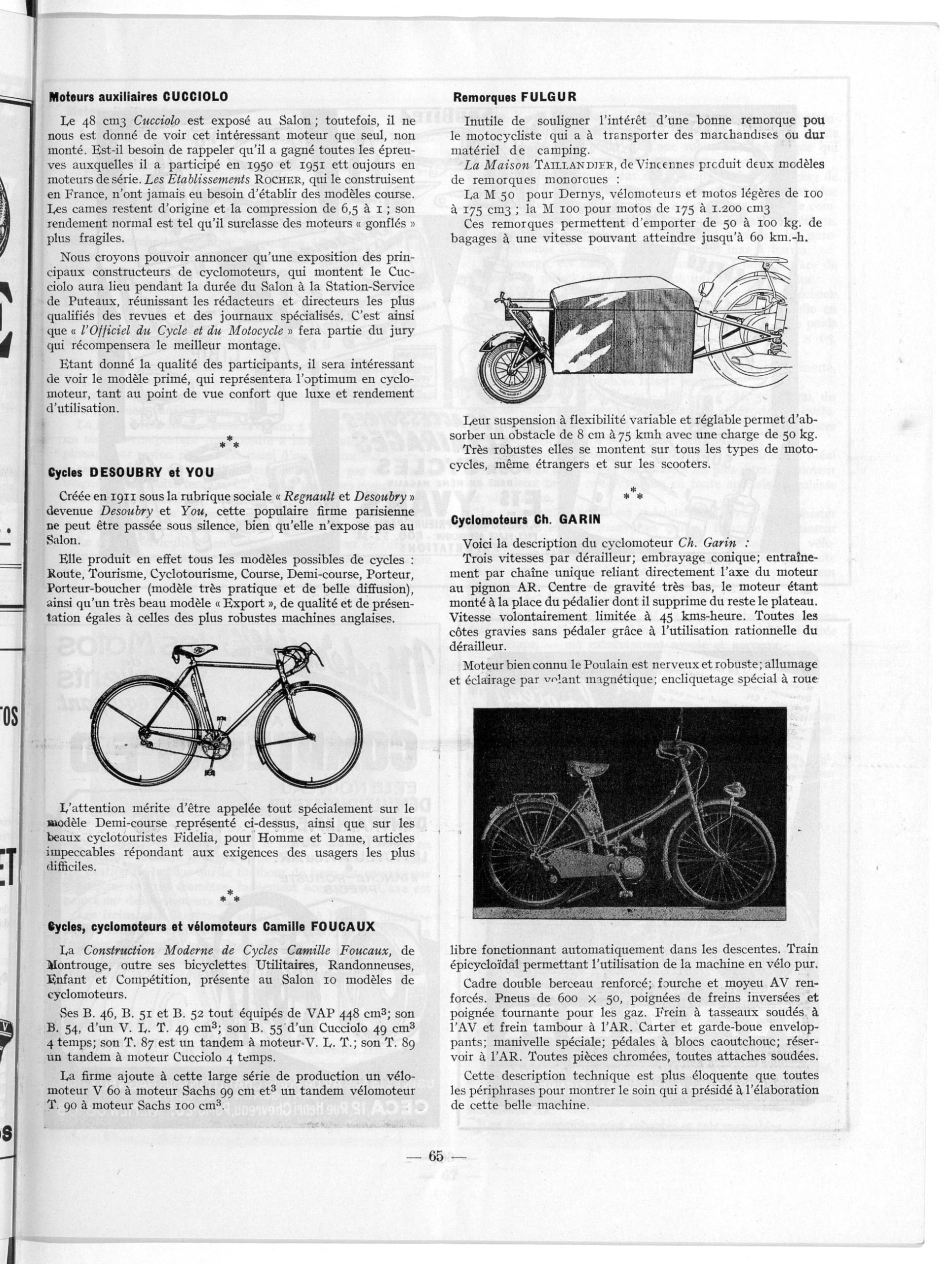
Cycles DESOUBRY et YOU
[Ebykr summary; the article’s text is not reproduced. Founded in 1911 as « Regnault et Desoubry », later Desoubry et You, this popular Paris firm does not exhibit at the Salon but is noted all the same. It makes every kind of cycle: Route, Tourisme, Cyclotourisme, Course, Demi-course, Porteur and Porteur-boucher (a practical and widely sold model), and a fine « Export » model said to equal the sturdiest English machines in quality and finish. The paper draws particular attention to the Demi-course model in the drawing and to the Fidelia cyclotouring bicycles for men and women.]
Cycles, cyclomoteurs et vélomoteurs Camille FOUCAUX
[Ebykr summary; the article’s text is not reproduced. The Construction Moderne de Cycles Camille Foucaux of Montrouge, besides its Utilitaires, Randonneuses, Enfant and Compétition bicycles, shows 10 cyclomoteur models at the Salon: the B. 46, B. 51 and B. 52, all with the VAP engine (printed « 448 cm3 »); the B. 54 with a V. L. T. 49 cm3; the B. 55 with a Cucciolo 49 cm3 4-stroke; the T. 87, a tandem with a V. L. T. engine; and the T. 89, a tandem with a Cucciolo 4-stroke. It adds a V 60 vélomoteur with a Sachs 99 cm3 engine and a T. 90 tandem vélomoteur with a Sachs 100 cm3 engine.]
Remorques FULGUR
[Ebykr summary; the article’s text is not reproduced. The Maison Taillandier of Vincennes makes two single-wheel trailers for motorcyclists carrying goods or camping gear: the M 50 for Dernys, vélomoteurs and light motorcycles of 100 to 175 cm3, and the M 100 for motorcycles of 175 to 1,200 cm3. They carry 50 to 100 kg of luggage at up to 60 km an hour; their variable, adjustable suspension absorbs an 8 cm obstacle at 75 km/h with a 50 kg load, and they fit every type of motorcycle, foreign ones included, and scooters.]
Cyclomoteurs Ch. GARIN
[Ebykr summary; the article’s text is not reproduced. The Ch. Garin cyclomoteur has three speeds by derailleur, a cone clutch and a single chain from the engine shaft to the rear sprocket; the engine, the Poulain, sits in place of the bottom bracket and does away with the chainwheel, giving a very low center of gravity. Speed is deliberately limited to 45 km an hour, and every hill is climbed without pedaling by sensible use of the derailleur. The Poulain has flywheel-magneto ignition and lighting and a special freewheel ratchet that works automatically on descents; an epicyclic train lets the machine be ridden as a plain bicycle. The reinforced double-cradle frame has a reinforced fork and front hub, 600 x 50 tires, inverted brake levers and a twist-grip throttle, a cleat brake at the front and a drum brake at the rear, enclosing crankcase and fenders, special cranks, rubber-block pedals, a rear tank, all parts chromed and all fittings brazed.]
[Two line drawings and one halftone photograph. In the left column, a drawing of the Desoubry et You Demi-course bicycle in side view, with drop handlebars, fenders and a derailleur; in the right column, a drawing of the Fulgur single-wheel trailer hitched behind the rear wheel of a motorcycle, its box body shaded. Lower right, a photograph of the Ch. Garin cyclomoteur, a lady’s-style frame with rear rack, on a dark ground. No signature was found on the drawings. Three asterisks separate the sections. A strip of the facing page at the left edge (parts of advertisements) and the mirrored print showing through from the other side of the leaf are not part of the record.]
— Page 4 —
Motocycles GIMA
[Ebykr summary; the article’s text is not reproduced. The GIMA make of Chamalières (P.-de-D.) offers a 125 cm3 vélomoteur with 3 speeds and an A. M. C. 4-stroke overhead-valve engine; a 125 cm3 vélomoteur with 4 speeds and an A. M. C. engine; a 175 cm3 motorcycle, 4 speeds, 4-stroke (96 kg); and a 175 cm3 motorcycle, 4 speeds, A. M. C. 4-stroke overhead-valve engine, telescopic fork and rear suspension (110 kg). Every Gima model has the telescopic fork, and the finish matches the engineering.]
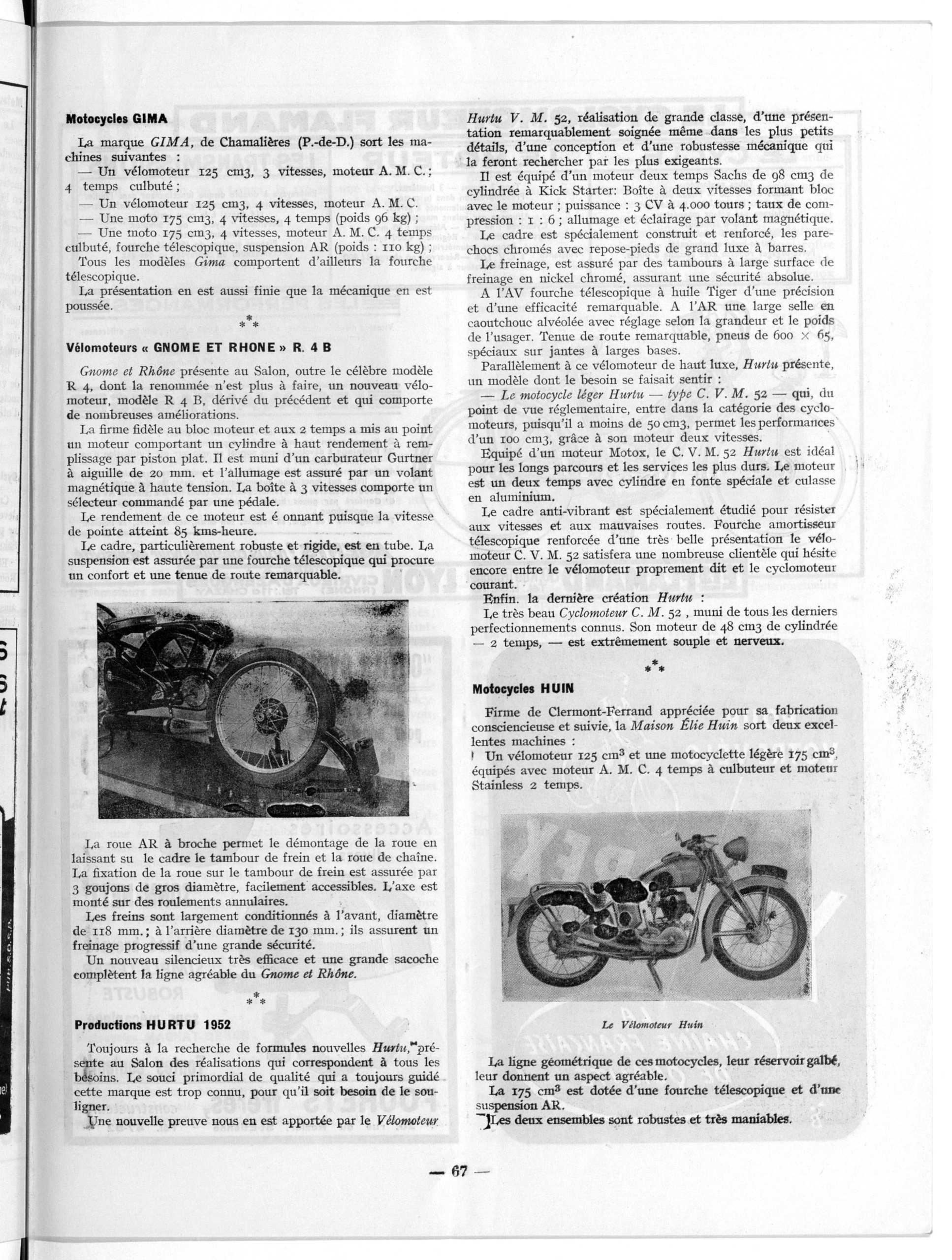
Vélomoteurs « GNOME ET RHONE » R. 4 B
[Ebykr summary; the article’s text is not reproduced. Besides the well-known R 4, Gnome et Rhône show at the Salon a new vélomoteur, the R 4 B, derived from it with many improvements. Faithful to the unit engine and the 2-stroke, the firm has developed a high-efficiency cylinder with flat-piston scavenging, a 20 mm Gurtner needle carburetor and high-tension flywheel-magneto ignition; the 3-speed gearbox has a pedal-operated selector, and top speed reaches 85 km an hour. The frame is in tube and very rigid, with a telescopic fork. The rear wheel on a spindle comes out leaving the brake drum and chain sprocket on the frame; it is fixed to the drum by 3 large studs and runs on annular bearings. Brakes are 118 mm in diameter at the front and 130 mm at the rear. A new, very effective silencer and a large bag complete the machine.]
Productions HURTU 1952
[Ebykr summary; the article’s text is not reproduced. Hurtu shows at the Salon machines for every need. The Vélomoteur Hurtu V. M. 52 has a Sachs 2-stroke engine of 98 cm3 with kick starter, a two-speed gearbox in unit with the engine, 3 CV at 4,000 rpm, a compression ratio of 1 : 6 and flywheel-magneto ignition and lighting; a specially built and reinforced frame, chromed crash bars with deluxe bar footrests, large chromed drum brakes, a Tiger oil telescopic fork at the front, a large cellular-rubber saddle adjustable to the rider’s height and weight at the rear, and special 600 x 65 tires on wide-base rims. Alongside it comes the light motorcycle Hurtu type C. V. M. 52, under 50 cm3 and so in the cyclomoteur class for the regulations, but with the performance of a 100 cm3 thanks to its two-speed Motox 2-stroke engine with a special cast-iron cylinder and aluminum head, an anti-vibration frame and a reinforced telescopic fork, aimed at buyers hesitating between a vélomoteur and an ordinary cyclomoteur. Last comes the Cyclomoteur C. M. 52, with a very supple and lively 48 cm3 2-stroke engine.]
Motocycles HUIN
[Ebykr summary; the article’s text is not reproduced. The Maison Élie Huin of Clermont-Ferrand shows two machines: a 125 cm3 vélomoteur and a 175 cm3 light motorcycle, with the A. M. C. 4-stroke overhead-valve engine and the Stainless 2-stroke engine. Their geometric lines and shaped tanks are praised; the 175 cm3 has a telescopic fork and rear suspension, and both are called sturdy and very handy.]
Le Vélomoteur Huin
[Two halftone photographs: in the left column, a close view of the rear wheel of the Gnome et Rhône R 4 B, showing the spindle-mounted wheel, brake drum and luggage rack, unlabeled; in the right column, the Huin vélomoteur in side view, with its caption. Three asterisks separate the sections. A strip of the facing page at the left edge (parts of advertisements, one carrying a vertical agency mark reading about “PUB. S.O.S.P.”) and the mirrored print showing through from the other side of the leaf are not part of the record.]
— Page 5 —
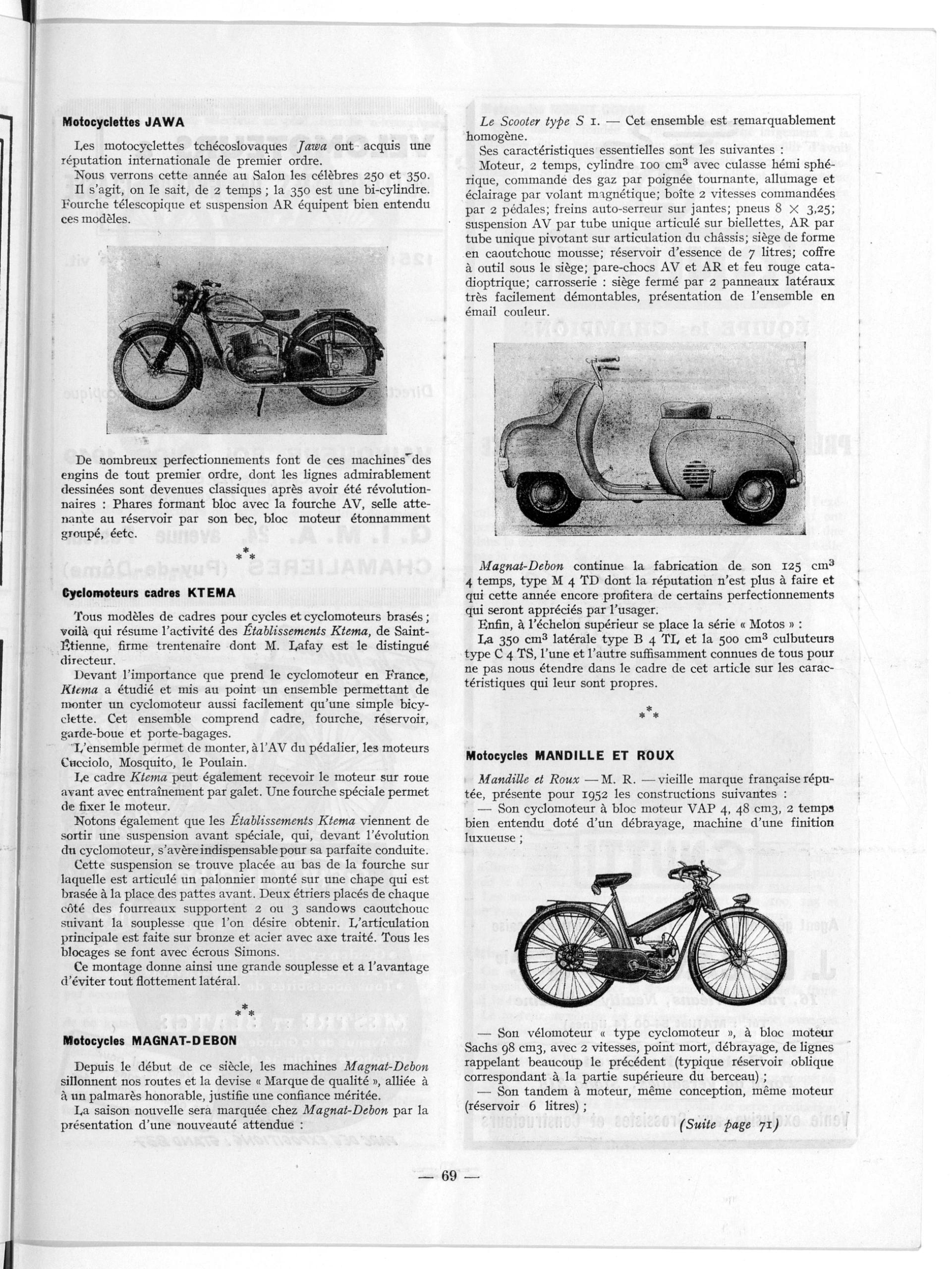
Motocyclettes JAWA
[Ebykr summary; the article’s text is not reproduced. The Czechoslovak Jawa motorcycles, of first-rank international reputation, are shown at the Salon in the famous 250 and 350, both 2-strokes, the 350 a twin, with telescopic fork and rear suspension. Their many refinements include a headlamp built in unit with the front fork, a saddle joined to the tank by its nose and a remarkably compact engine unit; their lines, once revolutionary, have become classic.]
Cyclomoteurs cadres KTEMA
[Ebykr summary; the article’s text is not reproduced. The Établissements Ktema of Saint-Étienne, a thirty-year-old firm directed by M. Lafay, make every kind of brazed frame for cycles and cyclomoteurs. For the growing cyclomoteur market Ktema has developed a set (frame, fork, tank, fender and carrier) that makes a cyclomoteur as easy to assemble as a bicycle; it takes the Cucciolo, Mosquito and Poulain engines ahead of the bottom bracket, and the frame can also take a front-wheel engine with roller drive, held by a special fork. Ktema has also brought out a special front suspension at the foot of the fork: a rocker on a clevis brazed in place of the dropouts, with two stirrups on each side carrying 2 or 3 rubber « sandows » according to the suppleness wanted, the main pivot in bronze and steel on a treated spindle and all clamps by Simons nuts; it gives great suppleness and prevents lateral float.]
Motocycles MAGNAT-DEBON
[Ebykr summary; the article’s text is not reproduced. Magnat-Debon machines have been on the roads since the beginning of the century under the motto « Marque de qualité ». The new season brings the Scooter type S 1: 2-stroke 100 cm3 engine with a hemispherical head, twist-grip throttle, flywheel-magneto ignition and lighting, 2-speed gearbox worked by 2 pedals, self-servo rim brakes, 8 x 3.25 tires, single-tube front suspension on links and single-tube rear suspension pivoting on the chassis, foam-rubber seat, 7-liter tank, tool box under the seat, front and rear bumpers and a red reflector lamp, the seat enclosed by 2 easily removed side panels and the whole finished in colored enamel. Magnat-Debon also continues its 125 cm3 4-stroke type M 4 TD, with some improvements, and at the top of the range its « Motos » series: the 350 cm3 side-valve type B 4 TL and the 500 cm3 overhead-valve type C 4 TS.]
Motocycles MANDILLE ET ROUX
[Ebykr summary; the article’s text is not reproduced. Mandille et Roux (M. R.), an old and well-known French make, show for 1952 a cyclomoteur with the VAP 4 engine unit, 48 cm3, 2-stroke with a clutch, luxuriously finished; a vélomoteur « type cyclomoteur » with a Sachs 98 cm3 engine unit, 2 speeds, neutral and clutch, with lines like the cyclomoteur (a typical sloping tank forming the top of the cradle); and a motor tandem of the same design and engine (6-liter tank). The section continues on a later page.]
(Suite page 71)
[Three halftone photographs, none captioned: in the left column, a Jawa motorcycle in side view; in the right column, the Magnat-Debon type S 1 scooter in side view, with its rounded rear body and louvered side panel; lower right, the Mandille et Roux cyclomoteur in side view, cut out on the white page. Three asterisks separate the sections. A strip of the facing page at the left edge and the mirrored print showing through from the other side of the leaf are not part of the record.]
— Page 6 —
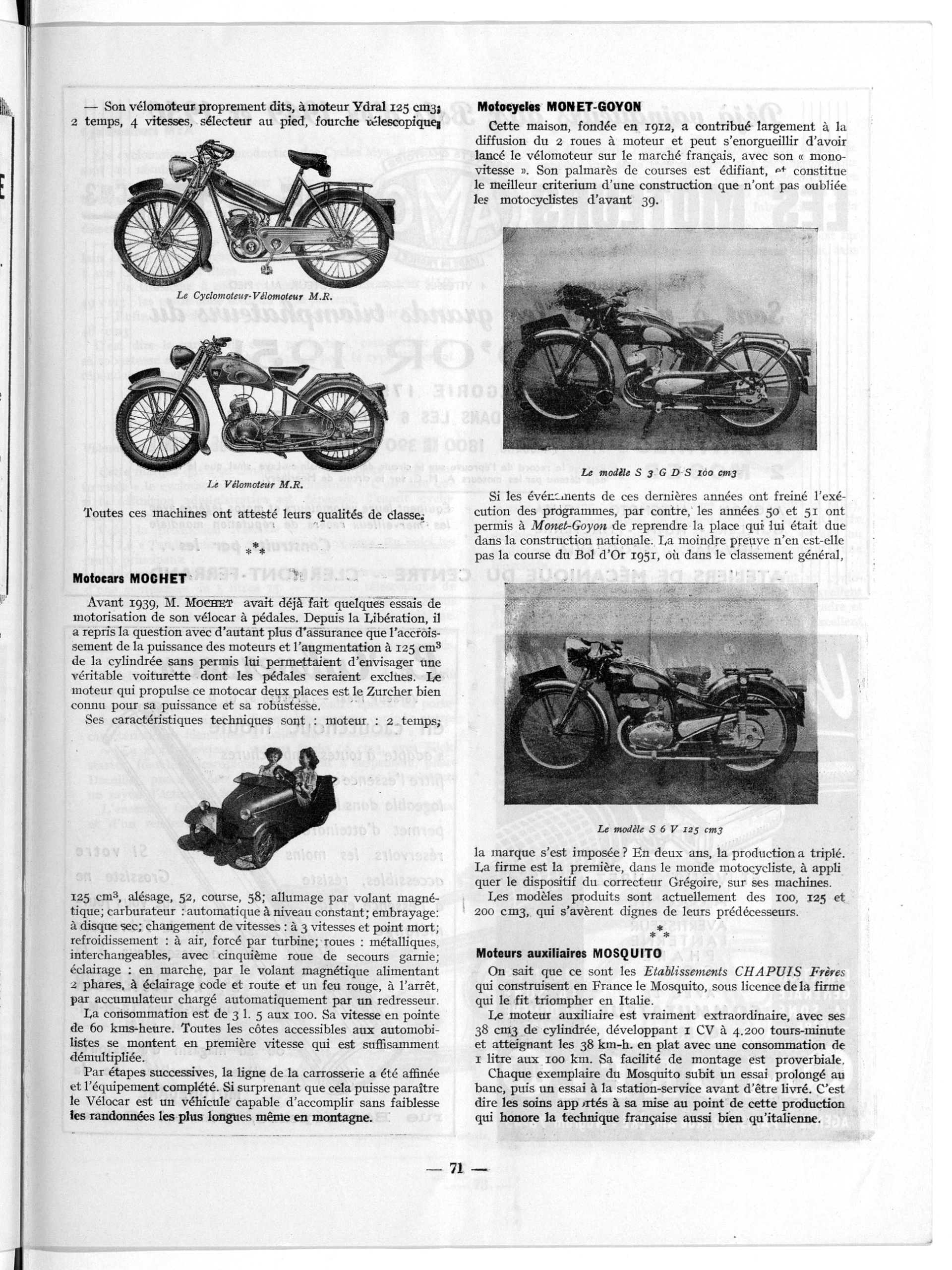
[Ebykr summary; the article’s text is not reproduced. The Mandille et Roux section continues from the previous page: the firm’s vélomoteur proper has the Ydral 125 cm3 2-stroke engine, 4 speeds, foot selector and telescopic fork. The paper adds that all these machines have proved their class.]
Le Cyclomoteur-Vélomoteur M.R.
Le Vélomoteur M.R.
Motocars MOCHET
[Ebykr summary; the article’s text is not reproduced. Before 1939 M. Mochet had already tried fitting an engine to his pedal vélocar. Since the Liberation, with stronger engines and the license-free class raised to 125 cm3, he has built a true small car with no pedals: a two-seat motocar driven by the well-known Zurcher engine. Specifications: 2-stroke, 125 cm3, bore 52, stroke 58; flywheel-magneto ignition; automatic constant-level carburetor; dry-plate clutch; 3 speeds and neutral; forced-air cooling by turbine; interchangeable metal wheels with a fifth, fitted spare; lighting by the flywheel magneto feeding 2 headlamps with dipped and main beams and a red rear lamp, and when stopped by a battery charged automatically through a rectifier. Consumption is 3.5 liters per 100 km and top speed 60 km an hour; every hill a motorist can climb is taken in first gear. The body lines and equipment have been refined step by step, and the Vélocar is said to manage the longest runs, even in the mountains.]
Motocycles MONET-GOYON
[Ebykr summary; the article’s text is not reproduced. Founded in 1912, Monet-Goyon did much to spread the motor two-wheeler and launched the vélomoteur on the French market with its « mono-vitesse »; its racing record is recalled by prewar motorcyclists. After years in which events slowed its programs, 1950 and 1951 restored its place in national production, the 1951 Bol d’Or, where the make came out on top of the general classification, being cited as proof. Production has tripled in two years. The firm is the first in the motorcycle world to fit the Grégoire corrector to its machines. Current models are of 100, 125 and 200 cm3.]
Le modèle S 3 G D S 100 cm3
Le modèle S 6 V 125 cm3
Moteurs auxiliaires MOSQUITO
[Ebykr summary; the article’s text is not reproduced. The Établissements Chapuis Frères build the Mosquito in France under license from the firm that made it a success in Italy. The auxiliary engine is of 38 cm3, gives 1 CV at 4,200 rpm, reaches 38 km/h on the flat and uses 1 liter per 100 km; it is famously easy to fit. Every Mosquito has a long bench test and then a test at the service station before delivery, which the paper says does credit to French as well as Italian engineering.]
[Two retouched halftone illustrations at the upper left show the Mandille et Roux machines in side view: the cyclomoteur-vélomoteur, with a rear carrier, and the vélomoteur, with « MR » on its tank; each has its caption below. Lower left, a halftone of the Mochet motocar, a small open two-seater with two women aboard, unlabeled. In the right column, two photographs of Monet-Goyon motorcycles in side view, each captioned. No signature was found. Three asterisks separate the sections. A strip of the facing page at the left edge and the mirrored print showing through from the other side of the leaf are not part of the record.]
— Page 7 —
Cyclomoteurs MYA
[Ebykr summary; the article’s text is not reproduced. The Mya cyclomoteurs, made by Cycles Mya of Paris, come in four versions: one with a Vimer 45 cm3 engine, a triangulated frame with a single down tube, a special 4-liter tank and a large casing that covers the chain and ducts air for cooling; one with a cradle frame and a Poulain 48 cm3 engine resting on the two cradle tubes, with a 3-liter tank; a third with a triangulated frame, a VLT 49 cm3 engine and carrier-type mudguards; and a fourth with the Cucciolo 48 cm3 engine. The text stresses a sturdy yet light range (22 kg for the Vimer type) to suit every taste.]
* * *
Vélomoteurs NARCISSE
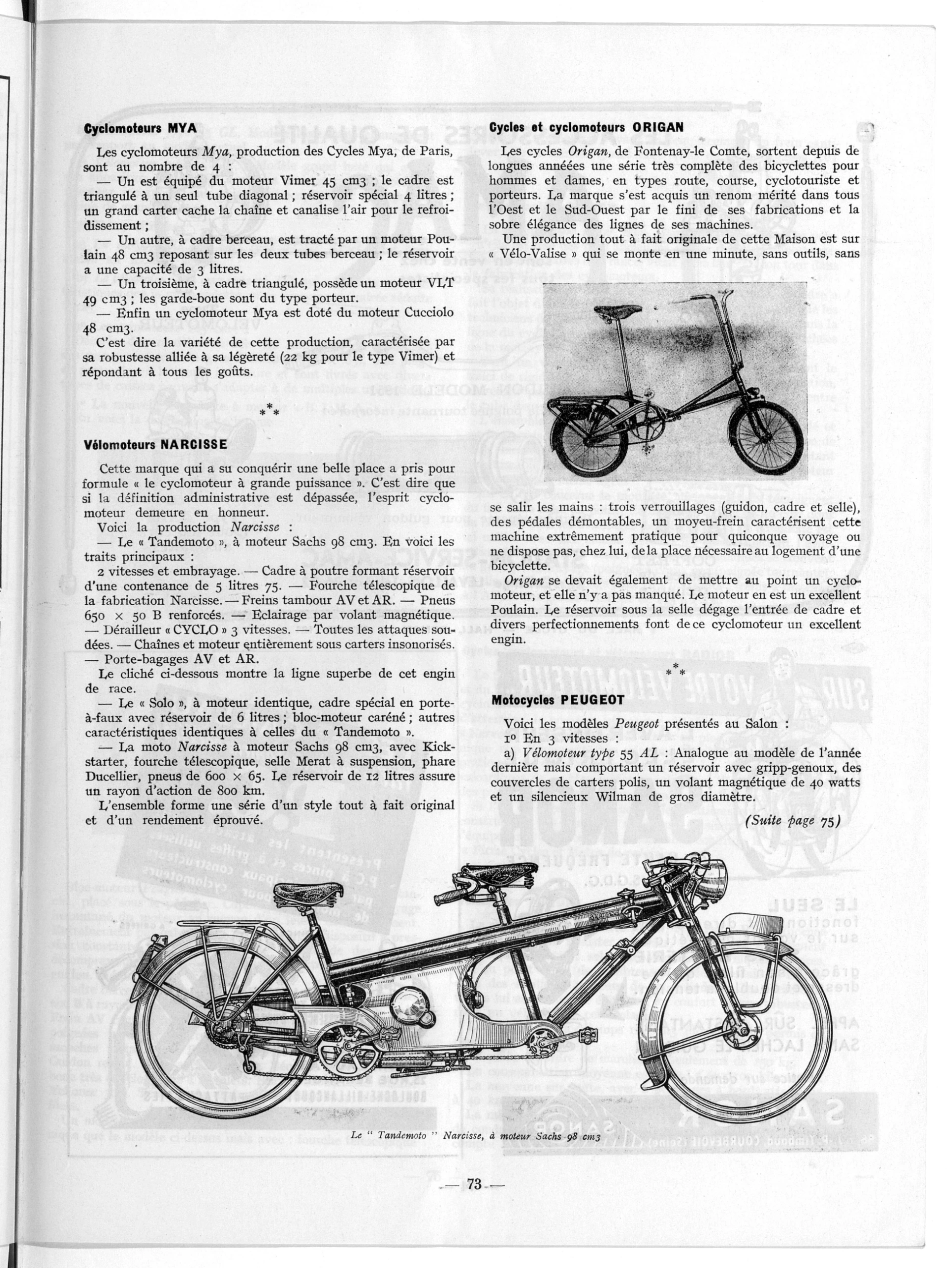
[Ebykr summary; the article’s text is not reproduced. Narcisse has built its name on what it calls the high-powered cyclomoteur, beyond the administrative definition but true to its spirit. The range: the « Tandemoto », with a Sachs 98 cm3 engine, 2 speeds and clutch, a beam frame forming a 5.75-liter tank, Narcisse’s own telescopic fork, drum brakes front and rear, reinforced 650 x 50 B tires, flywheel-magneto lighting, a « CYCLO » 3-speed derailleur, all joints brazed, chains and engine fully enclosed in silenced casings and front and rear racks; the « Solo », with the same engine, a special cantilever frame with a 6-liter tank and a faired engine unit, otherwise as the Tandemoto; and the Narcisse motorcycle with a Sachs 98 cm3 engine, kick-starter, telescopic fork, Merat sprung saddle, Ducellier headlamp, 600 x 65 tires and a 12-liter tank giving a range of 800 km. The writer calls the whole an original and proven series.]
Cycles et cyclomoteurs ORIGAN
[Ebykr summary; the article’s text is not reproduced. Origan cycles of Fontenay-le-Comte have long made a complete series of bicycles for men and women, in road, racing, cyclotouriste and carrier types, with a well-earned name across the West and Southwest of France for finish and sober line. An original product is the « Vélo-Valise », assembled in a minute without tools or dirty hands: three locks (handlebar, frame and saddle), removable pedals and a hub brake, for anyone who travels or lacks room at home for a bicycle. Origan has also developed a cyclomoteur with a Poulain engine, the tank under the saddle leaving the frame open.]
* * *
Motocycles PEUGEOT
[Ebykr summary; the article’s text is not reproduced. Peugeot’s Salon models begin with the 3-speed range: a) the Vélomoteur type 55 AL, like last year’s model but with a tank with knee grips, polished casing covers, a 40-watt flywheel magneto and a large-diameter Wilman silencer. The section continues on page 75.]
(Suite page 75)
Le ” Tandemoto ” Narcisse, à moteur Sachs 98 cm3
— 73 —
[A halftone photograph in the right-hand column shows the Origan « Vélo-Valise », a small-wheeled folding bicycle with a tall handlebar stem and seat post, a sprung saddle and a rear rack, against a plain mottled background; it has no caption. Across the foot of the page, a detailed line drawing shows the Narcisse « Tandemoto » from the right side: a long beam frame with “NARCISSE” on a plate on the top tube, two sprung saddles, an enclosed engine and chain casing, a headlamp, deep valanced mudguards and front and rear racks; captioned below. No signature or monogram was found on either image.]
— Page 8 —
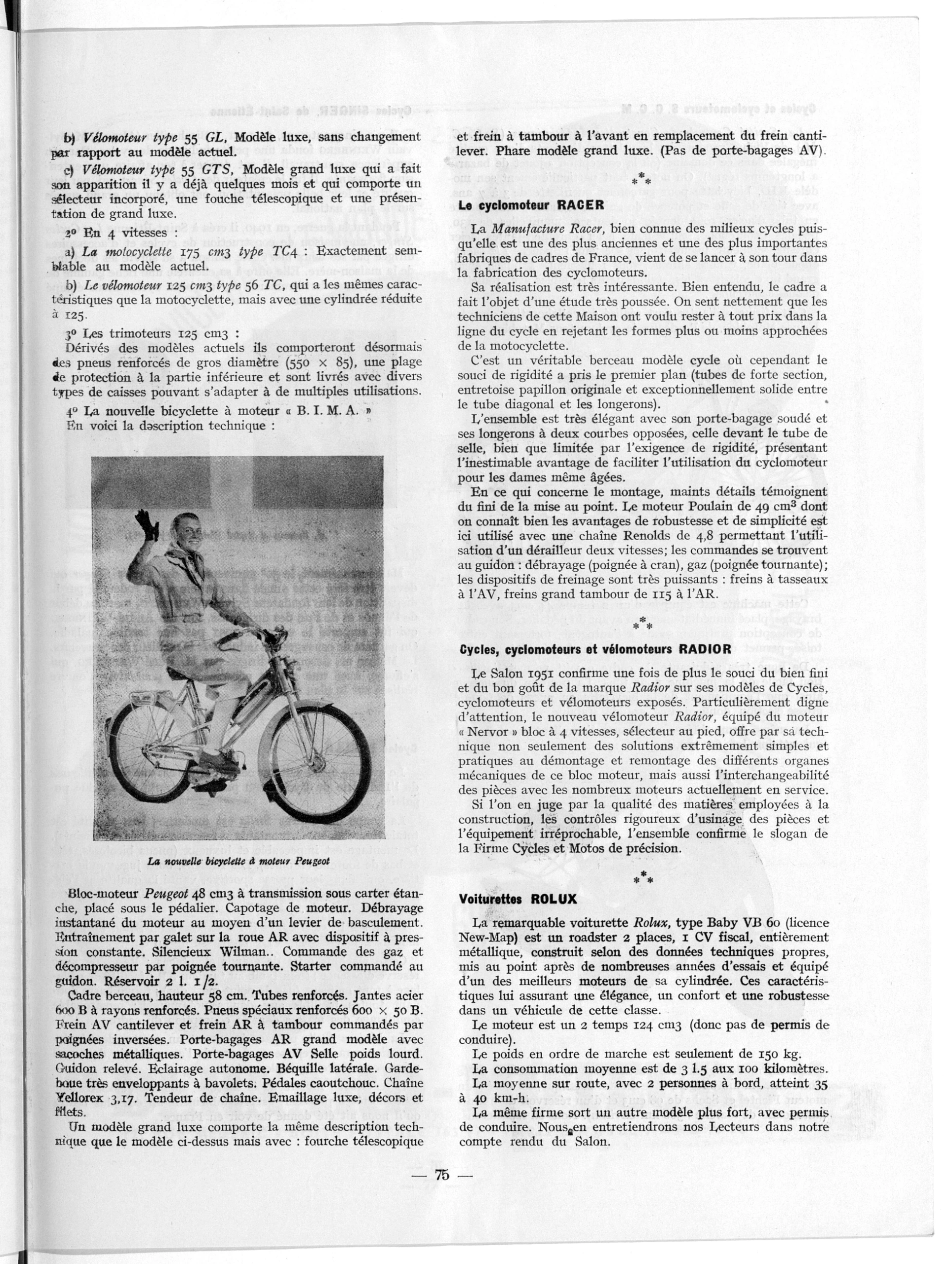
[Ebykr summary; the article’s text is not reproduced. The Peugeot section continues from page 73 with the rest of the 3-speed range: b) the Vélomoteur type 55 GL, a luxury model unchanged from the current one; c) the Vélomoteur type 55 GTS, a grand-luxury model introduced a few months earlier, with a built-in selector, telescopic fork and grand-luxury finish. 2° In 4 speeds: a) the motorcycle 175 cm3 type TC4, exactly like the current model; b) the vélomoteur 125 cm3 type 56 TC, with the same features as the motorcycle but reduced to 125. 3° The 125 cm3 trimoteurs (three-wheeled carriers), derived from the current models, will now have large reinforced tires (550 x 85), a protective plate underneath and a choice of bodies for many uses. 4° The new motorized bicycle « B. I. M. A. »: a Peugeot 48 cm3 engine unit with transmission in a sealed casing, placed under the bottom bracket; an engine cowl; instant declutching by a tilting lever; roller drive on the rear wheel with a constant-pressure device; a Wilman silencer; throttle and decompressor by twist grip; a choke worked from the handlebar; a 2.5-liter tank; a cradle frame 58 cm high with reinforced tubes; 600 B steel rims with reinforced spokes; special reinforced 600 x 50 B tires; a front cantilever brake and rear drum brake on reversed levers; a large rear rack with metal bags; a front rack; a heavy-duty saddle; a raised handlebar; self-powered lighting; a side stand; deeply valanced mudguards; rubber pedals; a Yellorex 3.17 chain; a chain tensioner; luxury enamel with decoration and lining. A grand-luxury model has the same specification but with a telescopic fork, a front drum brake in place of the cantilever and a grand-luxury headlamp, without the front rack.]
* * *
Le cyclomoteur RACER
[Ebykr summary; the article’s text is not reproduced. The Manufacture Racer, one of the oldest and largest frame makers in France, now enters cyclomoteur production. The frame was carefully studied: its designers kept to the lines of a bicycle rather than a motorcycle. It is a true bicycle-type cradle frame built for rigidity (heavy-section tubes and an original, very strong butterfly brace between the down tube and the cradle tubes), with a brazed-on rack and twin cradle tubes curved in opposite directions, the curve ahead of the seat tube easing use by women, even older ones. It has a Poulain 49 cm3 engine and a 4.8 Renolds chain allowing a two-speed derailleur; controls on the handlebar (clutch by notched grip, throttle by twist grip); powerful brakes, block brakes in front and a large 115 drum at the rear.]
* * *
Cycles, cyclomoteurs et vélomoteurs RADIOR
[Ebykr summary; the article’s text is not reproduced. At the 1951 Salon, Radior again shows its care for finish and good taste on its cycles, cyclomoteurs and vélomoteurs. The new Radior vélomoteur with the « Nervor » 4-speed engine unit and foot selector offers simple, practical dismantling and reassembly of the engine unit and interchangeable parts with the many engines in service. Material quality, strict machining checks and faultless equipment bear out the firm’s slogan “Cycles et Motos de précision”.]
* * *
Voiturettes ROLUX
[Ebykr summary; the article’s text is not reproduced. The Rolux voiturette type Baby VB 60 (New-Map license) is an all-metal two-seat roadster rated at 1 CV fiscal, built to the firm’s own design after years of testing. Its two-stroke 124 cm3 engine needs no driving license; it weighs only 150 kg in running order, uses 3.5 liters per 100 km on average and reaches an average of 35 to 40 km/h with two aboard. A stronger model requiring a license will be covered in the paper’s Salon report.]
La nouvelle bicyclette à moteur Peugeot
— 75 —
[A halftone photograph in the left column shows a smiling young woman in a jacket and scarf, waving a gloved hand, riding the new Peugeot motorized bicycle (the « B. I. M. A. ») past a plain backdrop; captioned below. No signature or photo credit was found.]
— Page 9 —
Cycles et cyclomoteurs S. C. C. M.
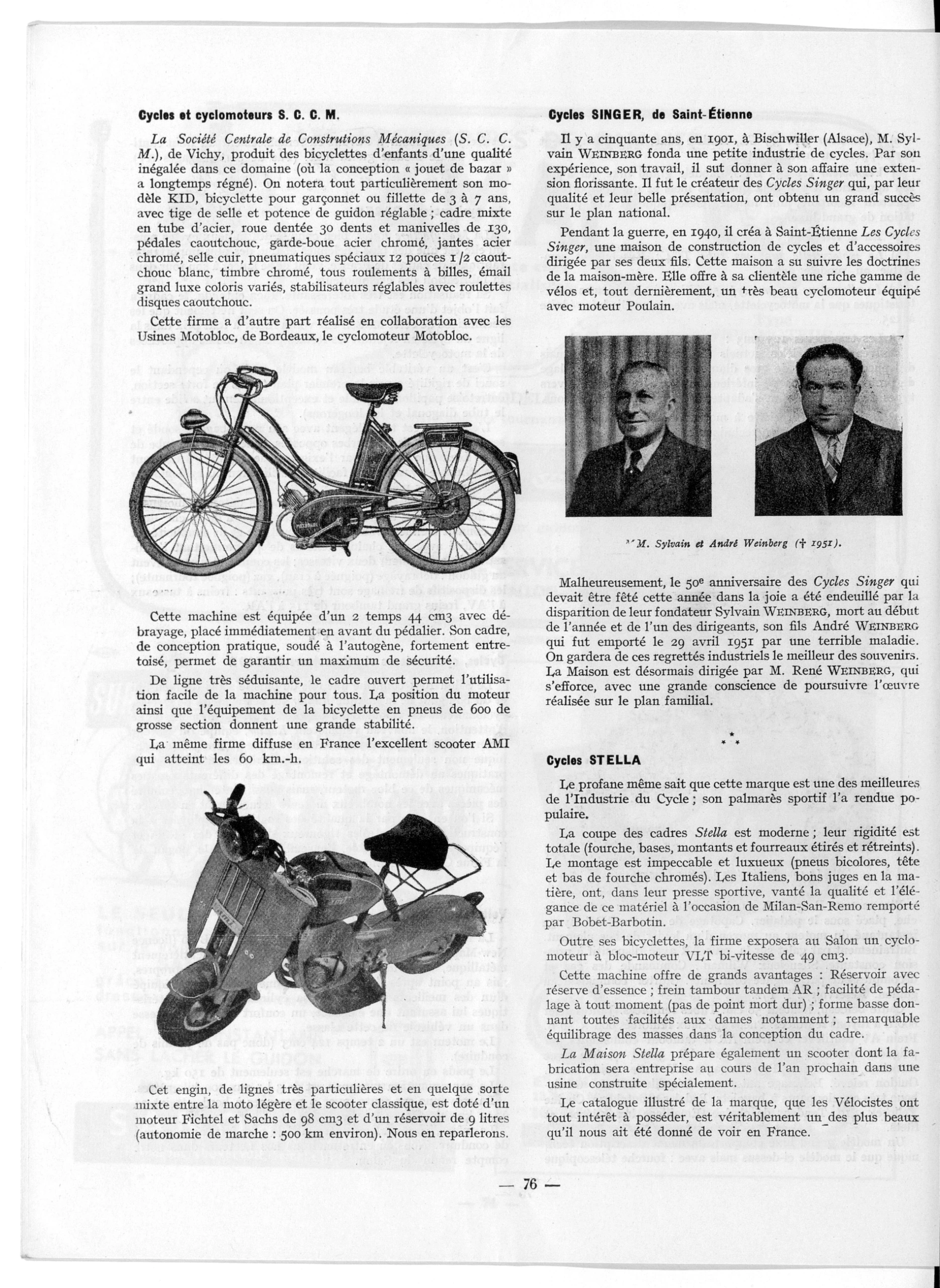
[Ebykr summary; the article’s text is not reproduced. The Société Centrale de Construtions Mécaniques (S. C. C. M.) of Vichy makes children’s bicycles of a quality unmatched in a field long ruled by the “jouet de bazar”. Its KID model, for boys or girls of 3 to 7, has an adjustable seat post and handlebar stem, a mixed (open) steel-tube frame, a 30-tooth chainwheel and 130 cranks, rubber pedals, chromed steel mudguards and rims, a leather saddle, special 12 1/2-inch white rubber tires, a chromed bell, ball bearings throughout, grand-luxury enamel in several colors and adjustable stabilizers with rubber disk wheels. With the Usines Motobloc of Bordeaux the firm has built the Motobloc cyclomoteur: a 44 cm3 two-stroke engine with clutch placed just ahead of the bottom bracket, a practical, oxy-acetylene welded and strongly braced frame, an open frame usable by anyone and large-section 600 tires for stability. The firm also distributes in France the AMI scooter, which reaches 60 km/h, a machine between a light motorcycle and a classic scooter, with a Fichtel et Sachs 98 cm3 engine and a 9-liter tank (a range of about 500 km), to be covered again later.]
Cycles SINGER, de Saint-Étienne
[Ebykr summary; the article’s text is not reproduced. Fifty years ago, in 1901, at Bischwiller (Alsace), M. Sylvain WEINBERG founded a small cycle business, grew it and created the Cycles Singer, which won national success for quality and presentation. During the war, in 1940, he founded Les Cycles Singer at Saint-Étienne, a maker of cycles and accessories run by his two sons, which offers a wide range of bicycles and, most recently, a cyclomoteur with a Poulain engine. The 50th anniversary was darkened by the deaths of the founder Sylvain WEINBERG early in the year and of his son André WEINBERG, one of the managers, on 29 April 1951 after a terrible illness. The firm is now run by M. René WEINBERG, who carries on the family work.]
MM. Sylvain et André Weinberg († 1951).
* * *
Cycles STELLA
[Ebykr summary; the article’s text is not reproduced. Even the layman knows Stella as one of the best names in the cycle industry, made popular by its racing record. Stella frames are modern in cut and fully rigid (fork, stays, tubes and fork blades drawn and tapered); assembly is impeccable and luxurious (two-tone tires, chromed fork crown and fork ends). The Italian sporting press praised the quality and elegance of the machine on which Bobet-Barbotin won Milan-San-Remo. Besides its bicycles, the firm will show a cyclomoteur with a VLT two-speed 49 cm3 engine unit: a tank with fuel reserve, a rear tandem drum brake, easy pedaling at all times (no hard dead point), a low build suited above all to women and well-balanced masses in the frame design. La Maison Stella is also preparing a scooter, to be built next year in a purpose-built factory. The illustrated catalog is called one of the finest the paper has seen in France and one every cycle dealer should own.]
— 76 —
[Three halftone photographs. In the left column, the S. C. C. M. Motobloc cyclomoteur, a step-through bicycle with a small engine ahead of the bottom bracket, a headlamp on the front mudguard, a rear rack and a leather saddle, shown in profile on a cut-out white ground, with small illegible lettering on the engine casing; below it, the AMI scooter seen from the front three-quarter, with a deep legshield, enclosed bodywork, a sprung saddle and a rear rack, also on a cut-out ground. In the right column, two head-and-shoulders portraits side by side: an older white-haired man in a dark suit and tie against a curtain (Sylvain Weinberg) and a younger dark-haired man in a suit and striped tie (André Weinberg), with the shared caption beneath. No signature or photo credit was found on any image.]
— Page 10 —
Scooters SPEED
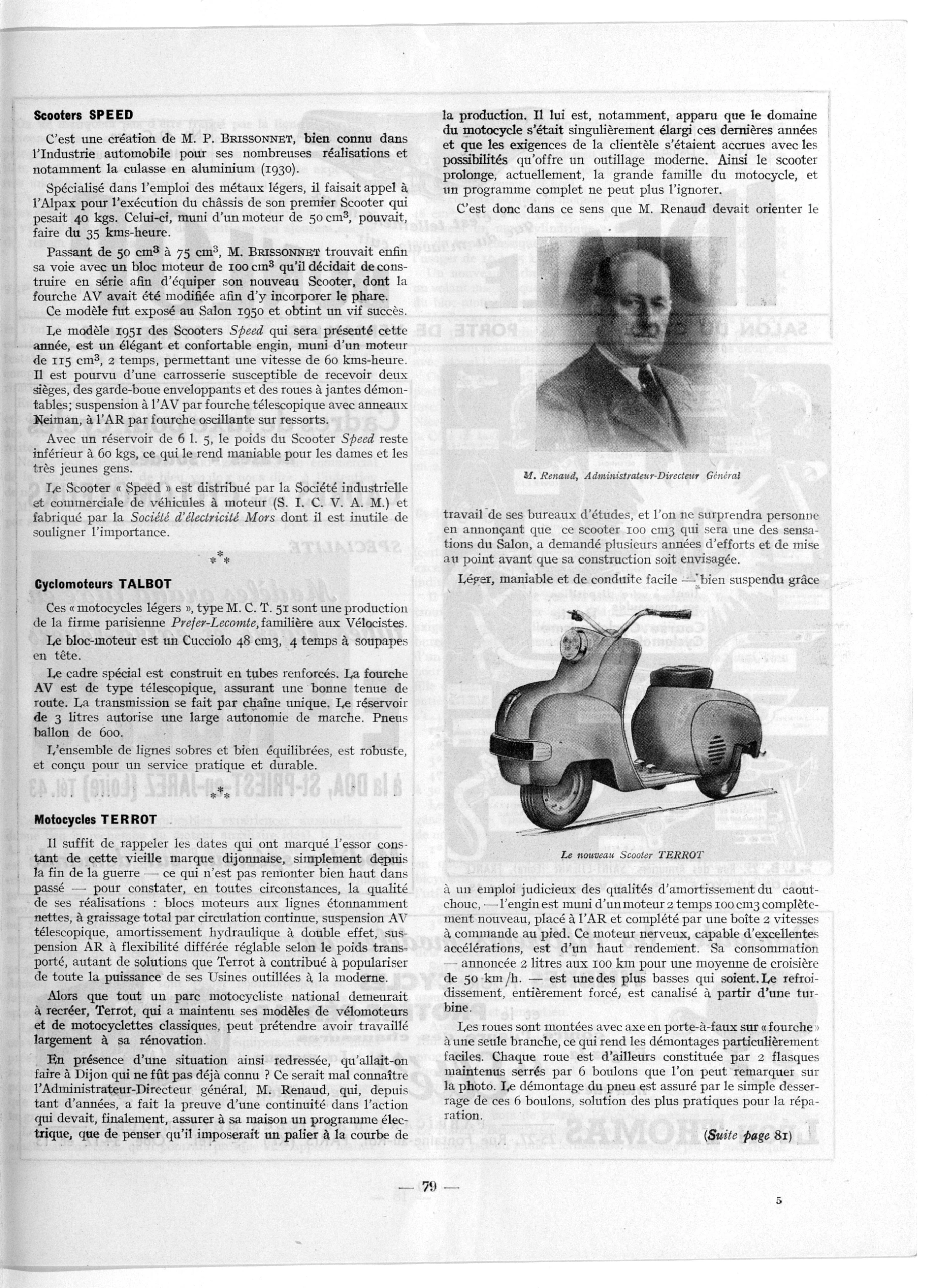
[Ebykr summary; the article’s text is not reproduced. The Speed scooter is the work of M. P. BRISSONNET, known in the motor industry for many designs, notably the aluminum cylinder head (1930). A specialist in light metals, he used Alpax for the chassis of his first scooter, which weighed 40 kg and with a 50 cm3 engine could do 35 km/h. Moving from 50 cm3 to 75 cm3, he settled on a 100 cm3 engine unit built in series for his new scooter, whose front fork was modified to take the headlamp; it was shown at the 1950 Salon with great success. The 1951 Speed, to be shown this year, has a 115 cm3 two-stroke engine for 60 km/h, a body able to take two seats, enveloping mudguards, wheels with detachable rims, a telescopic front fork with Neiman rings and a sprung swinging rear fork. With a 6.5-liter tank it weighs under 60 kg, light enough for women and the very young. It is distributed by the Société industrielle et commerciale de véhicules à moteur (S. I. C. V. A. M.) and made by the Société d’électricité Mors.]
* * *
Cyclomoteurs TALBOT
[Ebykr summary; the article’s text is not reproduced. These « motocycles légers », type M. C. T. 51, are made by the Paris firm Prefer-Lecomte, familiar to cycle dealers. The engine unit is a Cucciolo 48 cm3 four-stroke with overhead valves; the special frame is of reinforced tubes, with a telescopic front fork, single-chain transmission, a 3-liter tank for a long range and 600 balloon tires, in a sober, well-balanced, sturdy design built for practical, lasting service.]
* * *
Motocycles TERROT
[Ebykr summary; the article’s text is not reproduced. The writer recalls the steady rise of this old Dijon marque since the end of the war: cleanly styled engine units with full circulating lubrication, telescopic front suspension, double-acting hydraulic damping and rear suspension adjustable for load, solutions Terrot helped popularize with its modernized works. While the national stock of motorcycles had to be rebuilt, Terrot kept its classic vélomoteurs and motorcycles and can claim a large share in that renewal. The Administrateur-Directeur général, M. Renaud, has shown continuity of purpose for years; seeing that the motorcycle field had widened and that customers expected more from modern tooling, he judged that the scooter now belongs to the motorcycle family and directed his design offices accordingly. The new 100 cm3 scooter, expected to be one of the sensations of the Salon, took several years of development. It is light, handy and easy to ride, well sprung through a judicious use of rubber damping, with a completely new 100 cm3 two-stroke engine at the rear and a 2-speed foot-change gearbox; its consumption is given as 2 liters per 100 km at a 50 km/h cruising average, and its fully forced cooling is ducted from a turbine. The wheels are cantilevered on a single-sided « fourche » for easy removal; each wheel is made of 2 flanges held by 6 bolts, visible in the photograph, so that a tire is removed by undoing those 6 bolts. The section continues on page 81.]
(Suite page 81)
M. Renaud, Administrateur-Directeur Général
Le nouveau Scooter TERROT
— 79 —
[Two halftone photographs in the right column: a head-and-shoulders portrait of M. Renaud, an older man with a mustache in a dark suit and tie, vignetted on a light ground; and the new Terrot scooter seen from the front three-quarter, with a rounded body, a headlamp on the legshield, a dual saddle and a louvered engine cover, on a cut-out ground with a shadow line. No signature or photo credit was found. A small “5” printed at the lower right corner of the page is the printer’s gathering mark.]
— Page 11 —
[Ebykr summary; the article’s text is not reproduced. The Terrot section, continued from page 79, closes on the scooter’s elegant and rational « carrosserie », a true body with an unusual curve, where Terrot brings its long experience of pressed sheet steel; with precise know-how, specialized tooling and skilled staff Terrot has produced a truly French, popular scooter that will add to the marque’s name.]
* * *
VAP et la motorisation de la bicyclette
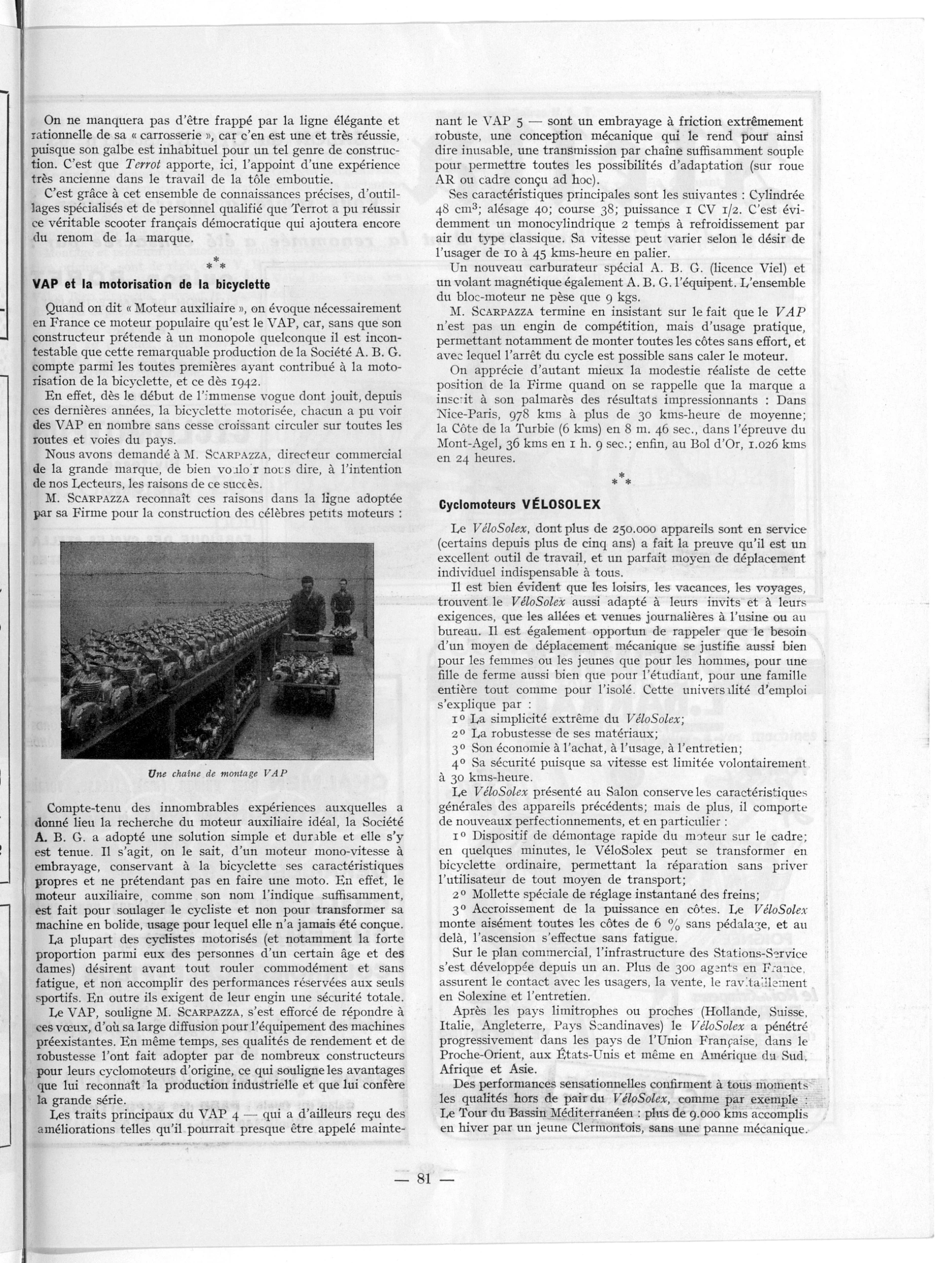
[Ebykr summary; the article’s text is not reproduced. To say « Moteur auxiliaire » in France is to think of the VAP: without claiming a monopoly, the Société A. B. G. was among the very first to motorize the bicycle, from 1942, and VAP engines are seen in ever larger numbers on every road. M. SCARPAZZA, the firm’s commercial director, explains the success by the line the firm chose: after countless experiments, a simple and durable single-speed engine with clutch that keeps the bicycle a bicycle, made to relieve the cyclist rather than turn the machine into a racer. Most motorized cyclists (many of them older people and women) want comfort, no fatigue and complete safety; the VAP meets these wishes, hence its wide use for fitting existing machines, and its efficiency and strength have led many makers to fit it to their own cyclomoteurs. The VAP 4, improved so far that it could almost be called the VAP 5, has a very strong friction clutch, near-indestructible mechanics and a chain drive supple enough to adapt to a rear wheel or a purpose-built frame. Its main figures: 48 cm3 capacity, bore 40, stroke 38, 1 1/2 CV, a classic air-cooled single-cylinder two-stroke, speed variable from 10 to 45 km/h on the level, a new special A. B. G. carburetor (Viel license) and an A. B. G. flywheel magneto; the engine unit weighs only 9 kg. M. SCARPAZZA insists that the VAP is not a competition machine but a practical one that climbs hills without effort and lets the cycle stop without stalling. The writer notes the firm’s modesty given its results: in Nice-Paris, 978 km at over 30 km/h average; La Côte de la Turbie (6 km) in 8 min 46 sec; in the Mont-Agel climb, 36 km in 1 h 9 sec; and at the Bol d’Or, 1,026 km in 24 hours.]
Une chaîne de montage VAP
* * *
Cyclomoteurs VÉLOSOLEX
[Ebykr summary; the article’s text is not reproduced. With more than 250,000 machines in service, some for over five years, the VéloSolex has proved itself as a working tool and personal transport for everyone, for leisure, holidays and travel as well as the daily trip to factory or office, and for women, the young, a farm girl, a student, a whole family or a single person. This versatility rests on: 1° its extreme simplicity; 2° the strength of its materials; 3° its economy to buy, run and maintain; 4° its safety, its speed being deliberately limited to 30 km/h. The Salon VéloSolex keeps the general features of earlier machines with new improvements: 1° quick removal of the engine from the frame, turning it into an ordinary bicycle in minutes so that it can be repaired without leaving the owner without transport; 2° a special knurled wheel for instant brake adjustment; 3° more power on hills, climbing 6 % grades easily without pedaling and steeper ones without fatigue. Commercially, the Stations-Service network has grown in a year: more than 300 agents in France handle sales, supply of Solexine and maintenance. After the neighboring countries (Holland, Switzerland, Italy, England and Scandinavia) the VéloSolex has spread to the French Union, the Near East, the United States and even South America, Africa and Asia. As an example of its performances: the Tour du Bassin Méditerranéen, more than 9,000 km covered in winter by a young man from Clermont without a mechanical breakdown.]
— 81 —
[A halftone photograph in the left column shows a VAP assembly line: long benches and trolleys loaded with rows of small engines, with two workers in overalls at the back of the shop; captioned below. No signature or photo credit was found.]
— Page 12 —
Cycles V. B. F.
[Ebykr summary; the article’s text is not reproduced. Forty years of experience and reputation explain the growing success of V. B. F. Under its esteemed and dynamic owner, M. Georges BALLANDRAS, this Saint-Étienne marque, one of the oldest (founded in 1908), strengthens its standing each season with a large and loyal clientele. Modern assembly and presentation, craftsman’s finish and original design are the rule at V. B. F., which builds and delivers only “Vélos Bien Faits, Vélos Bien Finis, Vélos Bien Français”, as the firm’s slogan has it, and shows its 1951-52 range. Its latest creations are the CycloRev 1952, one with a Poulain engine at the bottom bracket, the other a « moto légère » type with a Sachs engine.]
Moteurs auxiliaires V. L. T.
[Ebykr summary; the article’s text is not reproduced. La Maison Véloto shows its new single-speed VLT 49 cm3, adaptable to any bicycle or to a maker’s frame. The engine’s record: Paris-Nice and Paris-Grenoble at a 38.500 km/h average; the 1st Tour Cyclotouriste (tandem); the Grand Prix du Lac Daumesnil (average 66.665 km/h). Most recently, at Pau, in a six-day, six-night round, a V. L. T. ran for 144 hours at a 40.500 km/h average, a feat the paper will report on later. The single-speed model joins the 2-speed V. L. T. used by many makers; the design of these engine units is notable for the enclosure of all working parts.]
VOIR AUX PAGES SUIVANTES :
Quelques ÉQUIPEMENTS et OUTILLAGES 1951-1952
pour CYCLES et MOTOCYCLES
— 83 —
[The page has no illustration belonging to the survey. A boxed panel across the page below the two articles, in sans-serif capitals with the first line underlined, points the reader to the next survey.]
[The lower half of the page carries two advertisements that are not part of this record: Helyett (Usines, Sully-sur-Loire, « Championne olympique 1948 1952 », Salon stand no. 81) and Les Productions NAP (Vitry-le-François, « Le carter tournant NAP »).]
Ebykr presents this material for research and education. If you hold rights to it or notice an ownership issue, please contact us and we will respond promptly.
The Ebykr Digest
New articles, timelines, catalog finds and registry activity — assembled from the archive once a month. Your address is never shared.
Double opt-in. One email per month. Unsubscribe at any time with one click.