About Ebykr
Ebykr celebrates classic and vintage lightweight bicycles through provocative imagery and opinion. Ride along with us.
About Ebykr
Ebykr celebrates classic and vintage lightweight bicycles through provocative imagery and opinion. Ride along with us.

Source: Gallica (Bibliothèque nationale de France), L'Officiel du cycle, du motocycle et du camping, 5 May 1951, N° 11, page 5; ark:/12148/bd6t54185542v. Source gallica.bnf.fr / BnF.
| Type | Review |
|---|---|
| Year | 1951 |
| Publisher | L'Officiel du cycle |
| Country | France |
| Language | French |
| Pages | 1 |
| Source | Gallica (Bibliothèque nationale de France), L'Officiel du cycle, du motocycle et du camping, 5 May 1951, N° 11, page 5; ark:/12148/bd6t54185542v. Source gallica.bnf.fr / BnF. |
| Credit | Ebykr archive; Bibliothèque nationale de France |
| Identifier | Gallica (BnF) ark:/12148/bd6t54185542v/f5 |
| Transcription | Headings and specifications transcribed; article text summarized |
Reference
"Le chapitre des pédales s'enrichit." L'Officiel du cycle, 5 May 1951. Ebykr, https://ebykr.com/library/lofficiel-du-cycle-1951-05-05-chapitre-des-pedales-massal-ducoudray/.
Wikipedia
{{cite magazine |title=Le chapitre des pédales s'enrichit |magazine=L'Officiel du cycle |date=5 May 1951 |language=French |url=https://ebykr.com/library/lofficiel-du-cycle-1951-05-05-chapitre-des-pedales-massal-ducoudray/ |via=Ebykr |access-date=}}La Bicyclette LE CHAPITRE DES PÉDALES S'ENRICHIT par R. DUCOUDRAY FIG.1 FIG.2 FIG.3 * * * VÉLOCISTES, faites-nous part de vos suggestions et conceptions techniques.
This is a magazine article, so its running text is summarized here rather than reproduced; the headline, byline, specifications and scores are transcribed as printed.
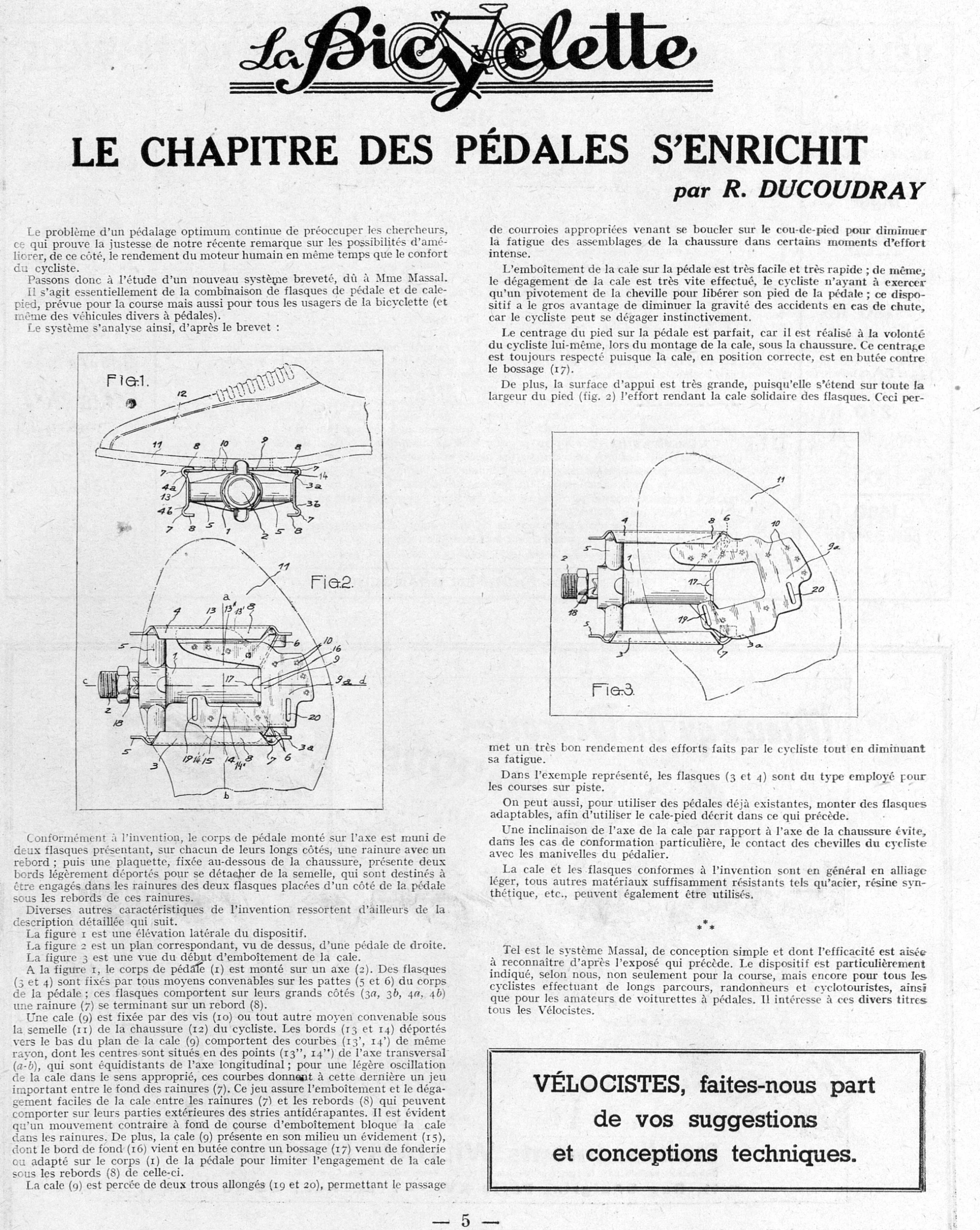
From L’Officiel du cycle, du motocycle et du camping, 5 May 1951, page 5: “Le chapitre des pédales s’enrichit” by R. Ducoudray, under the heading “La Bicyclette”: Mme Massal’s patented pedal with flanges and a toe-clip cleat, with three patent figures. The title, headings, captions and lists are transcribed as printed; the text is summarized in Ebykr’s words, and the page images carry it in full.
— Page 1 —
La Bicyclette
LE CHAPITRE DES PÉDALES S’ENRICHIT
par R. DUCOUDRAY
[Ebykr summary; the article’s text is not reproduced. The author opens by noting that the search for an ideal pedaling action goes on, which he says confirms the journal’s recent remark that the human engine could gain in output and the rider in comfort. He then takes up a new patented system due to Mme Massal: essentially a combination of pedal cheeks (flasques) and a toe-clip cleat (cale-pied), intended for racing but also for every user of the bicycle and even of other pedal-driven vehicles. He says the system is analyzed as the patent describes it.]
FIG.1
FIG.2
[Ebykr summary, after the first two figures. According to the patent, the pedal body mounted on the axle carries two cheeks, each with a groove and a lip along its long side. A small plate fixed under the shoe has two slightly offset edges meant to slide into the grooves of the two cheeks on one side of the pedal, under the lips. The text says the other features appear in the detailed description and lists the three figures: figure 1 is a side elevation, figure 2 a plan view from above of a right pedal and figure 3 a view of the start of engaging the cleat. It then walks through the numbered parts: the pedal body (1) on an axle (2), the cheeks (3 and 4) fixed on the legs (5 and 6) of the body, their grooves (7) ending in a lip (8) and the cleat (9) screwed by screws (10) under the sole (11) of the cyclist’s shoe (12). The cleat’s downturned edges (13 and 14) carry curves (13′, 14′) of equal radius, centered at points (13”, 14”) on the transverse axis (a-b) and equidistant from the longitudinal axis, which gives the cleat a large play between the groove bottoms (7) for easy entry and release, while a contrary movement at the end of the engagement stroke locks it. The lips may have anti-slip ridges on their outer parts. The cleat has a central cutout (15) whose bottom edge (16) abuts a boss (17), cast or fitted on the pedal body, which limits how far the cleat enters under the lips (8). The cleat is also pierced by two elongated holes (19 and 20) that allow the passage of suitable straps buckled over the instep to relieve the shoe’s assembly during moments of intense effort.]
FIG.3
[Ebykr summary, continued. The author says the cleat enters the pedal very easily and quickly and is as quickly freed, the rider needing only a pivot of the ankle to release the foot, which he calls a great advantage in lessening the gravity of falls because the rider can disengage by instinct. Centering of the foot is perfect because the rider sets it himself when mounting the cleat under the shoe, and it is always kept because the cleat in correct position abuts the boss (17). The bearing surface is very large, extending across the full width of the foot (fig. 2), the effort making the cleat one with the cheeks, which gives very good output of the rider’s efforts while reducing fatigue. In the example shown the cheeks (3 and 4) are of the type used for track racing. Adaptable cheeks can also be fitted to existing pedals so the cleat can be used with them. An inclination of the cleat’s axis in relation to the shoe’s axis avoids, in riders of particular conformation, contact between the ankles and the cranks. The cleat and cheeks are in general of light alloy, but steel, synthetic resin and other sufficiently strong materials may be used.]
* * *
[Ebykr summary, after a three-star break. The author concludes that the Massal system is simple in design and its efficiency easy to see from the preceding account. In the journal’s view the device is especially suited not only to racing but to all riders on long runs, randonneurs and cyclotourists, as well as to enthusiasts of pedal cars, and so it concerns all bicycle dealers (Vélocistes).]
VÉLOCISTES, faites-nous part
de vos suggestions
et conceptions techniques.
[An editorial page article with text only in running columns, set in a seriffed text face, under a large script masthead reading “La Bicyclette” in black with a line drawing of a bicycle among the letters and three horizontal rules beneath. The title stands in heavy black roman capitals across the full width and the byline “par R. DUCOUDRAY” in bold italic capitals sits at the right below it. Three patent line drawings are printed in ruled rectangular frames, each labeled “FIG.1”, “FIG.2” and “FIG.3” in thin hand lettering and covered with small reference numerals and leader lines. Figure 1 shows a shoe sole seen from the side above a pedal body with two grooved cheeks and a round axle end. Figures 2 and 3 show the pedal from above under the outline of a shoe sole, with a perforated cleat plate bearing two elongated slots, a threaded axle end with a nut at the left and a boss on the pedal body. A three-star ornament separates the article from its closing paragraph. At the foot, a ruled rectangular panel in bold sans-serif type invites bicycle dealers to send in their suggestions and technical ideas. The page number “5” appears below. No signature or artist mark is visible.]
Ebykr presents this material for research and education. If you hold rights to it or notice an ownership issue, please contact us and we will respond promptly.
The Ebykr Digest
New articles, timelines, catalog finds and registry activity — assembled from the archive once a month. Your address is never shared.
Double opt-in. One email per month. Unsubscribe at any time with one click.