About Ebykr
Ebykr celebrates classic and vintage lightweight bicycles through provocative imagery and opinion. Ride along with us.
About Ebykr
Ebykr celebrates classic and vintage lightweight bicycles through provocative imagery and opinion. Ride along with us.

Source: Gallica (Bibliothèque nationale de France), L'Officiel du cycle, du motocycle et du camping, 24 March 1951, N° 6, 61e Année, page 11; ark:/12148/bd6t54185539c. Source gallica.bnf.fr / BnF.
| Marque | Hiry's |
|---|---|
| Type | Review |
| Year | 1951 |
| Publisher | L'Officiel du cycle |
| Country | France |
| Language | French |
| Pages | 2 |
| Source | Gallica (Bibliothèque nationale de France), L'Officiel du cycle, du motocycle et du camping, 24 March 1951, N° 6, 61e Année, page 11; ark:/12148/bd6t54185539c. Source gallica.bnf.fr / BnF. |
| Credit | Ebykr archive; Bibliothèque nationale de France |
| Identifier | Gallica (BnF) ark:/12148/bd6t54185539c/f11 |
| Transcription | Headings and specifications transcribed; article text summarized |
Reference
"La roue-libre HIRY'S à roulement annulaire." L'Officiel du cycle, 24 March 1951. Ebykr, https://ebykr.com/library/lofficiel-du-cycle-1951-03-11-roue-libre-hirys-roulement-annulaire-bourrin/.
Wikipedia
{{cite magazine |title=La roue-libre HIRY'S à roulement annulaire |magazine=L'Officiel du cycle |date=24 March 1951 |language=French |url=https://ebykr.com/library/lofficiel-du-cycle-1951-03-11-roue-libre-hirys-roulement-annulaire-bourrin/ |via=Ebykr |access-date=}}La roue-libre HIRY'S à roulement annulaire
This is a magazine article, so its running text is summarized here rather than reproduced; the headline, byline, specifications and scores are transcribed as printed.
From L’Officiel du cycle, du motocycle et du camping, 24 March 1951, page 11: ‘La roue-libre HIRY’S à roulement annulaire’: annular-bearing freewheel (a trend in bicycle building), Maison Bourrin Frères, Saint-Étienne; part 1 is the heading and opening of the text at the foot of column 1. The title, headings, captions and lists are transcribed as printed; the text is summarized in Ebykr’s words, and the page images carry it in full.
— Page 1 —
La roue-libre HIRY’S
à roulement annulaire
[Ebykr summary; the article’s text is not reproduced. The notice states that in bicycle building the annular bearing is now tending to replace the cup-and-cone bearing, as it did earlier in car and motorcycle construction, a logical trend since the cycle could not fail to follow progress. It then introduces the “HIRY’S” triple and quadruple toothed freewheel with annular bearing, and the text breaks off at the foot of the column after the words “triple et qua-“.]
[The opening of a text-only trade notice at the foot of a column. A small ornament of three stars arranged in a triangle sits at the top, above a two-line heading “La roue-libre HIRY’S à roulement annulaire” centered in bold roman capitals and lowercase. Below it the body text is set in italic roman type, with the first line of each paragraph indented. The firm is not named in this part and no address, drawing or signature appears. The text continues in the column that follows.]
— Page 2 —
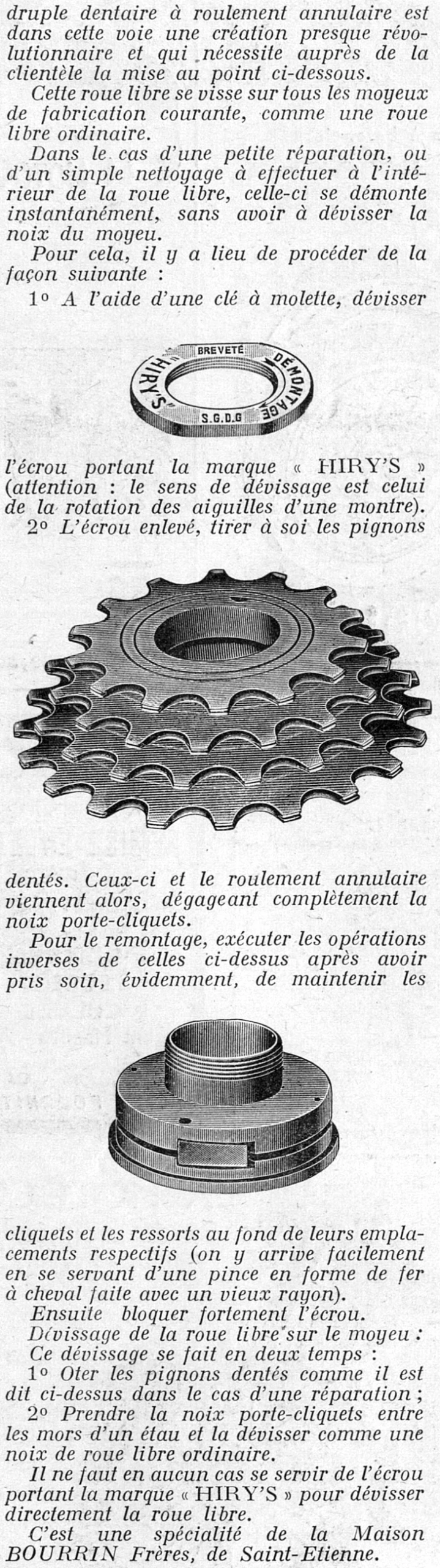
[Ebykr summary, continuing from the foot of the previous column; the article’s text is not reproduced. The sentence begins in mid-word, “druple dentaire à roulement annulaire”, and calls the quadruple toothed freewheel with annular bearing an almost revolutionary creation that needs the procedure set out below to be explained to customers. It screws onto all hubs of current manufacture like an ordinary freewheel. For a small repair or a simple cleaning of its interior it comes apart instantly, without unscrewing the hub nut. The steps given are as follows. First, using a knurled-head wrench, unscrew the nut that carries the “HIRY’S” mark, noting that the direction of unscrewing is that of a watch’s hands. Second, with the nut off, pull the toothed sprockets toward oneself; they come away together with the annular bearing and leave the pawl-carrier hub completely clear. For refitting, the operations are reversed, taking care to hold the pawls and springs at the bottom of their seats, which is easily done with a horseshoe-shaped pincer made from an old spoke, and then tightening the nut firmly. To unscrew the freewheel from the hub, two steps are needed: remove the sprockets as described for a repair, then grip the pawl-carrier hub between the jaws of a vise and unscrew it like the hub of an ordinary freewheel. The nut marked “HIRY’S” must never be used to unscrew the freewheel directly. The notice closes by saying that this is a specialty of the Maison BOURRIN Frères, of Saint-Etienne.]
[Continuation of the text-only trade notice, set in italic roman type with the numbered steps indented, and three line-engraved drawings set into the column between paragraphs. The first, near the top, shows a thick ring nut seen obliquely, drawn in fine hatching; lettering on its upper face reads “BREVETÉ”, on its left side “HIRY’S” and on its right “DÉMONTAGE” with an arrow curving round it, and “S.G.D.G” appears on its front edge. The second, in the middle, shows a stack of three toothed sprockets of decreasing size seen from above at an angle, with a hollow center, drawn in close parallel shading. The third, near the foot, shows a cylindrical freewheel body with a threaded neck, a broad stepped base, a small rectangular tab on its side and a few small holes in the top face, drawn in the same engraved manner. No artist signature is visible. The last line of the text names the Maison Bourrin Frères of Saint-Etienne. Faint text from the reverse of the leaf shows through at the left of the last drawing.]
Ebykr presents this material for research and education. If you hold rights to it or notice an ownership issue, please contact us and we will respond promptly.
The Ebykr Digest
New articles, timelines, catalog finds and registry activity — assembled from the archive once a month. Your address is never shared.
Double opt-in. One email per month. Unsubscribe at any time with one click.