About Ebykr
Ebykr celebrates classic and vintage lightweight bicycles through provocative imagery and opinion. Ride along with us.
About Ebykr
Ebykr celebrates classic and vintage lightweight bicycles through provocative imagery and opinion. Ride along with us.

Source: Gallica (Bibliothèque nationale de France), L'Officiel du cycle, du motocycle et du camping, 24 March 1951, N° 6, 61e Année, page 5; ark:/12148/bd6t54185539c. Source gallica.bnf.fr / BnF.
| Type | Review |
|---|---|
| Year | 1951 |
| Publisher | L'Officiel du cycle |
| Country | France |
| Language | French |
| Pages | 3 |
| Source | Gallica (Bibliothèque nationale de France), L'Officiel du cycle, du motocycle et du camping, 24 March 1951, N° 6, 61e Année, page 5; ark:/12148/bd6t54185539c. Source gallica.bnf.fr / BnF. |
| Credit | Ebykr archive; Bibliothèque nationale de France |
| Identifier | Gallica (BnF) ark:/12148/bd6t54185539c/f5 |
| Transcription | Headings and specifications transcribed; article text summarized |
Reference
"La construction suédoise." L'Officiel du cycle, 24 March 1951. Ebykr, https://ebykr.com/library/lofficiel-du-cycle-1951-03-05-construction-suedoise-nyman-ducoudray/.
Wikipedia
{{cite magazine |title=La construction suédoise |magazine=L'Officiel du cycle |date=24 March 1951 |language=French |url=https://ebykr.com/library/lofficiel-du-cycle-1951-03-05-construction-suedoise-nyman-ducoudray/ |via=Ebykr |access-date=}}La Bicyclette LA CONSTRUCTION SUÉDOISE par R. DUCOUDRAY
This is a magazine article, so its running text is summarized here rather than reproduced; the headline, byline, specifications and scores are transcribed as printed.
From L’Officiel du cycle, du motocycle et du camping, 24 March 1951, page 5: LA CONSTRUCTION SUÉDOISE by R. Ducoudray under the La Bicyclette banner: the Swedish bicycle (Nyman) with two line drawings, one man’s and one lady’s machine (part 1, left column). The title, headings, captions and lists are transcribed as printed; the text is summarized in Ebykr’s words, and the page images carry it in full.
— Page 1 —
La Bicyclette
LA CONSTRUCTION SUÉDOISE
par R. DUCOUDRAY
[Text only: the heading strip of an article under the standing banner of the bicycle column. At the top, the words “La Bicyclette” are set in a bold, flowing script with swash capitals, the large B and the y trailing long strokes, and a line-engraved side view of a bicycle is drawn in among the letters so that its rear wheel forms the round of the c and its saddle and handlebar rise above the word. Three horizontal rules of different lengths run beneath the script. Below the banner, “LA CONSTRUCTION SUÉDOISE” is set across the width in widely spaced roman capitals, and under it at the right “par R. DUCOUDRAY” is set in italic with the surname in italic capitals. The strip carries no signature and no firm name.]
— Page 2 —
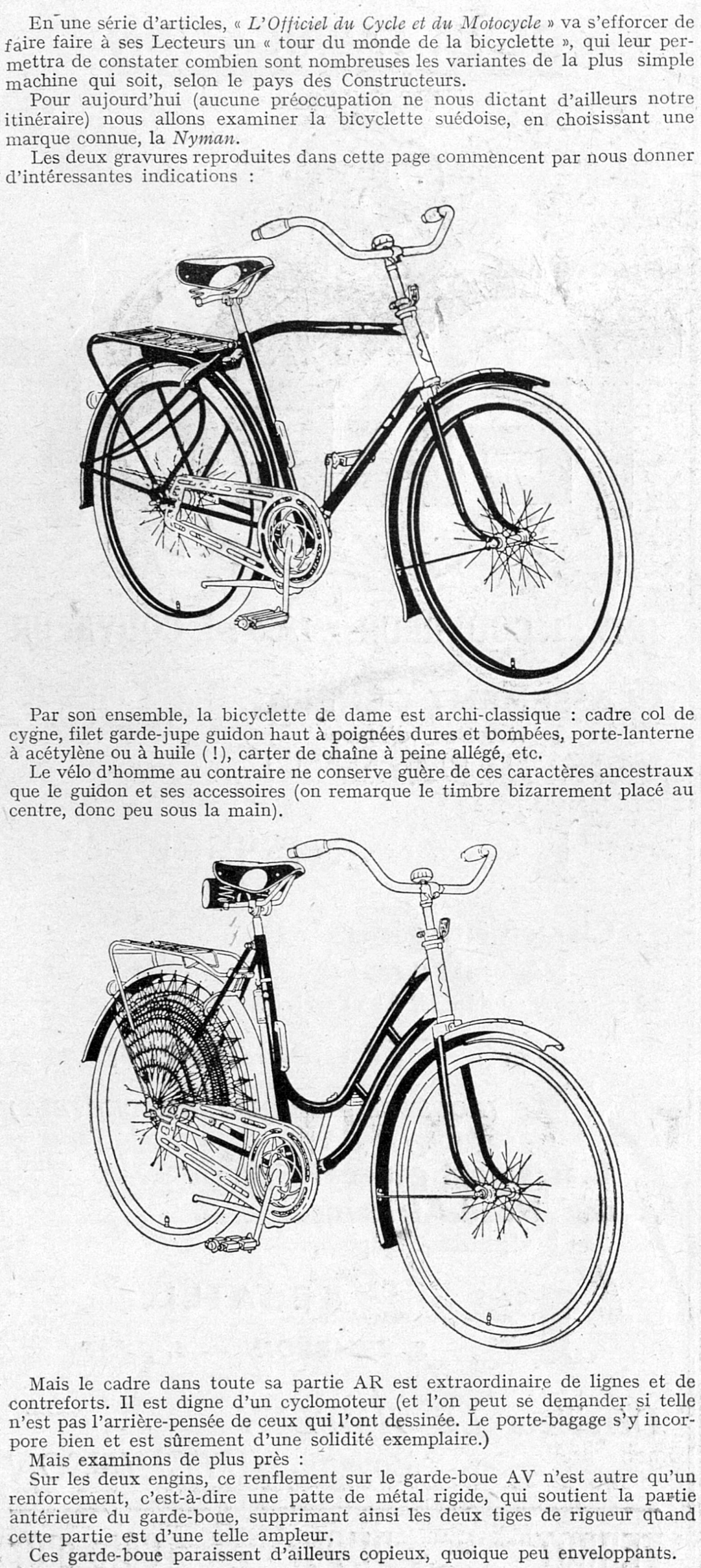
[Ebykr summary; the article’s text is not reproduced. The opening says that in a series of articles “L’Officiel du Cycle et du Motocycle” will try to give its readers a “tour du monde de la bicyclette”, to show how many variants there are of the simplest machine according to the makers’ country. For today, with no particular preoccupation dictating the route, the writer will look at the Swedish bicycle, taking a well-known make, the Nyman, and says the two engravings reproduced on the page give interesting indications to begin with.]
[Ebykr summary, after the first engraving. Overall, the writer says, the lady’s bicycle is thoroughly classic: swan-neck frame, skirt guard net, high handlebar with hard, rounded grips, an acetylene or even oil lantern holder (he adds an exclamation mark), and a chain case barely lightened. The man’s bicycle, by contrast, keeps hardly any of these ancestral features other than the handlebar and its accessories, and he notes the bell oddly placed at the center of the bars, so hardly under the hand.]
[Ebykr summary, after the second engraving. The whole rear part of the frame is extraordinary in its lines and bracing, in the writer’s words worthy of a cyclomoteur, and he wonders whether that was the designers’ afterthought; the luggage rack is built in well and is surely of exemplary strength. He then looks closer: on both machines the swelling on the front mudguard is only a reinforcement, a rigid metal bracket that supports the front of the guard and removes the two stays of rigidity when the guard is so wide. These mudguards seem generous, though somewhat enveloping.]
[Two line engravings, each a three-quarter view of a bicycle from the front left and drawn in black outline with solid black for the frame tubes and tires, one above the other in a single column with a short run of text between them. The upper engraving shows a man’s machine: a high handlebar with a bell clamped at its center, a black padded saddle, a rear luggage carrier above a fully enclosed chain case and a deep front mudguard with a bracket on it, and a straight top tube. The lower engraving shows a lady’s machine with a swan-neck frame, a skirt guard of fine radiating cords over the rear wheel, a small lamp or tool case beside the saddle, a rear carrier and the same enclosed chain case and deep mudguards. No signature or artist mark is visible in the corners of either engraving. The text above and between the engravings is set in a small serif roman.]
— Page 3 —
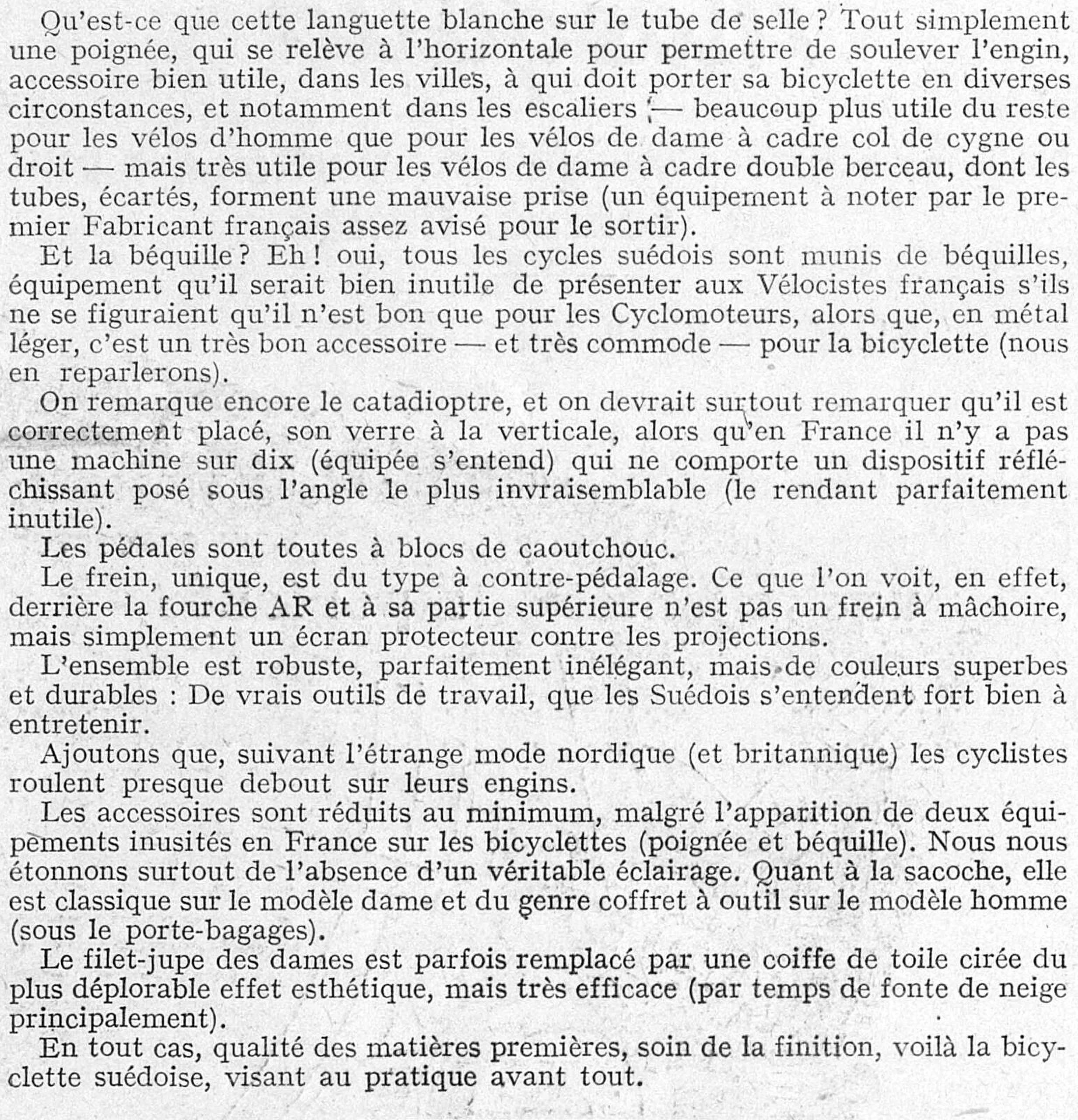
[Ebykr summary; the article’s text is not reproduced. The writer asks what the white tongue on the seat tube is: simply a handle that folds up to the horizontal so the machine can be lifted, a useful accessory in towns for anyone who must carry a bicycle, notably on stairs; it is more useful on men’s machines than on ladies’ swan-neck or straight frames, but very useful on ladies’ double-cradle frames, whose spread tubes give a poor grip, and he suggests the first French maker shrewd enough to bring one out should take note. He then says all Swedish cycles have kickstands, which French dealers should not dismiss as fit only for cyclomoteurs since in light metal they make a very good and convenient bicycle accessory (to be discussed again later). He notes the rear reflector, correctly placed with its glass vertical, whereas in France not one equipped machine in ten has a reflecting device set at an angle that makes it useless. The pedals are all rubber-block pedals. The single brake is a coaster (back-pedaling) brake; what appears behind the upper part of the rear fork is not a caliper brake but a screen against splashes. He judges the whole sturdy, perfectly inelegant, but of superb and durable colors, true working tools that the Swedes maintain well. Following a Nordic (and British) fashion, riders ride almost standing on their machines. Accessories are kept to a minimum, despite two items unusual in France on bicycles (the handle and the kickstand), and he is surprised above all by the lack of a real lighting set. The saddlebag is classic on the lady’s model and of the tool-box type on the man’s, under the carrier. The ladies’ skirt net is sometimes replaced by a waxed-cloth hood of deplorable looks but very effective, chiefly in melting snow. In all cases, he concludes, quality of raw materials and care in finish describe the Swedish bicycle, aimed at the practical above all.]
[Text only: a single column of running text set in a small, light serif roman in justified paragraphs with indented first lines. No drawing, photograph, heading, signature or firm name appears in this image.]
Ebykr presents this material for research and education. If you hold rights to it or notice an ownership issue, please contact us and we will respond promptly.
The Ebykr Digest
New articles, timelines, catalog finds and registry activity — assembled from the archive once a month. Your address is never shared.
Double opt-in. One email per month. Unsubscribe at any time with one click.