About Ebykr
Ebykr celebrates classic and vintage lightweight bicycles through provocative imagery and opinion. Ride along with us.
About Ebykr
Ebykr celebrates classic and vintage lightweight bicycles through provocative imagery and opinion. Ride along with us.

Source: Gallica (Bibliothèque nationale de France), L'Officiel du cycle, du motocycle et du camping, 16 December 1950, page 15; ark:/12148/bd6t54185532g. Source gallica.bnf.fr / BnF.
| Type | Review |
|---|---|
| Year | 1950 |
| Publisher | L'Officiel du cycle |
| Country | France |
| Language | French |
| Pages | 1 |
| Source | Gallica (Bibliothèque nationale de France), L'Officiel du cycle, du motocycle et du camping, 16 December 1950, page 15; ark:/12148/bd6t54185532g. Source gallica.bnf.fr / BnF. |
| Credit | Ebykr archive; Bibliothèque nationale de France |
| Identifier | Gallica (BnF) ark:/12148/bd6t54185532g/f15 |
| Transcription | Headings and specifications transcribed; article text summarized |
Reference
"Équipements et Outillage." L'Officiel du cycle, 16 December 1950. Ebykr, https://ebykr.com/library/lofficiel-du-cycle-1950-12-15-equipements-outillage-lambert-sedis-liberty/.
Wikipedia
{{cite magazine |title=Équipements et Outillage |magazine=L'Officiel du cycle |date=16 December 1950 |language=French |url=https://ebykr.com/library/lofficiel-du-cycle-1950-12-15-equipements-outillage-lambert-sedis-liberty/ |via=Ebykr |access-date=}}Frein LAMBERT et CAGNON 1° Tirage central au milieu d'un palonnier, donc parfaitement équilibré sur les 2 patins de freins ; 2° Serrage très progressif et très puissant en fin de course ; 3° Organes bien protégés de la boue et des poussières (en particulier les galets sont presque entièrement cachés) ; 4° Arrêt en …
This is a magazine article, so its running text is summarized here rather than reproduced; the headline, byline, specifications and scores are transcribed as printed.
From L’Officiel du cycle, du motocycle et du camping, 16 December 1950, page 15: “Équipements et Outillage” column: Lambert et Cagnon center-pull brake, Quiet fuel tap, Sedis chains (Yellow, Yellorex), Liberty saddle suspension, Stabylcar windshield. The title, headings, captions and lists are transcribed as printed; the text is summarized in Ebykr’s words, and the page images carry it in full.
— Page 1 —
Frein LAMBERT et CAGNON
[Ebykr summary; the article’s text is not reproduced. The paper draws its readers’ attention to the new center-pull brake developed by the firm Lambert et Cagnon, of Lyon, and notes that a fine illustration of it appeared in the issue of 21 October (page 24). The brake is then characterized by seven points, given as printed.]
1° Tirage central au milieu d’un palonnier, donc parfaitement équilibré sur les 2 patins de freins ;
2° Serrage très progressif et très puissant en fin de course ;
3° Organes bien protégés de la boue et des poussières (en particulier les galets sont presque entièrement cachés) ;
4° Arrêt en fin de course pour éviter la sortie du palonnier ;
5° Branches renforcées et estampées dans de l’acier de 4 mm. donnant une très grande rigidité ;
6° Très belle présentation de l’ensemble et visserie très soignée ;
7° Facilité de réglage des patins de frein.
Le robinet « LE QUIET »
[Ebykr summary; the article’s text is not reproduced. The note presents a novelty meant to spare motorcyclists the dry breakdown and to give motorcycle dealers (Motocistes) a new article to sell. The « Quiet » is a reserve fuel tap whose patented parts, by allowing rational series production, permit a selling price as modest as that of an ordinary tap.]
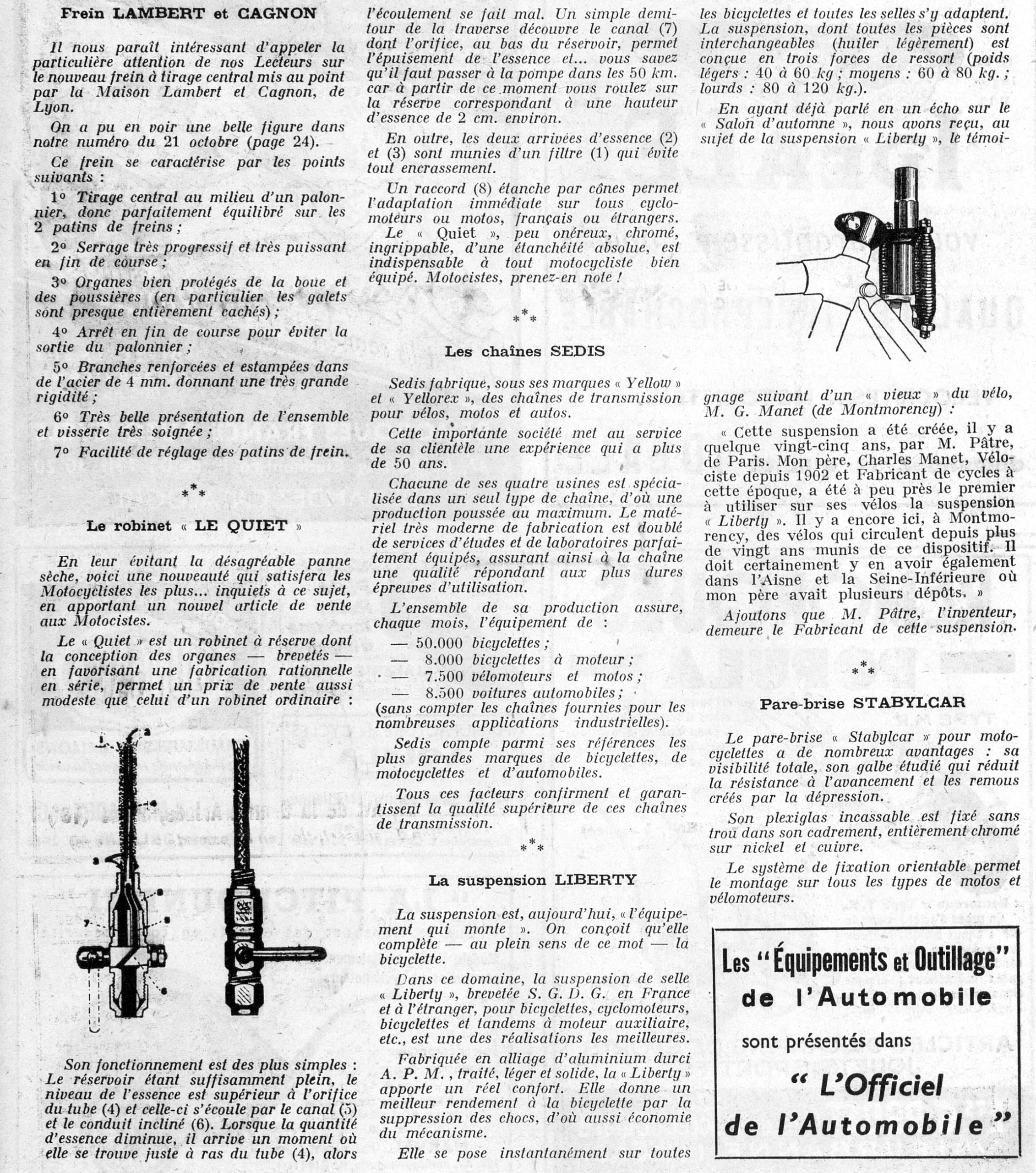
[Ebykr summary, after the figure. Operation is described as very simple: with the tank sufficiently full, the fuel level is above the orifice of the tube (4) and the fuel runs out through the channel (5) and the inclined passage (6). When the quantity falls to the level of the tube (4), the flow becomes poor. A simple half-turn of the cross-piece then opens the channel (7), whose orifice at the bottom of the tank allows the rest of the fuel to be used; the rider then knows a pump must be reached within 50 km., because from that moment the machine runs on the reserve, which corresponds to a fuel height of about 2 cm. The two fuel inlets (2) and (3) each carry a filter (1) that prevents any clogging. A tight cone union (8) allows immediate fitting to any moped, motor-assisted cycle or motorcycle, French or foreign. The tap is described as low in cost, chromed, seize-proof and absolutely tight, and as essential to any well-equipped motorcyclist; the note ends by telling dealers to take note.]
Les chaînes SEDIS
[Ebykr summary; the article’s text is not reproduced. Sedis makes, under its marks « Yellow » and « Yellorex », transmission chains for bicycles, motorcycles and cars. The company puts at its customers’ service an experience of more than 50 years. Each of its four factories is specialized in a single type of chain, which pushes output to the maximum, and very modern manufacturing equipment is backed by well-equipped design offices and laboratories, giving a quality that meets the hardest tests in use. The note then lists what its monthly production equips, as follows.]
— 50.000 bicyclettes ;
— 8.000 bicyclettes à moteur ;
— 7.500 vélomoteurs et motos ;
— 8.500 voitures automobiles ;
(sans compter les chaînes fournies pour les nombreuses applications industrielles).
[Ebykr summary, after the list. Sedis counts among its references the greatest makes of bicycles, motorcycles and cars, and the note concludes that all these factors confirm and guarantee the superior quality of its transmission chains.]
La suspension LIBERTY
[Ebykr summary; the article’s text is not reproduced. Suspension is today called « l’équipement qui monte », and it completes the bicycle in the full sense of the word. In this field the « Liberty » saddle suspension, patented S. G. D. G. in France and abroad, for bicycles, mopeds, motor-assisted bicycles and tandems and so on, is described as one of the best designs. Made in a hardened, treated aluminum alloy marked A. P. M., light and strong, it is said to bring real comfort and to give the bicycle better performance by removing shocks, with a saving in wear of the mechanism. It fits instantly on all bicycles and all saddles fit it. All of its parts are interchangeable (to be oiled lightly), and it is built in three spring strengths, given as follows.]
poids légers : 40 à 60 kg ;
moyens : 60 à 80 kg. ;
lourds : 80 à 120 kg.
[Ebykr summary, after the figures. The paper had already mentioned the suspension in an echo on the « Salon d’automne » and has since received a testimonial from an old hand of the trade, M. G. Manet, of Montmorency, which is given as a quotation. The suspension was created some twenty-five years ago by M. Pâtre, of Paris. His father, Charles Manet, a cycle dealer since 1902 and a cycle maker at that time, was about the first to use the « Liberty » suspension on his bicycles. Bicycles fitted with it have been running in Montmorency for more than twenty years, and there must also be some in the Aisne and Seine-Inférieure, where his father had several depots. The note adds that M. Pâtre, the inventor, remains the maker of the suspension.]
Pare-brise STABYLCAR
[Ebykr summary; the article’s text is not reproduced. The « Stabylcar » windshield for motorcycles is said to have many advantages: total visibility and a studied curve that reduces resistance to forward motion and the eddies created by the vacuum. Its unbreakable Plexiglas is fixed without holes in its frame, which is entirely chromed over nickel and copper, and its adjustable fixing system allows mounting on all types of motorcycles and mopeds.]
Les “ Équipements et Outillage ”
de l’Automobile
sont présentés dans
“ L’Officiel
de l’Automobile ”
[A column of short equipment notes set in three columns on a ruled page. Headings are centered in bold sans-serif type and are followed by paragraphs in italic roman type, with small three-star marks between the items. Two line drawings are printed: across the lower left column, a pair of drawings of a fuel tap shows a sectional view with small numbered leader lines and dotted lines beside a solid outside view of the same tap with a side lever, the two drawn in black line work with some solid black shading; and in the right column a drawing of a saddle suspension shows a coiled spring and a vertical post clamped to the head of a frame, with the saddle clamp at the upper left, in fine line engraving. A Sedis production list is set as four dashed lines with figures. At the foot of the right column a ruled box carries a promotional notice in bold condensed sans-serif capitals and lowercase, with the words “Équipements et Outillage” and the title “L’Officiel de l’Automobile” set largest. No signature, artist mark or firm address shows, and faint text from the reverse of the leaf shows through behind the tap drawing and the center column.]
Ebykr presents this material for research and education. If you hold rights to it or notice an ownership issue, please contact us and we will respond promptly.
The Ebykr Digest
New articles, timelines, catalog finds and registry activity — assembled from the archive once a month. Your address is never shared.
Double opt-in. One email per month. Unsubscribe at any time with one click.