About Ebykr
Ebykr celebrates classic and vintage lightweight bicycles through provocative imagery and opinion. Ride along with us.
About Ebykr
Ebykr celebrates classic and vintage lightweight bicycles through provocative imagery and opinion. Ride along with us.

Source: Gallica (Bibliothèque nationale de France), L'Officiel du cycle, du motocycle et du camping, 21 October 1950, page 5; ark:/12148/bd6t541855290. Source gallica.bnf.fr / BnF.
| Type | Review |
|---|---|
| Year | 1950 |
| Publisher | L'Officiel du cycle |
| Country | France |
| Language | French |
| Pages | 1 |
| Source | Gallica (Bibliothèque nationale de France), L'Officiel du cycle, du motocycle et du camping, 21 October 1950, page 5; ark:/12148/bd6t541855290. Source gallica.bnf.fr / BnF. |
| Credit | Ebykr archive; Bibliothèque nationale de France |
| Identifier | Gallica (BnF) ark:/12148/bd6t541855290/f5 |
| Transcription | Headings and specifications transcribed; article text summarized |
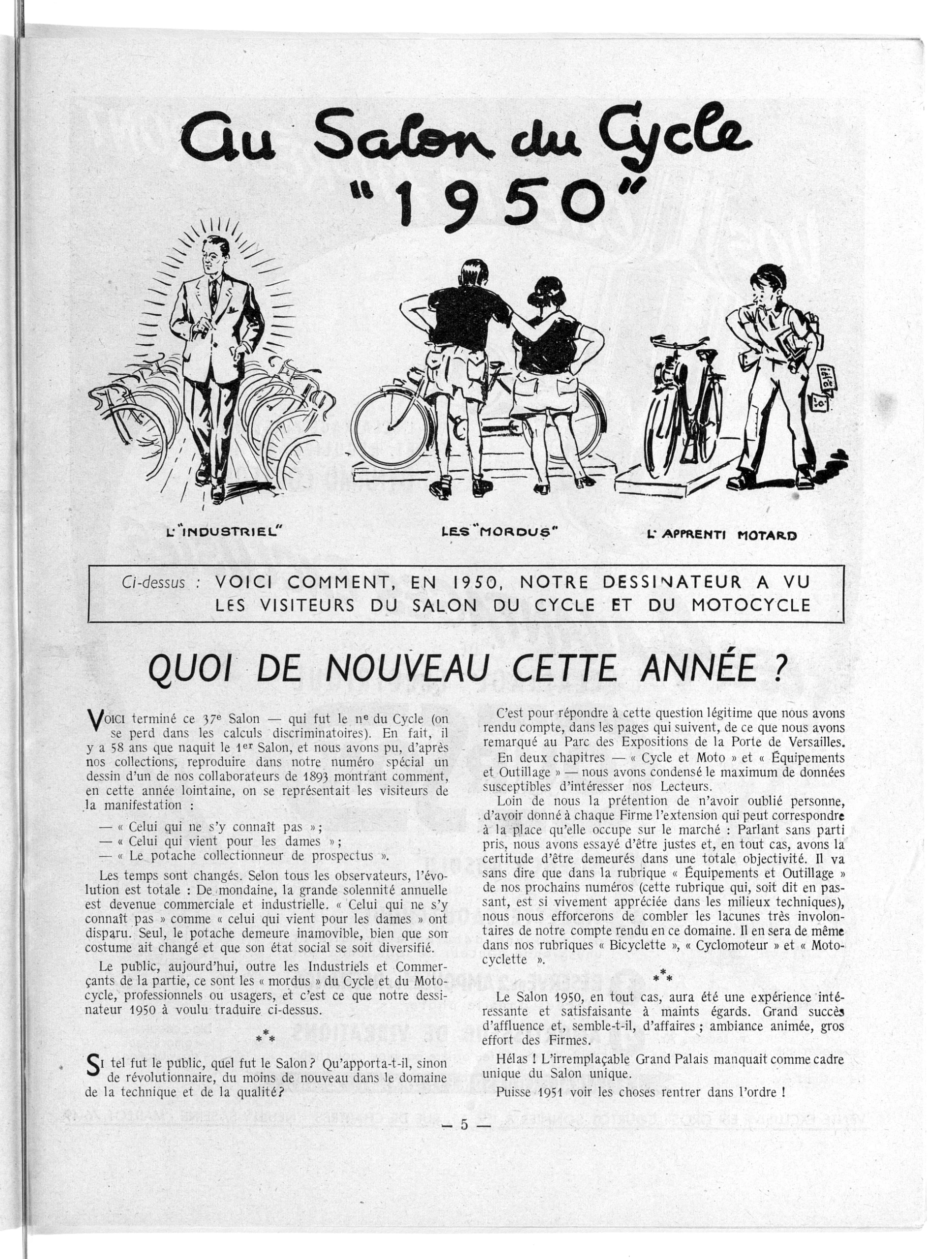
Au Salon du Cycle "1950" L'"INDUSTRIEL" LES "MORDUS" L'APPRENTI MOTARD Ci-dessus : VOICI COMMENT, EN 1950, NOTRE DESSINATEUR A VU LES VISITEURS DU SALON DU CYCLE ET DU MOTOCYCLE QUOI DE NOUVEAU CETTE ANNÉE ? — « Celui qui ne s'y connaît pas » ; — « Celui qui vient pour les dames » ; …
This is a magazine article, so its running text is summarized here rather than reproduced; the headline, byline, specifications and scores are transcribed as printed.
“Au Salon du Cycle « 1950 »” and “Quoi de nouveau cette année ?”, L’Officiel du cycle, du motocycle et du camping, 21 October 1950, page 5: the magazine’s drawing of three kinds of Salon visitor, with its captions, and the editorial introducing its report on the 37th Salon. The headings, captions and legend are transcribed as printed; the text is summarized in Ebykr’s words.
— Page 1 —
Au Salon du Cycle
“1950”
L'”INDUSTRIEL”
LES “MORDUS”
L’APPRENTI MOTARD
Ci-dessus : VOICI COMMENT, EN 1950, NOTRE DESSINATEUR A VU
LES VISITEURS DU SALON DU CYCLE ET DU MOTOCYCLE
QUOI DE NOUVEAU CETTE ANNÉE ?
— « Celui qui ne s’y connaît pas » ;
— « Celui qui vient pour les dames » ;
— « Le potache collectionneur de prospectus ».
[Ebykr summary; the article’s text is not reproduced. The unsigned piece notes that the 37th Salon is over (the “nth” for the cycle, it jokes, since the counting is disputed); the first Salon was held 58 years ago, and the paper had reproduced in its special issue, from its own files, a drawing by one of its 1893 contributors showing how visitors were then pictured: the three types listed above (the man who knows nothing about it, the man who comes for the ladies and the schoolboy collecting brochures). Times have changed: the annual event has turned from a society occasion into a commercial and industrial one; the first two types have gone and only the schoolboy remains, in different clothes and from a wider range of backgrounds. Today’s public, beside the industrialists and traders of the trade, is the cycle and motorcycle enthusiasts (« mordus »), professional or rider, as the 1950 draftsman shows above. Asking what the Salon brought that was new, if not revolutionary, in technique and quality, the paper says the following pages report what it saw at the Parc des Expositions de la Porte de Versailles in two chapters, « Cycle et Moto » and « Équipements et Outillage »; it does not claim to have missed no one or to have given each firm space in proportion to its market place, but says it has been fair and objective, and promises to fill gaps in later issues under its regular headings « Équipements et Outillage », « Bicyclette », « Cyclomoteur » and « Motocyclette ». The 1950 Salon was an interesting and satisfying experience: large attendance, apparently good business, a lively atmosphere and a big effort by the firms; but the irreplaceable Grand Palais was missed as the single setting for a single Salon, and the paper hopes 1951 will set things right.]
[Beneath the hand-lettered title, a pen-and-ink cartoon in three scenes shows the visitor types named in the captions. At the left, “L’Industriel”: a confident man in a double-breasted suit and tie, one hand at his lapel, strides forward haloed by radiating lines, with heaps of bicycles curving away on either side of him. In the center, “Les Mordus”: a young couple seen from behind, the man in a dark shirt and shorts with his arm round the woman, both with hands on hips, studying a bicycle on a display stand. At the right, “L’Apprenti motard”: a boy with an armful of brochures, more stuffed in his pockets and leaflets falling at his feet, glances sideways at a small motorized bicycle (a cyclomoteur) on a low plinth. Below the captions, a ruled box holds the legend “Ci-dessus : …”. No signature or monogram was found in the drawing. The section break in the text is a three-star asterism; the page number “— 5 —” is printed at the foot.]
Ebykr presents this material for research and education. If you hold rights to it or notice an ownership issue, please contact us and we will respond promptly.
The Ebykr Digest
New articles, timelines, catalog finds and registry activity — assembled from the archive once a month. Your address is never shared.
Double opt-in. One email per month. Unsubscribe at any time with one click.