About Ebykr
Ebykr celebrates classic and vintage lightweight bicycles through provocative imagery and opinion. Ride along with us.
About Ebykr
Ebykr celebrates classic and vintage lightweight bicycles through provocative imagery and opinion. Ride along with us.

Source: Gallica (Bibliothèque nationale de France), L'Officiel du cycle, du motocycle et du camping, 21 October 1950, pages 7, 9, 11, 13, 15 and 17; ark:/12148/bd6t541855290. Source gallica.bnf.fr / BnF.
| Type | Review |
|---|---|
| Year | 1950 |
| Publisher | L'Officiel du cycle |
| Country | France |
| Language | French |
| Pages | 6 |
| Source | Gallica (Bibliothèque nationale de France), L'Officiel du cycle, du motocycle et du camping, 21 October 1950, pages 7, 9, 11, 13, 15 and 17; ark:/12148/bd6t541855290. Source gallica.bnf.fr / BnF. |
| Credit | Ebykr archive; Bibliothèque nationale de France |
| Identifier | Gallica (BnF) ark:/12148/bd6t541855290/f7 |
| Transcription | Headings and specifications transcribed; article text summarized |
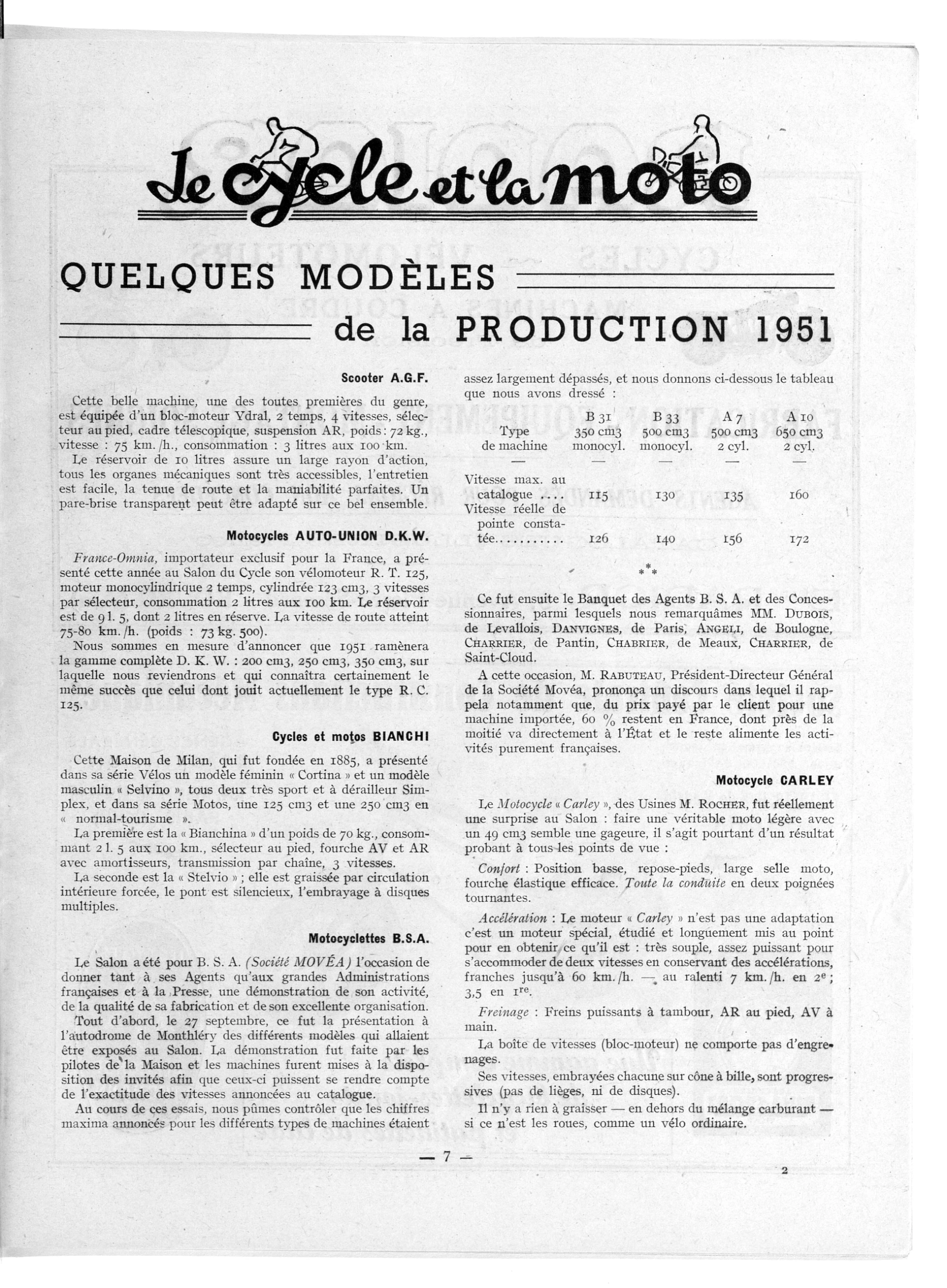
Le Cycle et la Moto QUELQUES MODÈLES de la PRODUCTION 1951 Scooter A.G.F. Motocycles AUTO-UNION D.K.W. Cycles et motos BIANCHI Motocyclettes B.S.A. B 31 B 33 A 7 A 10 Type 350 cm3 500 cm3 500 cm3 650 cm3 de machine monocyl. monocyl. 2 cyl. 2 cyl. — — — — — Vitesse max. au …
This is a magazine article, so its running text is summarized here rather than reproduced; the headline, byline, specifications and scores are transcribed as printed.
“Le Cycle et la Moto: Quelques modèles de la production 1951”, L’Officiel du cycle, du motocycle et du camping, 21 October 1950, pages 7, 9, 11, 13, 15 and 17: the magazine’s round of the bicycles, cyclomoteurs, auxiliary motors, scooters and motorcycles shown at the 1950 Salon, firm by firm. The headings, captions, table and list are transcribed as printed; the text is summarized in Ebykr’s words.
— Page 1 —
Le Cycle et la Moto
QUELQUES MODÈLES
de la PRODUCTION 1951
Scooter A.G.F.
[Ebykr summary; the article’s text is not reproduced. The A.G.F. scooter, described as one of the very first of its kind, uses a Ydral two-stroke engine unit with 4 speeds and a foot selector, a telescopic frame and rear suspension. It weighs 72 kg, reaches 75 km/h and uses 3 liters per 100 km. A 10-liter tank gives a wide range, the mechanical parts are easy to reach and service, and handling is praised. A transparent windshield can be fitted.]
Motocycles AUTO-UNION D.K.W.
[Ebykr summary; the article’s text is not reproduced. France-Omnia, sole importer for France, showed the R. T. 125 vélomoteur at the Salon: a single-cylinder two-stroke of 123 cc, 3 speeds by selector, fuel use of 2 liters per 100 km, a 9.5-liter tank with 2 liters in reserve, a road speed of 75 to 80 km/h and a weight of 73.5 kg. The paper announces that 1951 will bring the full D. K. W. range of 200 cc, 250 cc and 350 cc, which it expects to match the success of the type R. C. 125 (so printed).]
Cycles et motos BIANCHI
[Ebykr summary; the article’s text is not reproduced. The Milan firm, founded in 1885, showed in its bicycle series a women’s model, the “Cortina,” and a men’s model, the “Selvino,” both sporting and fitted with Simplex derailleurs. In its motorcycle series it showed a 125 cc and a 250 cc in “normal-tourisme” trim. The first, the “Bianchina,” weighs 70 kg, uses 2.5 liters per 100 km and has a foot selector, front and rear forks with shock absorbers, chain drive and 3 speeds. The second, the “Stelvio,” has forced internal lubrication, a quiet rear axle and a multi-plate clutch.]
Motocyclettes B.S.A.
[Ebykr summary; the article’s text is not reproduced. For B. S. A. (Société Movéa) the Salon was the occasion of a demonstration for its agents, government departments and the press. On 27 September the models to be shown at the Salon were presented at the Montlhéry autodrome, ridden by the firm’s riders and then lent to the guests to check the catalog speeds. The paper found the claimed maximum speeds well exceeded and gives this table:]
B 31 B 33 A 7 A 10
Type 350 cm3 500 cm3 500 cm3 650 cm3
de machine monocyl. monocyl. 2 cyl. 2 cyl.
— — — — —
Vitesse max. au
catalogue …. 115 130 135 160
Vitesse réelle de
pointe consta-
tée………. 126 140 156 172
* * *
[Ebykr summary; the article’s text is not reproduced. A banquet for B. S. A. agents and dealers followed, attended by MM. Dubois of Levallois, Danvignes of Paris, Angeli of Boulogne, Charrier of Pantin, Chabrier of Meaux and Charrier of Saint-Cloud. M. Rabuteau, president and managing director of the Société Movéa, said in a speech that of the price a customer pays for an imported machine, 60 % stays in France, nearly half of it going directly to the State and the rest supporting purely French activity.]
Motocycle CARLEY
[Ebykr summary; the article’s text is not reproduced. The “Carley” motocycle from the works of M. Rocher was a real surprise at the Salon: a true light motorcycle with a 49 cc engine. Under “Confort”: a low riding position, footrests, a large motorcycle saddle, an effective sprung fork and all controls in two twist grips. Under “Accélération”: the engine is not an adaptation but a purpose-built unit, very flexible and strong enough for two speeds, pulling cleanly up to 60 km/h and idling at 7 km/h in second and 3.5 in first. Under “Freinage”: powerful drum brakes, the rear by foot and the front by hand. The gearbox in the engine unit has no gears; its speeds, each engaged on a ball cone, are progressive (no cork or plates). Nothing needs greasing apart from the fuel mixture and the wheels, as on an ordinary bicycle.]
— 7 —
2
[The page opens with the drawn heading “Le Cycle et la Moto” in heavy script lettering over triple rules, with a small drawing of a racing cyclist rising from the “C” of “Cycle” and a rider on a motorcycle formed from the “o” of “moto”; no signature is visible. The title “QUELQUES MODÈLES de la PRODUCTION 1951” is set in two lines of spaced capitals with long rules. The text runs in two columns with bold sans-serif section heads set flush right. No photographs. The “2” at the foot is a printer’s signature mark. Show-through of an advertisement from the reverse of the leaf is faintly visible.]
— Page 2 —
Bicyclette CAPTIVANTE
[Ebykr summary; the article’s text is not reproduced. True to its motto « Construction Artisanale en grande série », the firm showed its hand-finished quality with a bicycle with 60 speeds, which the paper calls the great amusing success of technical curiosity at the Salon. Its stand, with a range of bicycles notable for their presentation and reasonable prices, drew large crowds throughout the show.]
Cyclomoteurs CAZENAVE
[Ebykr summary; the article’s text is not reproduced. The firm, of Belin near Bordeaux, makes cyclomoteurs in two versions, one with chain drive and one with roller drive, both powered by a VAP 4 engine adapted by Cazenave. A casing enclosing the whole engine keeps the rider clean. Its formula is quality cycles at very keen prices, and it exports from Finland to Uruguay, wherever French machines can find a place.]
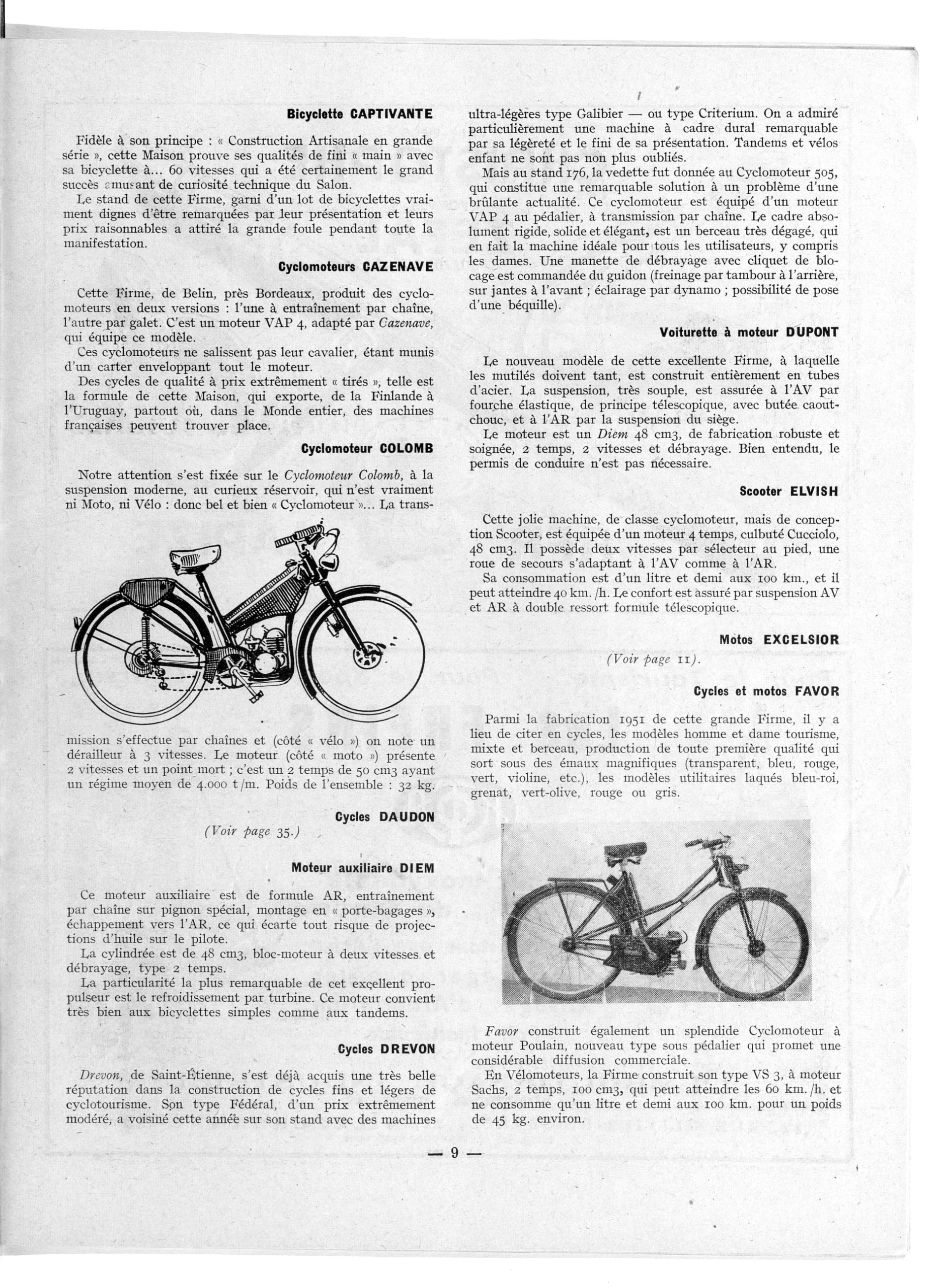
Cyclomoteur COLOMB
[Ebykr summary; the article’s text is not reproduced. The paper singles out the Colomb cyclomoteur, with modern suspension and an unusual tank, neither motorcycle nor bicycle and so truly a « Cyclomoteur ». Transmission is by chains; on the bicycle side there is a 3-speed derailleur, and the engine side has 2 speeds and neutral. The engine is a 50 cc two-stroke with an average speed of 4,000 rpm. Total weight is 32 kg.]
Cycles DAUDON
(Voir page 35.)
Moteur auxiliaire DIEM
[Ebykr summary; the article’s text is not reproduced. The Diem auxiliary engine mounts at the rear, in « porte-bagages » fashion, driving by chain to a special sprocket, with the exhaust to the rear so that no oil reaches the rider. It is a 48 cc two-stroke engine unit with two speeds and a clutch. Its most notable feature is turbine cooling. It suits single bicycles and tandems alike.]
Cycles DREVON
[Ebykr summary; the article’s text is not reproduced. Drevon, of Saint-Étienne, has a fine reputation for light, high-grade touring cycles. Its very modestly priced Fédéral type stood on the stand beside ultra-light machines of the Galibier or Criterium type. A dural-framed machine was admired for its lightness and finish, and tandems and children’s bicycles were also shown. At stand 176 the star was the Cyclomoteur 505, with a VAP 4 engine at the bottom bracket and chain drive, a fully rigid open cradle frame suited to all riders including women, a handlebar clutch lever with a locking pawl, a rear drum brake and rim brakes at the front, dynamo lighting and an optional stand.]
Voiturette à moteur DUPONT
[Ebykr summary; the article’s text is not reproduced. The new model from this firm, to which disabled riders owe so much, is built entirely of steel tube. Suspension is by a telescopic-type sprung fork with a rubber stop at the front and by the seat suspension at the rear. The engine is a 48 cc Diem two-stroke with 2 speeds and a clutch. No driving license is needed.]
Scooter ELVISH
[Ebykr summary; the article’s text is not reproduced. This machine is in the cyclomoteur class but of scooter design, with a 48 cc four-stroke overhead-valve Cucciolo engine, two speeds by foot selector and a spare wheel that fits front or rear. It uses one and a half liters per 100 km, reaches 40 km/h and has telescopic double-spring suspension front and rear.]
Motos EXCELSIOR
(Voir page 11).
Cycles et motos FAVOR
[Ebykr summary; the article’s text is not reproduced. Among the firm’s 1951 production are men’s and women’s touring models, a mixte and a « berceau » (cradle frame), finished in fine enamels (transparent, blue, red, green, violet and others), and utility models in royal blue, garnet, olive green, red or gray. Favor also builds a cyclomoteur with a Poulain engine, a new type mounted under the bottom bracket, and the type VS 3 vélomoteur with a 100 cc two-stroke Sachs engine, reaching 60 km/h on one and a half liters per 100 km and weighing about 45 kg.]
— 9 —
[Two illustrations. In the left column, a line drawing of the Colomb cyclomoteur in side view facing right: an open frame with a large hatched tank along the down tube, a saddle and a padded rear carrier, a coil-sprung rear end, the engine low in the frame, dashed chain lines and a headlamp; no signature is visible. In the right column, a halftone photograph of what appears to be the Favor cyclomoteur with the Poulain engine under the bottom bracket, an open frame facing right, shown against a plain background; uncaptioned.]
— Page 3 —
Motos EXCELSIOR
[Ebykr summary; the article’s text is not reproduced. C. Garreau, specialist in fast machines and general distributor of Excelsior motorcycles, showed the 1951 models of the Birmingham firm: the « L’Universal » U 2, 125 cc with a two-stroke Villiers engine unit; the « Roadmaster » R 2, 197 cc, also Villiers-engined; and the « Talisman » T. T. 1, 250 cc with two separate cylinders. In Norton, Garreau also showed the type 7 « Dominator », a 500 cc side-by-side twin capable of 145 km/h.]
Cyclomoteur GELEM
[Ebykr summary; the article’s text is not reproduced. This cyclomoteur weighs only 23 kg and is driven by a 48 cc VAP 4 engine fixed in the plane of the frame, with chain transmission and a friction clutch. It reaches 45 km/h and its tank holds 3 1/4 liters of fuel.]
Cyclomoteur GUITTON
[Ebykr summary; the article’s text is not reproduced. Among the young cyclomoteur makes, the Guitton stays resolutely a « Cycle » rather than a « Moto ». It is built from standard parts: the maker’s own frame takes a 45 cc « Vimer » engine, gears are changed by a « Simplex » derailleur, the brakes are drums and the engine controls are « Simplex » twist grips. The paper calls the whole harmonious and well thought out.]
Motos GUZZI
[Ebykr summary; the article’s text is not reproduced. From the firm’s range the paper describes the « Galletto » 160 cc: a four-stroke overhead-valve engine with a light-alloy cylinder and special cast-iron liner, 62 mm bore and 53 mm stroke, air cooling and a 3-speed foot change. It notes the roller-chain drive and the sprung rear suspension on swinging arms; top speed is 80 km/h. The sole concessionaire for France is the Maison F. N. Olivari, 74, rue de Rome, Paris (8e).]
Motocyclette HOREX
[Ebykr summary; the article’s text is not reproduced. A 350 cc sports machine with a single-cylinder four-stroke overhead-valve engine unit, fully enclosed valve gear, automatic lubrication and a light-alloy piston. It uses 2.6 liters per 100 km, reaches 115 km/h and weighs 142 kg.]
Cycles HURTU
[Ebykr summary; the article’s text is not reproduced. This well-known French make is exactly as old as the paper and, like it, will celebrate its 60th anniversary next year; at the Salon, on neighboring stands, Hurtu showed a bicycle it built in 1891 while L’Officiel du Cycle showed one of its own issues of the same year. Besides its bicycles, Hurtu now supplies its C M 50 cyclomoteur, and this year adds the « Corsaire » motor tandem, designed for touring two-up, using one and a half to 2 liters per 100 km at 50 to 60 km/h, with a large protective fairing enclosing the body of the machine.]
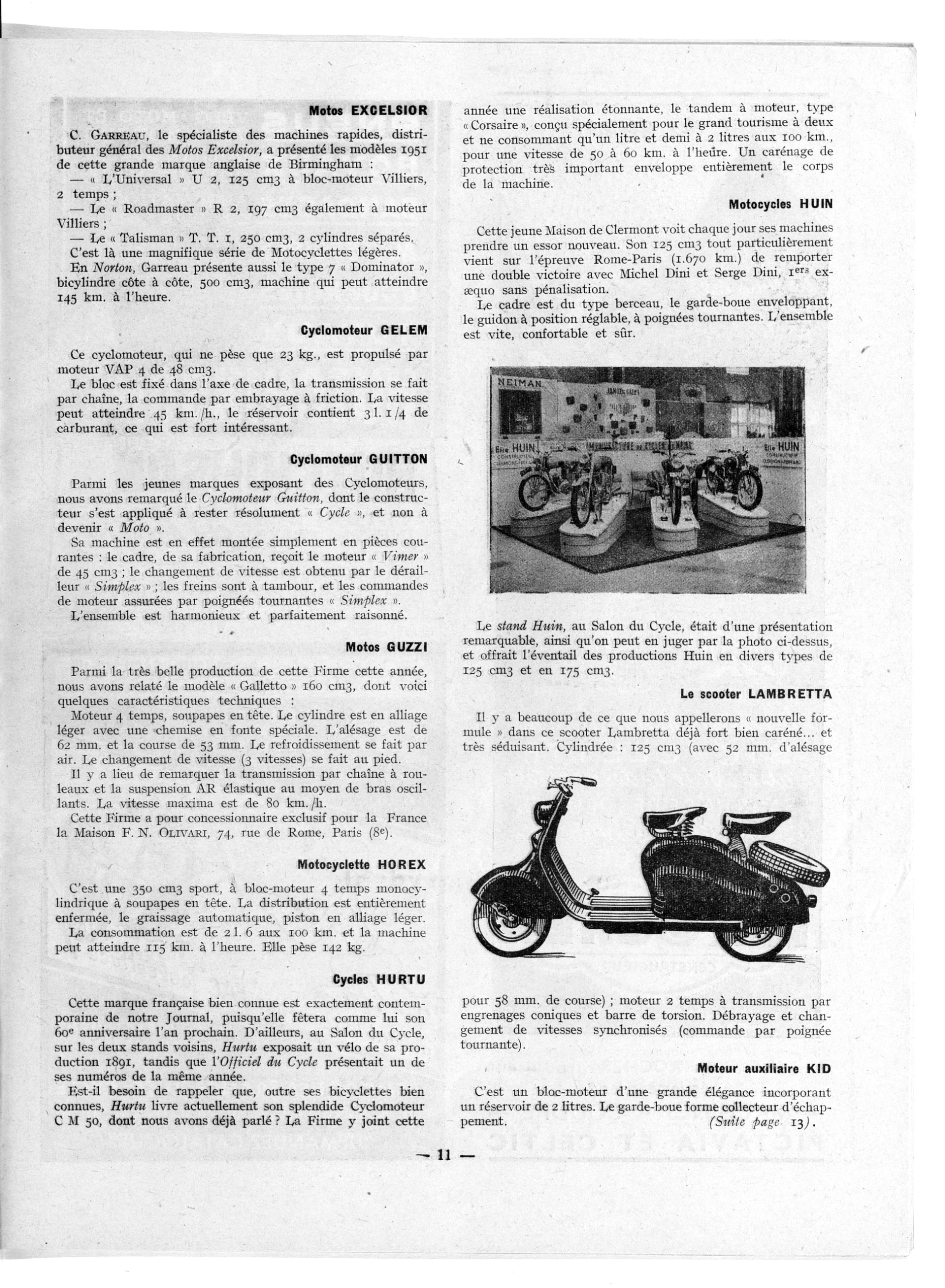
Motocycles HUIN
[Ebykr summary; the article’s text is not reproduced. This young Clermont firm’s 125 cc has just won a double victory in the Rome-Paris trial (1,670 km) with Michel Dini and Serge Dini, placed first equal without penalty. It has a cradle frame, enveloping mudguards and an adjustable handlebar with twist grips, and is fast, comfortable and safe.]
Le stand Huin, au Salon du Cycle, était d’une présentation remarquable, ainsi qu’on peut en juger par la photo ci-dessus, et offrait l’éventail des productions Huin en divers types de 125 cm3 et en 175 cm3.
Le scooter LAMBRETTA
[Ebykr summary; the article’s text is not reproduced. The paper finds much that is « nouvelle formule » in the already well-faired Lambretta scooter: 125 cc (52 mm bore, 58 mm stroke), a two-stroke engine with bevel-gear and torsion-bar transmission, and synchronized clutch and gear change worked by a twist grip.]
Moteur auxiliaire KID
[Ebykr summary; the article’s text is not reproduced. An elegant engine unit with a built-in 2-liter tank; the mudguard serves as the exhaust collector.]
(Suite page 13).
— 11 —
[Two illustrations in the right column. A halftone photograph of the Huin stand at the Salon: four motorcycles on low white plinths on a dark floor, with signs reading “Ets HUIN” (with smaller lines, apparently “CONSTRUCTEUR” and “CLERMONT-FERRAND”) at left and right, a banner beginning “MANUFACTURE DE CYCLES” (the rest unreadable) along the back, and neighboring stand signs “NEIMAN” and “JANOD & GADET [?]” behind. Below, a line drawing of the Lambretta scooter in side view facing left, with an enclosed rear body, a sprung single saddle, a pillion seat and a spare wheel mounted at the back; no signature is visible.]
— Page 4 —
[Ebykr summary; the article’s text is not reproduced. Continued from page 11 (Moteur auxiliaire KID): the engine is a 48 cc single-cylinder two-stroke driving the front wheel by roller, with an alpax cylinder and centrifugally cast iron liners, and it fits quickly to any bicycle.]
Cycles MAGNAT-DEBON
[Ebykr summary; the article’s text is not reproduced. For the 1951 season this Dijon firm, long known for quality, offers a full range of bicycles: standard, « tourisme luxe » and « grand luxe », cyclotouring, racing and children’s models, all with sober, well-balanced lines and fine workmanship.]
Cyclomoteur MANDILLE ET ROUX
[Ebykr summary; the article’s text is not reproduced. Fitted with a 48 cc two-stroke VAP 4 engine with a clutch; very luxurious and comfortable, with a tank of 2 1/2 liters giving a good range.]
MANUFACTURE ORLÉANAISE DE CYCLOMOTEURS
[Ebykr summary; the article’s text is not reproduced. Among the models shown, the paper notes the « porteur » type with a VAP 4 auxiliary engine, specially strengthened at the front (front wheel 550 x 42), two drum brakes in the hubs and a large « boucher » carrier. Also shown was the « Cyclorette » motor tandem with the same engine, a 5 1/2-liter tank replacing the top tube, chain drive through an intermediate relay for a better chain line with no risk of the chain jumping, and a frame assembled by braze welding.]
Moteur auxiliaire MINIMOTOR
[Ebykr summary; the article’s text is not reproduced. This small gearless engine mounts at the rear and drives the wheel by a finned contact roller. It fits any bicycle, needing only a notch in the mudguard, and suits single machines and tandems alike. It is 49 cc, nearly the maximum for the class, cruises at about 35 to 40 km/h and uses only 1.3 liters per 100 km.]
Voiturette Ch. MOCHET
[Ebykr summary; the article’s text is not reproduced. The Mochet stand showed the CM 125 Luxe, a small four-wheeled light car with two seats and a large trunk, economical and simple, with a folding hood for all weather and room for two large people. Technical points: a 125 cc two-stroke engine; flywheel-magneto ignition; an automatic constant-level carburetor; a dry-plate clutch; three speeds and neutral; forced-air cooling by turbine; interchangeable metal wheels with a fifth wheel as a mounted spare; fuel use of 3.5 liters per 100 km; lighting from the flywheel magneto feeding two headlamps with dipped and main beams and a red tail lamp when running, and from a battery charged automatically through a rectifier when stopped. Top speed is 60 km/h, and any hill a motorist can climb is taken in the low first gear. The Établissements Ch. Mochet, specialists in small-capacity voiturettes, kept their proven chassis this year but showed a graceful new body that won general approval. An important detail for some buyers: the driver needs no driving license.]
Cyclomoteur LE MOINEAU
[Ebykr summary; the article’s text is not reproduced. An original machine designed for the famous 38 cc Italian Mosquito engine (printed « 38 c3m »), built by Chapuis Frères. It reaches 38 km/h on 1.350 liters per 100 km, and a 2.200-liter tank gives a range of 180 km. The frame, fully oxy-acetylene welded with an oval-section beam tube, encloses the tank. The sprung fork, of the pushed-wheel type with a swinging system, has Neiman ring suspension. The special two-piece handlebar carries Saker twist grips for the throttle and decompressor. The wheels have 38 mm rims with heavy 15-gauge spokes and drum brakes front and rear; lighting is by a dynamo independent of the engine. The normal crank spacing allows pedaling if fuel runs out.]
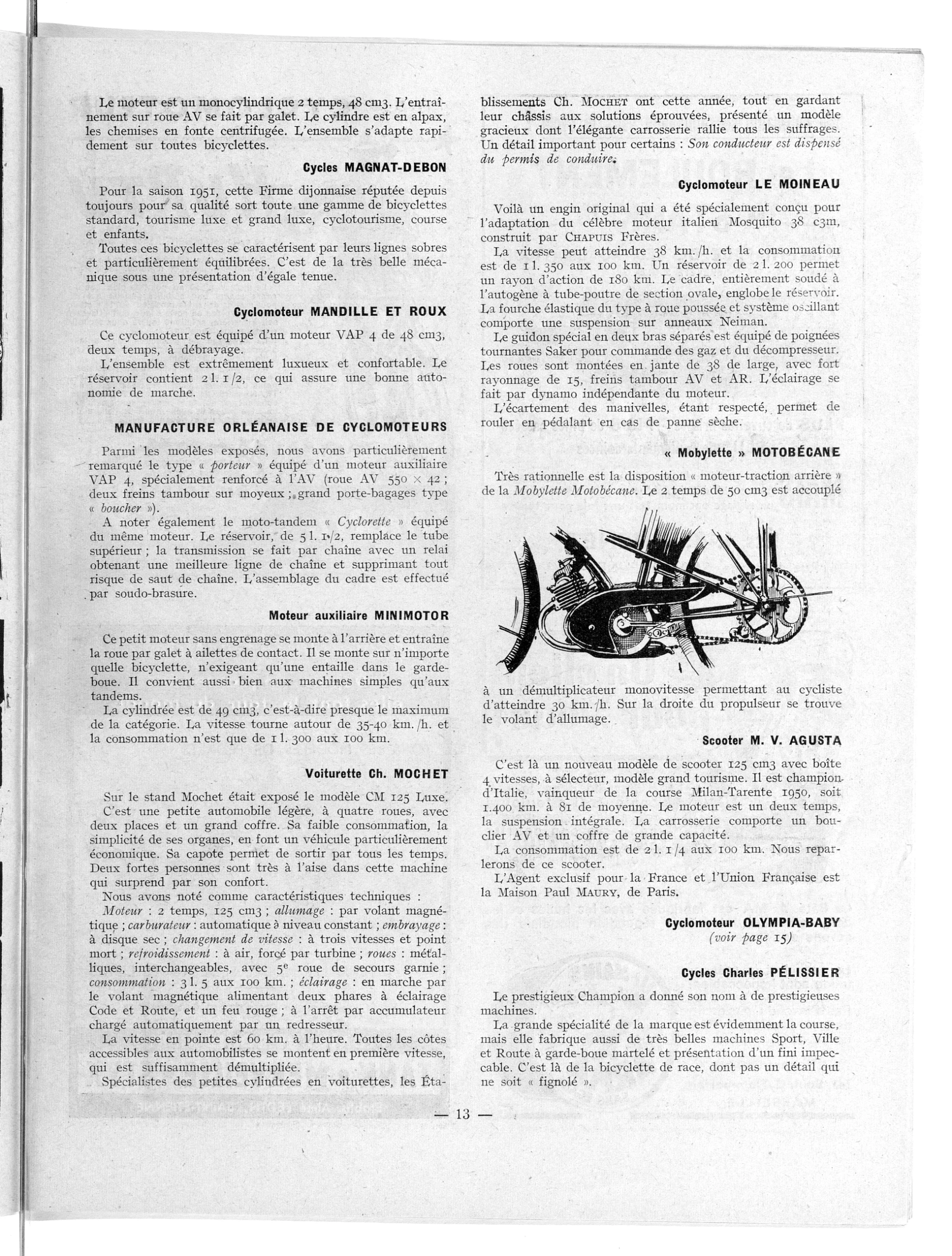
« Mobylette » MOTOBÉCANE
[Ebykr summary; the article’s text is not reproduced. The paper praises the rear-drive layout of the Motobécane Mobylette: the 50 cc two-stroke is coupled to a single-speed reduction gear that lets the rider reach 30 km/h, with the ignition flywheel on the right of the engine.]
Scooter M. V. AGUSTA
[Ebykr summary; the article’s text is not reproduced. A new 125 cc touring scooter with a 4-speed gearbox and selector, champion of Italy and winner of the 1950 Milan-Taranto race (1,400 km at an average of 81). The engine is a two-stroke with full suspension; the bodywork has a front shield and a large trunk. Fuel use is 2 1/4 liters per 100 km. The paper will return to it. The sole agent for France and the Union Française is the Maison Paul Maury, of Paris.]
Cyclomoteur OLYMPIA-BABY
(voir page 15)
Cycles Charles PÉLISSIER
[Ebykr summary; the article’s text is not reproduced. The famous champion has given his name to fine machines. The make specializes in racing but also builds Sport, Ville and Route models with hammered mudguards and a faultless finish: racing bicycles in which every detail is carefully worked.]
— 13 —
[One illustration in the right column: a line drawing of the Mobylette engine unit and rear frame in close detail, showing the engine with its finned cylinder, the enclosed transmission casing, the pedal crank and chainwheel, part of the mudguard and the frame tubes; no signature is visible.]
— Page 5 —
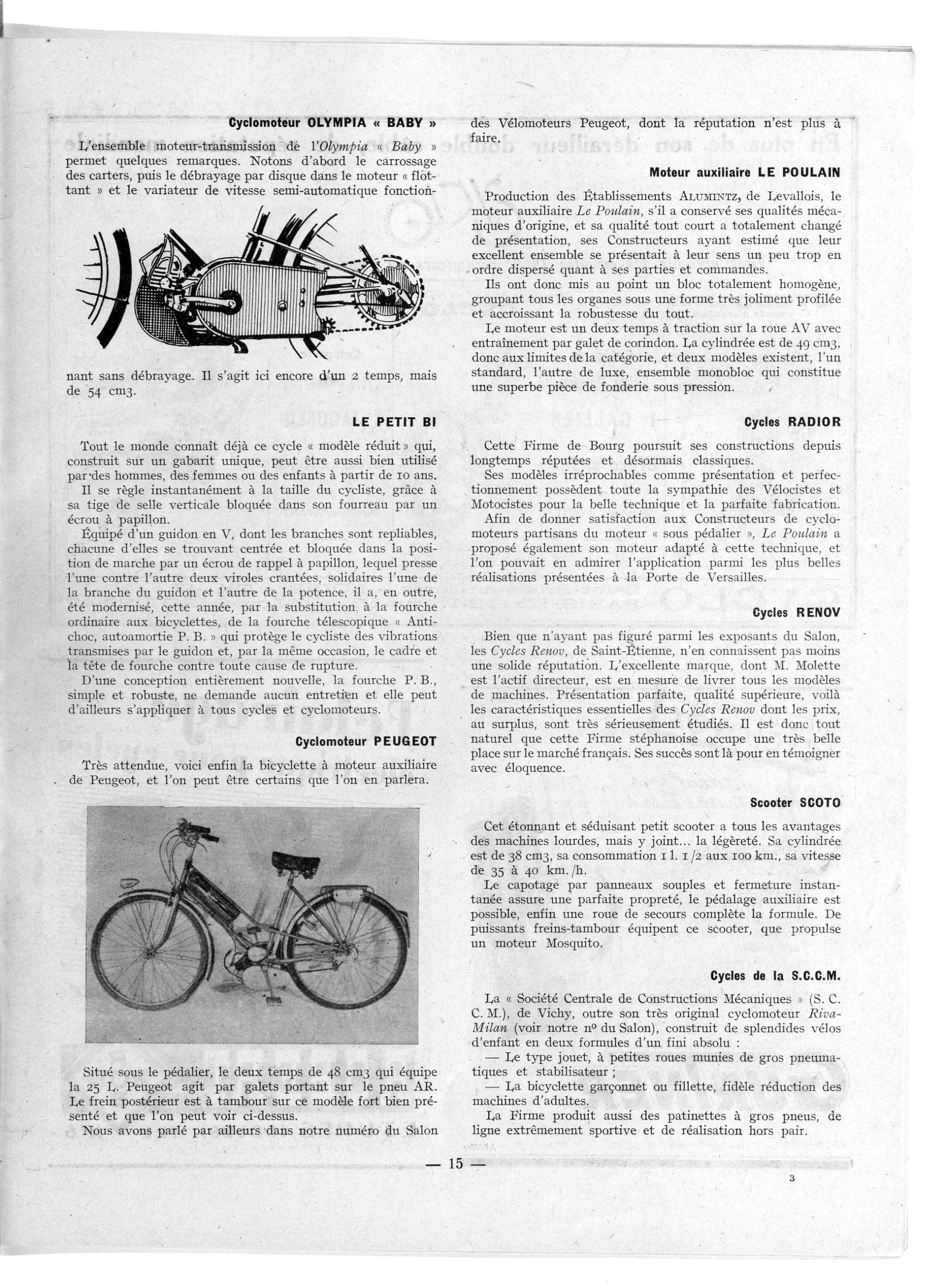
Cyclomoteur OLYMPIA « BABY »
[Ebykr summary; the article’s text is not reproduced. The paper comments on the engine-transmission unit of the Olympia « Baby »: the enclosed casings, the plate clutch in the « flottant » (floating) engine and the semi-automatic speed variator that works without declutching. It is again a two-stroke, but of 54 cc.]
LE PETIT BI
[Ebykr summary; the article’s text is not reproduced. This well-known « modèle réduit » cycle, built on a single frame size, can be ridden by men, women and children from 10 years old. It adjusts instantly to the rider by a vertical seat pillar locked in its sleeve by a wing nut. Its V handlebar has folding arms, each centered and locked in the riding position by a wing-nut return screw pressing two notched collars together, one on the bar arm and one on the stem. This year it was modernized by replacing the ordinary fork with the « Anti-choc, autoamortie P. B. » telescopic fork, which shields the rider from vibration through the handlebar and protects the frame and fork crown from breakage. The new P. B. fork is simple, strong and maintenance-free, and fits any cycle or cyclomoteur.]
Cyclomoteur PEUGEOT
[Ebykr summary; the article’s text is not reproduced. Peugeot’s long-awaited bicycle with an auxiliary engine has arrived. The 48 cc two-stroke on the 25 L. Peugeot sits under the bottom bracket and drives by rollers bearing on the rear tire; the rear brake is a drum on this well-presented model, shown in the photograph. The paper recalls that its Salon issue covered the Peugeot vélomoteurs, whose reputation is long established.]
Moteur auxiliaire LE POULAIN
[Ebykr summary; the article’s text is not reproduced. Made by the Établissements Alumintz (so printed) of Levallois, the Le Poulain auxiliary engine keeps its original mechanical qualities but has been completely restyled, its makers finding its parts and controls too scattered; they have developed a fully unified, neatly streamlined and stronger unit. It is a two-stroke driving the front wheel by a corundum roller, of 49 cc, at the limit of the class, made in standard and de luxe models, the one-piece unit being a fine pressure die casting.]
Cycles RADIOR
[Ebykr summary; the article’s text is not reproduced. The Bourg firm continues its long-respected, now classic production; its models, faultless in presentation and finish, enjoy the esteem of cycle and motorcycle dealers for their technique and manufacture. The section then notes that, to satisfy cyclomoteur builders who favor an engine « sous pédalier » (under the bottom bracket), Le Poulain also offered its engine adapted to that layout, seen in some of the finest machines at the Porte de Versailles.]
Cycles RENOV
[Ebykr summary; the article’s text is not reproduced. Although not among the Salon exhibitors, Cycles Renov of Saint-Étienne has a solid reputation. The make, actively directed by M. Molette, can deliver every type of machine, with perfect presentation, superior quality and carefully studied prices, and holds a fine place on the French market.]
Scooter SCOTO
[Ebykr summary; the article’s text is not reproduced. A small scooter with the advantages of heavy machines plus lightness: 38 cc, 1 1/2 liters per 100 km and 35 to 40 km/h. Flexible quick-fastening panels keep it clean, auxiliary pedaling is possible and a spare wheel is carried. It has powerful drum brakes and a Mosquito engine.]
Cycles de la S.C.C.M.
[Ebykr summary; the article’s text is not reproduced. The « Société Centrale de Constructions Mécaniques » (S. C. C. M.) of Vichy, besides its very original Riva-Milan cyclomoteur (covered in the paper’s Salon issue), builds fine children’s bicycles in two forms: a toy type with small wheels, fat tires and a stabilizer, and boys’ or girls’ bicycles that faithfully reduce adult machines. The firm also makes sporting fat-tired scooters (« patinettes »).]
— 15 —
3
[Two illustrations in the left column. At the top, a line drawing of the Olympia « Baby » engine and transmission unit fitted at the rear of a bicycle, with the vertically ribbed transmission casing, the rear sprocket, a dashed chain and part of the mudguard; no signature is visible. Lower, a halftone photograph of the Peugeot cyclomoteur, an open-frame bicycle facing left with the small engine under the bottom bracket and a rear carrier, against a plain background. The “3” at the foot is a printer’s signature mark. Show-through of an advertisement from the reverse of the leaf is faintly visible.]
— Page 6 —
Motocycles TERROT
[Ebykr summary; the article’s text is not reproduced. Already covered in the paper’s Salon issue; besides the 500 cc R. G. S. T. pictured there, the firm builds a 125 cc overhead-valve light road motorcycle of very clean line whose engine is among the most economical on fuel.]
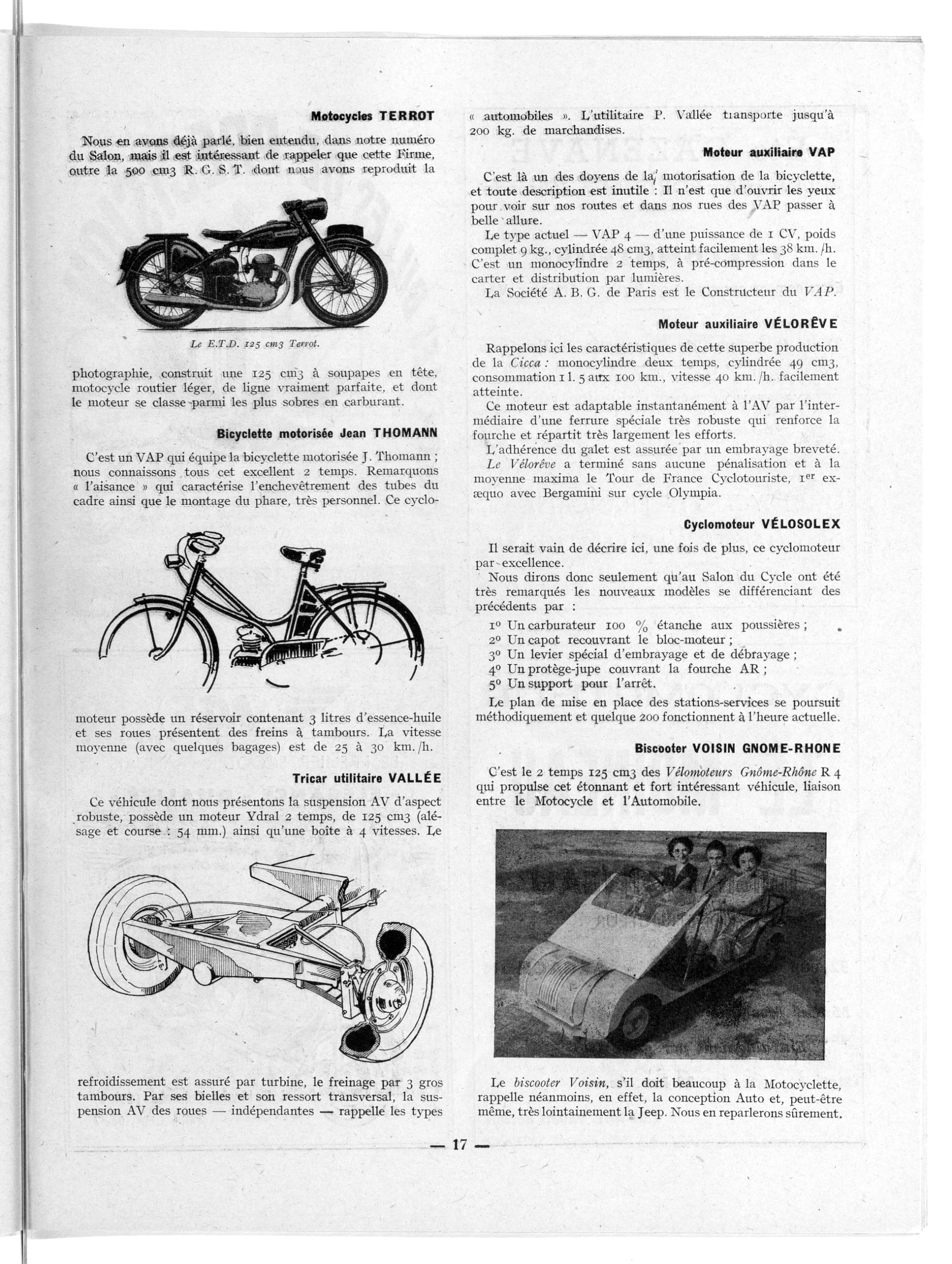
Le E.T.D. 125 cm3 Terrot.
Bicyclette motorisée Jean THOMANN
[Ebykr summary; the article’s text is not reproduced. The J. Thomann motorized bicycle uses the VAP two-stroke. The paper notes the easy-flowing arrangement of the frame tubes and the very individual headlamp mounting. It has a 3-liter tank for the fuel-oil mixture and drum brakes, and averages 25 to 30 km/h with some luggage.]
Tricar utilitaire VALLÉE
[Ebykr summary; the article’s text is not reproduced. This vehicle, whose sturdy-looking front suspension is pictured, has a 125 cc two-stroke Ydral engine (bore and stroke 54 mm), a 4-speed gearbox, turbine cooling and braking by 3 large drums. With its links and transverse spring, the independent front-wheel suspension recalls automobile practice. The P. Vallée utility carries up to 200 kg of goods (« transporte » is misprinted « tiansporte »).]
Moteur auxiliaire VAP
[Ebykr summary; the article’s text is not reproduced. One of the pioneers of the motorized bicycle, needing no description since VAP machines are everywhere on the roads and streets. The current type, VAP 4, gives 1 CV, weighs 9 kg complete, is of 48 cc and easily reaches 38 km/h. It is a single-cylinder two-stroke with crankcase pre-compression and port timing. The Société A. B. G. of Paris builds the VAP.]
Moteur auxiliaire VÉLORÊVE
[Ebykr summary; the article’s text is not reproduced. A product of the Cicca: a 49 cc single-cylinder two-stroke using 1.5 liters per 100 km and easily reaching 40 km/h. It fits instantly at the front through a very strong special bracket that reinforces the fork and spreads the loads, and roller grip is ensured by a patented clutch. The Vélorêve finished the Tour de France Cyclotouriste with no penalty at the maximum average, first equal with Bergamini on an Olympia cycle.]
Cyclomoteur VÉLOSOLEX
[Ebykr summary; the article’s text is not reproduced. No need to describe this cyclomoteur « par excellence » again; the new models much noticed at the Salon differ from the earlier ones by the following points, printed as a list:]
1° Un carburateur 100 % étanche aux poussières ;
2° Un capot recouvrant le bloc-moteur ;
3° Un levier spécial d’embrayage et de débrayage ;
4° Un protège-jupe couvrant la fourche AR ;
5° Un support pour l’arrêt.
[Ebykr summary, continued. The network of service stations is being set up methodically, and some 200 are now working.]
Biscooter VOISIN GNOME-RHONE
[Ebykr summary; the article’s text is not reproduced. The 125 cc two-stroke of the Gnôme-Rhône R 4 vélomoteurs powers this vehicle, a link between the motorcycle and the automobile.]
Le biscooter Voisin, s’il doit beaucoup à la Motocyclette, rappelle néanmoins, en effet, la conception Auto et, peut-être même, très lointainement la Jeep. Nous en reparlerons sûrement.
— 17 —
[Four illustrations. Left column, top: a halftone photograph of the Terrot E.T.D. 125 cc motorcycle in side view facing right, with its caption beneath in italics. Middle: a line drawing of the Jean Thomann motorized bicycle, an open frame facing left with the engine low ahead of the bottom bracket, a hatched tank in the frame, a rear carrier and a headlamp on the handlebar; no signature is visible. Bottom: a line drawing in perspective of the Vallée tricar’s front suspension and chassis, showing the frame members, the transverse spring and two front wheels with drum brakes; no signature is visible. Right column: a halftone photograph of the Voisin biscooter, a small open two-seat car with a ribbed nose and a windshield, carrying a woman, a man and a second woman; faint lettering at the lower right of the photograph is unreadable.]
Ebykr presents this material for research and education. If you hold rights to it or notice an ownership issue, please contact us and we will respond promptly.
The Ebykr Digest
New articles, timelines, catalog finds and registry activity — assembled from the archive once a month. Your address is never shared.
Double opt-in. One email per month. Unsubscribe at any time with one click.