About Ebykr
Ebykr celebrates classic and vintage lightweight bicycles through provocative imagery and opinion. Ride along with us.
About Ebykr
Ebykr celebrates classic and vintage lightweight bicycles through provocative imagery and opinion. Ride along with us.

Source: Gallica (Bibliothèque nationale de France), L'Officiel du cycle, du motocycle et du camping, November 1954, N° 46, page 5; ark:/12148/bd6t54196207z. Source gallica.bnf.fr / BnF.
| Type | Review |
|---|---|
| Year | 1954 |
| Publisher | L'Officiel du cycle |
| Country | France |
| Language | French |
| Pages | 1 |
| Source | Gallica (Bibliothèque nationale de France), L'Officiel du cycle, du motocycle et du camping, November 1954, N° 46, page 5; ark:/12148/bd6t54196207z. Source gallica.bnf.fr / BnF. |
| Credit | Ebykr archive; Bibliothèque nationale de France |
| Identifier | Gallica (BnF) ark:/12148/bd6t54196207z/f5 |
| Transcription | Headings and specifications transcribed; article text summarized |
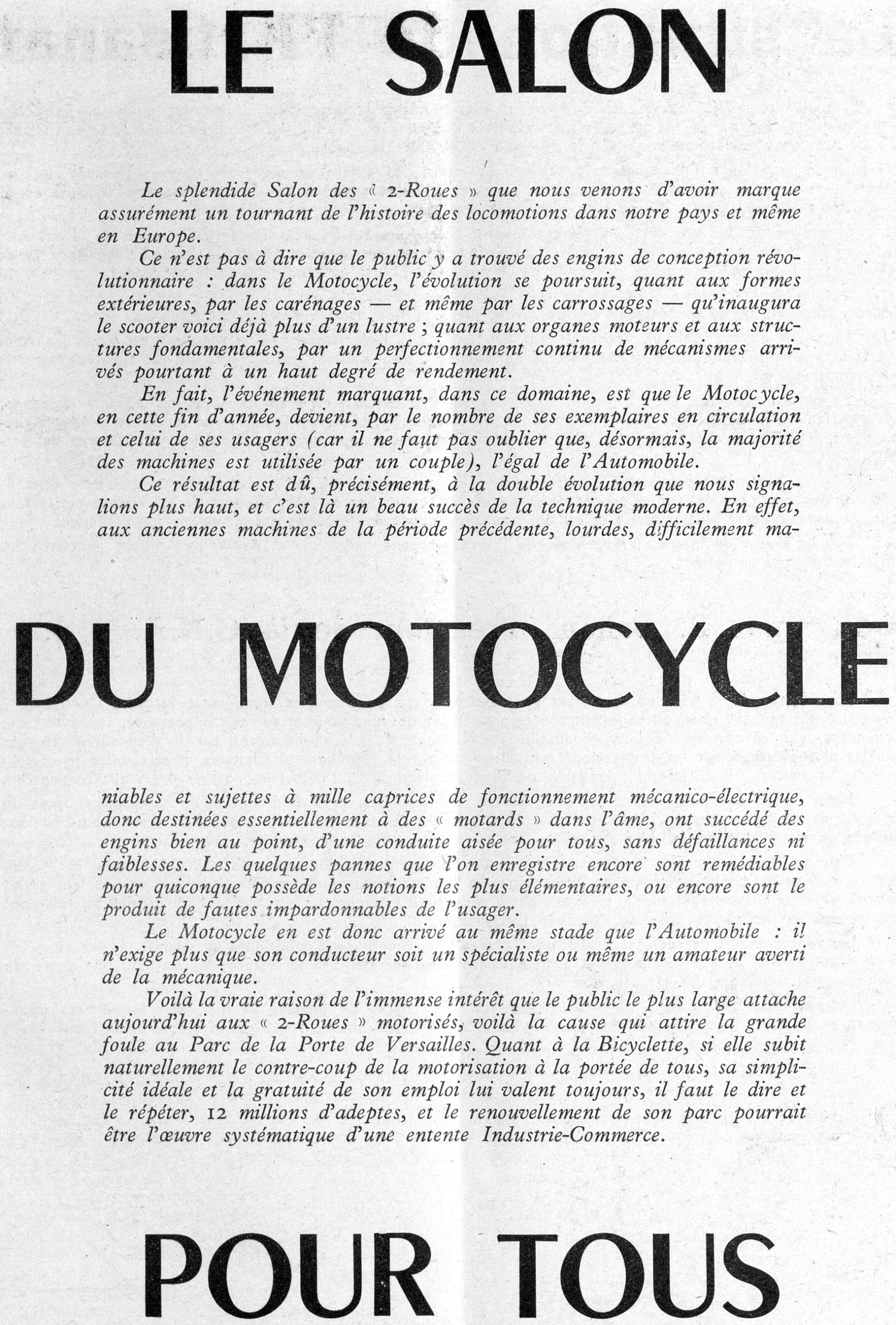
LE SALON DU MOTOCYCLE POUR TOUS
This is a magazine article, so its running text is summarized here rather than reproduced; the headline, byline, specifications and scores are transcribed as printed.
From L’Officiel du cycle, du motocycle et du camping, November 1954, the paper’s number reporting the 1954 Paris Salon du Cycle et du Motocycle, page 5: the paper’s editorial on the 41st Salon: the motor two-wheeler as easy to use as the car, the crowds at the Porte de Versailles, and a closing word on the bicycle’s 12 million users. The title, headings, captions and lists are transcribed as printed; the text is summarized in Ebykr’s words, and the page images carry it in full.
— Page 1 —
LE SALON
DU MOTOCYCLE
POUR TOUS
[Ebykr summary; the article’s text is not reproduced. The unsigned editorial holds that the “splendid” Salon of the « 2-Roues » just held marks a turning point in the history of locomotion in France and even in Europe. Not that the public found machines of revolutionary design there: in the Motocycle, evolution continues in outward form, through fairings and even the enclosed bodywork that the scooter introduced more than five years earlier, and in engines and basic structures through the steady refinement of mechanisms that had already reached a high efficiency. The notable event, the writer says, is that at the end of this year the Motocycle becomes the equal of the Automobile in the number of machines in circulation and in the number of its users, since most machines are now ridden by a couple.]
[Ebykr summary, continued. The writer credits this to the double evolution described above, a success of modern technique: the heavy, hard-to-handle machines of the previous period, subject to a thousand mechanical and electrical caprices and so meant for « motards » at heart, have given way to well-developed machines that anyone can ride easily, without failures or weaknesses; the few breakdowns still recorded can be remedied by anyone with the most elementary notions, or are the product of the rider’s unpardonable faults. The Motocycle has thus reached the same stage as the Automobile: it no longer demands that its rider be a specialist or even an informed amateur of mechanics. That, he says, is the true reason for the immense interest the broadest public takes in motorized « 2-Roues » and the cause that drew the great crowd to the Parc de la Porte de Versailles.]
[Ebykr summary of the closing passage on the bicycle. The writer turns to the Bicycle last: even if it naturally suffers the counter-blow of a motorization now within everyone’s reach, its ideal simplicity and the fact that it costs nothing to use still earn it, as he says must be said and repeated, 12 million adherents (« 12 millions d’adeptes »). The renewal of that fleet of bicycles, he concludes, could be the systematic work of an agreement between industry and trade, an « entente Industrie-Commerce ».]
[A full-page editorial set as a typographic poster: the title “LE SALON DU MOTOCYCLE POUR TOUS” is broken into three bands of very large, bold sans-serif capitals, “LE SALON” at the head, “DU MOTOCYCLE” across the middle and “POUR TOUS” at the foot, and the text runs between them in three short blocks of italic type set in a single wide measure, indented to the right of the left margin. There is no illustration, no signature and no byline; nothing else appears on the page.]
Ebykr presents this material for research and education. If you hold rights to it or notice an ownership issue, please contact us and we will respond promptly.
The Ebykr Digest
New articles, timelines, catalog finds and registry activity — assembled from the archive once a month. Your address is never shared.
Double opt-in. One email per month. Unsubscribe at any time with one click.