About Ebykr
Ebykr celebrates classic and vintage lightweight bicycles through provocative imagery and opinion. Ride along with us.
About Ebykr
Ebykr celebrates classic and vintage lightweight bicycles through provocative imagery and opinion. Ride along with us.

Source: Le Cycle, n° 119, May 1971, pages 18, 19, 20, 21, 23, 25; scan of the issue from Cycle Memory (Mémoire du Cycle), Collection privée H.D.
| Type | Review |
|---|---|
| Year | 1971 |
| Publisher | Le Cycle |
| Country | France |
| Language | French |
| Pages | 6 |
| Source | Le Cycle, n° 119, May 1971, pages 18, 19, 20, 21, 23, 25; scan of the issue from Cycle Memory (Mémoire du Cycle), Collection privée H.D. |
| Credit | Ebykr archive |
| Identifier | Permalink https://cyclememory.org/fr/search-coll-list.php?collectionID=773&docID=B-1-0000000811 |
| Transcription | Headings and specifications transcribed; article text summarized |
LE CYCLE 18 LE CYCLE PERSONNAGES CELEBRES Amis et propagateurs de la bicyclette (d'après Englebert Vélo Magazine 1957 sous la signature de F. K. MATHYS, Conservateur du Musée Suisse du Sport à Bâle.) 19 LE CYCLE PERSONNAGES CELEBRES • PERSONNAGES CELEBRES • PERSONNAGES CELEBRES 20 LE CYCLE PERSONNAGES CELEBRES • PERSONNAGES CELEBRES • PERSONNAGES CELEBRES …
This is a magazine article, so its running text is summarized here rather than reproduced; the headline, byline, specifications and scores are transcribed as printed.
“Personnages célèbres, amis et propagateurs de la bicyclette”, a six-page article in Le Cycle n° 119, May 1971, adapted from F. K. Mathys’s 1957 piece in Englebert Vélo Magazine: the famous early friends of the bicycle, from Lillian Russell, Émile Zola and the Danish and Russian royal families to Ettore Bugatti, Conan Doyle, the Curies, Tolstoy and Vélocio, with period photographs. The title, credit and signature are transcribed as printed; the text and captions are summarized in Ebykr’s words, and the page images carry them in full.
— Page 1 —
LE CYCLE
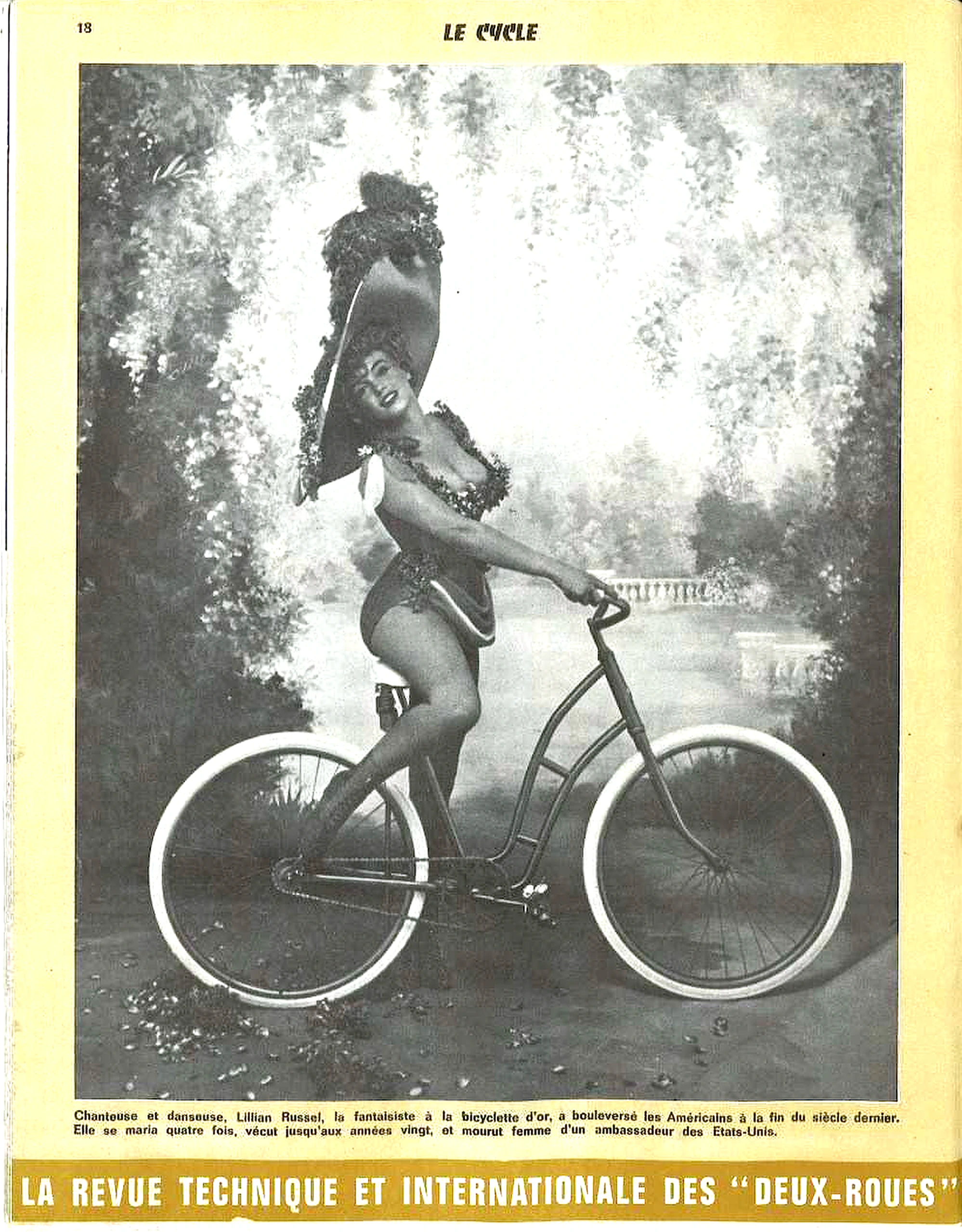
[Ebykr summary; the article’s text is not reproduced. The page is a single photograph with a two-line caption. The caption presents the singer and dancer Lillian Russel (so spelled) as the entertainer of the golden bicycle, who caused a sensation among Americans at the end of the last century; it adds that she married four times, lived into the twenties and died as the wife of an ambassador of the United States.]
[A full-page studio photograph shows a woman in a stage costume trimmed with garlands and an enormous flower-laden hat, seated on a lady’s bicycle with a looped double-tube drop frame, white tires and no fenders, posed before a painted backdrop of foliage, water and a stone balustrade, with petals strewn on the ground. The photograph is set on a gold ochre ground that fills the rest of the page.]
18
— Page 2 —
LE CYCLE
PERSONNAGES CELEBRES
Amis et propagateurs de la bicyclette
(d’après Englebert Vélo Magazine 1957 sous la signature de F. K. MATHYS, Conservateur du Musée Suisse du Sport à Bâle.)
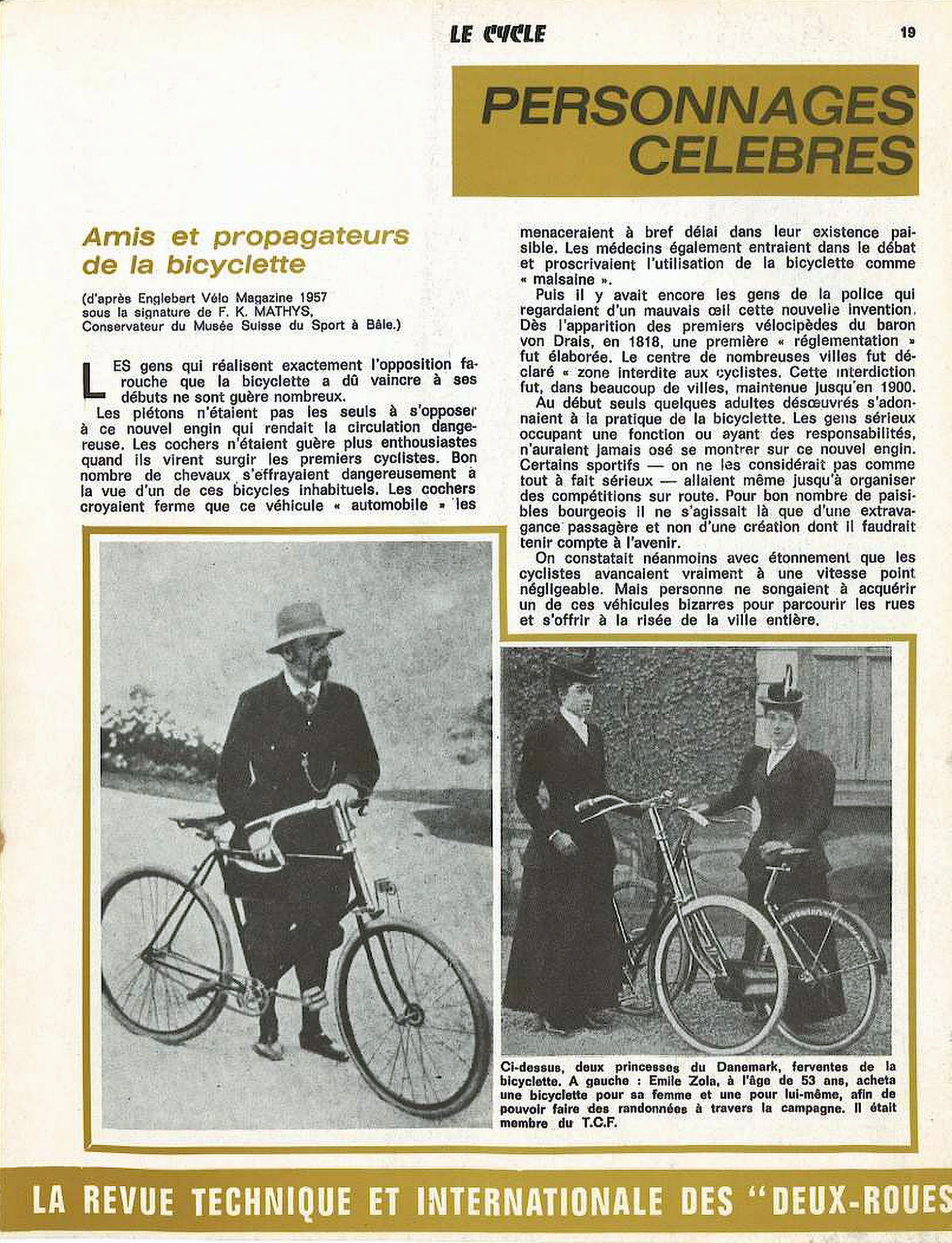
[Ebykr summary; the article’s text is not reproduced. The article opens by observing that few people now grasp how fierce the resistance was that the bicycle had to overcome in its early years. Pedestrians objected to a machine that made the roads dangerous; coachmen were no happier, since many horses shied at the sight of the strange machines, and they feared that this self-propelled vehicle would soon threaten their livelihood. Doctors joined in and condemned cycling as unhealthy, and the police frowned on it too: as soon as the first vélocipèdes of baron von Drais appeared in 1818, a first set of rules was drawn up, the centers of many towns were declared closed to cyclists, and in many of them the ban held until 1900. At first only a few idle adults rode; people of position or responsibility would never have dared be seen on such a machine, and the sportsmen who even organized road races were not taken quite seriously. To many quiet bourgeois it was a passing extravagance with no future. People did notice with surprise that cyclists moved at a real speed, but no one thought of buying one of these odd vehicles and becoming the laughingstock of the town. The captions identify two princesses of Denmark, keen cyclists, and Emile Zola, who at the age of 53 bought a bicycle for his wife and one for himself so that they could ride through the countryside, and who was a member of the T.C.F.]
[Two halftone photographs fill the lower part of the page inside a gold ochre rule that also frames the right-hand column. At left, Emile Zola stands on a road in a hat, spectacles, a dark jacket with a watch chain, knee breeches and stockings, holding a man’s diamond-frame bicycle with raised handlebars. At right, two princesses of Denmark in long dark skirts, fitted jackets and hats stand with two ladies’ drop-frame bicycles before an ivy-covered wall and a shuttered window. The title PERSONNAGES CELEBRES is printed in black on a gold ochre panel, and the subtitle in gold.]
19
— Page 3 —
LE CYCLE
PERSONNAGES CELEBRES • PERSONNAGES CELEBRES • PERSONNAGES CELEBRES
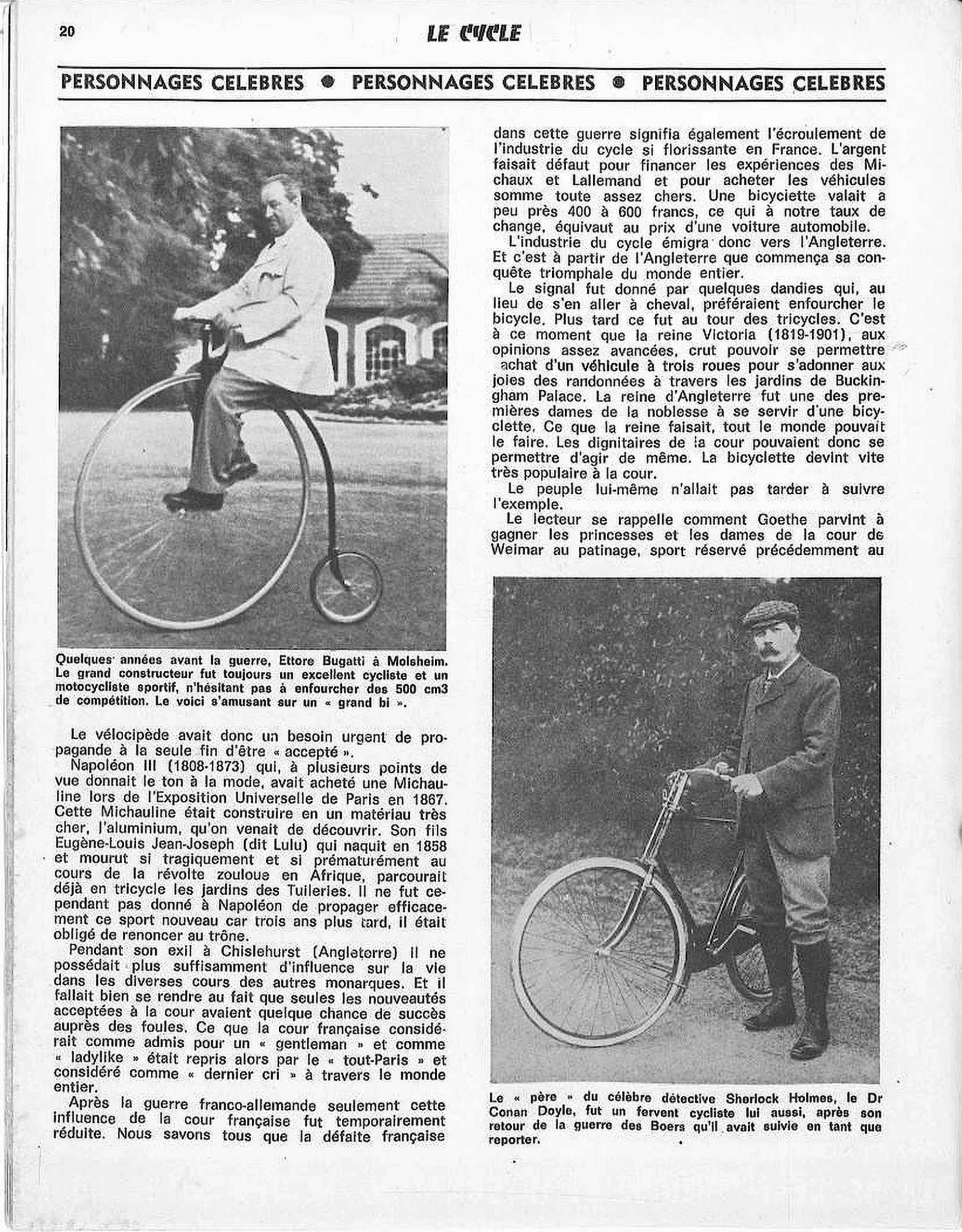
[Ebykr summary; the article’s text is not reproduced. The vélocipède needed promotion simply to be accepted. Napoléon III (1808-1873) bought a Michauline at the Exposition Universelle de Paris in 1867, built of costly, newly discovered aluminum; his son Eugène-Louis Jean-Joseph (dit Lulu), born in 1858 and killed young in the Zulu revolt in Africa, already rode a tricycle in the Tuileries gardens. Napoléon lost the throne three years later, and in exile at Chislehurst, England, lacked sway over the courts whose approval alone launched a novelty: what the French court found gentlemanly or ladylike the tout-Paris adopted and the world copied. The Franco-German war curbed that influence, and the French defeat also ruined the flourishing French cycle industry: money ran short for the experiments of Michaux and Lallemand and for machines that cost about 400 to 600 francs, at today’s rate the price of a motorcar. The industry moved to England and conquered the world from there. Dandies led the way, preferring the bicycle to the horse, then came tricycles; Queen Victoria (1819-1901), of fairly advanced views, took a three-wheeler for rides in the gardens of Buckingham Palace and was among the first noblewomen to use a bicycle, so the court and then the people followed. The page ends recalling how Goethe won the princesses and ladies of the court of Weimar over to skating (the sentence runs on to the next page). The captions show Ettore Bugatti at Molsheim a few years before the war, a fine cyclist and sporting motorcyclist who raced 500 cm3 machines, amusing himself on a high-wheeler (a “grand bi”), and Dr Conan Doyle, the creator of Sherlock Holmes, a keen cyclist after returning from the Boer War, which he had covered as a reporter.]
[Two halftone photographs. At upper left, Ettore Bugatti, a heavy-set man in a light jacket and gray trousers, rides a high-wheeler across a lawn before a low building with arched windows and tall trees. At lower right, Conan Doyle, mustached, in a tweed cap, a tweed jacket, knickerbockers and tall dark boots or stockings, stands holding a diamond-frame bicycle with raised handlebars before a hedge.]
20
— Page 4 —
LE CYCLE
PERSONNAGES CELEBRES • PERSONNAGES CELEBRES • PERSONNAGES CELEBRES
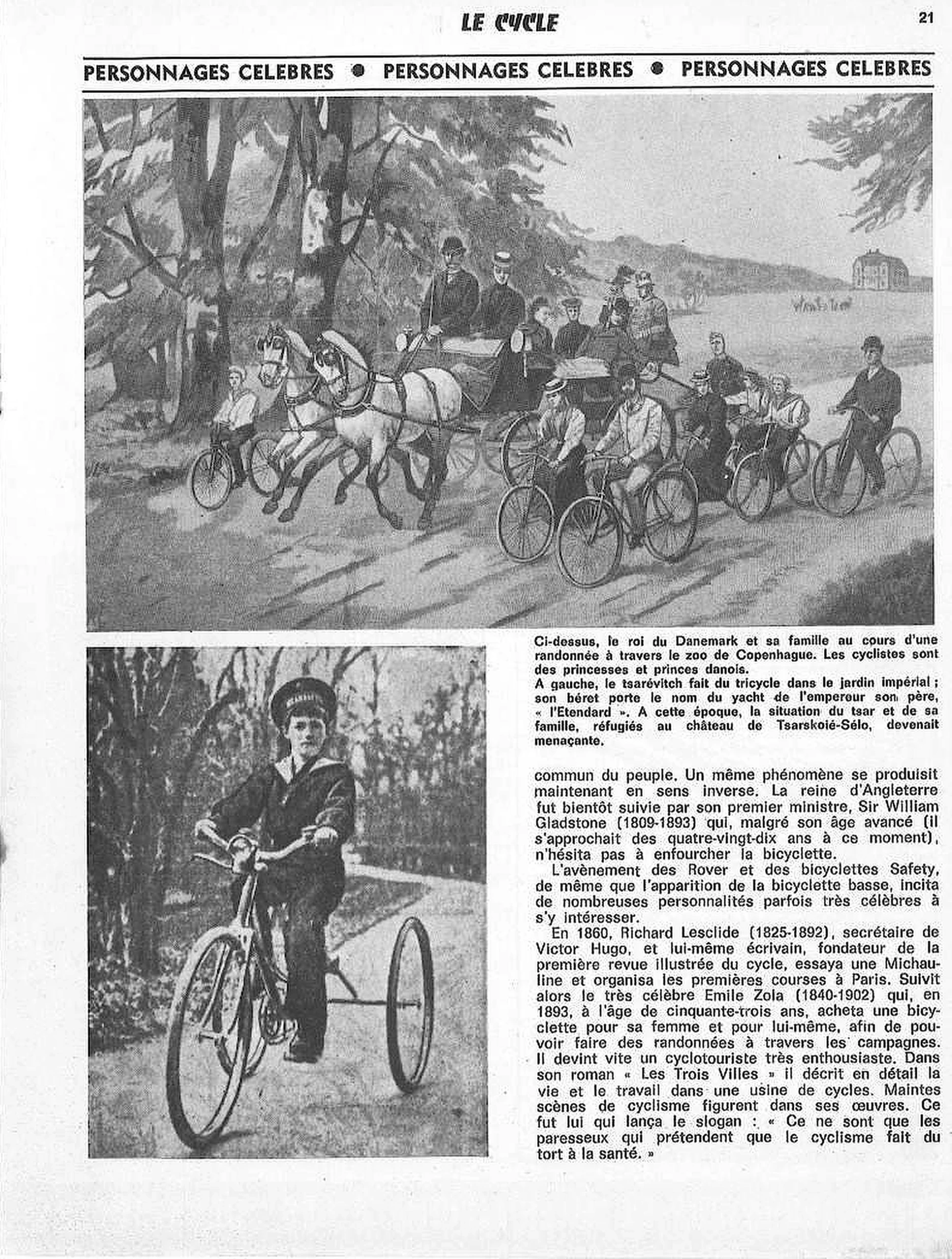
[Ebykr summary; the article’s text is not reproduced. (Continued from page 20.) The page finishes the comparison with Goethe, who brought the princesses and ladies of the court of Weimar to skating, a pastime until then left to the common people, and says the same thing now happened the other way round: the Queen of England was soon followed by her prime minister Sir William Gladstone (1809-1893), who took to the bicycle although he was nearly 90. The arrival of the Rover and Safety bicycles and of the low bicycle in general drew many well-known people to cycling. The page then says that in 1860 Richard Lesclide (1825-1892), secretary to Victor Hugo, himself a writer and the founder of the first illustrated cycling review, tried a Michauline and organized the first races in Paris. Emile Zola (1840-1902) followed: in 1893, aged 53, he bought a bicycle for his wife and for himself so as to ride through the countryside and became an enthusiastic cyclotourist. His novel « Les Trois Villes » describes life and work in a cycle factory in detail, cycling scenes occur throughout his work and he coined a saying that only the lazy claim cycling harms the health. The captions say the upper picture shows the King of Denmark (printed Danemark) and his family on a ride through the zoo at Copenhague, the cyclists being Danish princesses and princes; the lower picture shows the Tsarevich (tsarévitch) riding a tricycle in the imperial garden, his cap bearing the name of the yacht of his father the emperor, « l’Etendard », at a time when the situation of the tsar and his family, refugees at the château of Tsarskoié-Sélo, was turning menacing.]
[The upper half of the page carries a halftone of a period drawing: an open carriage drawn by two white horses and carrying several people is followed and flanked by men and women riding safety bicycles along a park road, with deer grazing and a large house in the distance; no signature shows in it as reproduced. At lower left a photograph shows the Tsarevich as a boy in a sailor suit and a cap with a lettered band, riding a tricycle along a garden path. The page carries no drawing signed Rebour.]
21
— Page 5 —
LE CYCLE
PERSONNAGES CELEBRES • PERSONNAGES CELEBRES • PERSONNAGES CELEBRES
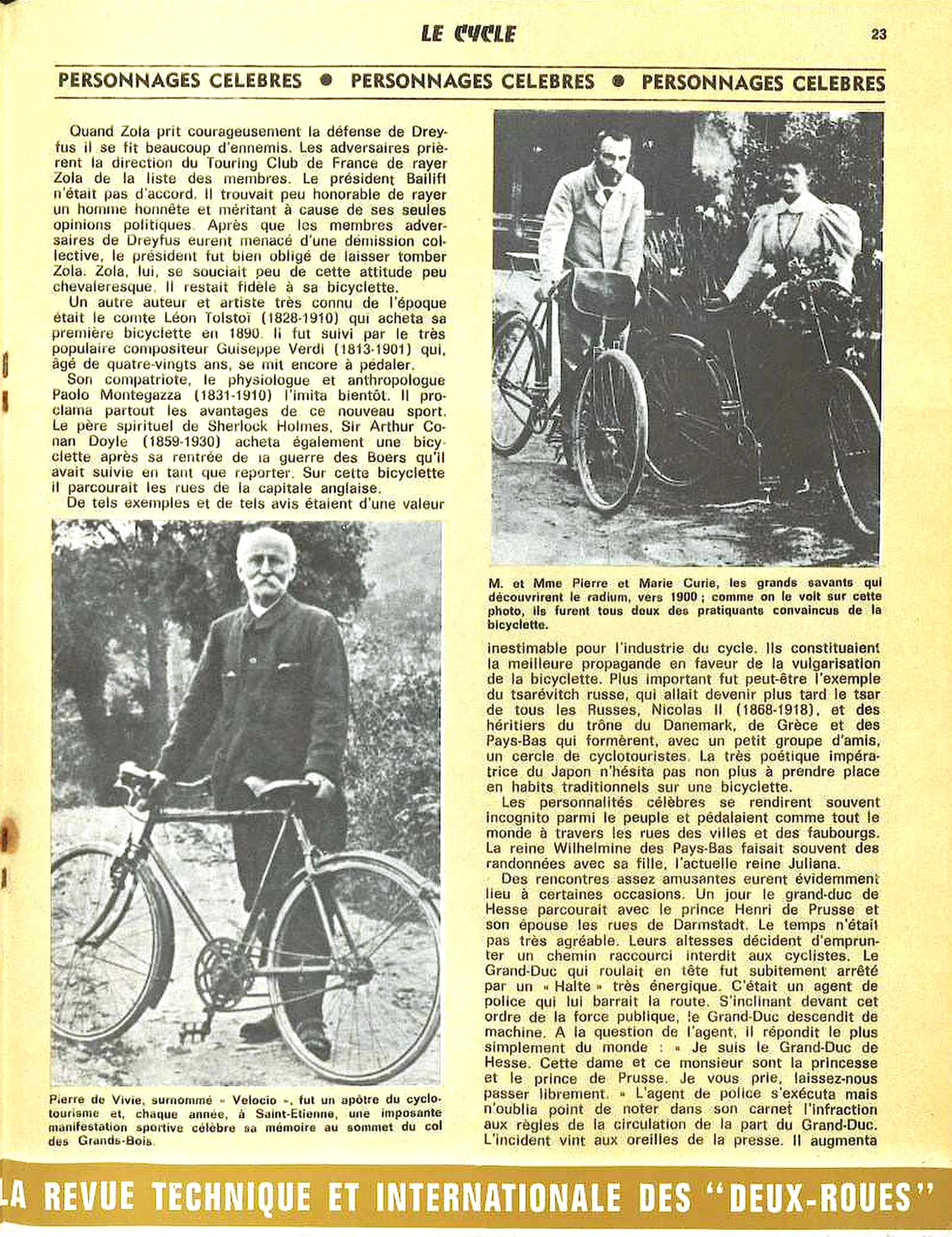
[Ebykr summary; the article’s text is not reproduced. When Zola defended Dreyfus, his enemies asked the Touring Club de France to strike him from its members; the president, named as Bailift, refused until the anti-Dreyfus members threatened to resign together, and Zola stayed loyal to his bicycle. Count Léon Tolstoï (1828-1910) bought his first bicycle in 1890; the composer Guiseppe Verdi (1813-1901) took up pedaling at 80; the physiologist and anthropologist Paolo Montegazza (1831-1910) followed and praised the new sport; Sir Arthur Conan Doyle (1859-1930), creator of Sherlock Holmes, bought a bicycle on returning from the Boer War (guerre des Boers), which he had covered as a reporter, and rode it in the English capital. Such examples were the best propaganda for the cycle industry. More important still were the Russian Tsarevich, later Nicolas II (1868-1918), and the heirs to the thrones of Denmark (Danemark), Greece (Grèce) and the Netherlands (Pays-Bas), who formed a cyclotouring circle; the Empress of Japan rode in traditional dress, and Queen Wilhelmine of the Netherlands rode with her daughter, the present Queen Juliana. The Grand Duke of Hesse (grand-duc de Hesse), riding through Darmstadt with Prince Henri de Prusse and his wife, took a shortcut closed to cyclists, was halted by a policeman and let through on giving his name, though the offense was noted and reached the press (continued on page 25). Captions: Pierre and Marie Curie, discoverers of radium, were keen cyclists around 1900; Pierre de Vivie, called « Velocio », apostle of cyclotourism, is honored every year at Saint-Etienne by a large event at the summit of the col des Grands-Bois.]
[At upper right a photograph shows Pierre and Marie Curie standing with their two bicycles in a garden, he in a light suit beside a gentleman’s bicycle with a bag at the handlebar, she in a light blouse beside a lady’s bicycle. At lower left a photograph shows Pierre de Vivie, white-haired and mustached, standing in a dark suit behind a diamond-frame bicycle on a country path. The page carries no drawing signed Rebour.]
23
— Page 6 —
LE CYCLE
PERSONNAGES CELEBRES • PERSONNAGES CELEBRES • PERSONNAGES CELEBRES
1923 [?] – 1931
A UMBERTO [?] DEI
[illegible]
F. K. MATHYS.
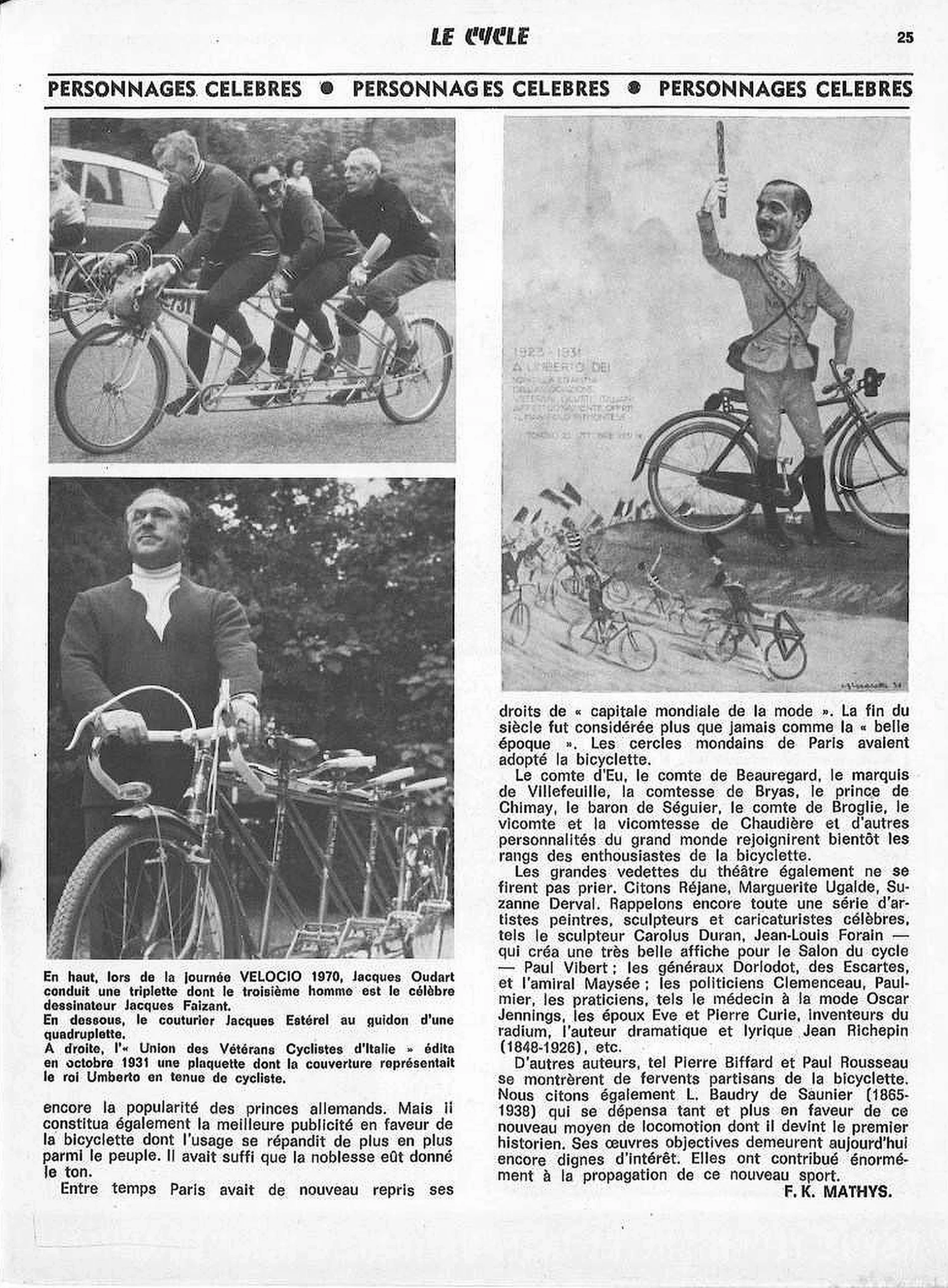
[Ebykr summary; the article’s text is not reproduced. (Continued from page 23.) The Darmstadt incident added to the popularity of the German princes and was the best publicity for the bicycle, which spread among ordinary people once the nobility had set the tone. Paris had again become the world capital of fashion, the end of the century was the « belle époque » and Paris society adopted the bicycle: the page names le comte d’Eu, le comte de Beauregard, le marquis de Villefeuille, la comtesse de Bryas, le prince de Chimay, le baron de Séguier, le comte de Broglie and le vicomte and la vicomtesse de Chaudière. Stars of the theater followed (Réjane, Marguerite Ugalde, Suzanne Derval), as did artists: the sculptor Carolus Duran, Jean-Louis Forain (who made a fine poster for the Salon du cycle) and Paul Vibert. Also named are the generals Dorlodot and des Escartes, the admiral Maysée, the politicians Clemenceau and Paulmier, the fashionable doctor Oscar Jennings, the couple printed as Eve and Pierre Curie, called the inventors of radium, and the playwright and lyric author Jean Richepin (1848-1926). The writers Pierre Biffard and Paul Rousseau were keen partisans, and L. Baudry de Saunier (1865-1938) worked tirelessly for the new means of locomotion and became its first historian, his objective works still worth reading. The captions say the top photograph shows Jacques Oudart, at the VELOCIO 1970 day, steering a triplette whose third rider is the cartoonist Jacques Faizant; the one below shows the couturier Jacques Estérel at the handlebars of a quadruplette; the picture at right is the cover of a booklet published in October 1931 by the « Union des Vétérans Cyclistes d’Italie », said to show King Umberto in cycling dress.]
[At upper left a photograph shows three men in sweaters riding a triplet with a handlebar bag and a number plate on the front, past a parked car. Below it a photograph shows Jacques Estérel in a dark jacket and white roll-neck standing at the front handlebars of a quadruplet. The right column carries a reproduced booklet cover: a caricature of a mustached man in cycling dress, standing beside his bicycle and raising a baton, above a crowd of small cyclists with flags; at its left a block of capitals opens with the dates and a dedication, and a script signature with the figure 31 sits at its lower right. The page carries no drawing signed Rebour.]
25
Ebykr presents this material for research and education. If you hold rights to it or notice an ownership issue, please contact us and we will respond promptly.
The Ebykr Digest
New articles, timelines, catalog finds and registry activity — assembled from the archive once a month. Your address is never shared.
Double opt-in. One email per month. Unsubscribe at any time with one click.