About Ebykr
Ebykr celebrates classic and vintage lightweight bicycles through provocative imagery and opinion. Ride along with us.
About Ebykr
Ebykr celebrates classic and vintage lightweight bicycles through provocative imagery and opinion. Ride along with us.

Source: Le Cycle, n° 43, January 1964, pages 15, 16, 17, 18; scan of the issue from Cycle Memory (Mémoire du Cycle), Collection privée H.D.
| Type | Review |
|---|---|
| Year | 1964 |
| Publisher | Le Cycle |
| Country | France |
| Language | French |
| Pages | 4 |
| Source | Le Cycle, n° 43, January 1964, pages 15, 16, 17, 18; scan of the issue from Cycle Memory (Mémoire du Cycle), Collection privée H.D. |
| Credit | Ebykr archive |
| Identifier | Permalink https://cyclememory.org/fr/search-coll-list.php?collectionID=773&docID=B-1-0000000809 |
| Transcription | Headings and specifications transcribed; article text summarized |
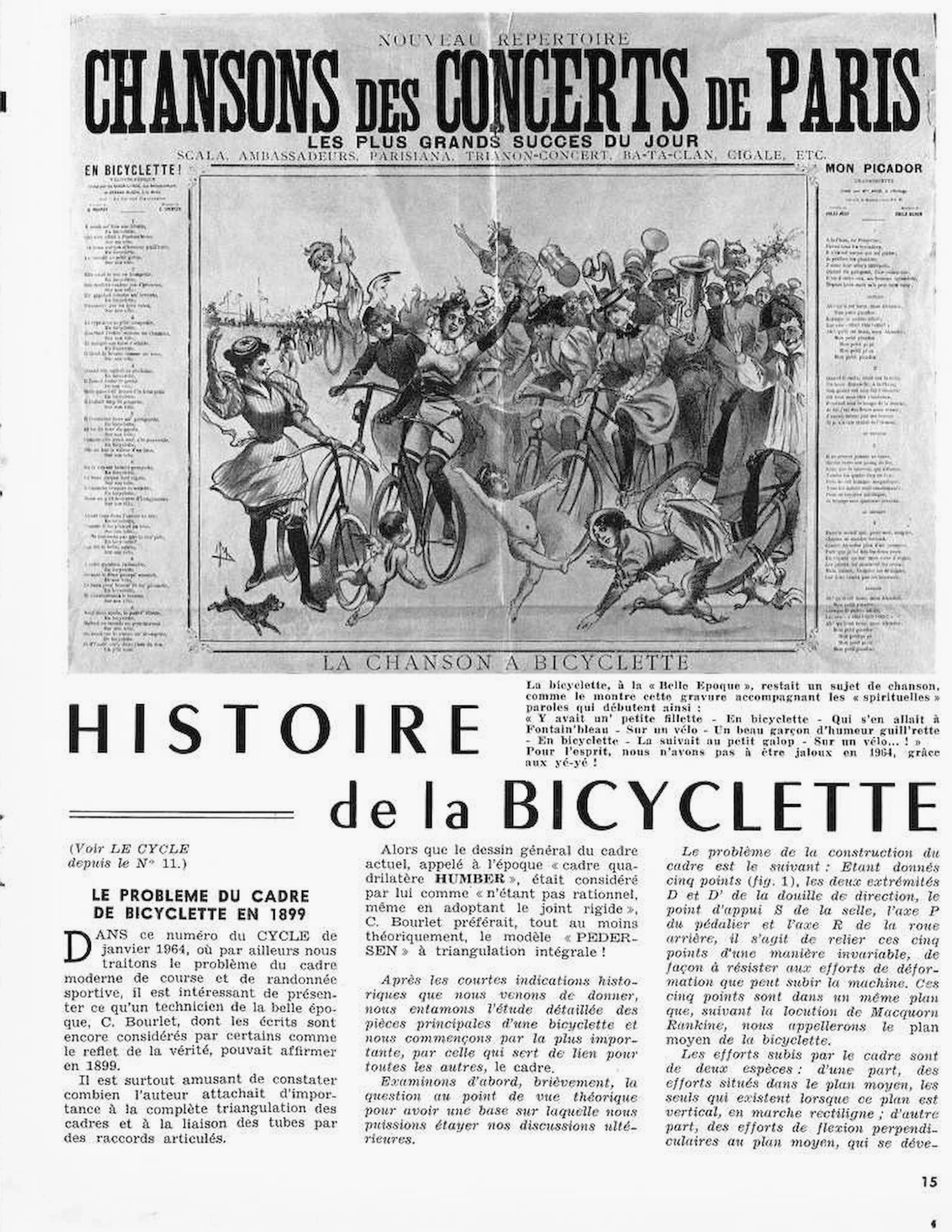
NOUVEAU REPERTOIRE CHANSONS DES CONCERTS DE PARIS LES PLUS GRANDS SUCCES DU JOUR SCALA, AMBASSADEURS, PARISIANA, TRIANON-CONCERT, BA-TA-CLAN, CIGALE, ETC. EN BICYCLETTE! MON PICADOR LA CHANSON A BICYCLETTE HISTOIRE de la BICYCLETTE (Voir LE CYCLE depuis le N° 11.) LE PROBLEME DU CADRE DE BICYCLETTE EN 1899 15 HISTOIRE DE LA BICYCLETTE -- HISTOIRE DE …
This is a magazine article, so its running text is summarized here rather than reproduced; the headline, byline, specifications and scores are transcribed as printed.
An installment of Le Cycle’s serial “Histoire de la Bicyclette”, pages 15 to 18 of n° 43, January 1964: “Le problème du cadre de bicyclette en 1899”, set beside Rebour’s article on the modern frame in the same issue. It reprints at length what C. Bourlet wrote in 1899 on frame theory, triangulation and pinned joints, the Pedersen and Humber machines and the Whitworth and Gladiator frame ranges, under a reproduced Belle Époque song sheet. The headings, figure labels and footnote references are transcribed as printed; the text and captions are summarized in Ebykr’s words, and the page images carry them in full.
— Page 1 —
NOUVEAU REPERTOIRE
CHANSONS DES CONCERTS DE PARIS
LES PLUS GRANDS SUCCES DU JOUR
SCALA, AMBASSADEURS, PARISIANA, TRIANON-CONCERT, BA-TA-CLAN, CIGALE, ETC.
EN BICYCLETTE!
MON PICADOR
LA CHANSON A BICYCLETTE
HISTOIRE de la BICYCLETTE
(Voir LE CYCLE depuis le N° 11.)
LE PROBLEME DU CADRE DE BICYCLETTE EN 1899
[Ebykr summary; the article’s text is not reproduced. The caption beside the series title says that in the « Belle Epoque » the bicycle was still a subject for songs, as the reproduced engraving shows: it accompanied the words of a song (ironically called witty) about a girl riding her bicycle to Fontain’bleau with a young man following on his own vélo, and the caption jokes that in 1964, thanks to the yé-yé singers, there is no reason to envy that era its wit. The running text opens by noting that this January 1964 number of LE CYCLE treats elsewhere the problem of the modern racing and randonnée sportive (sporting touring) frame, so it is worth presenting what a technician of the belle époque, C. Bourlet, whose writings some still take as the truth, could assert in 1899. It finds it amusing how much weight the author gave to complete triangulation of the frame and to joining the tubes with articulated (pinned) lugs: while he held that the general design of the present-day frame, then called the « cadre quadrilatère HUMBER » (Humber quadrilateral frame), was not rational even with rigid joints, C. Bourlet preferred, in theory at least, the fully triangulated « PEDERSEN » model. The italic text that follows sets out the 1899 reasoning. Having given short historical notes, it begins a detailed study of the main parts of a bicycle with the most important, the frame, the part that links all the others, and first takes the question theoretically. The problem of frame construction is stated as joining five points invariably so as to resist the deforming loads the machine undergoes (fig. 1): the two ends D and D’ of the head tube (douille de direction), the saddle support point S, the bottom bracket axle P (pédalier) and the rear wheel axle R. The five points lie in one plane, which, borrowing a term from Macquorn Rankine, the text calls the median plane (plan moyen) of the bicycle. The loads on the frame are of two kinds: those lying in the median plane, the only ones present when that plane is vertical in straight-line riding, and bending loads perpendicular to the median plane, which the sentence goes on to describe (continued on page 16).]
[The top half of the page reproduces an old printed sheet, the cover of a “NOUVEAU REPERTOIRE” song collection: a large masthead, a line of Paris music halls, a narrow column of small type down each side headed by a song title (“EN BICYCLETTE!” at left, “MON PICADOR” at right) and a framed central engraving titled beneath “LA CHANSON A BICYCLETTE”. The engraving shows a crowd of women cyclists in short skirts, bloomers and dark stockings riding and pushing high-framed bicycles, a band of men with brass instruments behind them, cherubs running among the wheels, a fallen rider with a goose at lower right, a small dog at lower left and riders on a road in the distance. A small monogram is drawn at the lower left of the engraving, beside the dog; it is not legible enough to read. The credit lines under each song title and the verses are too small to read in this scan. A vertical fold line runs down the center of the reproduced sheet. The page carries no drawing signed “Rebour” and no byline.]
15
— Page 2 —
HISTOIRE DE LA BICYCLETTE — HISTOIRE DE LA BICYCLETTE
Fig. 1
Fig. 2
Fig. 3
Fig. 4
Fig. 5 :
(1) [Footnote summary: the idea is set out in great detail in a very interesting letter from] M. Beaujouan, ingénieur, [published in] le « Cycliste », du 1er octobre 1890.
(2) [Footnote summary: very curious and well-documented articles have been written on the subject; the reader is referred, for example, to] deux articles signés L. C…, du « Cycliste Belge », d’octobre et novembre 1891. [which recommend] la forme 34, [and to] un nouvel article de M. Beaujouan, dans le « Cycliste » de janvier 1892, [which prefers] la forme 33. [The reader may also consult with profit] le très intéressant volume, « Bicycles and Tricycles », par M. Sharp (London, 1896), p. 303 à 315.
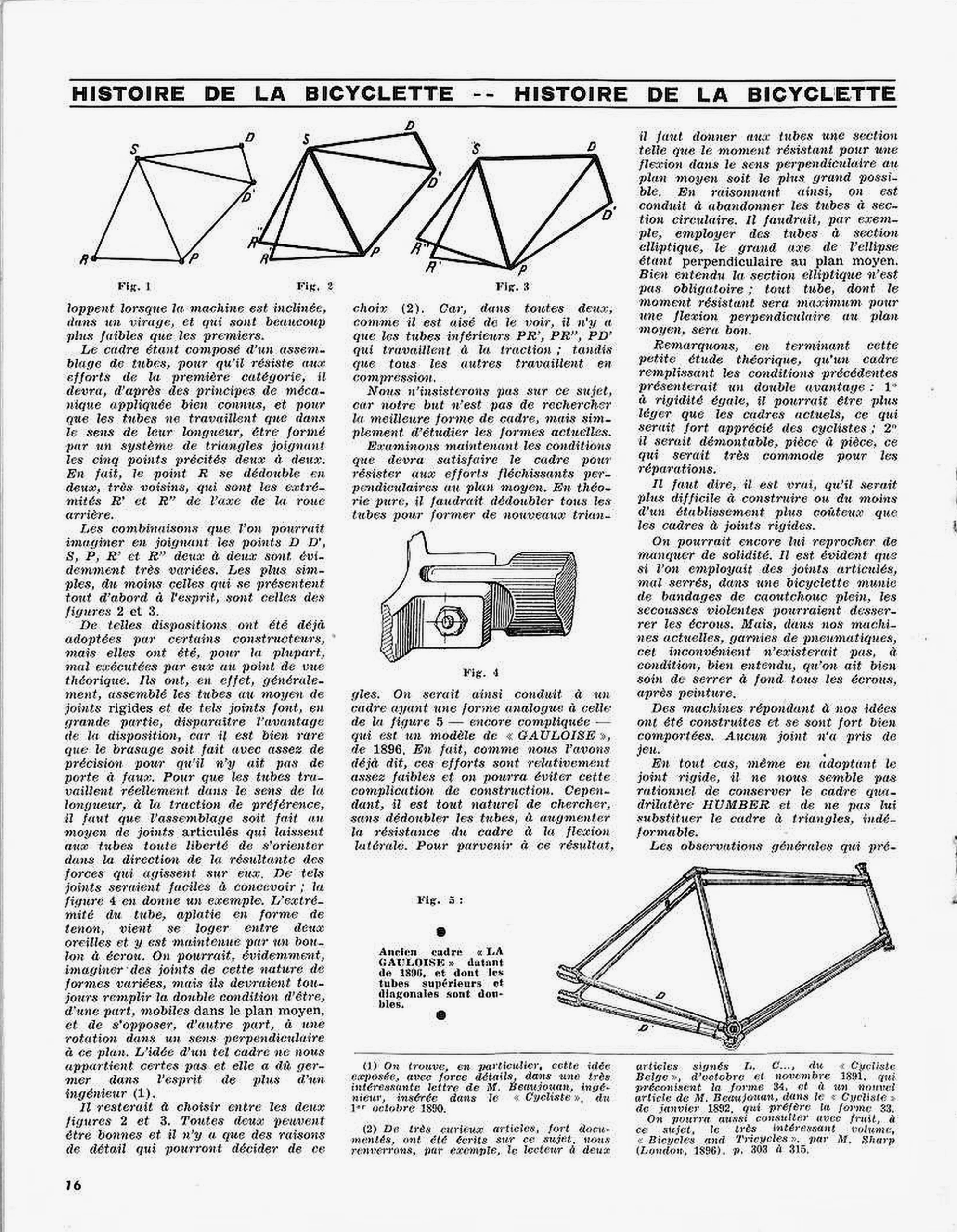
[Ebykr summary; the article’s text is not reproduced. (Continued from page 15.) The italic 1899 text goes on: the bending loads perpendicular to the median plane arise when the machine leans in a turn and are much weaker than the in-plane loads. Since the frame is an assembly of tubes, the text argues from applied mechanics that to resist the in-plane loads, with every tube working only along its length, it must be a system of triangles joining the five points in pairs; in fact the point R splits into two very close points, R’ and R”, the two ends of the rear wheel axle. Of the many ways of joining D D’, S, P, R’ and R”, the simplest are those of figures 2 and 3. Some constructeurs (builders) had already adopted such layouts but, in the author’s view, executed them badly: they joined the tubes with rigid brazed joints, and brazing is rarely precise enough to avoid off-axis loading (porte à faux), which throws away most of the advantage. For the tubes to work truly lengthwise, preferably in tension, the frame should be assembled with articulated (pinned) joints that let each tube align with the resultant of the forces on it; in the example of figure 4, the tube end is flattened into a tenon, held between two lugs (oreilles) by a nut and bolt. Such joints must pivot within the median plane yet resist rotation across it. The author disclaims the idea as his own, saying it must have occurred to more than one ingénieur (engineer) (note 1). The choice between figures 2 and 3 is a matter of detail (note 2): in both only the lower tubes PR’, PR” and PD’ work in tension and all the others in compression. The text says its aim is not to find the best frame but to study the frames of its day. To resist lateral bending, pure theory would double every tube to form new triangles, which leads to a frame like figure 5, a « GAULOISE » model of 1896, still complicated; because those loads are fairly weak, the text proposes instead tubes whose section gives the greatest resisting moment against bending across the median plane, abandoning round tubes for, for example, elliptical ones with the major axis perpendicular to that plane, though any section meeting the condition will do. Closing this theoretical study, it claims two advantages for such a frame: lighter than present frames for equal rigidity, which cyclists would value, and demountable piece by piece, which would ease repairs. It concedes that the frame would be harder, or at least costlier, to make than rigid-jointed frames, and answers the charge of weakness: on a bicycle with solid rubber tires (bandages de caoutchouc plein), loosely tightened pinned joints could be shaken loose, but on present machines with pneumatic tires (pneumatiques) this would not happen provided every nut is fully tightened after painting. Machines built on these ideas behaved very well and no joint developed play. Even with rigid joints, the text holds it irrational to keep the « cadre quadrilatère HUMBER » (Humber quadrilateral frame) rather than the undeformable triangulated frame; the next paragraph begins at the foot of the third column (continued on page 17). The caption of figure 5 describes it as an old « LA GAULOISE » frame of 1896 whose top tubes and diagonals are doubled. Footnote 1 credits the pinned-frame idea to a letter by M. Beaujouan; footnote 2 cites articles that favor forme 34 or forme 33, and the book by M. Sharp.]
[Five line drawings. Across the top, three diagrams of points and straight lines: Fig. 1 marks the five points S, D, D’, P and R as dots joined by thin lines into triangles; Fig. 2 and Fig. 3 draw two fully triangulated frame schemes in heavy lines, with the rear axle point split into R’ and R”. In Fig. 2 the seat point S is braced to both ends D and D’ of the head and a single tube runs from D’ to P; in Fig. 3 a top tube runs from S to D and two tubes run from D and from D’ down to P. Fig. 4, in the middle column, is a shaded drawing of a pinned joint: a flattened tube end held between two lugs by a bolt with a hexagonal nut. Fig. 5, at lower right, is a perspective drawing of a bare diamond frame with doubled top tubes and doubled down tubes, its two chain stays lettered D and D’; its caption sits at left between two bullets. None of the drawings is signed, and the page carries no byline.]
16
— Page 3 —
HISTOIRE DE LA BICYCLETTE — HISTOIRE DE LA BICYCLETTE
A
B
Fig. 6.
FORME GÉNÉRALE
Fig. 7.
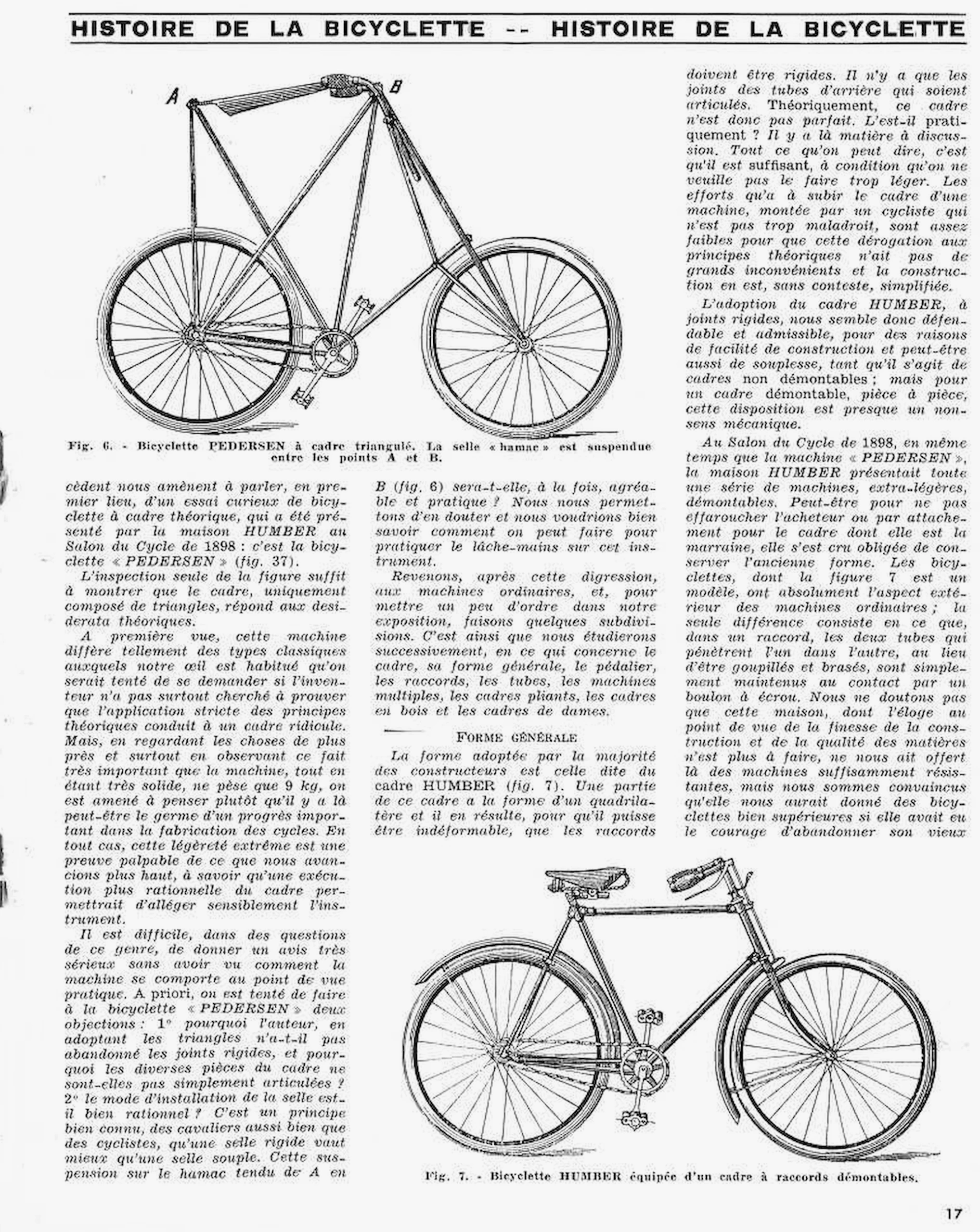
[Ebykr summary; the article’s text is not reproduced. (Continued from page 16.) The italic 1899 text says its general remarks lead first to a curious attempt at a bicycle with a theoretical frame, shown by the maison HUMBER (the Humber firm) at the Salon du Cycle of 1898: the « PEDERSEN » bicycle, which the running text calls fig. 37 although the drawing above is captioned Fig. 6. The drawing alone shows that its frame, made only of triangles, meets the theoretical requirements. At first sight the machine is so unlike the classic types that one might suspect its inventor of trying to prove that strict theory leads to a ridiculous frame, but since it is very strong yet weighs only 9 kg, the text suggests it may hold the germ of real progress in cycle building, and calls its extreme lightness tangible proof of the earlier claim that a more rational frame would make the machine appreciably lighter. Without seeing how it behaves in use, the text raises two objections a priori: first, why its designer, having adopted triangles, kept rigid joints rather than simply articulating the frame members; second, whether the saddle mounting is rational, since horsemen (cavaliers) and cyclists alike know that a rigid saddle is better than a soft one. It doubts that the hammock slung from A to B (fig. 6) can be both comfortable and practical, and wonders how one could ride no-hands (le lâche-mains) on it. Returning to ordinary machines, the text sets out its plan for the frame: its general form, the bottom bracket (pédalier), the lugs (raccords), the tubes, multiple machines (machines multiples), folding frames (cadres pliants), wooden frames (cadres en bois) and ladies’ frames (cadres de dames). Under the heading FORME GÉNÉRALE it says that most constructeurs use the so-called HUMBER frame (fig. 7); because part of it is a quadrilateral, its lugs must be rigid for it to be undeformable, and only the joints of the rear tubes are articulated. The frame is therefore imperfect in theory; whether it is in practice is open to debate, and the most the text will say is that it is adequate provided it is not made too light: the loads on the frame of a machine ridden by a not too clumsy cyclist are low enough for this departure from theory to do little harm, and it makes construction simpler. The rigid-jointed HUMBER frame is therefore defensible for ease of construction, and perhaps for its souplesse (flexibility), as long as the frame is not demountable; for a frame that comes apart piece by piece it is almost a mechanical nonsense. At the same 1898 Salon du Cycle as the « PEDERSEN » machine, HUMBER showed a whole series of extra-light demountable machines but, perhaps so as not to alarm buyers or from attachment to the frame it had sponsored (the text calls the firm its marraine, godmother), kept the old form: these bicycles, of which figure 7 is one, look exactly like ordinary machines, the only difference being that where two tubes fit into each other at a lug they are held together by a nut and bolt instead of being pinned and brazed (goupillés et brasés). The text does not doubt that the firm, whose fine construction and quality of materials need no praise, made machines strong enough, but is sure it would have made far better bicycles had it dared to abandon its old frame (continued on page 18). The caption of Fig. 6 identifies a PEDERSEN bicycle with a triangulated frame and its « hamac » (hammock) saddle slung between points A and B; the caption of Fig. 7 identifies a HUMBER bicycle fitted with a frame of demountable lugs (raccords démontables).]
[Two engravings of complete machines. At top left, Fig. 6 shows the Pedersen bicycle in side view: a tall frame of slender tubes braced entirely in triangles, with a hammock saddle stretched between two points lettered A (at the rear) and B (at the front, behind the handlebar), equal-size wheels, a chainwheel with block pedals and no mudguards. At lower right, Fig. 7 shows the Humber bicycle in side view: a conventional diamond frame with a leather saddle on coil springs, a handlebar with grips, full mudguards, a chainwheel and block pedals. Neither engraving is signed, and the page carries no byline.]
17
— Page 4 —
HISTOIRE DE LA BICYCLETTE — HISTOIRE DE LA BICYCLETTE
Fig. 8
Fig. 9
Fig. 10
Fig. 11
Fig. 12
(A suivre.)
Fig. 13.
Fig. 14.
(1) [Footnote summary: on this subject the reader may consult with profit] d’intéressants articles signés L. de N. et de Nevache, dans la « Revue du Touring-Club de France », de 1896 et 1897.
(2) « Nouveau Traité des Bicycles et Bicyclettes », par C. Bourlet, p. 77 et 80.
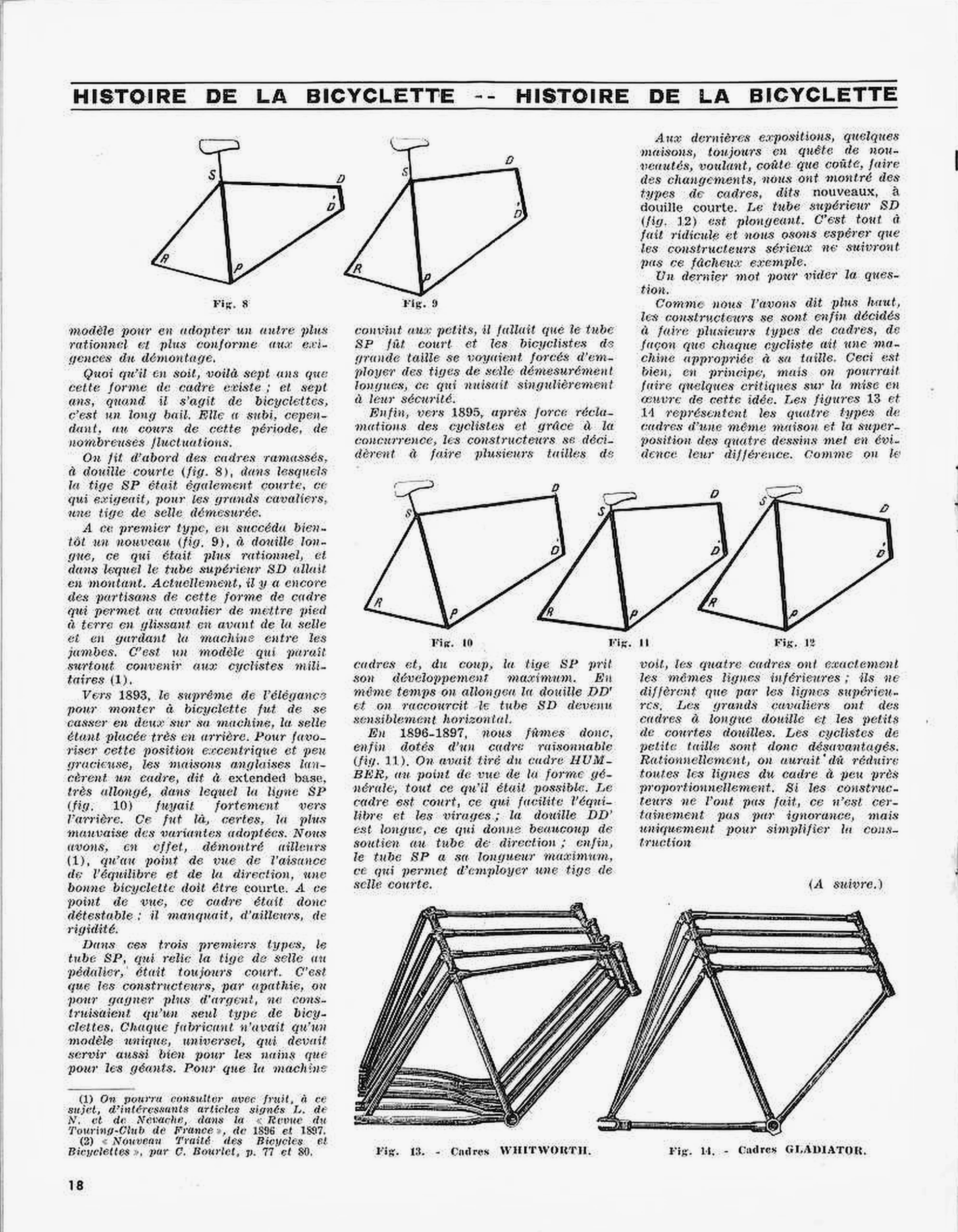
[Ebykr summary; the article’s text is not reproduced. (Continued from page 17.) The italic 1899 text completes its point that the Humber firm should have dropped its old model for a more rational one suited to a demountable frame. It notes that this form of frame has existed for seven years, a long lease where bicycles are concerned, and has gone through many changes in that time. First came compact frames (cadres ramassés) with a short head tube (douille courte) (fig. 8), in which the seat tube SP was also short, so that tall riders (grands cavaliers) needed an inordinately long seat pillar (tige de selle). These were soon followed by a type with a long head tube (fig. 9), more rational, whose top tube SD rose toward the front; it still has supporters because the rider can put a foot to the ground by sliding forward off the saddle while keeping the machine between his legs, and it seems especially suited to military cyclists (note 1). Around 1893 the height of elegance was to ride bent double with the saddle set far back, and to suit that eccentric and ungainly position les maisons anglaises (the English makers) brought out a very long frame called extended base (the English words are set in roman type in the print), in which the line SP (fig. 10) raked steeply backward; the text calls it the worst variant of all, since the author has shown elsewhere (the call is printed (1) but refers to note 2, his own book) that a good bicycle must be short for easy balance and steering, and adds that this frame also lacked rigidity. In these first three types the tube SP, joining the seat pillar to the bottom bracket, was always short, because builders, through apathy or to make more money, built one universal model meant for dwarfs and giants alike: SP had to be short to fit small riders, and tall cyclists had to use excessively long seat pillars, at real cost to their safety. Finally, around 1895, after many complaints from cyclists and under the pressure of competition, builders began to make several frame sizes; the seat tube SP reached its full length, the head tube DD’ was lengthened and the top tube SD shortened and made nearly horizontal. In 1896-1897 riders at last had a reasonable frame (fig. 11), which drew everything possible from the general form of the HUMBER frame: it is short, which helps balance and cornering; its long head tube DD’ gives the steering tube (tube de direction) plenty of support; and its full-length SP allows a short seat pillar. At the latest exhibitions, some firms chasing novelty at any price showed so-called new frames with a short head tube and a plunging top tube SD (fig. 12), which the text calls quite ridiculous, hoping serious builders will not follow suit. A last word: builders have decided to make several frame types so that every cyclist has a machine suited to his height, which is good in principle but open to criticism in practice. Figures 13 and 14 superimpose the four frame types of a single maker, and show that all four have exactly the same lower lines and differ only in their upper lines: tall riders get long head tubes and small riders short ones, so small cyclists are at a disadvantage. Rationally every line of the frame should have been scaled roughly in proportion; builders have not done so, the text says, not from ignorance but simply to make construction easier. The installment ends « (A suivre.) », to be continued. The captions name the frames of Fig. 13 as WHITWORTH frames and those of Fig. 14 as GLADIATOR frames.]
[Seven drawings. Across the top, Fig. 8 and Fig. 9 are line diagrams of frames with a saddle drawn above the point S and the points S, D, D’, P and R lettered; Fig. 8 has a short head tube D-D’ and Fig. 9 a long one with a top tube rising toward D. Across the middle, three more lettered diagrams: Fig. 10, a long, low frame whose rear triangle reaches far back; Fig. 11, a compact frame with a long head tube and a nearly horizontal top tube; Fig. 12, a frame whose top tube slopes down from S to a short head tube. At the foot of the page two engravings superimpose four frames of one maker each, drawn in perspective on a common bottom bracket, with four stacked top tubes and head tubes of different lengths: Fig. 13 shows WHITWORTH frames and Fig. 14 GLADIATOR frames. No drawing is signed, and there is no byline or signature at the end of the installment, which closes on « (A suivre.) ».]
18
Ebykr presents this material for research and education. If you hold rights to it or notice an ownership issue, please contact us and we will respond promptly.
The Ebykr Digest
New articles, timelines, catalog finds and registry activity — assembled from the archive once a month. Your address is never shared.
Double opt-in. One email per month. Unsubscribe at any time with one click.