About Ebykr
Ebykr celebrates classic and vintage lightweight bicycles through provocative imagery and opinion. Ride along with us.
About Ebykr
Ebykr celebrates classic and vintage lightweight bicycles through provocative imagery and opinion. Ride along with us.

Source: bulgier.net (Mark Bulgier's catalog archive), no scanner named for this folder; enlarged for Ebykr.
| Marque | Graftek |
|---|---|
| Type | Catalog |
| Year | 1977 |
| Publisher | Graftek Division, Exxon Enterprises, Inc., South Plainfield (New Jersey) |
| Country | United States |
| Language | English |
| Pages | 8 |
| Source | bulgier.net (Mark Bulgier's catalog archive), no scanner named for this folder; enlarged for Ebykr. |
| Credit | Ebykr archive |
| Identifier | Permalink http://bulgier.net/pics/bike/Catalogs/Exxon_Graftek_77/ |
| Transcription | Transcribed by eye |
Reference
Graftek Division, Exxon Enterprises, Inc., South Plainfield (New Jersey). Exxon Graftek G-1 Frame Catalog of 1977: It's Time, the Exxon Racing Team, the Graftek Story, Touring and the Frame and Fork Specifications. 1977. Ebykr, https://ebykr.com/library/exxon-graftek-g-1-frame-catalog-1977/.
Wikipedia
{{cite book |title=Exxon Graftek G-1 Frame Catalog of 1977: It's Time, the Exxon Racing Team, the Graftek Story, Touring and the Frame and Fork Specifications |publisher=Graftek Division, Exxon Enterprises, Inc., South Plainfield (New Jersey) |date=1977 |url=https://ebykr.com/library/exxon-graftek-g-1-frame-catalog-1977/ |via=Ebykr |access-date=}}It's time. the G-1 frame graftek EXXON The Exxon Racing Team The 1976 racing season saw the Graftek G-1 frame ready to compete with the world's finest to prove itself the world's finest. The Exxon team rode over 60,000 competitive and training miles on G-1 frames. Over the jarring boards of the Atlantic City Criterium. …
Eight pages of the Exxon Graftek G-1 frame catalog: the cover “It’s time”, the Exxon Racing Team and its 1976 race highlights, the Graftek story, stiffness, lightness, durability, touring and the two typed specification sheets dated 2/10/77.
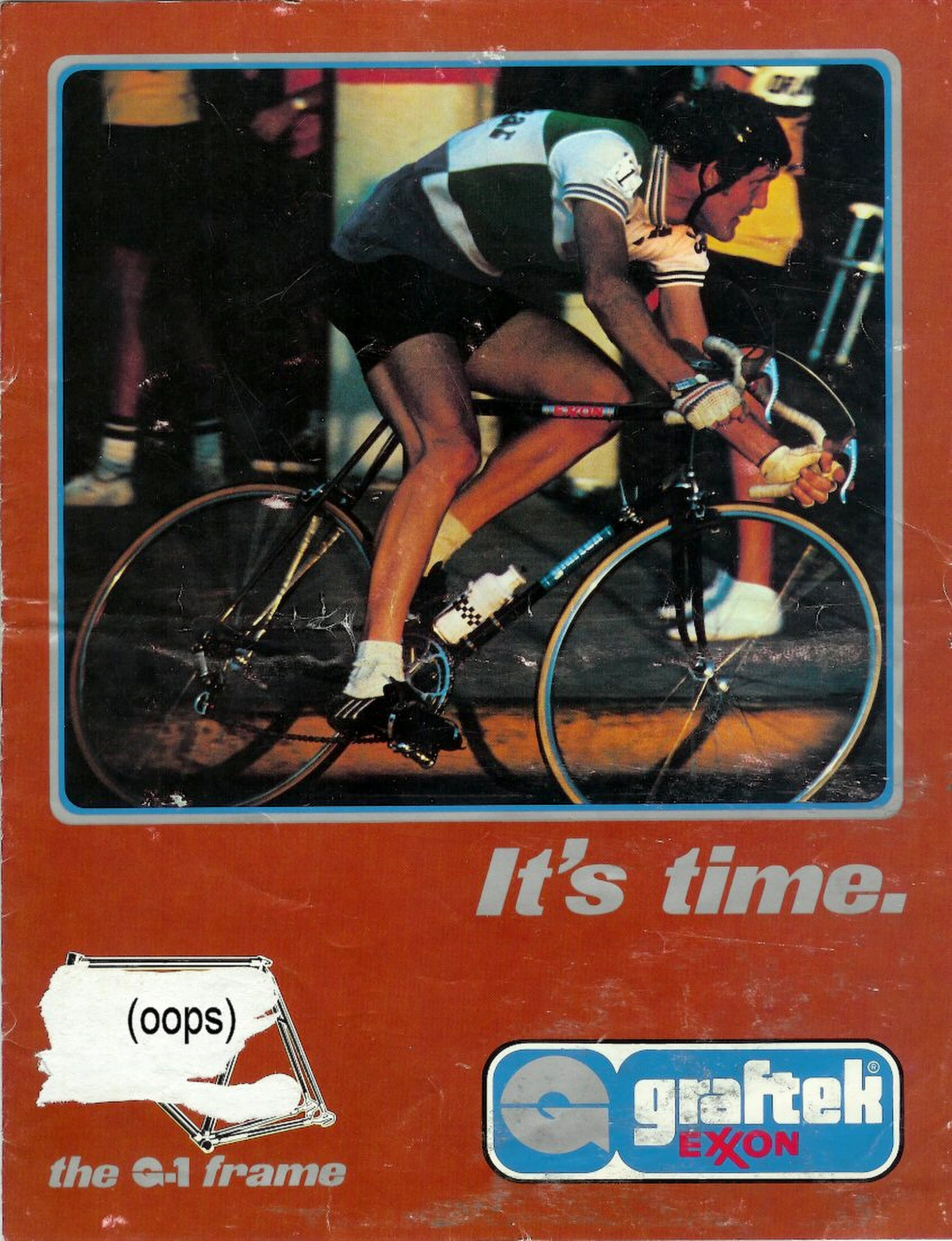
— Page 1 (front cover) —
It’s time.
the G-1 frame
graftek
EXXON
[A cyclist in a green and white jersey and helmet racing a bicycle with an Exxon frame at night, in a framed photograph above the cover headline and the Graftek Exxon logo. A line drawing of a bicycle frame at the lower left, captioned “the G-1 frame”, is partly covered by a pasted white paper patch with torn edges that hides much of its upper and middle part and carries the word “(oops)” in black; the patch covers the line drawing of the frame and no printed lettering is visible beneath it.]
— Page 2 —
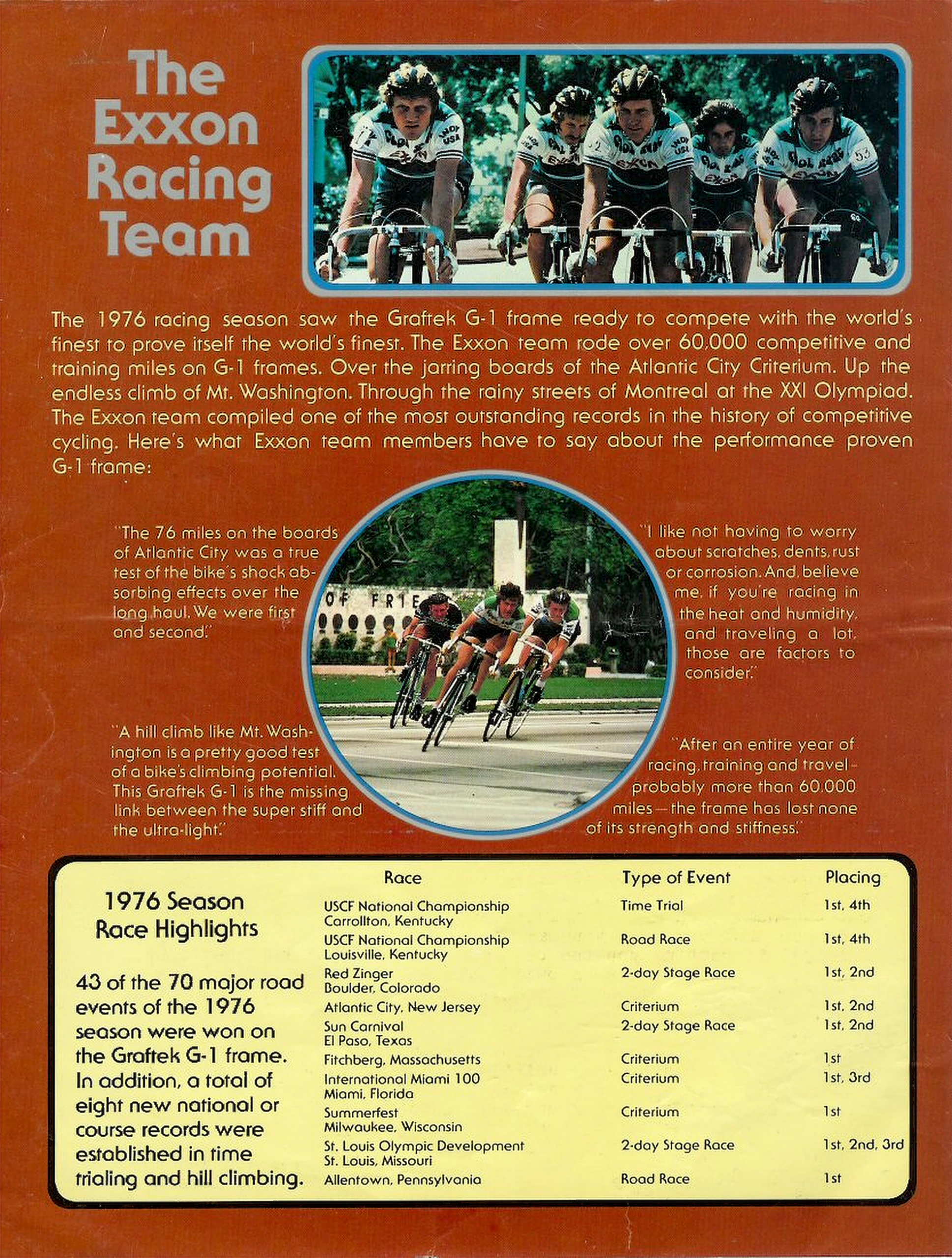
The Exxon Racing Team
The 1976 racing season saw the Graftek G-1 frame ready to compete with the world’s finest to prove itself the world’s finest. The Exxon team rode over 60,000 competitive and training miles on G-1 frames. Over the jarring boards of the Atlantic City Criterium. Up the endless climb of Mt. Washington. Through the rainy streets of Montreal at the XXI Olympiad. The Exxon team compiled one of the most outstanding records in the history of competitive cycling. Here’s what Exxon team members have to say about the performance proven G-1 frame:
“The 76 miles on the boards of Atlantic City was a true test of the bike’s shock absorbing effects over the long haul. We were first and second.”
“I like not having to worry about scratches, dents, rust or corrosion. And, believe me, if you’re racing in the heat and humidity, and traveling a lot, those are factors to consider.”
“A hill climb like Mt. Washington is a pretty good test of a bike’s climbing potential. This Graftek G-1 is the missing link between the super stiff and the ultra-light.”
“After an entire year of racing, training and travel—probably more than 60,000 miles—the frame has lost none of its strength and stiffness.”
1976 Season Race Highlights
43 of the 70 major road events of the 1976 season were won on the Graftek G-1 frame. In addition, a total of eight new national or course records were established in time trialing and hill climbing.
Race | Type of Event | Placing
USCF National Championship Carrollton, Kentucky | Time Trial | 1st, 4th
USCF National Championship Louisville, Kentucky | Road Race | 1st, 4th
Red Zinger Boulder, Colorado | 2-day Stage Race | 1st, 2nd
Atlantic City, New Jersey | Criterium | 1st, 2nd
Sun Carnival El Paso, Texas | 2-day Stage Race | 1st, 2nd
Fitchberg, Massachusetts | Criterium | 1st
International Miami 100 Miami, Florida | Criterium | 1st, 3rd
Summerfest Milwaukee, Wisconsin | Criterium | 1st
St. Louis Olympic Development St. Louis, Missouri | 2-day Stage Race | 1st, 2nd, 3rd
Allentown, Pennsylvania | Road Race | 1st
[Five riders in team jerseys riding abreast on Exxon bicycles in a framed photograph beside the heading “The Exxon Racing Team”, and three riders rounding a curve in a round photograph among four quotations from team members. A yellow panel headed “1976 Season Race Highlights” holds a table of races, types of event and placings.]
— Page 3 —
graftek
EXXON
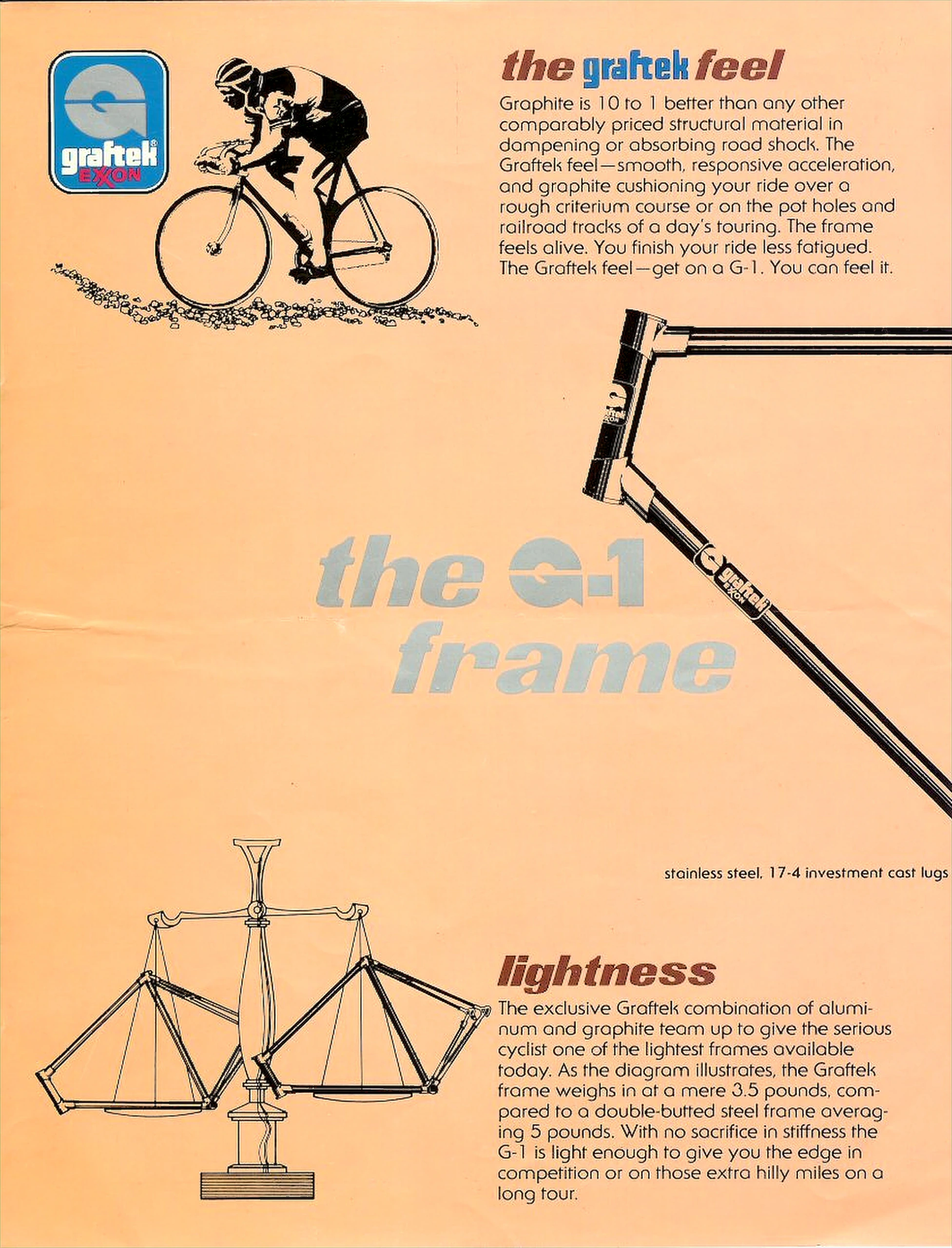
the graftek feel
Graphite is 10 to 1 better than any other comparably priced structural material in dampening or absorbing road shock. The Graftek feel—smooth, responsive acceleration, and graphite cushioning your ride over a rough criterium course or on the pot holes and railroad tracks of a day’s touring. The frame feels alive. You finish your ride less fatigued. The Graftek feel—get on a G-1. You can feel it.
the G-1 frame
stainless steel, 17-4 investment cast lugs
lightness
The exclusive Graftek combination of aluminum and graphite team up to give the serious cyclist one of the lightest frames available today. As the diagram illustrates, the Graftek frame weighs in at a mere 3.5 pounds, compared to a double-butted steel frame averaging 5 pounds. With no sacrifice in stiffness the G-1 is light enough to give you the edge in competition or on those extra hilly miles on a long tour.
[The Graftek Exxon logo and a line drawing of a racing cyclist on a rough road beside the heading “the graftek feel”, a large photograph of the head tube, lugs and down tube of the G-1 frame under the heading “the G-1 frame”, and a drawing of a balance scale weighing two bicycle frames beside the heading “lightness”.]
— Page 4 —
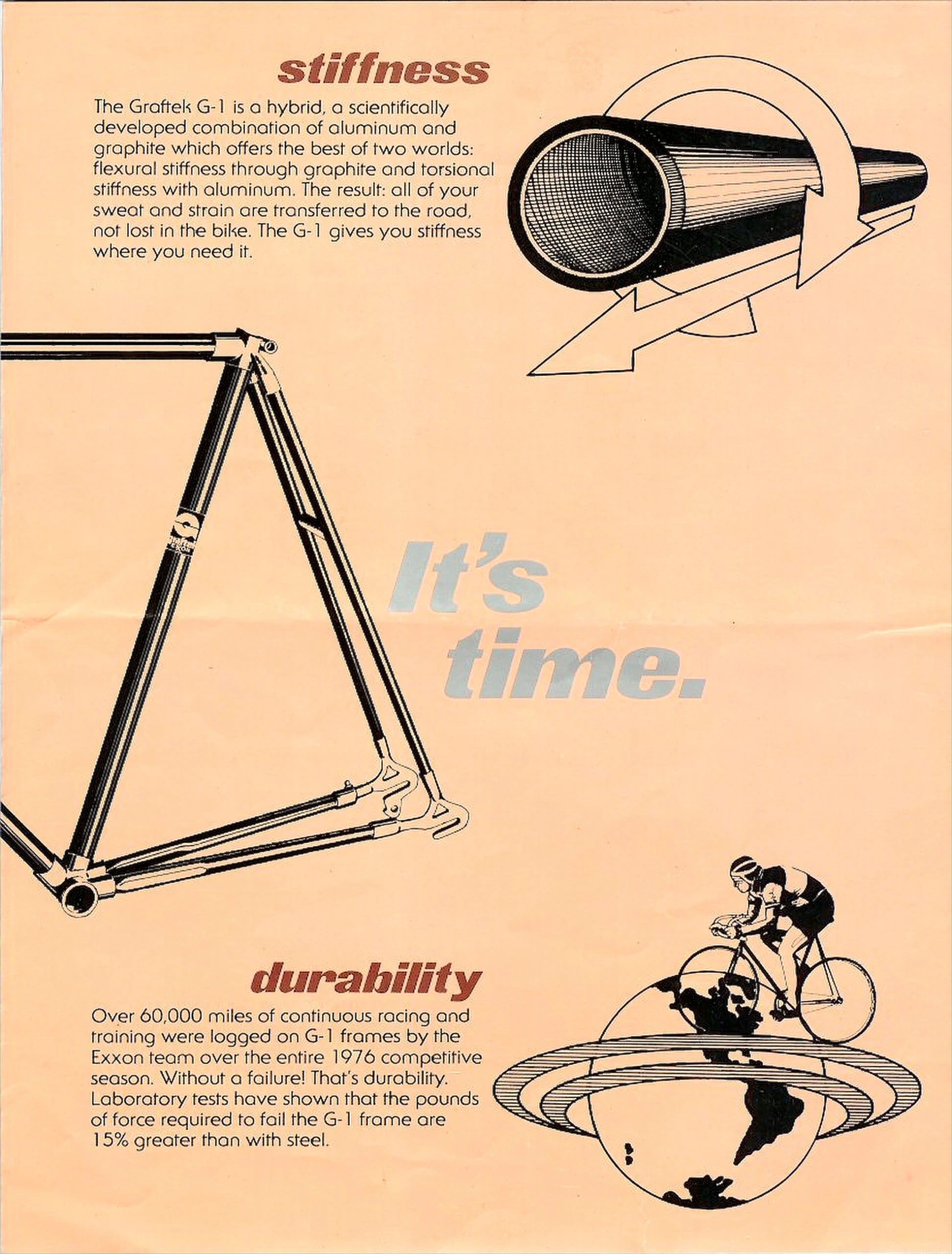
stiffness
The Graftek G-1 is a hybrid, a scientifically developed combination of aluminum and graphite which offers the best of two worlds: flexural stiffness through graphite and torsional stiffness with aluminum. The result: all of your sweat and strain are transferred to the road, not lost in the bike. The G-1 gives you stiffness where you need it.
It’s time.
durability
Over 60,000 miles of continuous racing and training were logged on G-1 frames by the Exxon team over the entire 1976 competitive season. Without a failure! That’s durability. Laboratory tests have shown that the pounds of force required to fail the G-1 frame are 15% greater than with steel.
[A drawing of a tube with curved arrows showing twisting and bending beside the heading “stiffness”, a large photograph of the seat tube, seat stays, chain stays and bottom bracket of a frame with the cover headline repeated across it, and a drawing of a racing cyclist riding on a globe beside the heading “durability”.]
— Page 5 —
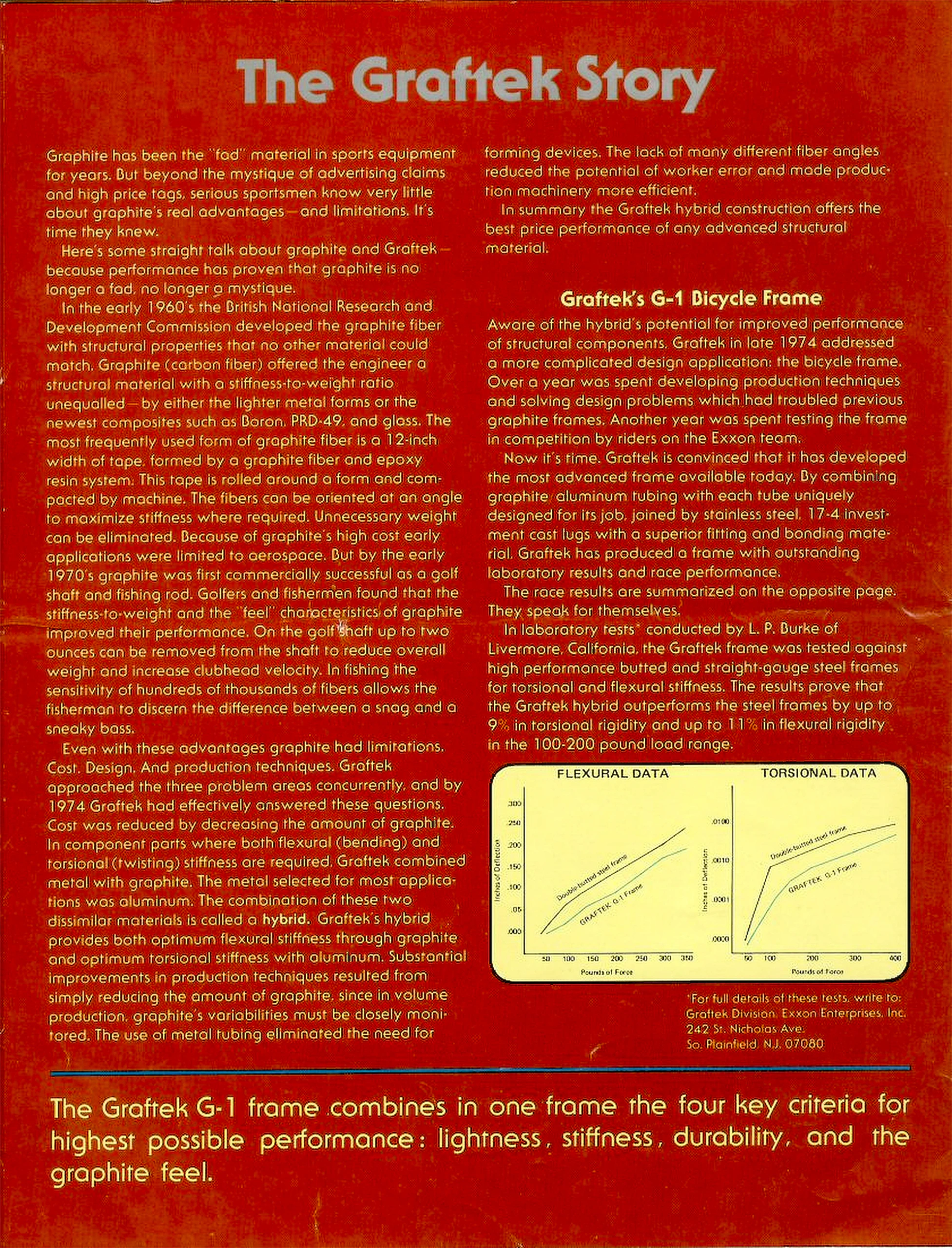
The Graftek Story
Graphite has been the “fad” material in sports equipment for years. But beyond the mystique of advertising claims and high price tags, serious sportsmen know very little about graphite’s real advantages—and limitations. It’s time they knew.
Here’s some straight talk about graphite and Graftek—because performance has proven that graphite is no longer a fad, no longer a mystique.
In the early 1960’s the British National Research and Development Commission developed the graphite fiber with structural properties that no other material could match. Graphite (carbon fiber) offered the engineer a structural material with a stiffness-to-weight ratio unequalled—by either the lighter metal forms or the newest composites such as Boron, PRD-49, and glass. The most frequently used form of graphite fiber is a 12-inch width of tape, formed by a graphite fiber and epoxy resin system. This tape is rolled around a form and compacted by machine. The fibers can be oriented at an angle to maximize stiffness where required. Unnecessary weight can be eliminated. Because of graphite’s high cost early applications were limited to aerospace. But by the early 1970’s graphite was first commercially successful as a golf shaft and fishing rod. Golfers and fishermen found that the stiffness-to-weight and the “feel” characteristics of graphite improved their performance. On the golf shaft up to two ounces can be removed from the shaft to reduce overall weight and increase clubhead velocity. In fishing the sensitivity of hundreds of thousands of fibers allows the fisherman to discern the difference between a snag and a sneaky bass.
Even with these advantages graphite had limitations. Cost. Design. And production techniques. Graftek approached the three problem areas concurrently, and by 1974 Graftek had effectively answered these questions. Cost was reduced by decreasing the amount of graphite. In component parts where both flexural (bending) and torsional (twisting) stiffness are required, Graftek combined metal with graphite. The metal selected for most applications was aluminum. The combination of these two dissimilar materials is called a hybrid. Graftek’s hybrid provides both optimum flexural stiffness through graphite and optimum torsional stiffness with aluminum. Substantial improvements in production techniques resulted from simply reducing the amount of graphite, since in volume production, graphite’s variabilities must be closely monitored. The use of metal tubing eliminated the need for forming devices. The lack of many different fiber angles reduced the potential of worker error and made production machinery more efficient.
In summary the Graftek hybrid construction offers the best price performance of any advanced structural material.
Graftek’s G-1 Bicycle Frame
Aware of the hybrid’s potential for improved performance of structural components, Graftek in late 1974 addressed a more complicated design application: the bicycle frame. Over a year was spent developing production techniques and solving design problems which had troubled previous graphite frames. Another year was spent testing the frame in competition by riders on the Exxon team.
Now it’s time. Graftek is convinced that it has developed the most advanced frame available today. By combining graphite/aluminum tubing with each tube uniquely designed for its job, joined by stainless steel, 17-4 investment cast lugs with a superior fitting and bonding material, Graftek has produced a frame with outstanding laboratory results and race performance.
The race results are summarized on the opposite page. They speak for themselves.
In laboratory tests* conducted by L. P. Burke of Livermore, California, the Graftek frame was tested against high performance butted and straight-gauge steel frames for torsional and flexural stiffness. The results prove that the Graftek hybrid outperforms the steel frames by up to 9% in torsional rigidity and up to 11% in flexural rigidity in the 100-200 pound load range.
FLEXURAL DATA
Inches of Deflection
.300 | .250 | .200 | .150 | .100 | .05 | .000
Double-butted steel frame
GRAFTEK G-1 Frame
50 | 100 | 150 | 200 | 250 | 300 | 350
Pounds of Force
TORSIONAL DATA
Inches of Deflection
.0100 | .0010 | .0001 | .0000
Double-butted steel frame
GRAFTEK G-1 Frame
50 | 100 | 200 | 300 | 400
Pounds of Force
*For full details of these tests, write to:
Graftek Division, Exxon Enterprises, Inc.
242 St. Nicholas Ave.
So. Plainfield, N.J. 07080
The Graftek G-1 frame combines in one frame the four key criteria for highest possible performance: lightness, stiffness, durability, and the graphite feel.
[The “Graftek Story” text in two columns about graphite, the hybrid of graphite and aluminum and the G-1 bicycle frame, with two line charts on a yellow panel headed “FLEXURAL DATA” and “TORSIONAL DATA” comparing a double-butted steel frame with the Graftek G-1 frame, and a closing line naming four criteria.]
— Page 6 —
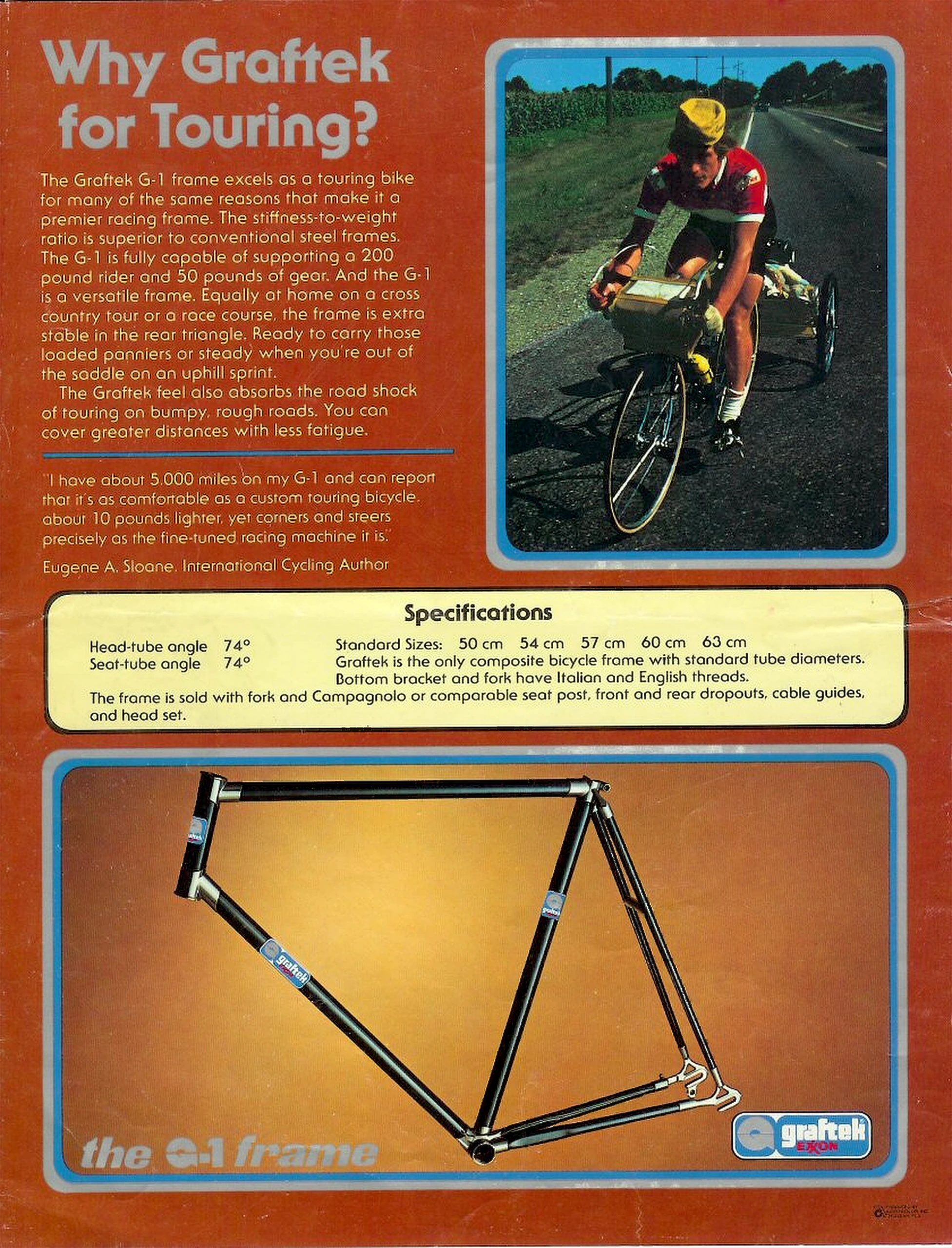
Why Graftek for Touring?
The Graftek G-1 frame excels as a touring bike for many of the same reasons that make it a premier racing frame. The stiffness-to-weight ratio is superior to conventional steel frames. The G-1 is fully capable of supporting a 200 pound rider and 50 pounds of gear. And the G-1 is a versatile frame. Equally at home on a cross country tour or a race course, the frame is extra stable in the rear triangle. Ready to carry those loaded panniers or steady when you’re out of the saddle on an uphill sprint.
The Graftek feel also absorbs the road shock of touring on bumpy, rough roads. You can cover greater distances with less fatigue.
“I have about 5,000 miles on my G-1 and can report that it’s as comfortable as a custom touring bicycle, about 10 pounds lighter, yet corners and steers precisely as the fine-tuned racing machine it is.”
Eugene A. Sloane, International Cycling Author
Specifications
Head-tube angle | 74°
Seat-tube angle | 74°
Standard Sizes: 50 cm | 54 cm | 57 cm | 60 cm | 63 cm
Graftek is the only composite bicycle frame with standard tube diameters. Bottom bracket and fork have Italian and English threads.
The frame is sold with fork and Campagnolo or comparable seat post, front and rear dropouts, cable guides, and head set.
the G-1 frame
graftek
EXXON
[illegible]
[A touring cyclist in a red and white jersey riding a loaded bicycle with a trailer on a country road, in a framed photograph beside the heading “Why Graftek for Touring?” and a yellow panel of specifications, above a studio photograph of the bare G-1 frame captioned “the G-1 frame”. A very small printed line with a logo at the lower right corner is too small to read.]
— Page 7 —
graftek
EXXON
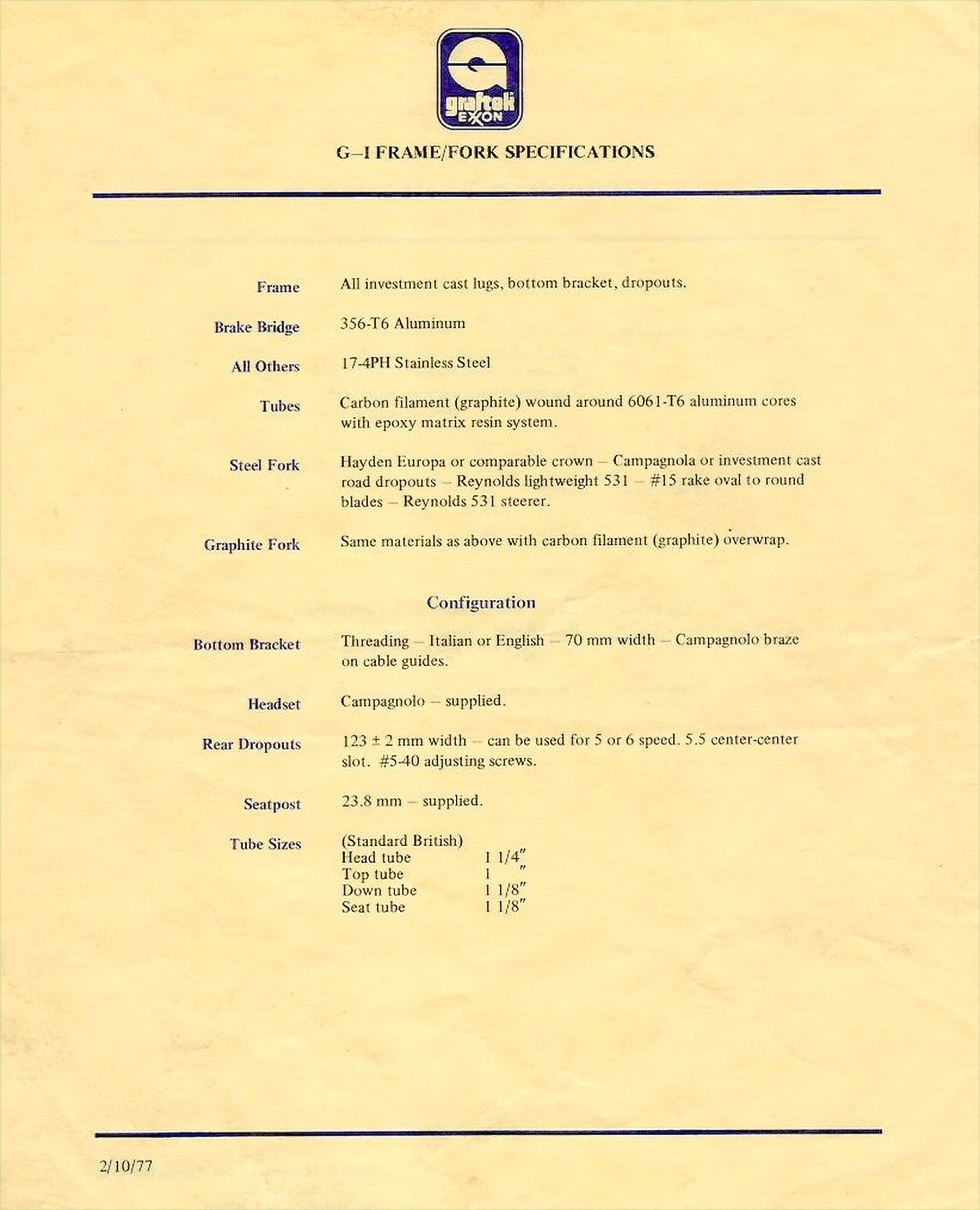
G–I[?] FRAME/FORK SPECIFICATIONS
Frame | All investment cast lugs, bottom bracket, dropouts.
Brake Bridge | 356-T6 Aluminum
All Others | 17-4PH Stainless Steel
Tubes | Carbon filament (graphite) wound around 6061-T6 aluminum cores with epoxy matrix resin system.
Steel Fork | Hayden Europa or comparable crown – Campagnola or investment cast road dropouts – Reynolds lightweight 531 – #15 rake oval to round blades – Reynolds 531 steerer.
Graphite Fork | Same materials as above with carbon filament (graphite) overwrap.
Configuration
Bottom Bracket | Threading – Italian or English – 70 mm width – Campagnolo braze on cable guides.
Headset | Campagnolo – supplied.
Rear Dropouts | 123 ± 2 mm width – can be used for 5 or 6 speed. 5.5 center-center slot. #5-40 adjusting screws.
Seatpost | 23.8 mm – supplied.
Tube Sizes | (Standard British)
Head tube | 1 1/4″
Top tube | 1 ”
Down tube | 1 1/8″
Seat tube | 1 1/8″
2/10/77
[The Graftek Exxon logo above a typed sheet headed “G–I FRAME/FORK SPECIFICATIONS” listing the frame, brake bridge, tubes and forks, then a “Configuration” section with the bottom bracket, headset, rear dropouts, seatpost and tube sizes, dated 2/10/77 at the lower left.]
— Page 8 —
graftek
EXXON
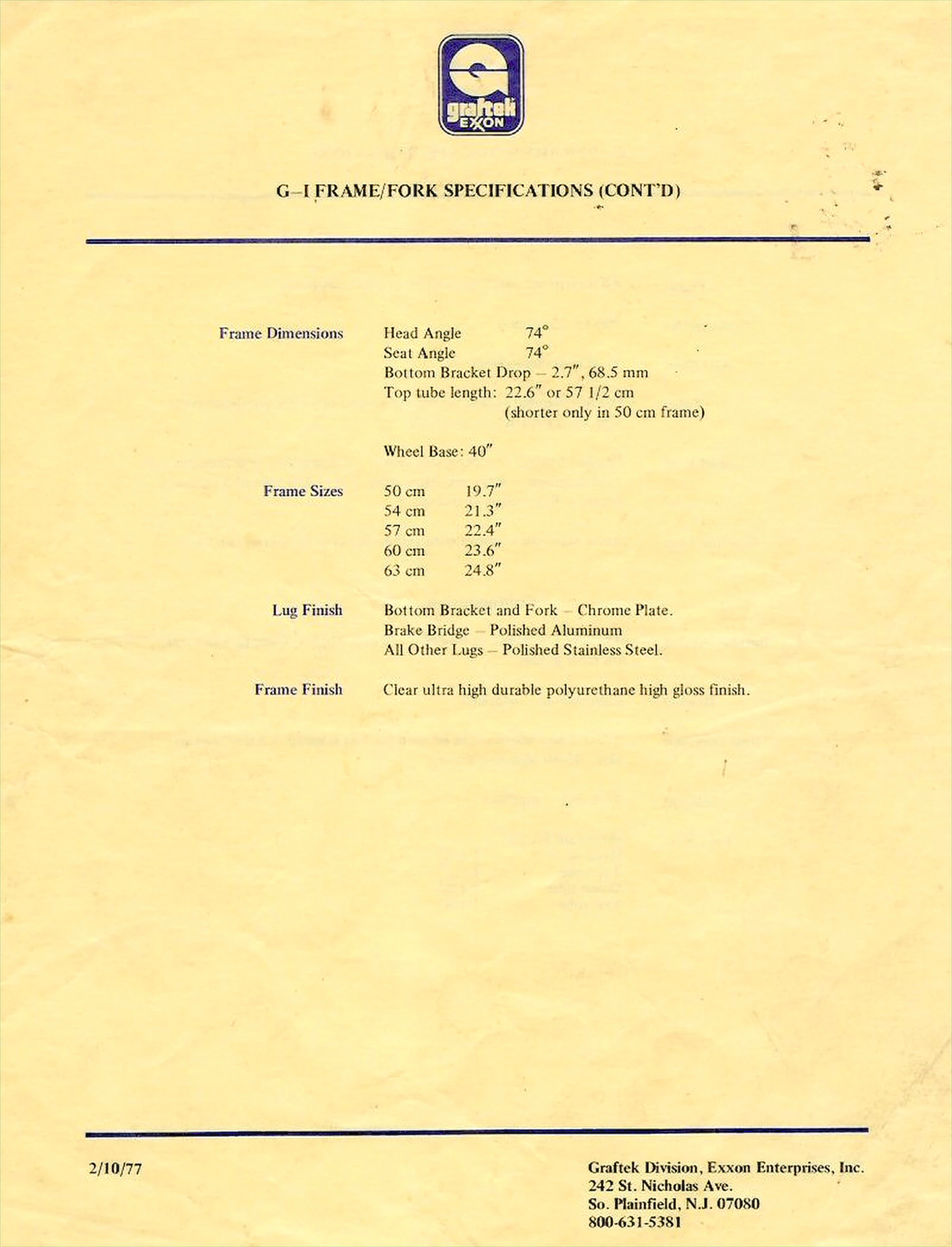
G–I[?] FRAME/FORK SPECIFICATIONS (CONT’D)
Frame Dimensions | Head Angle | 74°
| Seat Angle | 74°
| Bottom Bracket Drop – 2.7″, 68.5 mm
| Top tube length: | 22.6″ or 57 1/2 cm
| | (shorter only in 50 cm frame)
| Wheel Base: 40″
Frame Sizes | 50 cm | 19.7″
| 54 cm | 21.3″
| 57 cm | 22.4″
| 60 cm | 23.6″
| 63 cm | 24.8″
Lug Finish | Bottom Bracket and Fork – Chrome Plate.
| Brake Bridge – Polished Aluminum
| All Other Lugs – Polished Stainless Steel.
Frame Finish | Clear ultra high durable polyurethane high gloss finish.
2/10/77
Graftek Division, Exxon Enterprises, Inc.
242 St. Nicholas Ave.
So. Plainfield, N.J. 07080
800-631-5381
[The Graftek Exxon logo above a typed sheet with the continued frame and fork specifications title, giving frame dimensions, frame sizes in centimeters and inches, lug finish and frame finish, dated 2/10/77 with the Graftek Division address and a telephone number at the foot. Scattered dark specks, probably dirt or toner flecks, lie near the upper right edge.]
Ebykr presents this material for research and education. If you hold rights to it or notice an ownership issue, please contact us and we will respond promptly.
The Ebykr Digest
New articles, timelines, catalog finds and registry activity — assembled from the archive once a month. Your address is never shared.
Double opt-in. One email per month. Unsubscribe at any time with one click.