About Ebykr
Ebykr celebrates classic and vintage lightweight bicycles through provocative imagery and opinion. Ride along with us.
About Ebykr
Ebykr celebrates classic and vintage lightweight bicycles through provocative imagery and opinion. Ride along with us.

Source: L'Officiel du cycle, du motocycle et du camping, N° 24, 14 June 1952, page 21; scan of the issue from Cycle Memory (Mémoire du Cycle), Collection privée F.
| Type | Review |
|---|---|
| Year | 1952 |
| Publisher | L'Officiel du cycle |
| Country | France |
| Language | French |
| Pages | 1 |
| Source | L'Officiel du cycle, du motocycle et du camping, N° 24, 14 June 1952, page 21; scan of the issue from Cycle Memory (Mémoire du Cycle), Collection privée F. |
| Credit | Ebykr archive |
| Identifier | Permalink https://cyclememory.org/fr/search-coll-list.php?collectionID=325&docID=B-1-0000001004 |
| Transcription | Headings and specifications transcribed; article text summarized |
Equipements & Outillage Les remorques « monoroue » OLITUB La gaine « OLUX » Les avertisseurs CLEAR HOOTERS Le tire-stop « AFA » Le tampon de brillantage OUATOR — 21 —
This is a magazine article, so its running text is summarized here rather than reproduced; the headline, byline, specifications and scores are transcribed as printed.
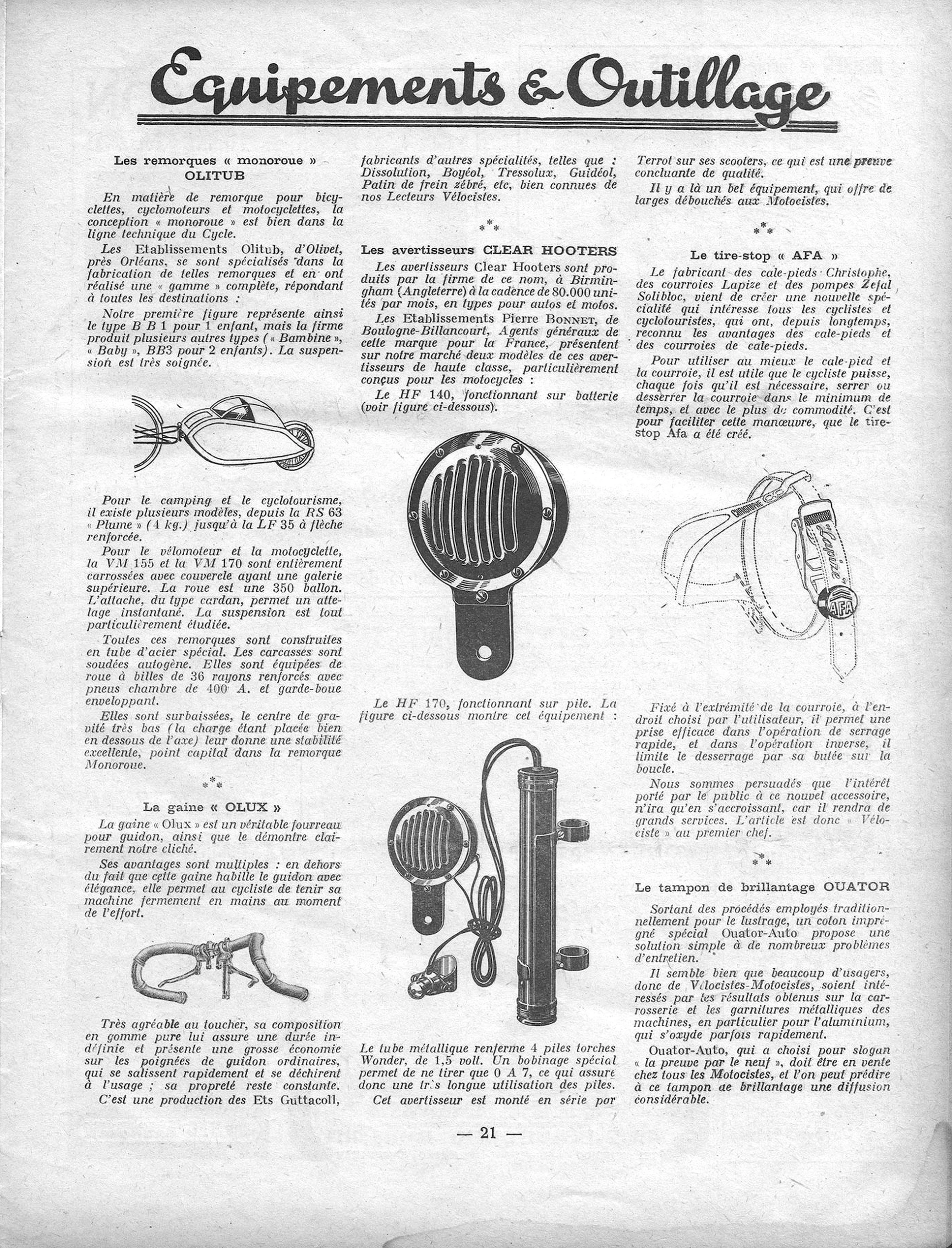
“Équipements & Outillage”, L’Officiel du cycle, 14 June 1952, page 21: Olitub single-wheel trailers for bicycles, the Olux handlebar sleeve of Guttacoll, Clear Hooters horns, the AFA tire-stop for toe straps and the Ouator polishing pad, with drawings. The headings are transcribed as printed; the text is summarized in Ebykr’s words, and the page image carries it in full.
— Page 1 —
Equipements & Outillage
Les remorques « monoroue » OLITUB
La gaine « OLUX »
Les avertisseurs CLEAR HOOTERS
Le tire-stop « AFA »
Le tampon de brillantage OUATOR
[Ebykr summary; the article’s text is not reproduced. The magazine’s equipment column reviews five products. Olitub single-wheel (“monoroue”) trailers: the writer calls the single-wheel trailer for bicycles, cyclomoteurs and motorcycles sound practice, and says the Etablissements Olitub of Olivet, near Orléans, specialize in such trailers and make a complete range. The first drawing shows the type B B 1 for one child; the firm also makes the “Bambine”, the “Baby” and the BB3 for two children, all with careful suspension. For camping and cyclotourism there are models from the RS 63 “Plume” (4 kg.) to the LF 35 with a reinforced drawbar; for the vélomoteur and the motorcycle the VM 155 and the VM 170 have fully enclosed bodies with a lid carrying a roof rack, a 350 balloon wheel, a cardan-type hitch for instant coupling and specially designed suspension. All are built of special steel tube with autogenously welded frames, run on a ball-bearing wheel with 36 reinforced spokes, a 400 A. tire and tube and an enclosing mudguard, and are underslung with the load carried below the axle for a low center of gravity and the stability a single-wheel trailer needs. The Olux handlebar sleeve (“gaine”) is a sheath for the whole handlebar that dresses it neatly and gives the rider a firm grip when pulling hard; made of pure rubber, it is pleasant to hold, lasts indefinitely and saves on ordinary grips, which soil and tear, and it stays clean. It is made by the Ets Guttacoll, makers of other specialties known to the magazine’s dealer readers: Dissolution, Boyéol, Tressolux, Guidéol and the “Patin de frein zébré” brake block. Clear Hooters horns are made by the firm of that name in Birmingham (Angleterre) at 80.000 units a month in types for cars and motorcycles; the Etablissements Pierre Bonnet of Boulogne-Billancourt, general agents for France, offer two high-grade models built for motorcycles: the HF 140, run from the battery, and the HF 170, run from dry cells held in a metal tube with four Wonder 1,5 volt torch batteries, its special winding drawing only 0 A 7 for long battery life. The horn is fitted as standard by Terrot on its scooters, which the writer takes as proof of quality and an opening for motorcycle dealers. The AFA tire-stop comes from the maker of Christophe toe clips, Lapize toe straps and Zefal Solibloc pumps: fixed to the end of the toe strap wherever the rider chooses, it gives a firm hold for quick tightening and, when loosening, stops against the buckle; the writer expects it to sell well to cycle dealers. The Ouator polishing pad is a specially impregnated cotton from Ouator-Auto that replaces traditional polishing methods and should interest cycle and motorcycle dealers for bodywork and bright metal, especially aluminum, which can oxidize quickly; the firm’s slogan offers a like-new finish as its proof, and the pad should be stocked by every motorcycle dealer.]
[Five illustrations. In the first column a line drawing of an enclosed child’s trailer with a clear canopy, riding on a single spoked wheel at its tail and hitched to the rear wheel of a bicycle; lower in the column a shaded drawing of a dropped handlebar with its stem and two brake levers, sheathed along its whole length in the Olux sleeve. In the middle column the round Clear Hooters HF 140 horn with a slotted grille and a slotted mounting bracket; below it the HF 170 outfit, the same horn with its coiled cable, a push-button switch on a clip and the long battery tube with two clamps. In the third column a dotted line drawing of a toe clip lettered “CHRISTOPHE” with a strap lettered “Lapize”, the strap’s end fitted with a round knob lettered “AFA”. No signature or monogram on any illustration.]
— 21 —
Ebykr presents this material for research and education. If you hold rights to it or notice an ownership issue, please contact us and we will respond promptly.
The Ebykr Digest
New articles, timelines, catalog finds and registry activity — assembled from the archive once a month. Your address is never shared.
Double opt-in. One email per month. Unsubscribe at any time with one click.