About Ebykr
Ebykr celebrates classic and vintage lightweight bicycles through provocative imagery and opinion. Ride along with us.
About Ebykr
Ebykr celebrates classic and vintage lightweight bicycles through provocative imagery and opinion. Ride along with us.

Source: Englebert Vélo-Magazine, n° 16, November 1951, pages 13, 14, 15 and 16 (the issue prints no folios: pages counted from the front cover); scan of the issue from Cycle Memory (Mémoire du Cycle), Collection privée
| Type | Review |
|---|---|
| Year | 1951 |
| Publisher | Englebert Vélo-Magazine |
| Country | France |
| Language | French |
| Pages | 4 |
| Source | Englebert Vélo-Magazine, n° 16, November 1951, pages 13, 14, 15 and 16 (the issue prints no folios: pages counted from the front cover); scan of the issue from Cycle Memory (Mémoire du Cycle), Collection privée |
| Credit | Ebykr archive |
| Identifier | Permalink https://cyclememory.org/fr/search-coll-list.php?collectionID=1999&docID=B-1-0000000980 |
| Transcription | Headings and specifications transcribed; article text summarized |
REGINALD HARRIS DEVINT CHAMPION DU MONDE DE VITESSE EN S'ENTRAINANT EXCLUSIVEMENT SUR ROUTE par Emile MASSON. PAS DE PISTE !... PENDANT 13 ANS, IL SE PREPARA SUR LA ROUTE... IL NE LAISSE RIEN AU HASARD... SON INTÉRIEUR NE RAPPELLE PAS SA PROFESSION... IL AIME LES CHIENS, LES AUTOS ET... LA MUSIQUE CLASSIQUE... Emile MASSON.
This is a magazine article, so its running text is summarized here rather than reproduced; the headline, byline, specifications and scores are transcribed as printed.
Emile Masson’s profile of the English sprinter Reginald Harris, professional world sprint champion of 1949, 1950 and 1951, in Englebert Vélo-Magazine, n° 16, November 1951: how he trained only on the road, his gears and racing weight, his Manchester and Wilmslow life and his match with Arie Van Vliet at Cardiff, with five photographs. The title, headings and signature are transcribed as printed; the text and captions are summarized in Ebykr’s words, and the page images carry them in full.
— Page 1 —
REGINALD HARRIS
DEVINT CHAMPION DU MONDE DE VITESSE EN S’ENTRAINANT EXCLUSIVEMENT SUR ROUTE
par Emile MASSON.
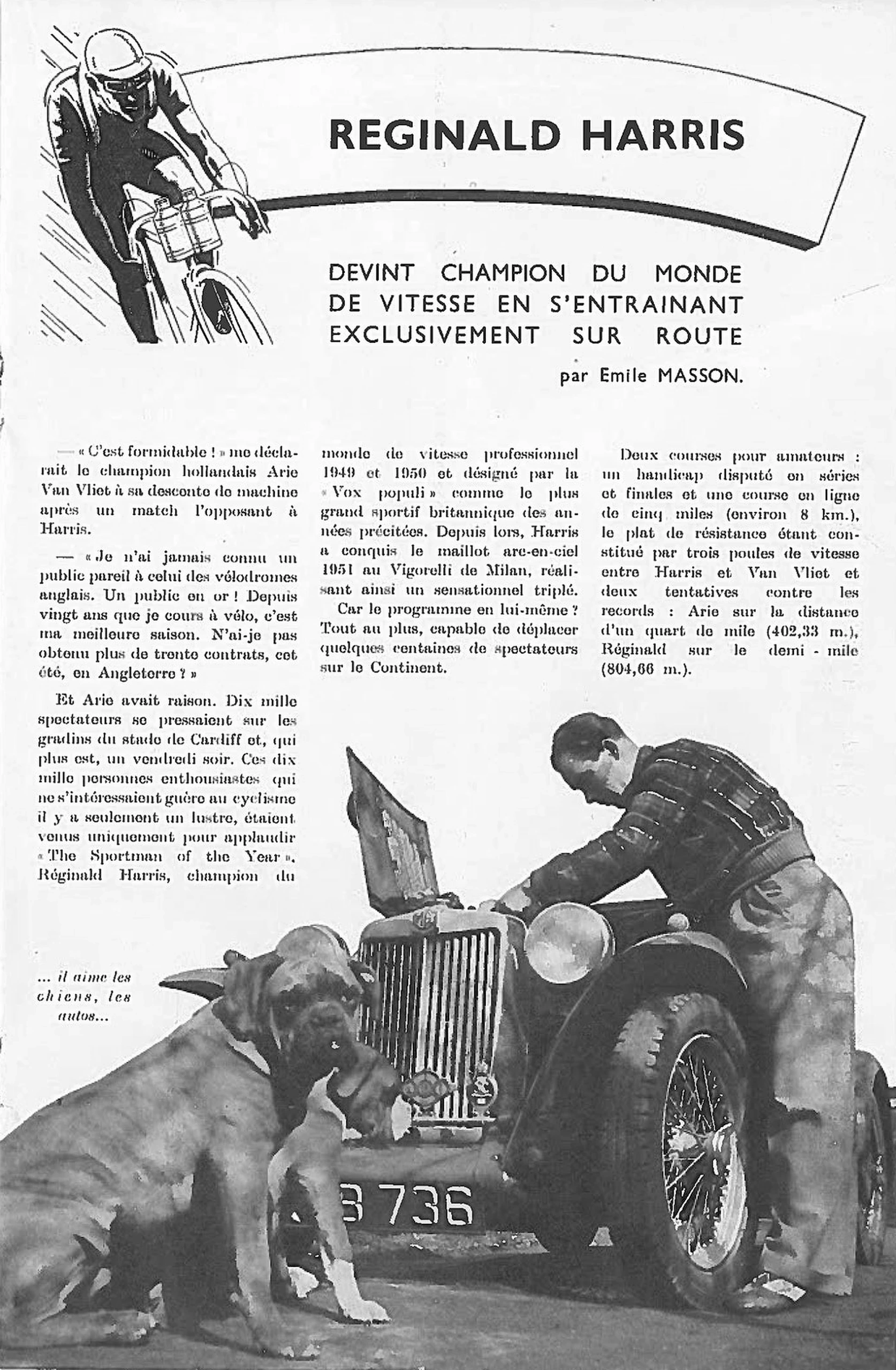
[Ebykr summary; the article’s text is not reproduced. The article opens on the Dutch champion Arie Van Vliet stepping off his machine after a match against Harris and praising the English velodrome crowds: in 20 years of racing he had never known such a public, it was his best season and he had signed more than 30 contracts in England (Angleterre) that summer. The author agrees: 10,000 spectators packed the terraces of the Cardiff stadium on a Friday evening, a public that had cared little for cycling only five years before, and they came only to applaud “The Sportman of the Year”, Réginald Harris, professional world sprint champion in 1949 and 1950, voted by the “Vox populi” the greatest British sportsman of those years, who had since won the 1951 rainbow jersey at the Vigorelli in Milan (Milan) for a remarkable triple. The program itself, the author notes, would have drawn only a few hundred spectators on the Continent: two amateur races, a handicap run in heats and finals and a five-mile scratch race (about 8 km.), with the main dish three sprint heats between Harris and Van Vliet and two record attempts, Arie over the quarter mile (402,33 m.) and Réginald over the half mile (804,66 m.). The single photograph caption says that Harris likes dogs and cars.]
[A line drawing at the head of the page shows a track sprinter in a padded helmet and goggles bent low over the bars of a track bicycle with two bottles in a carrier on the handlebar, riding toward the viewer, with the title set in a banner that sweeps out from behind him; the drawing carries no visible signature. A large photograph across the lower half shows Harris in a checked sweater leaning over the open bonnet of an open sports car with spoked wheels, an octagonal radiator badge and a number plate ending “B 736”, with two large mastiff-type dogs sitting in front of the car; its italic caption stands at the left margin and opens a caption sentence that runs on through the photographs of the following pages.]
— Page 2 —
PAS DE PISTE !…
PENDANT 13 ANS, IL SE PREPARA SUR LA ROUTE…
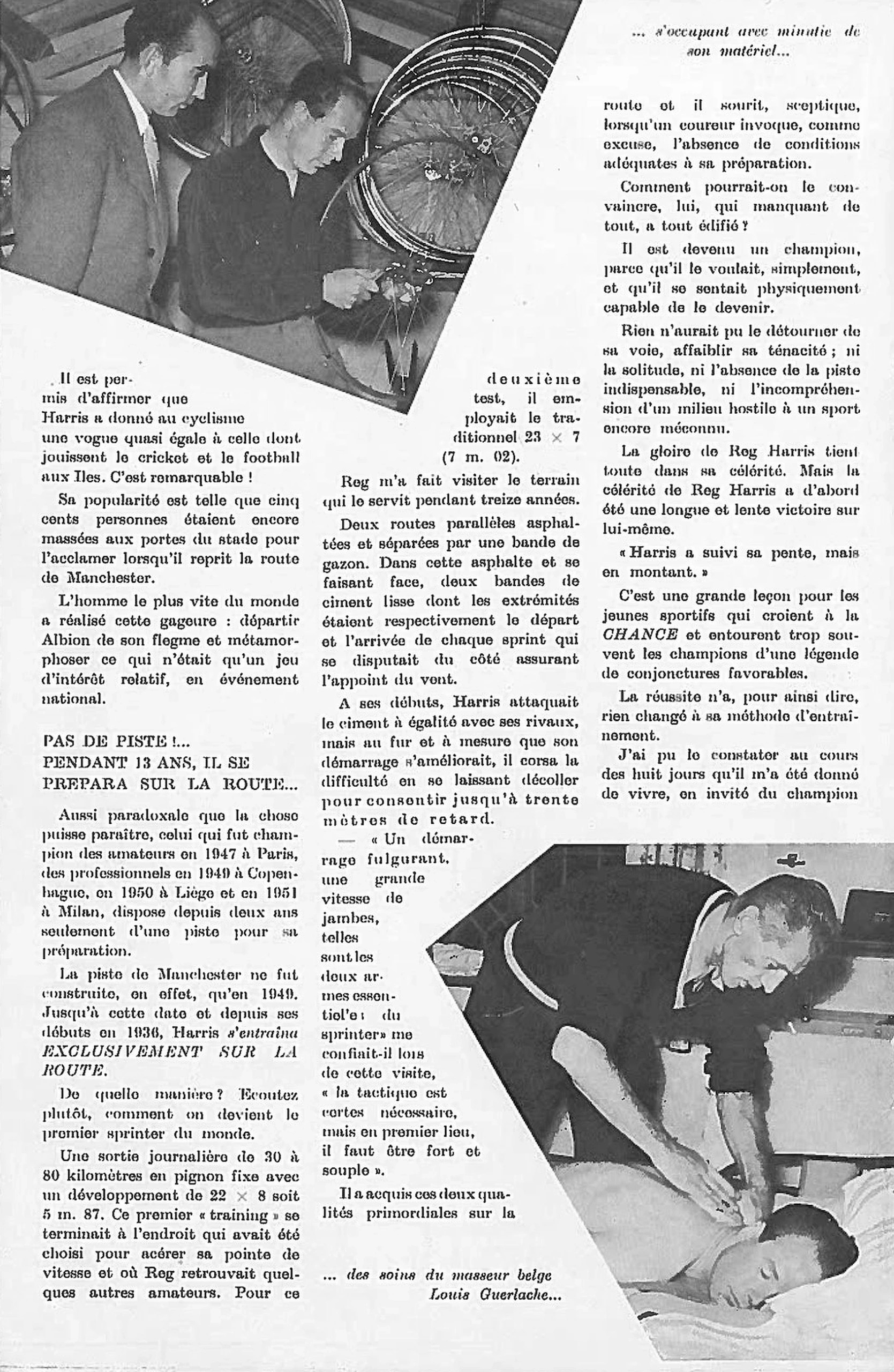
[Ebykr summary; the article’s text is not reproduced. The text runs on from the previous page. The author argues that Harris has given cycling a following in the British Isles almost equal to that of cricket and football: 500 people still waited at the stadium gates to cheer him as he set off back toward Manchester, and the fastest man in the world had shaken Albion out of its reserve and turned a minor sport into a national event. Under the section heading the author sets out the paradox: the man who was amateur champion in 1947 in Paris and professional champion in 1949 in Copenhague, in 1950 in Liège and in 1951 in Milan has had a track to train on for only two years, since the Manchester track was built only in 1949; from his debut in 1936 until then Harris trained exclusively on the road (the print sets this in italic capitals). His method: a daily ride of 30 to 80 kilometers on a fixed wheel geared 22 x 8, that is 5 m. 87, ending at a chosen spot where Reg met a few other amateurs to sharpen his sprint, and for this second test he used the traditional 23 x 7 (7 m. 02). Reg showed the author the ground he used for 13 years: two parallel asphalt roads separated by a strip of grass, with two strips of smooth cement facing each other marking the start and finish of each sprint, which was ridden on whichever side had the wind behind. At first Harris started level with his rivals, but as his jump improved he made it harder by giving away up to 30 meters. Harris told the author that a lightning jump and great leg speed are the sprinter’s two weapons, and that tactics matter but strength and suppleness come first; he built both on the road, and he smiles skeptically at riders who blame poor training conditions. The author praises his will and tenacity against solitude, the lack of a track and a milieu hostile to a little-known sport, says that the speed of Reg Harris was first a long victory over himself and draws a lesson for young athletes who believe in luck (the print sets CHANCE in italic capitals) and surround champions with legends of good fortune. Success has not changed his training method, as the author saw during eight days spent as the champion’s guest (the sentence runs on to the next page). The two captions on this page continue the running caption: Harris attending meticulously to his equipment, and the care of the Belgian masseur Louis Guerlache.]
[Two photographs cut on the diagonal: at the upper left, Harris in a dark sweater truing or working on a spoked wheel, watched by a man in a suit, with more wheels hanging on the workshop wall behind; at the lower right, a masseur in a dark shirt massaging the back and shoulders of a rider lying face down on a table. The first caption stands at the upper right, the second at the foot below the center column.]
— Page 3 —
IL NE LAISSE RIEN AU HASARD…
SON INTÉRIEUR NE RAPPELLE PAS SA PROFESSION…
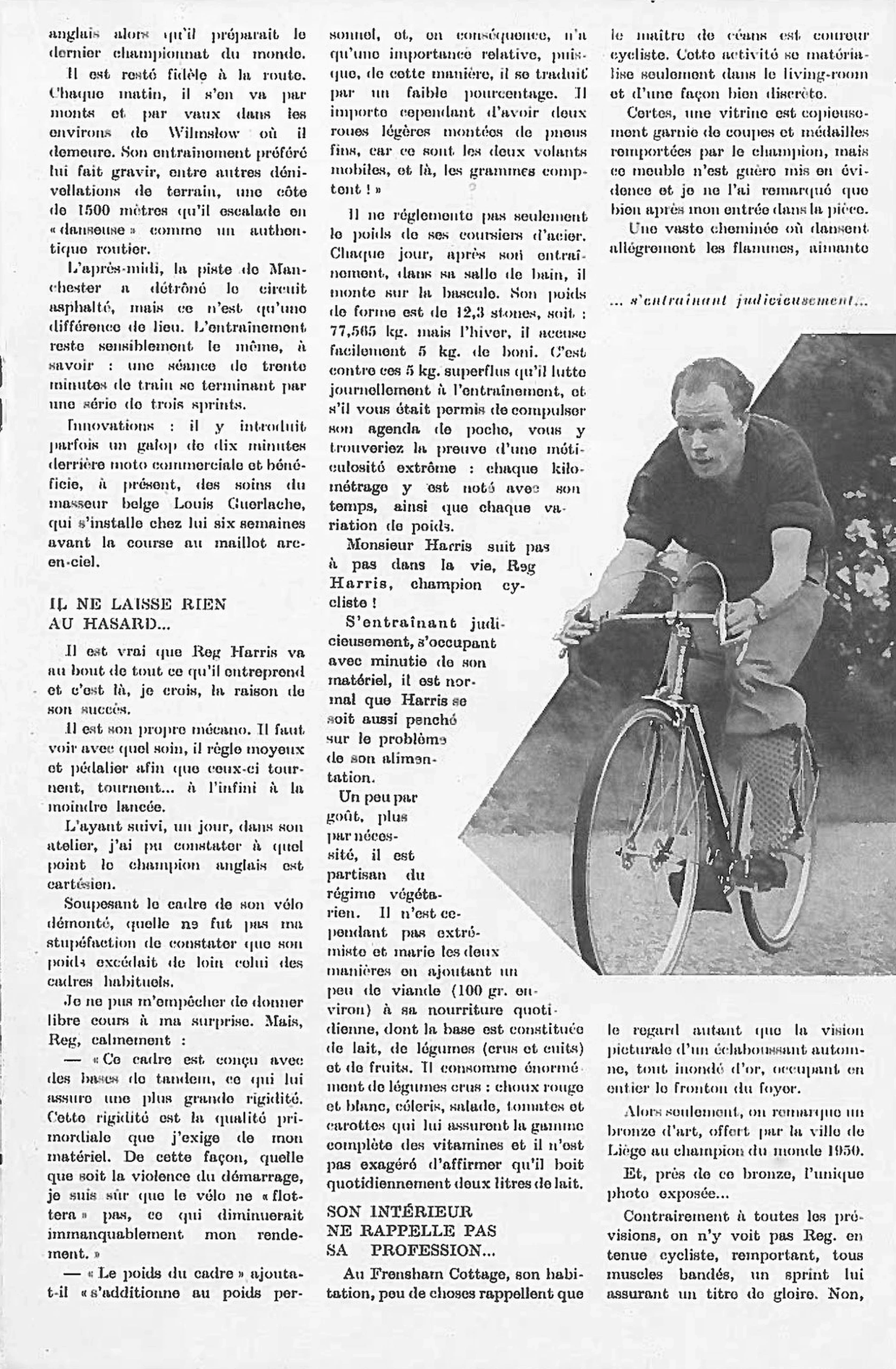
[Ebykr summary; the article’s text is not reproduced. The text runs on from the previous page, where the author was the English champion’s guest while he prepared for the last world championship. Harris has stayed faithful to the road: every morning he rides over hill and dale around Wilmslow, where he lives, and his favorite training includes a 1500-meter climb that he takes out of the saddle like a real road rider. In the afternoon the Manchester track has replaced the asphalt circuit, but the work is much the same: a 30-minute session at pace ending with a series of three sprints. The innovations are an occasional 10-minute burst behind a commercial motorcycle and, now, the care of the Belgian masseur Louis Guerlache, who moves into his house six weeks before the rainbow jersey race. Under the first section heading the author says Reg Harris carries everything through to the end: he is his own mechanic and adjusts his hubs and bottom bracket so they spin on and on, and in his workshop the author was amazed to find the frame of his dismantled bicycle far heavier than ordinary frames. Reg explained that it is built with tandem tubing for greater stiffness, the quality he demands above all, so that the bicycle does not flex under the hardest jump; frame weight only adds a small percentage to the rider’s own weight, but the two wheels, with light rims and fine tires, are the moving flywheels where every gram counts. He also weighs himself daily on the bathroom scale after training: his racing weight is 12,3 stones, that is 77,565 kg., but in winter he easily gains 5 kg., which he fights every day, and his pocket diary records every distance ridden with its time and every change of weight. Partly by taste and more by necessity he follows a vegetarian diet, though not strictly: he adds about 100 gr. of meat a day to a base of milk, raw and cooked vegetables and fruit, eats large amounts of raw vegetables (red and white cabbage, celery, salad, tomatoes and carrots) for their vitamins and drinks two liters of milk a day. Under the second section heading the author describes his home, Frensham Cottage, where little shows that the owner is a racing cyclist: a display cabinet full of cups and medals stands unobtrusively in the living-room; a large fireplace with a painting of a golden autumn above it draws the eye; then one notices an art bronze given by the city of Liège to the 1950 world champion, and beside it the only photograph on show, which, against all expectation, does not show Reg in racing kit winning a sprint (the sentence runs on to the next page). The caption on this page continues the running caption: Harris training judiciously.]
[A photograph cut on the diagonal at the right of the page shows Harris in a dark short-sleeved jersey and long trousers riding toward the viewer on a road bicycle with dropped handlebars, a wristwatch on his left wrist and a hedge of flowering shrubs behind him; its caption stands above it at the right.]
— Page 4 —
IL AIME LES CHIENS, LES AUTOS ET… LA MUSIQUE CLASSIQUE…
Emile MASSON.
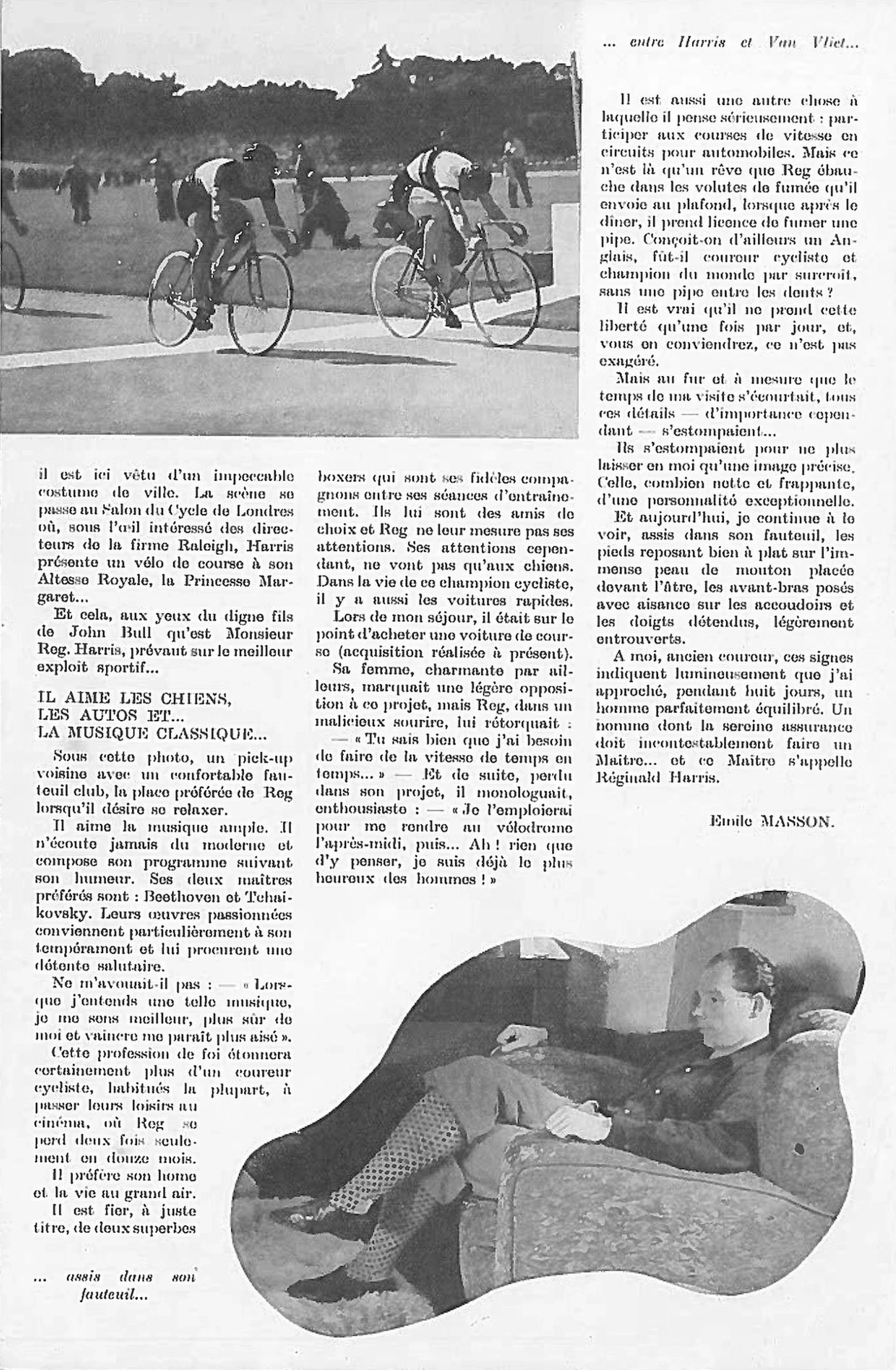
[Ebykr summary; the article’s text is not reproduced. The text runs on from the previous page: the one photograph on show in his living-room has Harris in an impeccable town suit at the London Cycle Show (Salon du Cycle de Londres), presenting a racing bicycle to Her Royal Highness Princess Margaret under the interested eye of the directors of the Raleigh firm, and for this worthy son of John Bull, Monsieur Reg. Harris, that counts for more than his best sporting exploit. Under the section heading the author describes a record player beside a comfortable club armchair beneath that photograph, Reg’s favorite place to relax. He likes full-scale music, never listens to modern work and chooses his program by mood; his two favorite composers are Beethoven and Tchaikovsky, whose passionate works suit his temperament and relax him, and he told the author that such music makes him feel better and surer of himself and makes winning seem easier. The author notes that this will surprise riders who spend their leisure at the cinema, where Reg goes only twice in 12 months; he prefers his home and the open air. He is proud of two superb boxers, his faithful companions between training sessions, and he also loves fast cars: during the author’s stay he was about to buy a racing car (since bought), over the mild objection of his wife, telling her with a smile that he needs some speed now and then and planning to drive it to the velodrome in the afternoons. He also dreams of racing cars on circuits, a dream he sketches in pipe smoke after dinner, when he allows himself his one pipe of the day, and the author asks whether an Englishman, even a racing cyclist and world champion, can be imagined without a pipe. As the visit drew to its end these details faded, leaving the author, a former racer himself, with the image of an exceptional and perfectly balanced man, seated in his armchair with his feet flat on a large sheepskin before the hearth, his forearms on the armrests and his fingers relaxed: a Master named Réginald Harris. The two captions on this page close the running caption: a sprint between Harris and Van Vliet, and Harris seated in his armchair.]
[Two photographs: across the top left, two track sprinters side by side on a velodrome, one in a dark jersey with a light band and one in a light jersey with a dark band, crouched over their track bicycles with spectators, officials and a kneeling photographer on the infield behind them, its caption at the upper right; and at the foot, in a rounded freeform frame, Harris seated at ease in a large upholstered armchair in a jacket, trousers and patterned socks, his forearms on the armrests, its caption at the lower left.]
Ebykr presents this material for research and education. If you hold rights to it or notice an ownership issue, please contact us and we will respond promptly.
The Ebykr Digest
New articles, timelines, catalog finds and registry activity — assembled from the archive once a month. Your address is never shared.
Double opt-in. One email per month. Unsubscribe at any time with one click.