About Ebykr
Ebykr celebrates classic and vintage lightweight bicycles through provocative imagery and opinion. Ride along with us.
About Ebykr
Ebykr celebrates classic and vintage lightweight bicycles through provocative imagery and opinion. Ride along with us.

Source: Englebert Vélo-Magazine, n° 16, November 1951, pages 21, 22, 23, 24, 25 and 26 (the issue prints no folios: pages counted from the front cover); scan of the issue from Cycle Memory (Mémoire du Cycle), Collection privée
| Type | Review |
|---|---|
| Year | 1951 |
| Publisher | Englebert Vélo-Magazine |
| Country | France |
| Language | French |
| Pages | 6 |
| Source | Englebert Vélo-Magazine, n° 16, November 1951, pages 21, 22, 23, 24, 25 and 26 (the issue prints no folios: pages counted from the front cover); scan of the issue from Cycle Memory (Mémoire du Cycle), Collection privée |
| Credit | Ebykr archive |
| Identifier | Permalink https://cyclememory.org/fr/search-coll-list.php?collectionID=1999&docID=B-1-0000000980 |
| Transcription | Headings and specifications transcribed; article text summarized |
L'HISTOIRE DU CYCLE ET L'EVOLUTION DE SON INDUSTRIE (II) par Oskar STÄHLIN. LA DYNASTIE STARLEY D C C A B A C C D A B F A LES PREMIERS PERFECTIONNEMENTS DE LA MICHAULINE B C A E D H G K. F I LE BICYCLE LES BICYCLETTES « DE SÉCURITÉ ». (A suivre.) Oskar …
This is a magazine article, so its running text is summarized here rather than reproduced; the headline, byline, specifications and scores are transcribed as printed.
The second installment of Oskar Stählin’s “L’Histoire du cycle et l’évolution de son industrie” in Englebert Vélo-Magazine, n° 16, November 1951: the Coventry Machinists and the Starley family, the improvements to the Michauline, the high bicycle and the first safety bicycles, with portraits, period engravings, diagrams and patent numbers. The title, headings and signature are transcribed as printed; the text and captions are summarized in Ebykr’s words, and the page images carry them in full.
— Page 1 —
L’HISTOIRE DU CYCLE ET L’EVOLUTION DE SON INDUSTRIE (II)
par Oskar STÄHLIN.
LA DYNASTIE STARLEY
D C C
A B A C C D A B F A
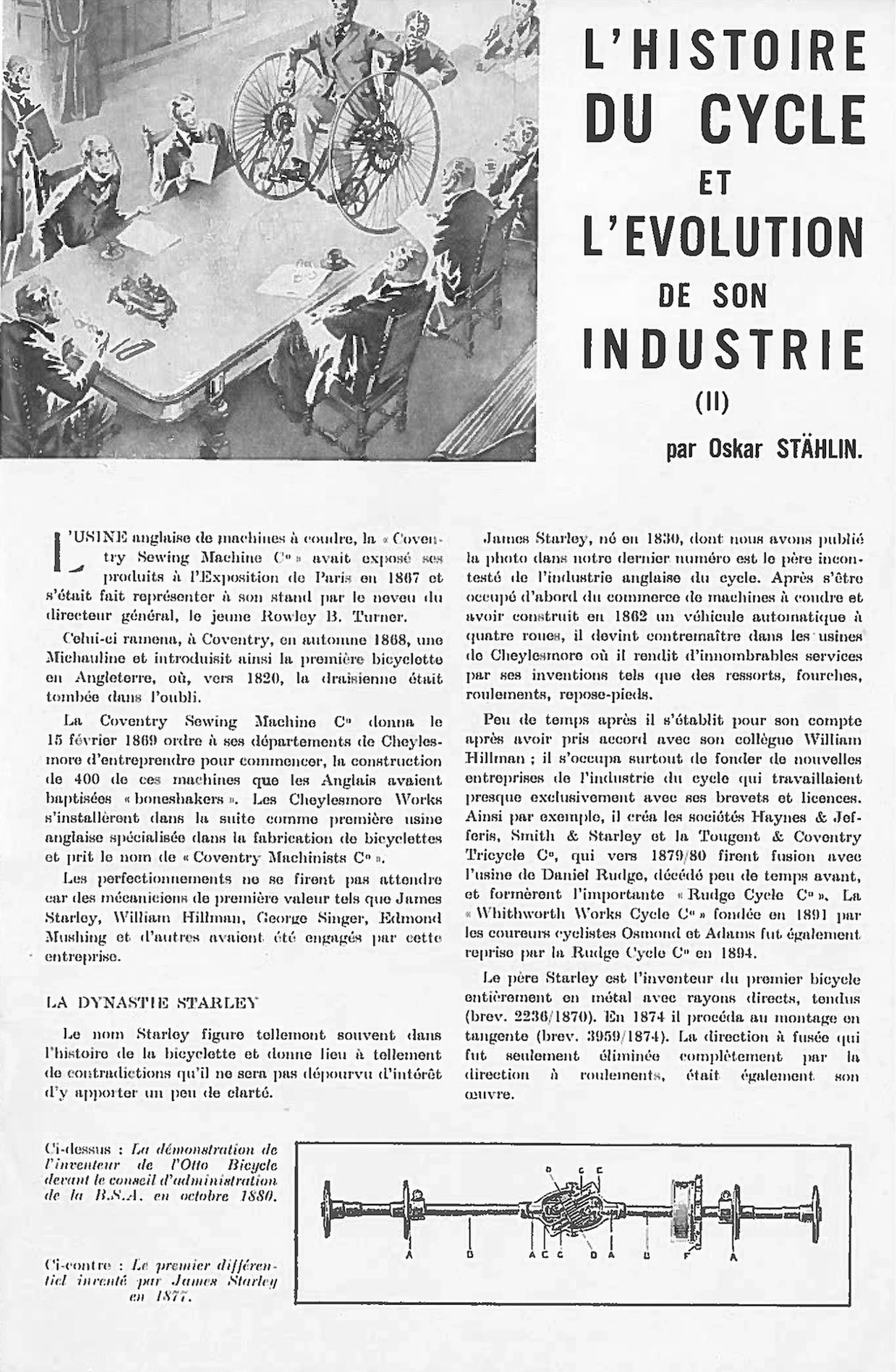
[Ebykr summary; the article’s text is not reproduced. The installment opens with the English sewing-machine works, the « Coventry Sewing Machine Cº », which showed its products at the Exposition in Paris in 1867, its stand kept by the general manager’s nephew, the young Rowley B. Turner. In autumn 1868 Turner brought a Michauline back to Coventry, so introducing the first bicycle to England, where the draisienne of about 1820 had been forgotten. On 15 February 1869 the Coventry Sewing Machine Cº ordered its Cheylesmore departments to build, to start with, 400 of these machines, which the English named « boneshakers »; the Cheylesmore Works then became the first English factory specialized in bicycles and took the name « Coventry Machinists Cº ». Improvements came quickly because the firm had engaged first-rate mechanics: James Starley, William Hillman, George Singer and Edmond Mushing. Under LA DYNASTIE STARLEY the author sets out to clear up the contradictions the Starley name causes. James Starley, born in 1830, whose photograph appeared in the previous issue, is called the undisputed father of the English cycle industry: after the sewing-machine trade and a four-wheeled automatic vehicle he built in 1862, he became foreman at the Cheylesmore works and contributed springs, forks, bearings and footrests. He then set up on his own in agreement with his colleague William Hillman and founded firms working almost entirely under his patents and licenses: Haynes & Jefferis, Smith & Starley and the Tougent & Coventry Tricycle Cº, which about 1879/80 merged with the works of the recently deceased Daniel Rudge to form the « Rudge Cycle Cº ». The « Whithworth Works Cycle Cº », founded in 1891 by the racing cyclists Osmond and Adams, was taken over by the Rudge Cycle Cº in 1894. Starley is credited with the first all-metal bicycle (the high wheeler) with direct tensioned spokes (brev. 2236/1870), tangent spoking in 1874 (brev. 3959/1874) and the cone steering head that ball-bearing steering later replaced. The captions identify the picture above as the inventor of the Otto Bicycle demonstrating it before the board of the B.S.A. in October 1880, and the drawing opposite as the first differential, invented by James Starley in 1877.]
[At the head of the page, beside the title, a wash illustration shows a boardroom: men in frock coats seated round a long table with papers and an inkstand watch a man riding a two-wheeled machine with two large side-by-side wheels across the room. At the foot, a framed line drawing shows a long axle with a wheel flange at each end, a geared differential in a housing at the center and a brake drum toward the right, its parts lettered A, B, C, D and F. Neither picture carries a legible signature.]
— Page 2 —
LES PREMIERS PERFECTIONNEMENTS DE LA MICHAULINE
B C A E D
H G K. F I
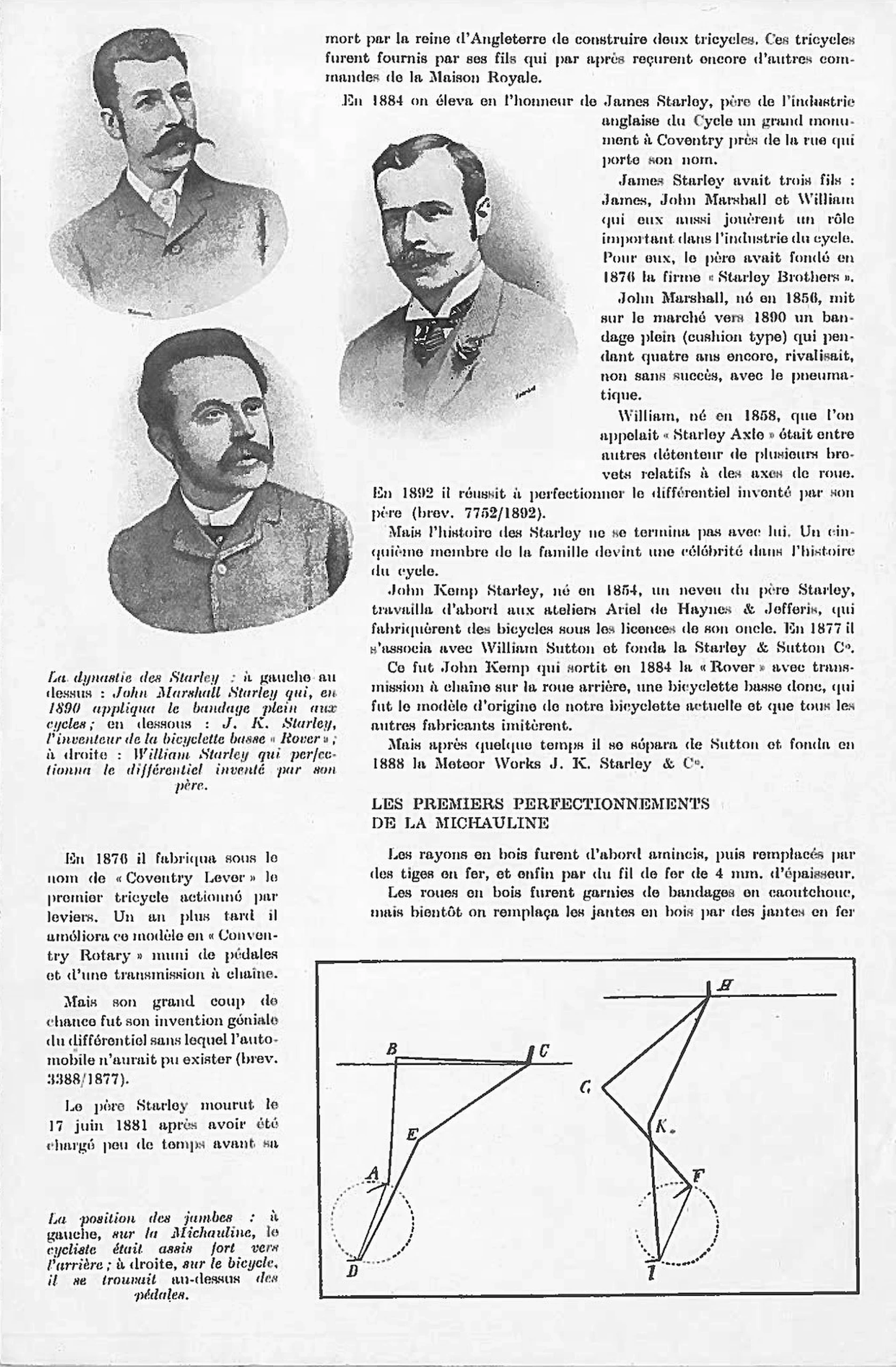
[Ebykr summary; the article’s text is not reproduced. The left column carries on from the previous page with the elder James Starley: in 1876 he built, under the name « Coventry Lever », the first tricycle driven by levers, and a year later improved it into the « Conventry Rotary » with pedals and chain drive. His great stroke was the differential, without which the automobile could not have existed (brev. 3388/1877). He died on 17 June 1881, shortly after the Queen of England had commissioned two tricycles from him; his sons delivered them and later received further orders from the Royal Household. In 1884 a large monument to him, father of the English cycle industry, was raised in Coventry near the street that bears his name. His three sons, James, John Marshall and William, also mattered to the industry; for them he had founded the firm « Starley Brothers » in 1876. John Marshall, born in 1856, put on the market about 1890 a solid tire (cushion type) that held its own against the pneumatic for four more years. William, born in 1858 and nicknamed « Starley Axle », held several patents on wheel axles and in 1892 improved his father’s differential (brev. 7752/1892). A fifth family member, John Kemp Starley, born in 1854 and a nephew of the elder Starley, worked first at the Ariel shops of Haynes & Jefferis, which built high-wheel bicycles under his uncle’s licenses; in 1877 he joined William Sutton to found the Starley & Sutton Cº. In 1884 John Kemp brought out the « Rover », a low bicycle with chain drive to the rear wheel, which the author calls the original model of the present-day bicycle, copied by every other maker; he later parted from Sutton and in 1888 founded the Meteor Works J. K. Starley & Cº. Under LES PREMIERS PERFECTIONNEMENTS DE LA MICHAULINE the author lists the first improvements: wooden spokes were thinned, then replaced by iron rods and finally by iron wire 4 mm. thick; the wooden wheels received rubber tires, and wooden rims soon gave way to iron rims (the sentence runs on to the next page). One caption names the three portraits as « La dynastie des Starley »: John Marshall Starley, who applied the solid tire to cycles in 1890 (upper left); J. K. Starley, inventor of the low « Rover » bicycle (below); and William Starley, who improved his father’s differential (right). The other caption explains the diagram: on the Michauline the rider sat well back, on the high-wheel bicycle he sat above the pedals.]
[Three halftone portrait photographs of mustached men in high collars fill the upper left: John Marshall Starley at upper left, J. K. Starley below him and William Starley at the right, set into the text. The upper-left and right portraits each carry a tiny illegible mark at the foot of the vignette, apparently a photographer’s or engraver’s signature. A framed line diagram at the foot compares leg positions: at left, the Michauline, straight lines lettered B, C, E, A and D running from a horizontal seat line down to a dotted pedal circle that lies well forward of the seat point C; at right, the high-wheel bicycle, lines lettered H, G, K., F and I running from a higher seat line straight down to a dotted pedal circle almost directly below the seat point H.]
— Page 3 —
LE BICYCLE
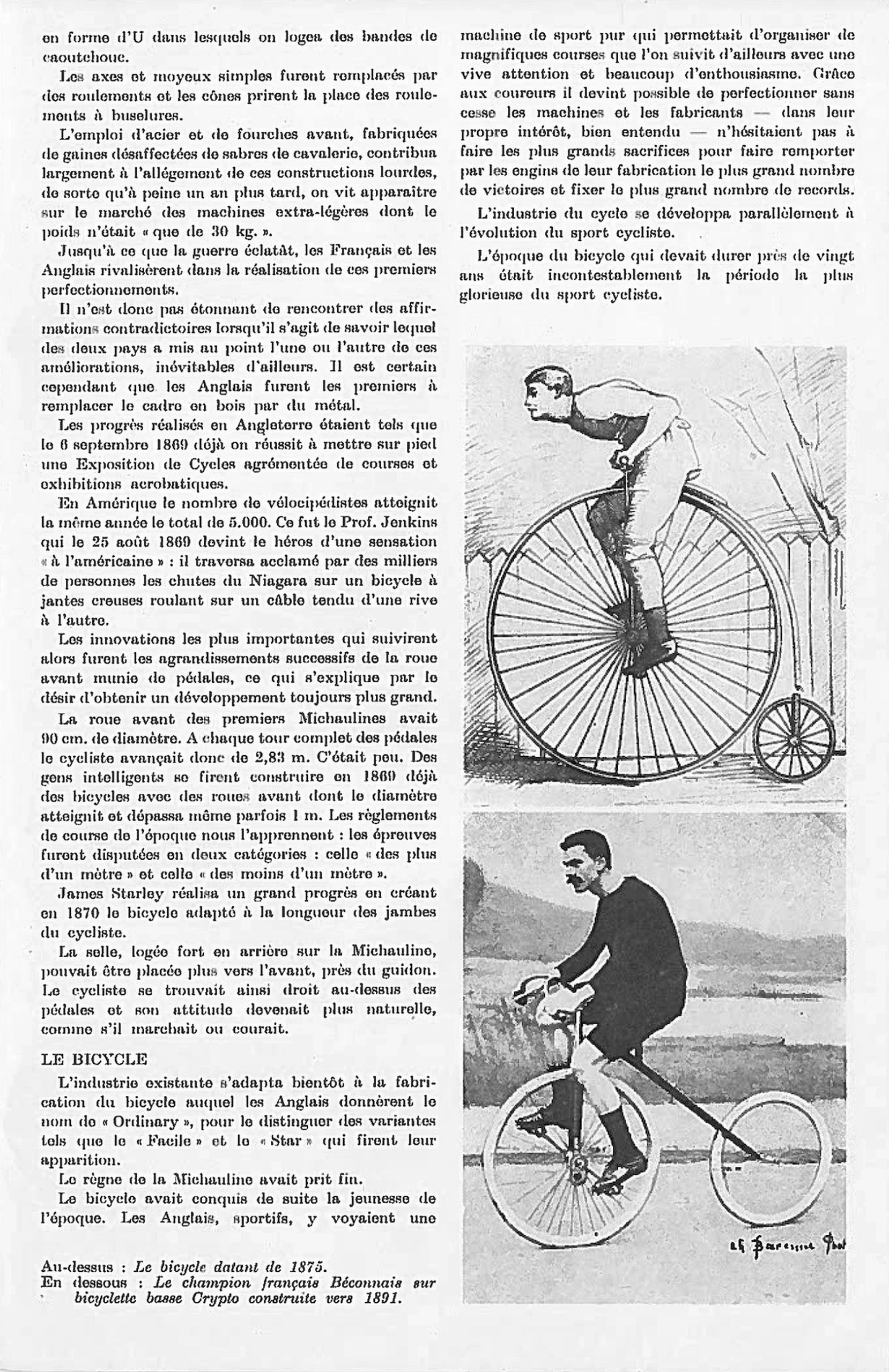
[Ebykr summary; the article’s text is not reproduced. The page carries on from the previous one with the first improvements to the Michauline: iron rims of U section that held rubber strips; plain axles and hubs replaced by bearings, and cones taking the place of bushed bearings; steel, and front forks made from surplus cavalry saber scabbards, lightened these heavy machines so much that barely a year later extra-light machines weighing « only » 30 kg. reached the market. The French and the English competed over these improvements until the war broke out, so claims about which country introduced which are contradictory, but the English were certainly first to replace the wooden frame with metal. England had progressed far enough to stage, on 6 September 1869, an Exposition de Cycles with races and acrobatic displays. In America the number of velocipedists reached 5.000 that same year, and on 25 August 1869 Prof. Jenkins crossed the Niagara falls before thousands of spectators on a hollow-rimmed bicycle running along a cable stretched from bank to bank. The front pedal wheel then grew larger and larger to give more gear: the first Michaulines had a 90 cm. front wheel, so one turn of the pedals carried the rider only 2,83 m.; by 1869 some riders had front wheels reaching or passing 1 m., and races were run in two classes, over and under one meter. In 1870 James Starley made the bicycle suit the length of the rider’s legs: the saddle, set far back on the Michauline, moved forward near the handlebar, putting the rider upright above the pedals in a more natural walking or running posture. Under LE BICYCLE the author says the trade soon took up the high bicycle, which the English called the « Ordinary » to tell it from variants such as the « Facile » and the « Star »; the reign of the Michauline was over. Sporting English youth saw it as a pure racing machine; races drew keen crowds, racers drove constant improvement and makers spared nothing to win races and set records. The cycle industry grew alongside cycle sport, and the near twenty-year era of the bicycle is called the most glorious period of the sport. The captions date the upper picture as the bicycle of 1875 and identify the lower one as the French champion Béconnais on a Crypto low bicycle built about 1891.]
[Two pictures fill the right column. Above, a pen drawing shows a racer in a sleeveless jersey and tights bent forward over the high front wheel of an Ordinary with a small trailing rear wheel, against a picket fence; it carries no visible signature. Below, a halftone photograph shows a mustached rider in a dark jersey, short breeches and stockings on a low front-driving bicycle, its pedals at the hub of the front wheel and a smaller rear wheel trailing on a single backbone tube, on an open road with hills behind; it is signed at lower right in script « Ch Barenne [?] Phot ».]
— Page 4 —
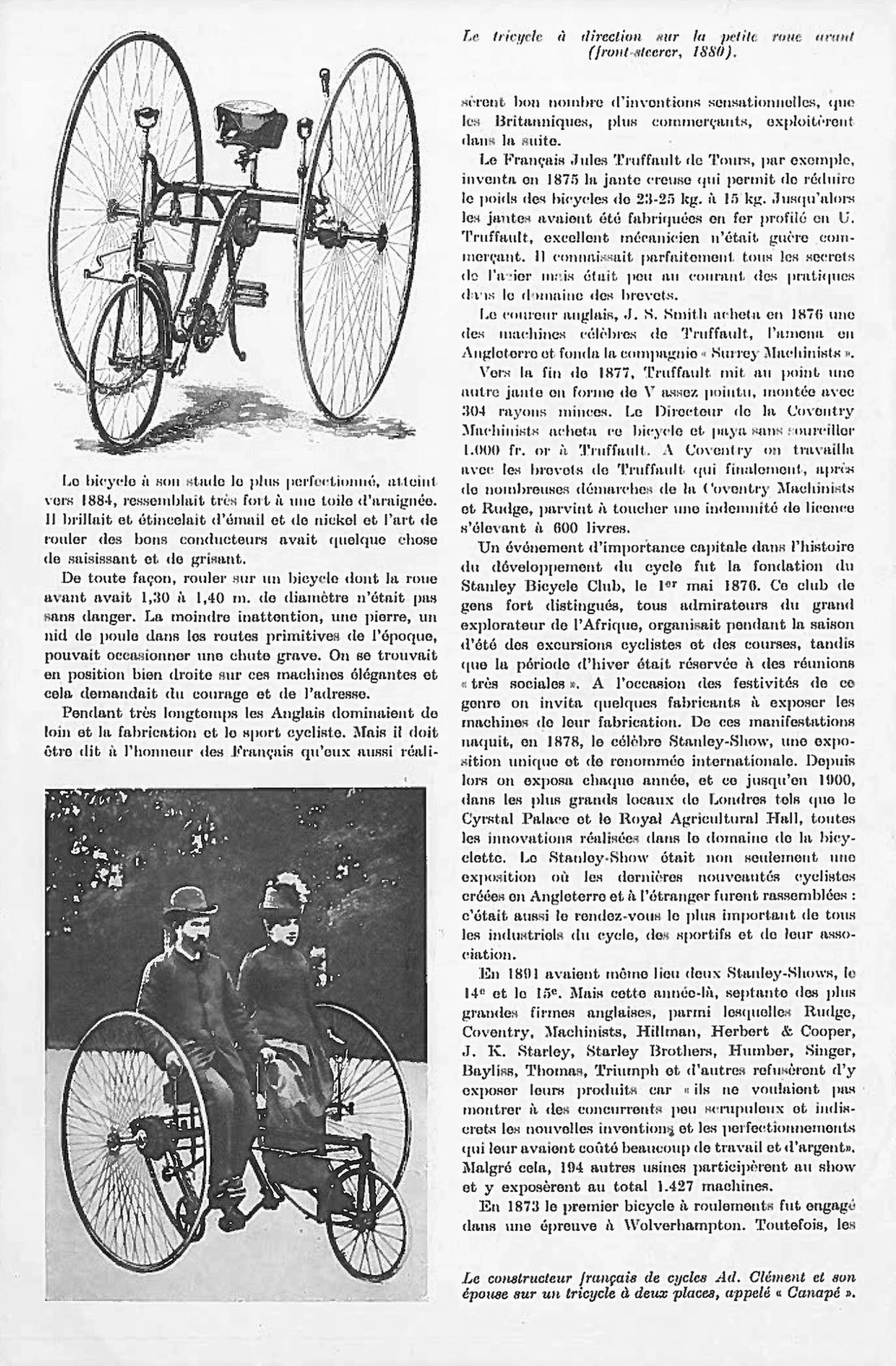
[Ebykr summary; the article’s text is not reproduced. The high bicycle at its most refined, reached about 1884, is likened to a spider’s web, gleaming with enamel and nickel, and the skill of good riders is called striking and exhilarating. Riding a bicycle whose front wheel measured 1,30 to 1,40 m. across was nonetheless dangerous: the slightest lapse, a stone or a pothole on the primitive roads of the day could cause a bad fall, and the upright position on these elegant machines took courage and skill. The English long dominated both manufacture and the sport, but the French made many sensational inventions that the more commercial British later exploited. The Frenchman Jules Truffault of Tours invented in 1875 the hollow rim, which cut bicycle weights from 23-25 kg. to 15 kg., rims having until then been made of U-section iron; Truffault was an excellent mechanic who knew steel thoroughly but was no businessman and knew little of patent practice. The English racer J. S. Smith bought one of Truffault’s famous machines in 1876, took it to England and founded the « Surrey Machinists » company. Toward the end of 1877 Truffault perfected a sharply V-shaped rim built with 304 thin spokes; the Directeur of the Coventry Machinists bought that bicycle and paid Truffault 1.000 fr. or without hesitation. Coventry worked under Truffault’s patents, and after many approaches to the Coventry Machinists and Rudge he finally received a license fee of 600 livres. A landmark was the founding of the Stanley Bicycle Club on 1er mai 1876, a club of distinguished members who admired the great explorer of Africa; it ran rides and races in summer and very social gatherings in winter, and invited makers to show their machines, from which grew in 1878 the famous Stanley-Show. Until 1900 it showed every year, in the largest halls in London such as the Cyrstal Palace and the Royal Agricultural Hall, all the innovations in the bicycle; it was the chief meeting place of the cycle trade, sportsmen and their association. In 1891 two Stanley-Shows were held, the 14e and the 15e, but 70 of the largest English firms, among them Rudge, Coventry, Machinists, Hillman, Herbert & Cooper, J. K. Starley, Starley Brothers, Humber, Singer, Bayliss, Thomas, Triumph and others, refused to exhibit for fear of unscrupulous competitors copying costly new work; even so, 194 other works took part and showed 1.427 machines in all. In 1873 the first bicycle on ball bearings was entered in a race at Wolverhampton (the sentence runs on to the next page). The captions name the upper picture as the tricycle steered by its small front wheel (front-steerer, 1880) and the lower as the French cycle builder Ad. Clément and his wife on a two-seat tricycle called the « Canapé ».]
[Two pictures fill the left column. Above, an engraving shows a tricycle with two tall wheels side by side at the rear and a small steering wheel in front, the saddle mounted on a cross frame between the large wheels, a chain running to the axle, pedals below and an upright handle on each side. Below, a halftone photograph shows a bearded man in a bowler hat and a woman in a plumed hat and long dress seated side by side on a two-seat tricycle with two large wheels and a small third wheel, against dark foliage. Neither picture carries a visible signature.]
— Page 5 —
LES BICYCLETTES « DE SÉCURITÉ ».
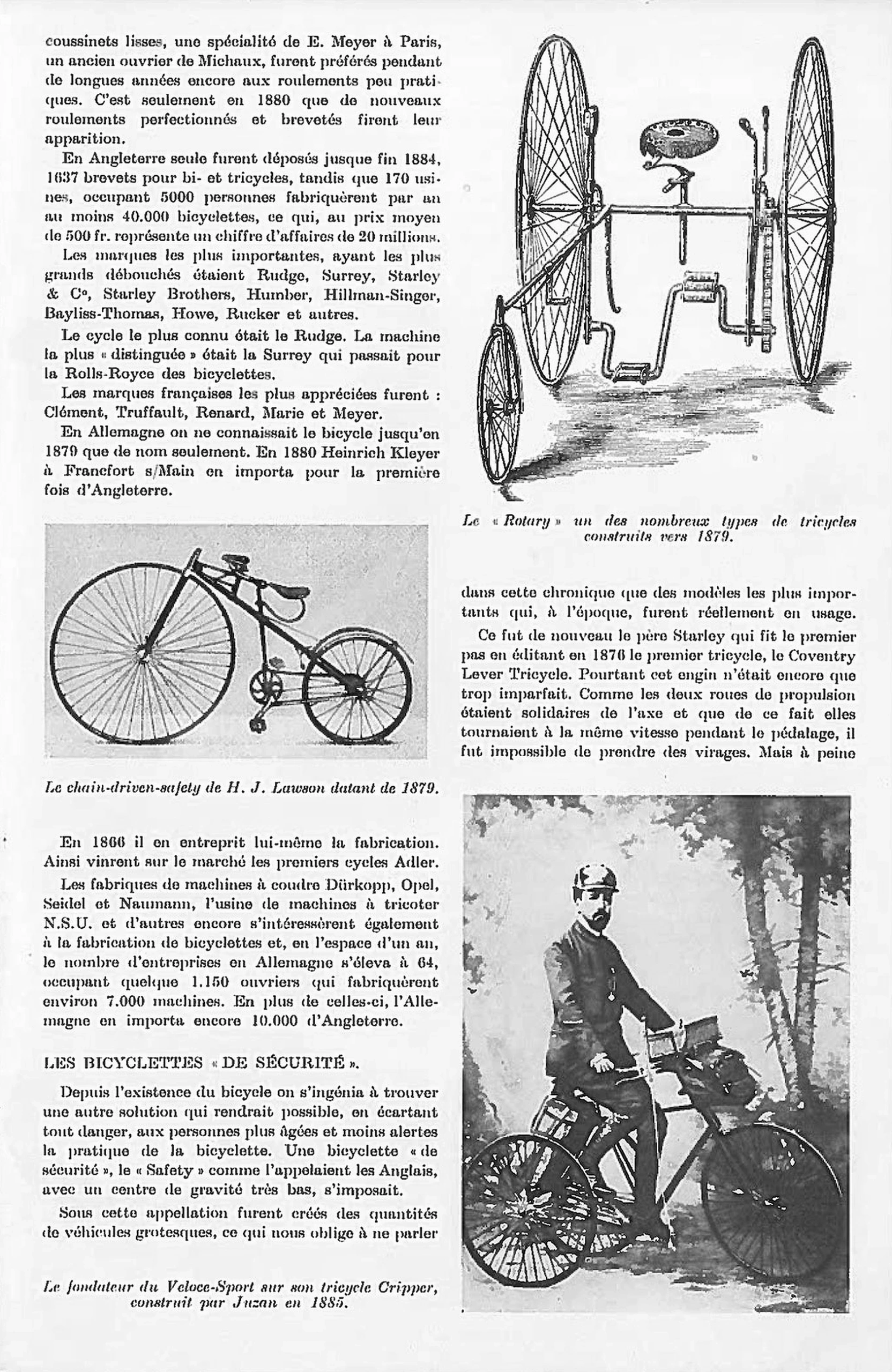
[Ebykr summary; the article’s text is not reproduced. Continuing the account of bearings from the previous page, plain bushings, a specialty of E. Meyer à Paris, a former workman of Michaux, were still preferred for many years over impractical ball bearings; improved, patented bearings appeared only in 1880. By the end of 1884, 1637 patents for bicycles and tricycles had been filed in England alone, while 170 works employing 5000 people made at least 40.000 bicycles a year, which at an average price of 500 fr. made a turnover of 20 millions. The leading makes with the largest markets were Rudge, Surrey, Starley & Cº, Starley Brothers, Humber, Hillman-Singer, Bayliss-Thomas, Howe, Rucker and others; the best known was the Rudge, and the most « distinguished » the Surrey, regarded as the Rolls-Royce of bicycles. The most esteemed French makes were Clément, Truffault, Renard, Marie and Meyer. In Germany the bicycle was known only by name until 1879; in 1880 Heinrich Kleyer of Francfort s/Main first imported machines from England and, in 1866 as printed, began making them himself, so bringing the first Adler cycles to market. The sewing-machine makers Dürkopp, Opel and Seidel et Naumann, the N.S.U. knitting-machine works and others took up bicycle making, and within a year Germany had 64 firms with some 1.150 workers making about 7.000 machines, besides 10.000 imported from England. Under LES BICYCLETTES « DE SÉCURITÉ » the author explains that ever since the high bicycle, makers had sought a safer machine for older and less agile people: a « Safety », as the English called it, with a very low center of gravity. The name covered many grotesque vehicles, so the article keeps to the important models actually used at the time. Again the elder Starley took the first step in 1876 with the first tricycle, the Coventry Lever Tricycle, which was still imperfect: both driving wheels were fixed to the axle and turned at the same speed, so it could not take corners (the sentence runs on to the next page). The captions name the « Rotary » as one of the many tricycle types built about 1879, the chain-driven-safety of H. J. Lawson dating from 1879, and the founder of the Veloce-Sport on his Cripper tricycle built by Juzan in 1885.]
[Three pictures. At upper right, an engraving shows the « Rotary » tricycle: two tall wheels on one side and a small wheel on the other, a saddle on a cross frame, cranked pedals and a chain on the right. At left, a photograph shows Lawson’s safety in profile, a tall front wheel with a long backbone, the saddle set low behind the head and a chain from a crank between the wheels to a smaller rear wheel. At lower right, a studio photograph shows a bearded man in a cap and dark jacket astride a tricycle with large spoked wheels and an upright handlebar, a case strapped to the handlebar, before a painted woodland backdrop. None of the three carries a visible signature.]
— Page 6 —
(A suivre.)
Oskar STÄHLIN.
[Ebykr summary; the article’s text is not reproduced. The page completes the sentence from the previous one: a year after the Coventry Lever Tricycle, Starley found the ideal answer to cornering by inventing the differential. Up to 1885 it helped launch at least 30 different tricycle models, steered by the wheel in front (front-steerer) or behind (rear-steerer); until 1880 tricycles had a small, indirectly steered rear wheel worked by a handle at the left or right of the seat. In 1881 Humber à Nottingham brought out the « Humber-Imbattable », with a handlebar between the two large driving wheels, which also steered, and a small rear wheel serving only as a support; this awkward layout was changed in 1884 by moving the small handlebar-steered wheel to the front, and because the racing cyclist Robert Cripps of Nottingham rode this type to his performances it was named the « Cripper ». The Frenchman Juzan of Bordeaux found the definitive solution on 2 novembre 1884: a tricycle with three wheels of the same diameter, still used for carrying goods. The Juzan-Cripper, promptly made by English industry, displaced the Coventry Rotary, the Cruiser, the Imperial Club, the Pionier, the Imbattable and many others. In 1877 the Frenchman Rousseau, at Marseille, built a « bicycle sûr » with a 90 cm. front wheel and a smaller rear wheel, driven by a chain on each side of the front wheel; the French ignored it, but the English tried it, and Hillman, Herbert & Cooper brought out an identical model in 1884 that became the famous « Kangaroo ». The same fate met Rousseau’s « Bicycle de Sûreté », the « Sphinx » of 1889, with a 75 cm. front wheel driven through gears in a metal case, made in England from 1891 as the « Crypto ». The Englishman H. J. Lawson had Rudge build his « Chain-driven-Safety » (brev. 3934/1879), perfected in 1879, a bicycle with a lengthened rear and chain drive to the rear wheel, a system John Kemp Starley generalized in 1884; it failed because the public would not yet accept chain drive on two wheels and the elegant « Ordinary » still held its place. Lawson had also built in 1876 a low bicycle with lever drive to the rear wheel (brev. 2649/1876 « first lever-driven-Safety »). In 1878 another machine caused much talk and led the « Birmingham Small Arms Cº » (B.S.A.) to take up cycle making in octobre 1880: the « Otto Bicycle », a two-wheeler with a tiny rear support wheel against tipping over, driven by pedals and thin steel belts to pulleys on each wheel, with two handles that steered and could disengage one wheel to turn left or right. The inventor Otto lifted his machine onto the B.S.A. boardroom table and rode it back and forth; the board took over the Otto patent and built 953 of the type, and at the Stanley-Show of février 1881 the B.S.A. showed eight types of bicycles. The installment ends « (A suivre.) » with the signature.]
[The page has no figures. At its foot sits a decorative emblem: a scalloped black disc like a wax seal, bearing a white outline drawing of an early two-wheeled running machine with equal wheels, a T handle on the front fork, a saddle block on the beam and a curled tail, laid over a blank gray screened ribbon whose folded ends sweep up to either side. It carries no lettering or signature.]
Ebykr presents this material for research and education. If you hold rights to it or notice an ownership issue, please contact us and we will respond promptly.
The Ebykr Digest
New articles, timelines, catalog finds and registry activity — assembled from the archive once a month. Your address is never shared.
Double opt-in. One email per month. Unsubscribe at any time with one click.