About Ebykr
Ebykr celebrates classic and vintage lightweight bicycles through provocative imagery and opinion. Ride along with us.
About Ebykr
Ebykr celebrates classic and vintage lightweight bicycles through provocative imagery and opinion. Ride along with us.

Source: Ebykr archive.
| Marque | Brooks |
|---|---|
| Type | Catalog |
| Year | 1919 |
| Publisher | J. B. Brooks & Co., Ltd. |
| Country | England |
| Language | English |
| Pages | 8 |
| Source | Ebykr archive. |
| Credit | Ebykr archive |
| Transcription | Transcribed by eye |
The BROOKS BOOK for 1919 The BROOKS (REGISTERED) Book Being the thirty-third Annual Catalogue of BROOKS Saddles & Bags for Cycles and Motor-Cycles J. B. BROOKS and Company Ltd. Gt. Charles St, BIRMINGHAM : ESTABLISHED 1866 : Quality First THIS is, as we have so frequently emphasized, the policy adopted in the manufacture of all …
The Brooks Book for 1919, from J. B. Brooks and Company Ltd. of Great Charles Street, Birmingham. Twenty-four printed pages between plain buff card covers, the year on the cover and the title page adding Being the thirty-third Annual Catalogue. Printed by Silk and Terry, Ltd., Birmingham.
This book was opened to fill the gap between 1916 and 1923, and it turns out to date the war in two independent ways.
THE PUBLICATION COUNT SHOWS THE WAR. The Brooks year-of-publication count runs 1910 twenty-sixth, 1911 twenty-seventh, 1912 twenty-eighth, 1913 twenty-ninth, 1914 thirtieth and 1916 thirty-second, each increment matching the year gap exactly. This book is the thirty-third. One increment across three years means Brooks issued only one annual catalogue between 1916 and 1919, so no catalogue was issued in two of those years. Anyone tempted to date the first Brooks Book by subtracting from a post-war count should not: subtracting thirty-two from 1919 gives 1887, which is two years wrong. The 1885 figure this project holds rests on the 1910 to 1916 run, where the series is demonstrably unbroken, and it is unaffected.
BROOKS SAYS WHY, ON PRINTED PAGE 2. The Quality First essay records that demand held up over so abnormal a period as the last four years, during which time our only regret has been that, owing to the concentration of nearly all our facilities on Government work, we have been unable to cope therewith as promptly and efficiently as usual. That is the firm stating outright that the war had taken its capacity, which is the obvious reason the annual catalogue lapsed.
THE HEIGHT CONVENTION IS DEFINED HERE, and this corrects something recorded earlier in this same run of work. Printed page 2 states that the stated height, in each case, represents the distance from the centre of the saddle clip bolt to the top surface of the saddle, not the height of the saddle above the L pin, as this naturally will vary according to the position of the clip. The 1920 book repeats it almost word for word. The 1932 book gives a different definition, from centre of clip to under surface of seat immediately above. So the height convention is defined from at least 1919, not from 1932, and it changes between 1920 and 1932 from the top face of the leather to the underside. A 1919 height and a 1932 height are not measured to the same surface and should not be compared directly.
The same page keeps the older caveat about length while dropping its metaphor. It says the dimensions given represent merely the overall length and breadth, and are not necessarily indicative of the amount of seat room available, which is the substance of the bootmaker statement of 1903, 1907, 1908 and 1910, but the bootmaker himself is gone.
THE B 90 STOPS CHANGING. Its three sizes here are 10 and a half by 8 and a half inches at 3 lb., 11 and a half by 9 inches at 3 lb. 4 oz., and 12 by 9 and a half inches at 4 lb. Those are the 1916 figures exactly, dimensions and weights alike, in all three sizes. The B 90 gained weight steadily from 1903 to 1916 and then held, so the climb was not an escalating wartime trend; it stopped as soon as it reached this level. The saddle grows again by 1932, but not here.
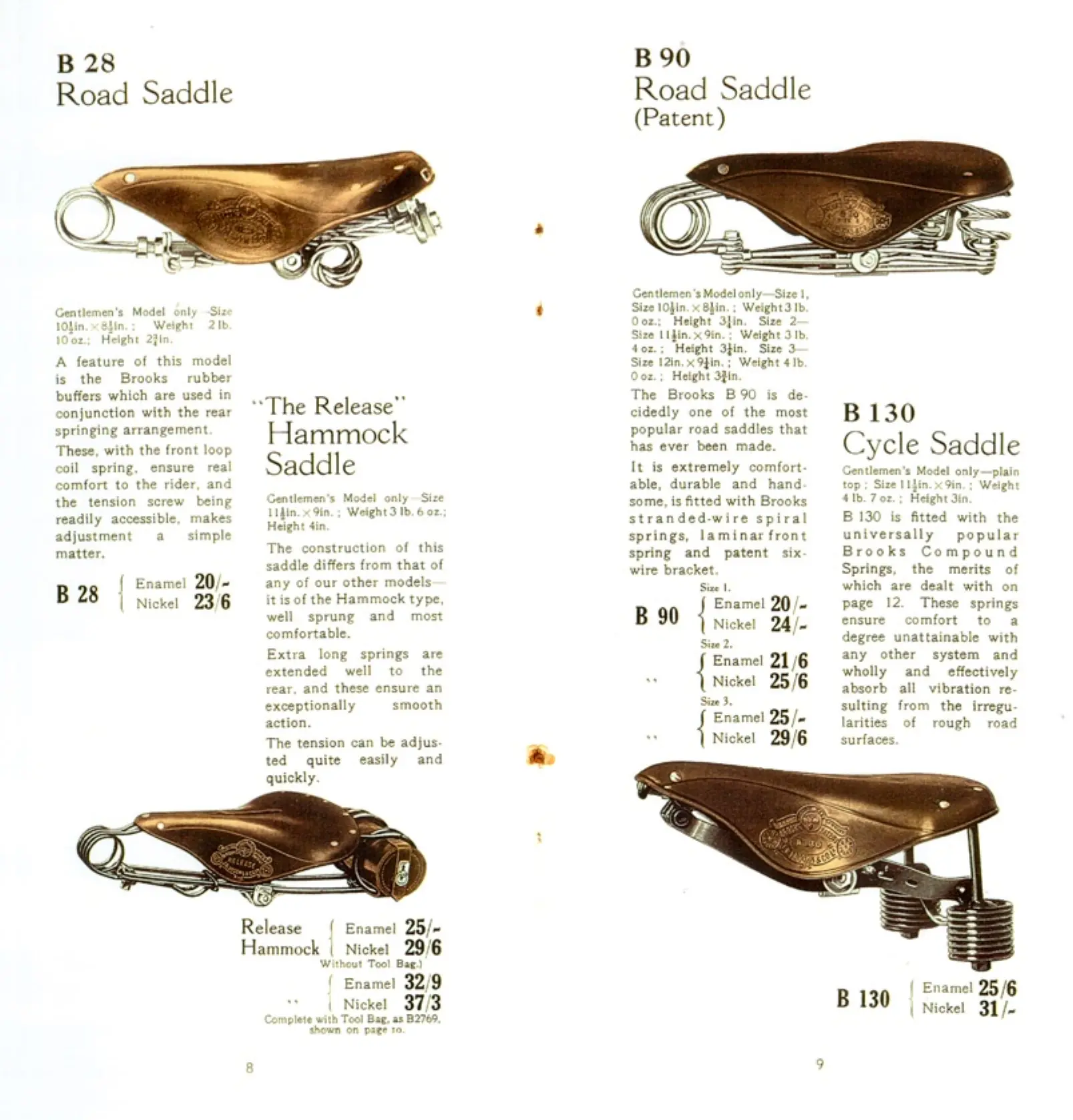
THE B 28 KEEPS ITS RUBBER BUFFERS. Printed page 8 says a feature of this model is the Brooks rubber buffers which are used in conjunction with the rear springing arrangement, and that these, with the front loop coil spring, ensure real comfort. It is offered in one size only, 10 and a half by 8 and a half inches, and no Size 3 is listed; the 1920 book restores a Size 3 at 12 by 9 and a half inches.
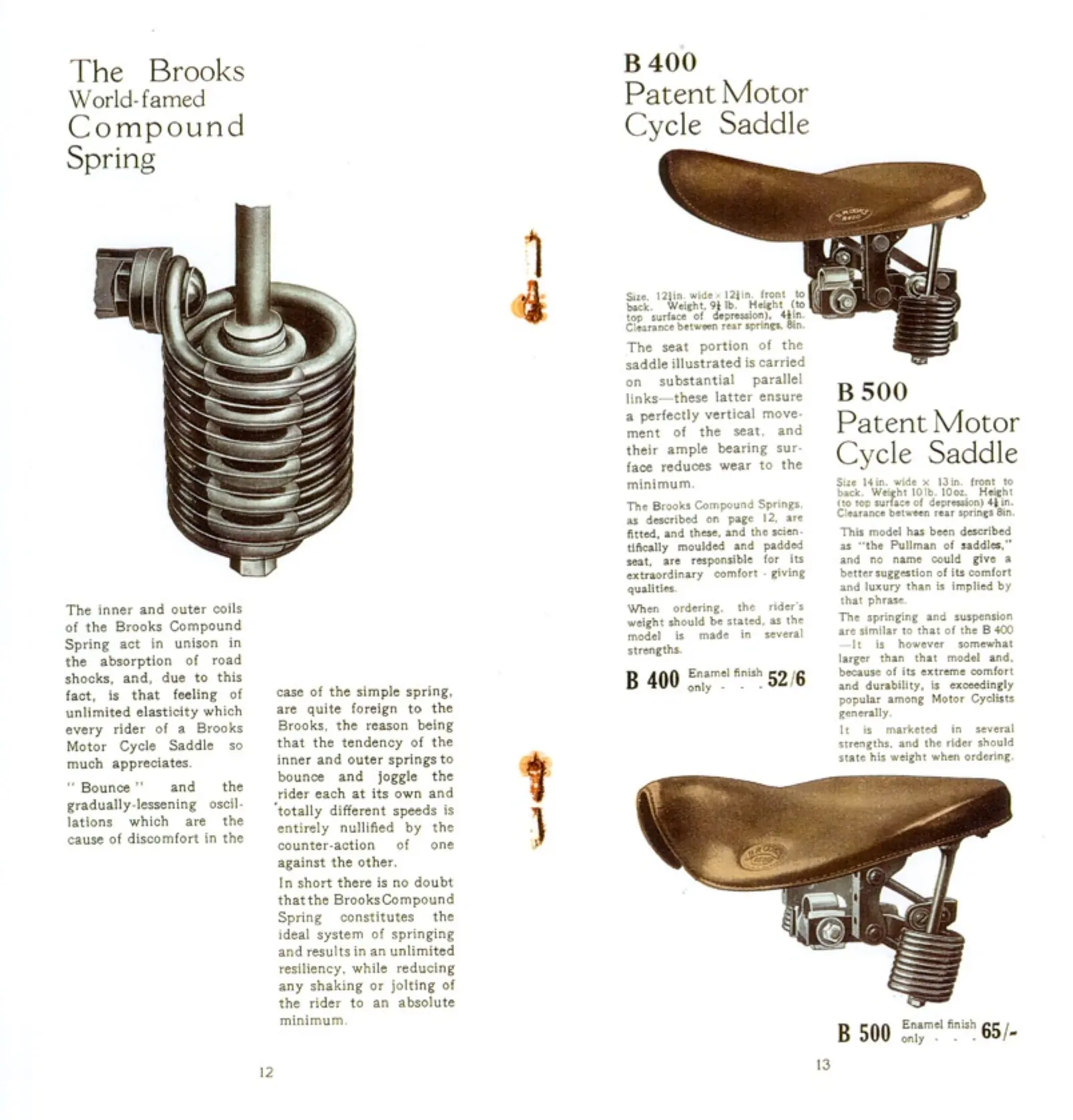
THE BEST ACCOUNT OF THE COMPOUND SPRING IN THE RUN IS ON PRINTED PAGE 12. It explains the mechanism rather than merely naming it: the inner and outer coils act in unison, and bounce and the gradually-lessening oscillations which are the cause of discomfort in the case of the simple spring are foreign to the Brooks because the tendency of the inner and outer springs to bounce and joggle the rider each at its own and totally different speeds is entirely nullified by the counter-action of one against the other. Two springs of different natural periods cancelling one another is a real engineering claim, and this is the clearest statement of it the Ebykr collection holds.
Prices in this book are the base against which the 1920 book should be read, because they move violently in one year. The B 400 motor cycle saddle is 52/6 here and 78/- in 1920; the B 500 is 65/- here and 113/- in 1920. The cycle B 28 is 20/- in enamel here and 33/3 in 1920. The 1920 book prints a note saying all prices are subject to revision without notice.
Also worth having: ESTABLISHED 1866 on the title page, now a tenth book; the policy dating as it does from the inception of the Brooks business in 1866 on printed page 2; the Champion racing saddle on printed page 3, whose comfort is credited to the cambered or domed weight-carrying portion of the saddle produced by the use of a curved cantle plate, so cantle plate remains Brooks vocabulary in 1919; solid copper rivets, which never become loose; and the B 220 motor saddle on printed page 15, whose laminated springs are now anchored in the centre instead of at one end as formerly, and which is described as eminently suitable for Spring Frame Machines.
NO SCAN DEFECT WAS FOUND. The printed pages run continuously from 2 to 24 with no gap and no repeat, no two embedded images in the file are byte-identical, and the sheet mapping is the usual one for this run, sheet N carrying printed pages 2N minus 4 and 2N minus 3.
A NOTE ON EXISTING CITATIONS. The Brooks saddle database behind post 1873 carries ten rows citing this book as 1919 p04, p06, p08 and p09. Those are PDF sheet numbers, not printed pages. Sheet 4 is printed pages 4 and 5, sheet 6 is printed pages 8 and 9, sheet 8 is printed pages 12 and 13, and sheet 9 is printed pages 14 and 15. Nine of the ten citations are therefore wrong as printed-page references, and they have been corrected against the pages themselves.
This record reproduces eight leaves: the cover, the title page, the Quality First essay with the Champion racing saddle, the light road saddles, the B 28 with the Release Hammock and the B 90 and B 130, the compound spring with the B 400 and B 500, the motor cycle saddles, and the back cover with the printer’s imprint. The remaining pages, covering the tool and frame bags, the motor cycle back rests, pannier and carrier bags, the repair outfit and plug cases, the spare tube boxes and belt cases, and the patent spring leggings, are held in the Ebykr collection but are not reproduced here.
The scan runs about 803 pixels across per two-page spread, roughly 400 pixels per printed page, and the images are presented at twice that, the house ratio for this run. The book is printed in a warm brown ink on buff paper with full-colour photographic plates of the saddles. Shipped as scanned, with no white point normalization.
[Front cover. Plain buff card, foxed, with two wire staples at the spine edge. Letterpress in warm brown.]
The
BROOKS BOOK
for 1919
[Title page, recto, facing a blank buff endpaper. Set in an Art Nouveau lettering face, the BROOKS lines in dark brown and the descriptive lines in a lighter gold.]
The BROOKS (REGISTERED) Book
Being the thirty-third Annual Catalogue of
BROOKS
Saddles & Bags
for Cycles and Motor-Cycles
J. B. BROOKS
and Company Ltd.
Gt. Charles St,
BIRMINGHAM
: ESTABLISHED 1866 :
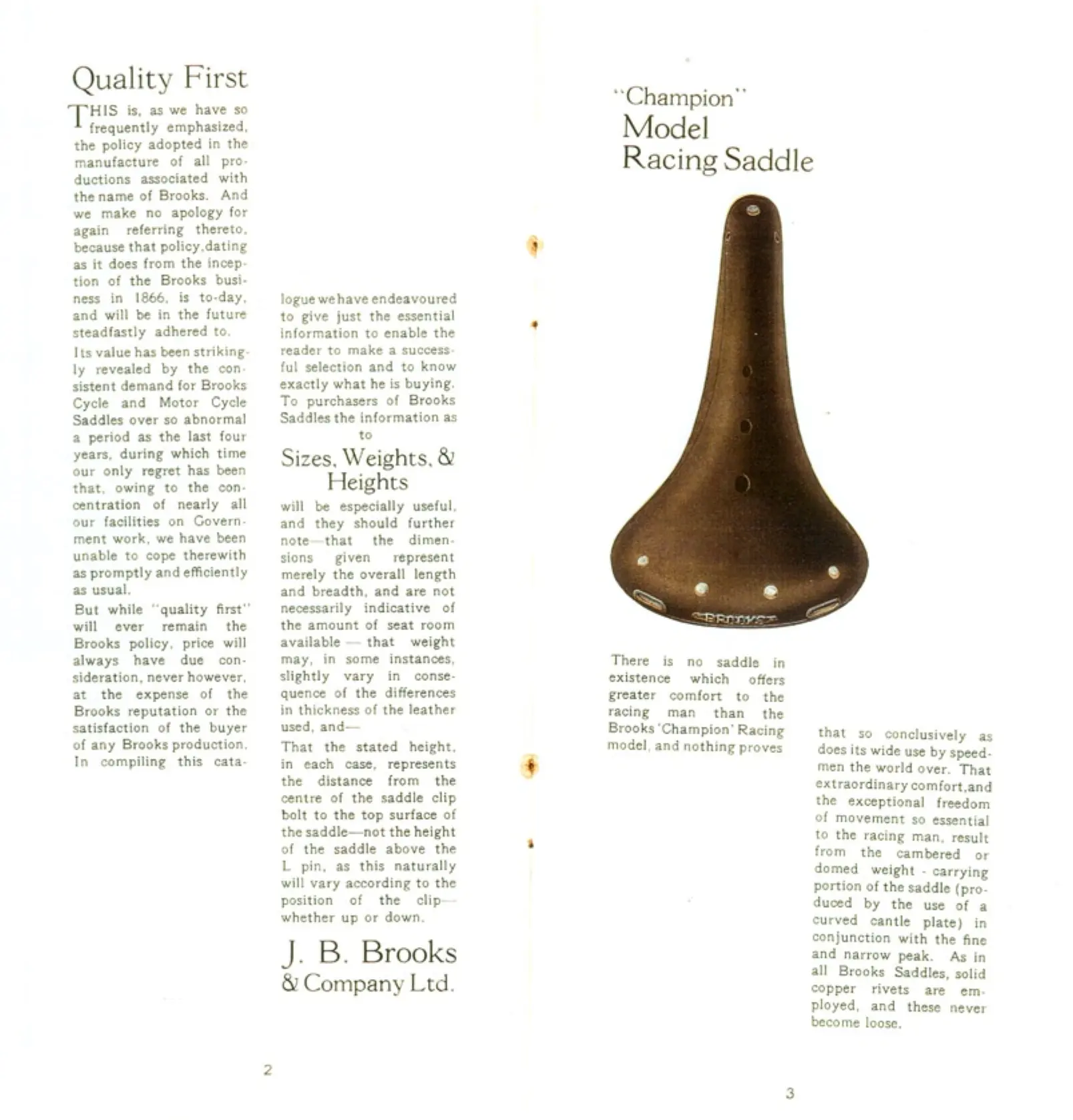
[Printed page 2, verso. The opening essay, set in three columns.]
Quality First
THIS is, as we have so frequently emphasized, the policy adopted in the manufacture of all productions associated with the name of Brooks. And we make no apology for again referring thereto, because that policy, dating as it does from the inception of the Brooks business in 1866, is to-day, and will be in the future steadfastly adhered to.
Its value has been strikingly revealed by the consistent demand for Brooks Cycle and Motor Cycle Saddles over so abnormal a period as the last four years, during which time our only regret has been that, owing to the concentration of nearly all our facilities on Government work, we have been unable to cope therewith as promptly and efficiently as usual.
But while “quality first” will ever remain the Brooks policy, price will always have due consideration, never however, at the expense of the Brooks reputation or the satisfaction of the buyer of any Brooks production. In compiling this catalogue we have endeavoured to give just the essential information to enable the reader to make a successful selection and to know exactly what he is buying. To purchasers of Brooks Saddles the information as to
Sizes, Weights, & Heights
will be especially useful, and they should further note-that the dimensions given represent merely the overall length and breadth, and are not necessarily indicative of the amount of seat room available – that weight may, in some instances, slightly vary in consequence of the differences in thickness of the leather used, and-
That the stated height, in each case, represents the distance from the centre of the saddle clip bolt to the top surface of the saddle-not the height of the saddle above the L pin, as this naturally will vary according to the position of the clip-whether up or down.
J. B. Brooks & Company Ltd.
[Printed page 3, recto. A full-page colour plate of a narrow racing saddle seen in plan view, above two columns of text.]
“Champion” Model Racing Saddle
There is no saddle in existence which offers greater comfort to the racing man than the Brooks “Champion” Racing model, and nothing proves that so conclusively as does its wide use by speedmen the world over. That extraordinary comfort, and the exceptional freedom of movement so essential to the racing man, result from the cambered or domed weight-carrying portion of the saddle (produced by the use of a curved cantle plate) in conjunction with the fine and narrow peak. As in all Brooks Saddles, solid copper rivets are employed, and these never become loose.
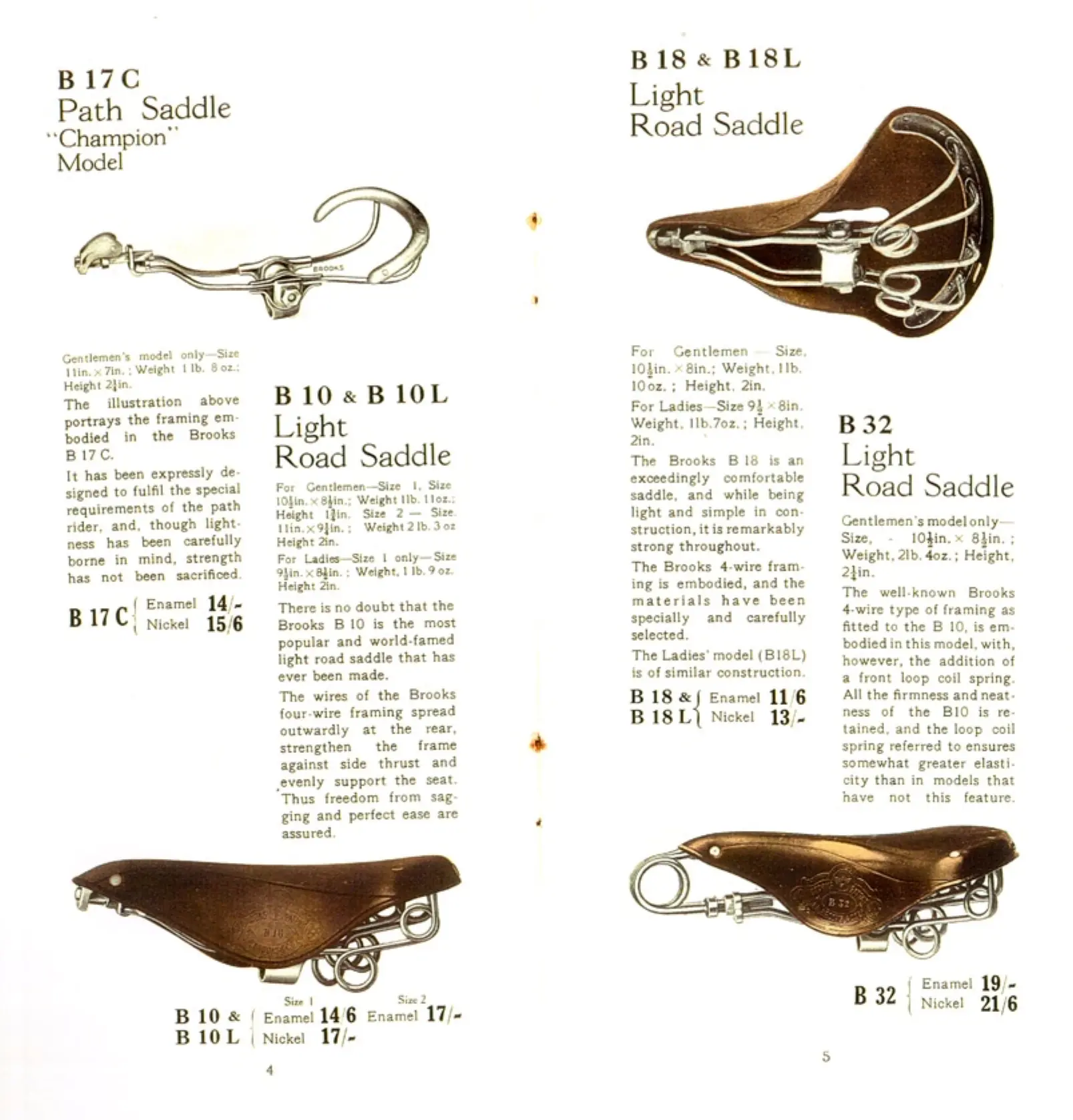
[Printed page 4, verso. Two models, each with a colour plate.]
B 17 C
Path Saddle
“Champion” Model
Gentlemen’s model only-Size 11in. x 7in.; Weight 1 lb. 8 oz.; Height 2 1/8in.
The illustration above portrays the framing embodied in the Brooks B 17 C.
It has been expressly designed to fulfil the special requirements of the path rider, and, though lightness has been carefully borne in mind, strength has not been sacrificed.
B 17 C Enamel 14/- Nickel 15/6
B 10 & B 10 L
Light Road Saddle
For Gentlemen-Size 1, Size 10 1/2in. x 8 1/2in.; Weight 1lb. 11oz.; Height 1 7/8in. Size 2 – Size 11in. x 9 1/2in.; Weight 2 lb. 3 oz; Height 2in.
For Ladies-Size 1 only-Size 9 1/2in. x 8 1/2in.; Weight 1 lb. 9 oz.; Height 2in.
There is no doubt that the Brooks B 10 is the most popular and world-famed light road saddle that has ever been made.
The wires of the Brooks four-wire framing spread outwardly at the rear, strengthen the frame against side thrust and evenly support the seat. Thus freedom from sagging and perfect ease are assured.
B 10 & B 10 L Size 1 Enamel 14/6 Size 2 Enamel 17/- Nickel 17/-
[Printed page 5, recto. Two models, each with a colour plate.]
B 18 & B 18 L
Light Road Saddle
For Gentlemen – Size, 10 1/2in. x 8in.; Weight, 1lb. 10oz.; Height, 2in.
For Ladies-Size 9 1/2 x 8in. Weight, 1lb. 7oz.; Height, 2in.
The Brooks B 18 is an exceedingly comfortable saddle, and while being light and simple in construction, it is remarkably strong throughout.
The Brooks 4-wire framing is embodied, and the materials have been specially and carefully selected.
The Ladies’ model (B18L) is of similar construction.
B 18 & B 18 L Enamel 11/6 Nickel 13/-
B 32
Light Road Saddle
Gentlemen’s model only-Size, 10 1/2in. x 8 1/2in.; Weight, 2lb. 4oz.; Height, 2 1/8in.
The well-known Brooks 4-wire type of framing as fitted to the B 10, is embodied in this model, with, however, the addition of a front loop coil spring. All the firmness and neatness of the B 10 is retained, and the loop coil spring referred to ensures somewhat greater elasticity than in models that have not this feature.
B 32 Enamel 19/- Nickel 21/6
[Printed page 8, verso. Two models, each with a colour plate.]
B 28
Road Saddle
Gentlemen’s Model only – Size 10 1/2in. x 8 1/2in.; Weight 2 lb. 10 oz.; Height 2 3/8in.
A feature of this model is the Brooks rubber buffers which are used in conjunction with the rear springing arrangement.
These, with the front loop coil spring, ensure real comfort to the rider, and the tension screw being readily accessible, makes adjustment a simple matter.
B 28 Enamel 20/- Nickel 23/6
“The Release” Hammock Saddle
Gentlemen’s Model only – Size 11 1/2in. x 9in.; Weight 3 lb. 6 oz.; Height 4in.
The construction of this saddle differs from that of any of our other models-it is of the Hammock type, well sprung and most comfortable.
Extra long springs are extended well to the rear, and these ensure an exceptionally smooth action.
The tension can be adjusted quite easily and quickly.
Release Hammock Enamel 25/- Nickel 29/6 (Without Tool Bag.)
Release Hammock Enamel 32/9 Nickel 37/3 (Complete with Tool Bag, as B2769, shown on page 10.)
[Printed page 9, recto. Two models, each with a colour plate.]
B 90
Road Saddle
(Patent)
Gentlemen’s Model only-Size 1, Size 10 1/2in. x 8 1/2in.; Weight 3 lb. 0 oz.; Height 3 1/8in.
Size 2-Size 11 1/2in. x 9in.; Weight 3 lb. 4 oz.; Height 3 3/8in.
Size 3-Size 12in. x 9 1/2in.; Weight 4 lb. 0 oz.; Height 3 7/8in.
The Brooks B 90 is decidedly one of the most popular road saddles that has ever been made.
It is extremely comfortable, durable and handsome, is fitted with Brooks stranded-wire spiral springs, laminar front spring and patent six-wire bracket.
B 90 Size 1. Enamel 20/- Nickel 24/-
B 90 Size 2. Enamel 21/6 Nickel 25/6
B 90 Size 3. Enamel 25/- Nickel 29/6
B 130
Cycle Saddle
Gentlemen’s Model only-plain top; Size 11 1/2in. x 9in.; Weight 4 lb. 7 oz.; Height 3in.
B 130 is fitted with the universally popular Brooks Compound Springs, the merits of which are dealt with on page 12. These springs ensure comfort to a degree unattainable with any other system and wholly and effectively absorb all vibration resulting from the irregularities of rough road surfaces.
B 130 Enamel 25/6 Nickel 31/-
[Printed page 12, verso. A large plate of the compound spring itself, shown in section with the inner coil visible inside the outer, above two columns of text.]
The Brooks
World-famed
Compound Spring
The inner and outer coils of the Brooks Compound Spring act in unison in the absorption of road shocks, and, due to this fact, is that feeling of unlimited elasticity which every rider of a Brooks Motor Cycle Saddle so much appreciates.
“Bounce” and the gradually-lessening oscillations which are the cause of discomfort in the case of the simple spring, are quite foreign to the Brooks, the reason being that the tendency of the inner and outer springs to bounce and joggle the rider each at its own and totally different speeds is entirely nullified by the counter-action of one against the other.
In short there is no doubt that the Brooks Compound Spring constitutes the ideal system of springing and results in an unlimited resiliency, while reducing any shaking or jolting of the rider to an absolute minimum.
[Printed page 13, recto. Two motor cycle saddles, each with a colour plate.]
B 400
Patent Motor Cycle Saddle
Size, 12 1/8in. wide x 12 1/8in. front to back. Weight, 9 1/4 lb. Height (to top surface of depression), 4 1/4in. Clearance between rear springs, 8in.
The seat portion of the saddle illustrated is carried on substantial parallel links-these latter ensure a perfectly vertical movement of the seat, and their ample bearing surface reduces wear to the minimum.
The Brooks Compound Springs, as described on page 12, are fitted, and these, and the scientifically moulded and padded seat, are responsible for its extraordinary comfort-giving qualities.
When ordering, the rider’s weight should be stated, as the model is made in several strengths.
B 400 Enamel finish only 52/6
B 500
Patent Motor Cycle Saddle
Size 14in. wide x 13in. front to back. Weight 10lb. 10oz. Height (to top surface of depression) 4 1/4 in. Clearance between rear springs 8in.
This model has been described as “the Pullman of saddles,” and no name could give a better suggestion of its comfort and luxury than is implied by that phrase.
The springing and suspension are similar to that of the B 400-It is however somewhat larger than that model and, because of its extreme comfort and durability, is exceedingly popular among Motor Cyclists generally.
It is marketed in several strengths, and the rider should state his weight when ordering.
B 500 Enamel finish only 65/-
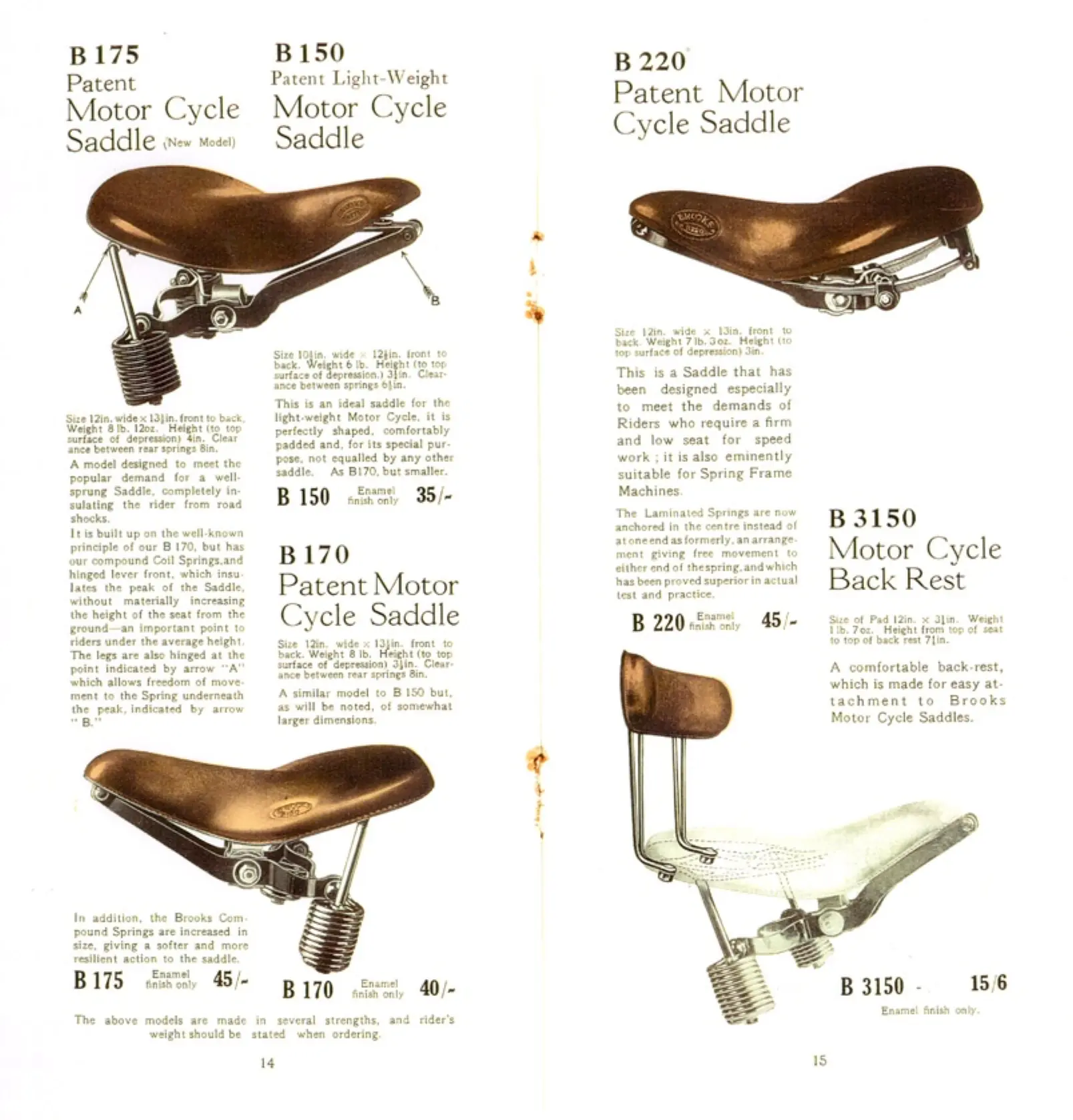
[Printed page 14, verso. Three motor cycle saddles, two with colour plates.]
B 175
Patent Motor Cycle Saddle (New Model)
Size 12in. wide x 13 1/2in. front to back. Weight 8 lb. 12oz. Height (to top surface of depression) 4in. Clearance between rear springs 8in.
A model designed to meet the popular demand for a well-sprung Saddle, completely insulating the rider from road shocks.
It is built up on the well-known principle of our B 170, but has our compound Coil Springs, and hinged lever front, which insulates the peak of the Saddle, without materially increasing the height of the seat from the ground-an important point to riders under the average height. The legs are also hinged at the point indicated by arrow “A” which allows freedom of movement to the Spring underneath the peak, indicated by arrow “B.”
In addition, the Brooks Compound Springs are increased in size, giving a softer and more resilient action to the saddle.
B 175 Enamel finish only 45/-
B 150
Patent Light-Weight Motor Cycle Saddle
Size 10 3/4in. wide x 12 1/2in. front to back. Weight 6 lb. Height (to top surface of depression) 3 1/2in. Clearance between springs 6 1/2in.
This is an ideal saddle for the light-weight Motor Cycle, it is perfectly shaped, comfortably padded and, for its special purpose, not equalled by any other saddle. As B170, but smaller.
B 150 Enamel finish only 35/-
B 170
Patent Motor Cycle Saddle
Size 12in. wide x 13 1/2in. front to back. Weight 8 lb. Height (to top surface of depression) 3 1/2in. Clearance between rear springs 8in.
A similar model to B 150 but, as will be noted, of somewhat larger dimensions.
B 170 Enamel finish only 40/-
The above models are made in several strengths, and rider’s weight should be stated when ordering.
[Printed page 15, recto. A motor cycle saddle and a back rest, each with a colour plate.]
B 220
Patent Motor Cycle Saddle
Size 12in. wide x 13in. front to back. Weight 7 lb. 3oz. Height (to top surface of depression) 3in.
This is a Saddle that has been designed especially to meet the demands of Riders who require a firm and low seat for speed work; it is also eminently suitable for Spring Frame Machines.
The Laminated Springs are now anchored in the centre instead of at one end as formerly, an arrangement giving free movement to either end of the spring, and which has been proved superior in actual test and practice.
B 220 Enamel finish only 45/-
B 3150
Motor Cycle Back Rest
Size of Pad 12in. x 3 1/2in. Weight 1 lb. 7oz. Height from top of seat to top of back rest 7 1/2in.
A comfortable back-rest, which is made for easy attachment to Brooks Motor Cycle Saddles.
B 3150 15/6 Enamel finish only.
[Back cover. Plain buff card, blank but for the printer’s imprint set very small at the foot.]
SILK & TERRY, LTD., B’HAM.
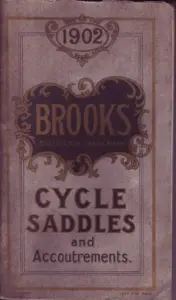 Brooks 1902 Catalog — Cycle Saddles and Accoutrements for 1902
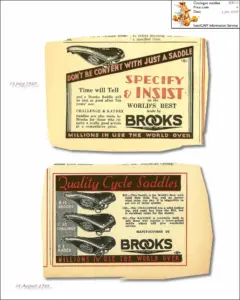 Brooks 1935 Advertisement — Specify and Insist, and Quality Cycle Saddles with Challenge and Kaydex
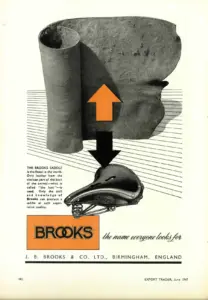 Brooks 1947 Advertisement — The Name Everyone Looks For (Export Trader)
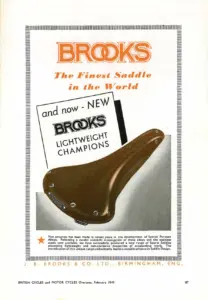 Brooks 1949 Advertisement — The New Lightweight Champions (British Cycles and Motor Cycles Overseas)
 Brooks chez A.F.C.O. — L’Officiel du cycle, 3 November 1951, Brooks Represented in France by AFCO
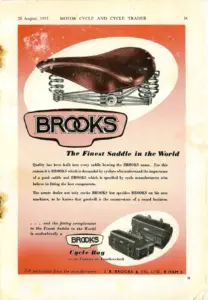 Brooks 1955 Advertisement — It’s the Saddle that Sells the Cycle (Motor Cycle and Cycle Trader)
Ebykr presents this material for research and education. If you hold rights to it or notice an ownership issue, please contact us and we will respond promptly.
The Ebykr Digest
New articles, timelines, catalog finds and registry activity — assembled from the archive once a month. Your address is never shared.
Double opt-in. One email per month. Unsubscribe at any time with one click.