About Ebykr
Ebykr celebrates classic and vintage lightweight bicycles through provocative imagery and opinion. Ride along with us.
About Ebykr
Ebykr celebrates classic and vintage lightweight bicycles through provocative imagery and opinion. Ride along with us.

Source: Ebykr archive.
| Marque | Brooks |
|---|---|
| Type | Catalog |
| Year | 1910 |
| Publisher | J. B. Brooks & Co., Ltd. |
| Country | England |
| Language | English |
| Pages | 10 |
| Source | Ebykr archive. |
| Credit | Ebykr archive |
| Transcription | Transcribed by eye |
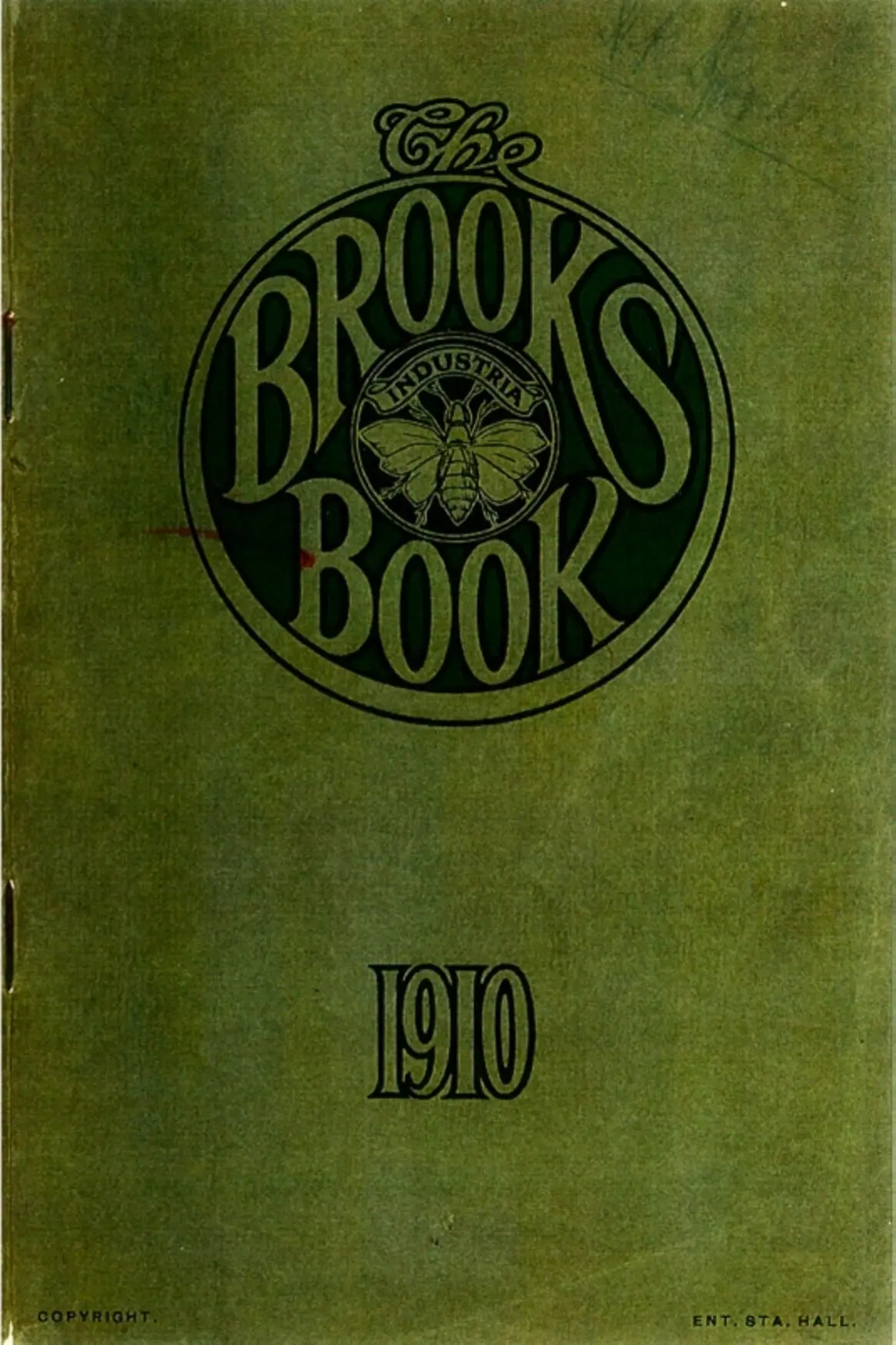
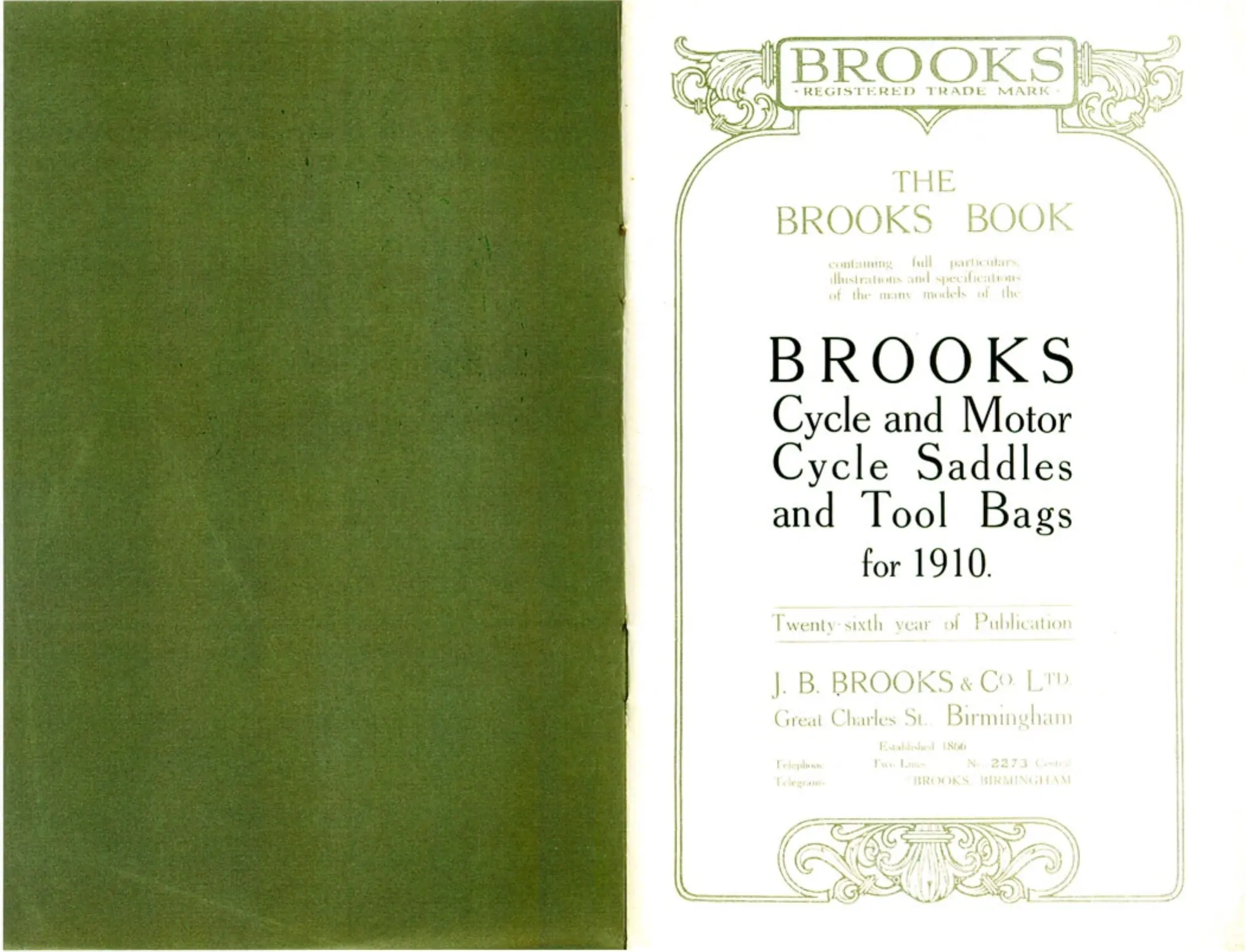
The BROOKS BOOK INDUSTRIA 1910 COPYRIGHT. ENT. STA. HALL. THE BROOKS BOOK containing full particulars, illustrations and specifications of the many models of the BROOKS Cycle and Motor Cycle Saddles and Tool Bags for 1910. Twenty-sixth year of Publication J. B. BROOKS & Co. Ltd. Great Charles St., Birmingham Established 1866 Telephone Two Lines No. …
The Brooks Book for 1910, from J. B. Brooks and Co. Ltd. of Great Charles Street, Birmingham. Seventy-two printed pages between green printed card covers, the title and the year on the cover and again on the title page, and the title page adding Twenty-sixth year of Publication.
This is the book that closes the B 28 question, and it does so by absence. The B 28 New Patent Road Saddle is in the 1905, 1906, 1907 and 1908 ranges, always on or about printed page 17. It is not in this book at all. Every model page in the 1910 book was checked by heading, and the gentlemen’s cycle range runs B 11 C, B 10 C and B 17 C, B 17 and B 17 N, B 19, B 11, B 10, B 32, B 18, B 24, B 85, B 302, B 95, B 33, B 90, B 120, B 94, then the motor saddles B 90 M, B 104, B 105 and the B 150 seat. There is no B 28. The B 28 therefore leaves the Brooks range between 1908 and 1910, and its absence from the 1911 and 1912 books, noted earlier in this project, is the continuation of a departure rather than its beginning.
What stands on printed page 17 in its place is the B 32, and the B 32 is not a new model invented to fill the gap; it is listed in the 1908 index at printed page 13. What it does carry is a good deal of the B 28’s character. Like the B 28 it is made in Gentlemen’s Model only; like the B 28 it has a front loop-coil spring. But where the B 28 resisted sagging by our patent system of rubber buffers at the rear, the B 32 does it by the BROOKS Patent system of sliding seat rods, riveted to the cantle plate at the rear and left free in front to slide within a sleeve attached to the peak plate. The rubber buffer is not named on that page, nor on the B 120, which is the anti-vibratory flagship and is fitted instead with the Brooks Patent Compound Springs. Printed page 38 states the position for the whole range: every model of our anti-vibratory Saddles and Seats is fitted with BROOKS PATENT COMPOUND SPRINGS. The rubber buffer returns to the B 28 in the 1913, 1914 and 1916 books, so its history, like the B 28’s own, is discontinuous.
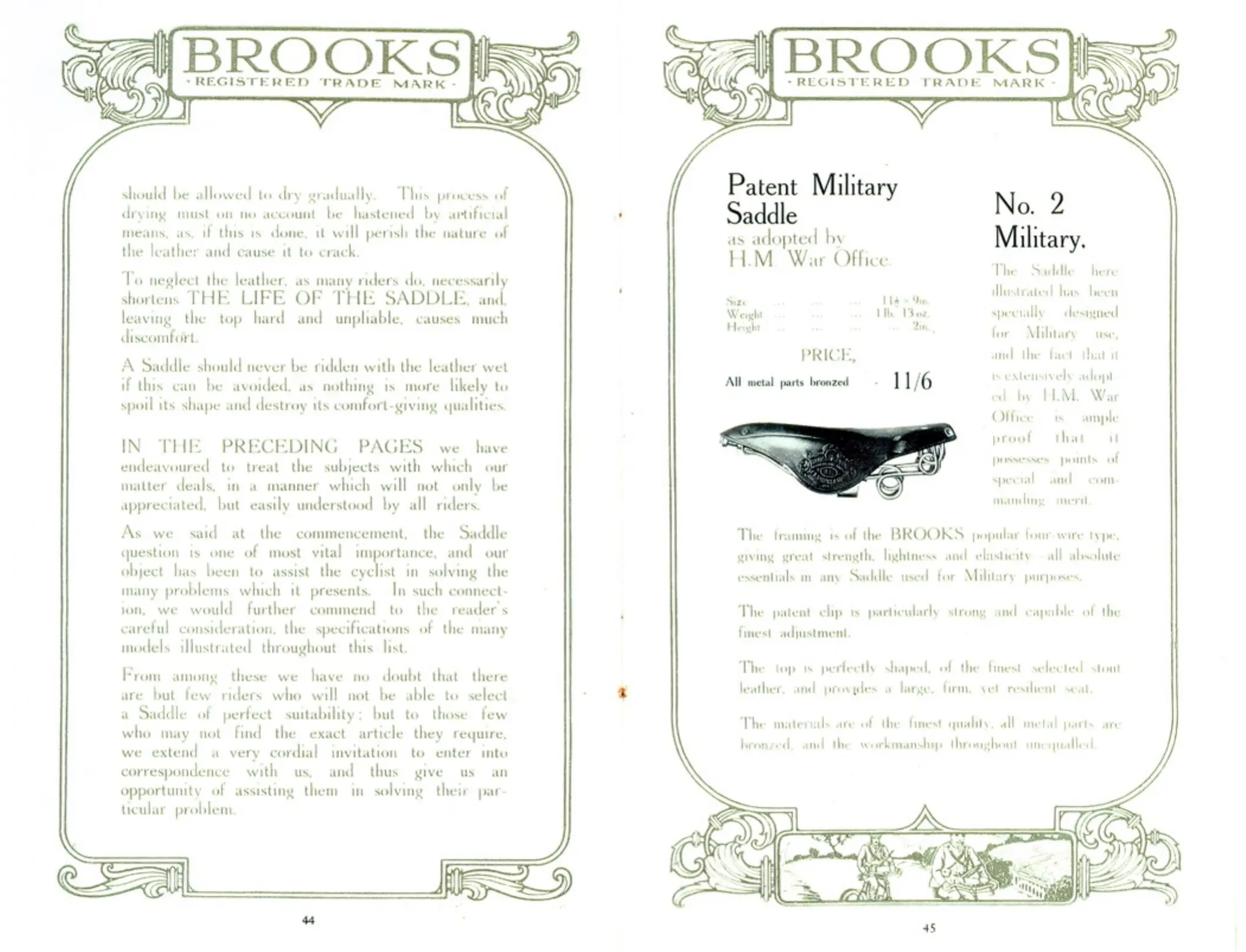
The military range is the second finding. Printed page 45 carries the Patent Military Saddle, No. 2 Military, alone, exactly as the 1908 book does. There is no No. 1 and no No. 3. The 1911 book, the very next in the run, heads its military page No. 2 and No. 3 Military, and so do the 1912, 1913 and 1914 books. The No. 3 military saddle therefore arrives between 1910 and 1911, which is a one-year bracket, where this project previously had only 1907 to 1913. The No. 1 does not return in any book read here. One further detail: the 1908 No. 2 has all metal parts gun-browned, while the 1910 No. 2 has all metal parts bronzed, at identical size, weight, height and price.
The title is the third finding. This book is called THE BROOKS BOOK on the cover, on the title page, and in its own body text on printed page 38, where it says the BROOKS BOOK would not be complete unless we dealt with these. The Ebykr project had previously placed that title no earlier than 1916. The 1911 book is The Brooks Book, Cyclist’s Edition, and the 1912 and 1913 books are The Brooks Book for Cyclists, which is the exact title post 1111 attaches to the year 1907. So that title is a real Brooks title; it is the year that is wrong.
The fourth finding is a correction to an inference this project made about weights. Session seven observed that the whole range gains weight between 1914 and 1916 at unchanged dimensions and offered wartime stock as the obvious reading. The 1910 B 90 shows the trend is older than the war. Its three sizes weigh 2 lb. 13 oz., 2 lb. 14 oz. and 3 lb. 9 oz. against 2 lb. 13 oz., 3 lb. 3 oz. and 3 lb. 12 oz. in 1914 and 3 lb., 3 lb. 4 oz. and 4 lb. in 1916. Sizes 2 and 3 gain more between 1910 and 1914 than they do across the war. What the 1910 book does confirm, and strongly, is the control that made the earlier finding safe: the B 90 holds 10 and a half by 8 and a half, 11 and a half by 9, and 12 by 9 and a half inches in 1910, 1914 and 1916 alike, to the fraction, across six years.
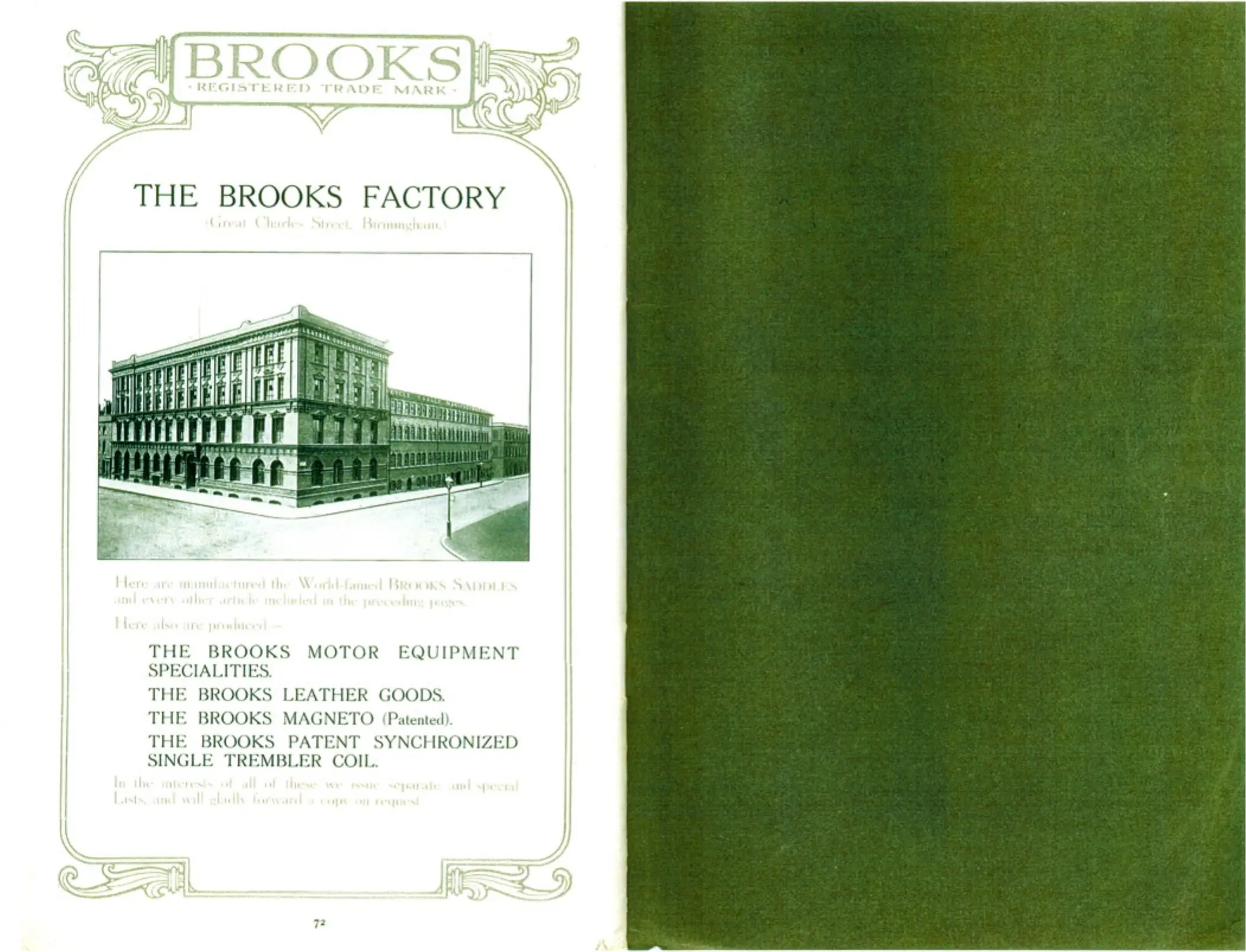
Three smaller things are worth having. Printed page 3 states the measuring convention outright, in almost the words the 1907 and 1908 books use, which is why a silent change of method between 1914 and 1916 would have been out of character. Printed page 5 gives the house policy as QUALITY FIRST, PRICE AFTERWARDS, and says the standard has for 26 years been identified with the name of BROOKS, which is the same count as the twenty-sixth year of publication on the title page rather than a second independent figure. And printed page 72 shows the factory in Great Charles Street and lists what else was made there: the Brooks Motor Equipment Specialities, the Brooks Leather Goods, the Brooks Magneto, patented, and the Brooks Patent Synchronized Single Trembler Coil, with separate lists issued for each. Brooks was making ignition equipment in 1910, which is not otherwise recorded in this archive.
The telephone series gains three years. This title page gives Telephone, Two Lines, No. 2273 Central, and the 1911 and 1912 title pages repeat it. The 1907 and 1908 books give Nos. 1213 and 5174, use either number; the 1913 and 1914 books give Six Lines, 3670 Central, which this project had previously attested no earlier than 1916. So the run is now 1213 to 1905, 1213 and 5174 for 1907 and 1908, 2273 for 1910 to 1912, and 3670 from 1913.
No scan defect was found. The printed pages run continuously from 2 to 72 with no gap and no repeat, no two sheets are near-duplicates, and no two embedded images in the file are byte-identical. There is no index anywhere in this book, unlike the 1905, 1906, 1907 and 1908 books; printed page 3 carries the measuring statement instead.
This record reproduces ten leaves: the cover, the title page, the warning and the measuring convention, the guarantee and the house policy, the B 32, the B 90, the B 120, the B 104 with the compound spring illustration, the military saddle, and the factory. The remaining pages, covering the path and champion saddles, the ladies’ models, the boys’ and girls’ models, the saddle clip and leather essays, the rifle and gun clips, the air rifle cover, the army and motor tool bags, the touring equipment and the carriers, are held in the Ebykr collection but are not reproduced here.
The scan runs about 1,055 pixels across per two-page spread, roughly 528 pixels per printed page, and the images are presented at twice that, the house ratio for this run. This book is printed in green throughout, in a lighter face than the 1908 book and within elaborate Art Nouveau borders, and the running text sits closer to the floor of legibility as a result. Headings, model numbers, prices and specification figures read cleanly at twice scale; the lighter body text is legible but less crisp. Shipped as scanned, with no white point normalization.
[Front cover. Green printed card, the design reversed out and lettered in dark green within a large circular roundel.]
The
BROOKS
BOOK
[At the centre of the roundel, a small medallion device showing a bee with outspread wings, encircled by the motto:] INDUSTRIA
1910
COPYRIGHT. ENT. STA. HALL.
[A faint pencil annotation, now illegible, runs across the upper right corner of the card.]
[Title page, recto, facing a plain green endpaper. Letterpress, with the two BROOKS lines in heavy black and the rest in green.]
THE BROOKS BOOK
containing full particulars, illustrations and specifications of the many models of the
BROOKS
Cycle and Motor Cycle Saddles and Tool Bags
for 1910.
Twenty-sixth year of Publication
J. B. BROOKS & Co. Ltd.
Great Charles St., Birmingham
Established 1866
Telephone Two Lines No. 2273 Central
Telegrams “BROOKS, BIRMINGHAM.”
[Note on this page. The telephone number here, 2273 Central on two lines, is exactly the number a period hand wrote in ink over the struck-through printed number on the title page of the Ebykr copy of the 1908 catalog. It is repeated on the 1911 and 1912 title pages. There is no Contractors to H.M. Government line on this title page; it appears from 1911 onward.]
[Printed page 2, verso. Letterpress within an elaborate Art Nouveau border, with a BROOKS REGISTERED TRADE MARK cartouche at the head.]
A WORD OF WARNING
In the interests of the Public it is essential for us to state definitely that
EVERY SADDLE WE MANUFACTURE BEARS THE NAME OF BROOKS
This will be found on both flaps, and at the back, in the form of our well-known name-plate, and
NO SADDLE WITHOUT THESE MARKS IS MADE :: OR SOLD BY US. ::
[Printed page 3, recto. Letterpress within the same border.]
Size, Weight and Height of BROOKS Saddles
For the convenience of the purchaser we have specified under every Saddle, throughout this Catalogue, the size, weight, and height of the model illustrated, and, for the further information of the reader, we would say that-
In the matter of size, in order that the figures given may be used for the purpose of comparison between one model and another, we have adopted a uniform method of measurement, viz., that by which the bootmaker measures the length of the foot; hence the measurements must be regarded only from this point of view, and not as indicating exactly the amount of seat room which the Saddle offers.
In the case of the weights quoted, these are in every case as accurate as it is possible to make them, in view of the slight variations which may occur in the weight and thickness of leather.
The height, in every instance, has been measured from the centre of the clip-bolt to the under surface of the leather and, of course, does not represent the height of the saddle above the L pin, as this naturally varies according to the position (turned up or down) in which the rider uses the Saddle-clip.
[Printed page 4, verso. Letterpress within the Art Nouveau border.]
Guarantee and Repairs.
There are some names which in themselves are guarantees.
We are proud to say that BROOKS is one of these, and that its presence on any article creates a perfect confidence, not only in the article itself, but in the fairness and liberality of the Manufacturers, should any question of repair arise during its use.
This being so, it is unnecessary for us to issue any stereotyped guarantee. At the same time we desire to emphasize the fact that BROOKS Saddles are, in every case, made of the finest material obtainable, that they have behind them an experience unequalled in the history of Saddle-construction, that only the best and most careful workmanship is employed in their production, and that every Saddle is subjected to the most stringent tests at every process of its manufacture.
In the matter of repair, each is considered on its individual merits, the necessary work carried out in the shortest possible time, and the Saddle returned to the owner immediately on completion.
All repairs should be sent preferably by Parcel Post, otherwise by rail (carriage paid). If sent by rail, the label should be marked “Carriage Paid,” otherwise a charge is again made on delivery to the company.
In order to ensure prompt return the name and address of the sender should be attached to the Saddle itself and, in addition, a letter should be sent advising its despatch.
If the Clip is returned with the Saddle, it should be securely attached thereto, as it is very liable to be lost in transit.
When writing for a part for replacement, it is advisable to return the defective part, to avoid delay and confusion.
[Printed page 5, recto. Letterpress within the Art Nouveau border.]
Of the few Best Things in the World of Wheels
THE BROOKS is Best among Saddles.
It is with no small amount of satisfaction that we find that truth universally acknowledged, and with the advent of another season we proclaim our unwavering adherence to the policy which is responsible therefor, and has made for us a world-wide reputation.
That policy is best crystallized in these words:-
QUALITY FIRST-PRICE AFTERWARDS
and these may be supplemented with the statement that whenever the necessity arises for the consideration of price with a view to its reduction, we use every effort to meet the prevailing demand, bringing to bear on the problem presented the knowledge born of a long and exceptional manufacturing experience.
Under no circumstances, however, do we allow economies in production to pass that point beyond which it is impossible to maintain the standard of quality which for 26 years has been identified with the name of BROOKS, and upon which the undoubted supremacy of our productions has been reared.
That standard, to our mind, is the secret of our success; hence we decline the manufacture of any article which falls short thereof.
In the following pages we give the reader full particulars of the whole of our 1910 models and, in addition, have embodied therein a few thoughts on THE SADDLE, ITS INFLUENCE, MANUFACTURE and SELECTION.
These are founded on a long and practical experience of both the pastime and the manufacture of this all-important item of equipment, and we feel sure they will prove of considerable interest to every buyer of a bicycle.
[Note on this page. The guarantee wording differs from the 1907 and 1908 books, which both print Whilst giving no so-called guarantee. Here the same idea is expressed as it is unnecessary for us to issue any stereotyped guarantee, followed by the same emphasis on materials. The passage is a standing house formula that Brooks rewrote from year to year, which is the context in which the epigraph used in post 1111 should be read. The phrase for 26 years is the same count as Twenty-sixth year of Publication on the title page, expressed as a duration, and is not an independent second figure.]
[Printed page 16, verso. Letterpress within the Art Nouveau border, with a photograph of a saddle clip at the head.]
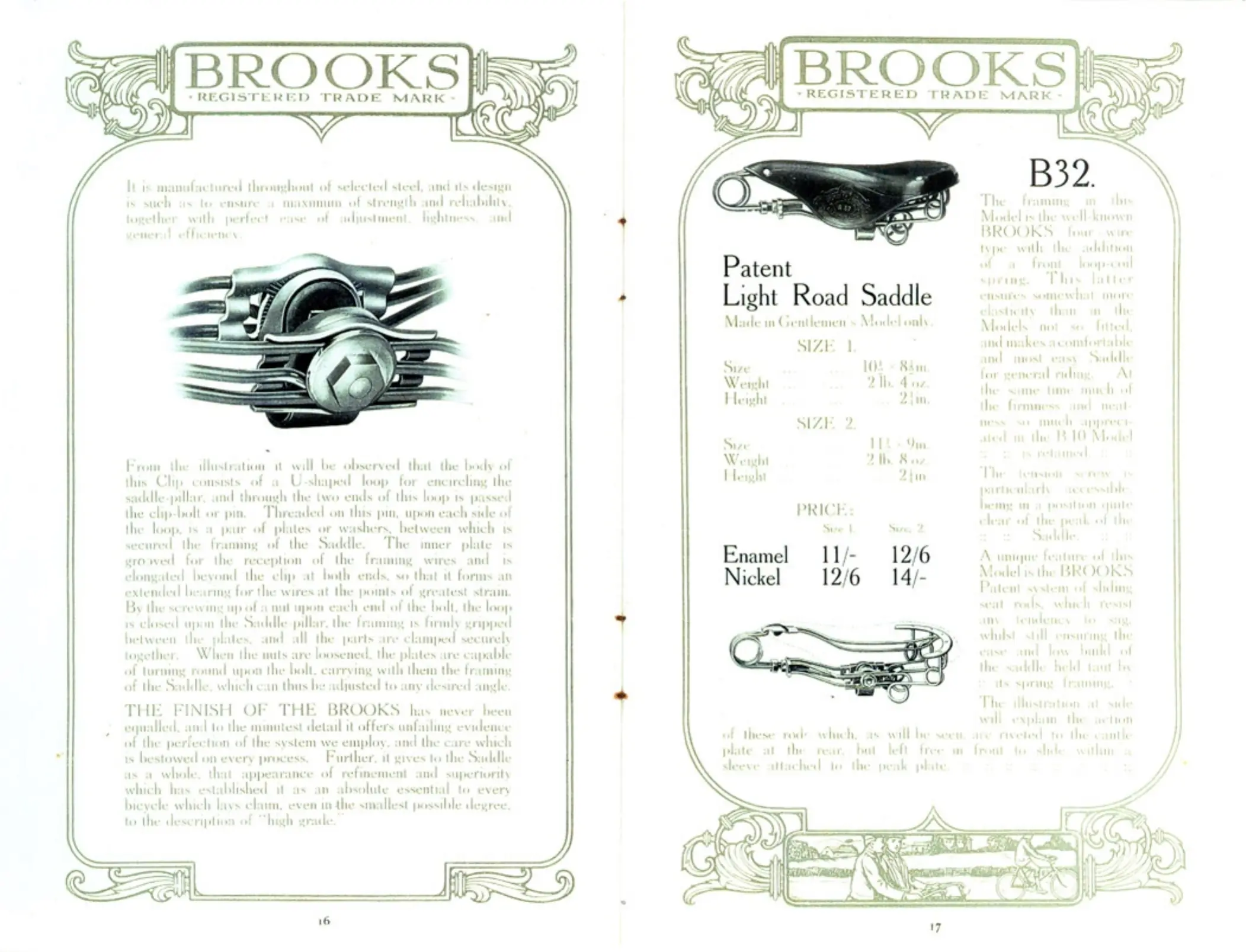
It is manufactured throughout of selected steel, and its design is such as to ensure a maximum of strength and reliability, together with perfect ease of adjustment, lightness, and general efficiency.
From the illustration it will be observed that the body of this Clip consists of a U-shaped loop for encircling the saddle-pillar, and through the two ends of this loop is passed the clip-bolt or pin. Threaded on this pin, upon each side of the loop, is a pair of plates or washers, between which is secured the framing of the Saddle. The inner plate is grooved for the reception of the framing wires and is elongated beyond the clip at both ends, so that it forms an extended bearing for the wires at the points of greatest strain. By the screwing up of a nut upon each end of the bolt, the loop is closed upon the Saddle-pillar, the framing is firmly gripped between the plates, and all the parts are clamped securely together. When the nuts are loosened, the plates are capable of turning round upon the bolt, carrying with them the framing of the Saddle, which can thus be adjusted to any desired angle.
THE FINISH OF THE BROOKS has never been equalled, and to the minutest detail it offers unfailing evidence of the perfection of the system we employ, and the care which is bestowed on every process. Further, it gives to the Saddle as a whole, that appearance of refinement and superiority which has established it as an absolute essential to every bicycle which lays claim, even in the smallest possible degree, to the description of “high grade.”
[Printed page 17, recto. Two photographs within the Art Nouveau border, a saddle in side elevation above and its framing below, with the model number and description in the outer column.]
B 32.
Patent Light Road Saddle
Made in Gentlemen’s Model only.
SIZE 1.
Size … 10 1/2 x 8 1/2 in.
Weight … 2 lb. 4 oz.
Height … 2 1/4 in.
SIZE 2.
Size … 11 1/2 x 9 in.
Weight … 2 lb. 8 oz.
Height … 2 1/4 in.
PRICE:
Size 1. Size 2.
Enamel 11/- 12/6
Nickel 12/6 14/-
The framing in this Model is the well-known BROOKS four-wire type with the addition of a front loop-coil spring. This latter ensures somewhat more elasticity than in the Models not so fitted, and makes a comfortable and most easy Saddle for general riding. At the same time much of the firmness and neatness so much appreciated in the B 10 Model is retained.
The tension screw is particularly accessible, being in a position quite clear of the peak of the Saddle.
A unique feature of this Model is the BROOKS Patent system of sliding seat rods, which resist any tendency to sag, whilst still ensuring the ease and low build of the saddle held taut by its spring framing.
The illustration at side will explain the action of these rods which, as will be seen, are riveted to the cantle plate at the rear, but left free in front to slide within a sleeve attached to the peak plate.
[Note on this page. This is the page the B 28 occupies in the 1906, 1907 and 1908 books. The B 32 is not new; it stands at printed page 13 in the 1908 index. It shares two of the B 28’s features, the Gentlemen’s Model only restriction and the front loop-coil spring, but it resists sagging by sliding seat rods rather than by the rubber buffers named on the B 28 in 1907 and 1908.]
[Printed page 30, verso. Letterpress within the Art Nouveau border.]
At this point it may be well for us to explain in detail the advantages of this clip.
It is in this part of a Saddle that economies in manufacture are often practised for the sake of cheapness. It lends itself to such treatment and, as a result, efficiency is sacrificed.
In the designing of the BROOKS it has been our special endeavour to produce that which will give a perfect and reliable grip, and absolute efficiency in adjustment.
We believe we have succeeded in this object and, in our present pattern, have a means of attachment which, while possessing the greatest possible rigidity and firmness when secured, is easily and quickly released for adjustment when this is necessary.
This question of rigidity is of vital importance, for the slightest movement of the Saddle at an inopportune moment endangers not only the comfort, but the safety of the rider.
To lay down hard and fast rules on the matter of adjustment is impossible, but taking height, tilt, and fore-and-aft position it may be remarked-
That THE MAJORITY OF CYCLISTS SIT TOO HIGH and too much over their work.
This fault is most commonly found among lady riders, and in some cases, where it is carried to extreme, it is difficult to understand how the unavoidable discomfort of such position can be endured.
To them, and to others who make the same mistake, we would say-
[Printed page 31, recto. Two photographs within the Art Nouveau border, a plain-topped saddle above and a padded one below, with the model number and description in the outer column.]
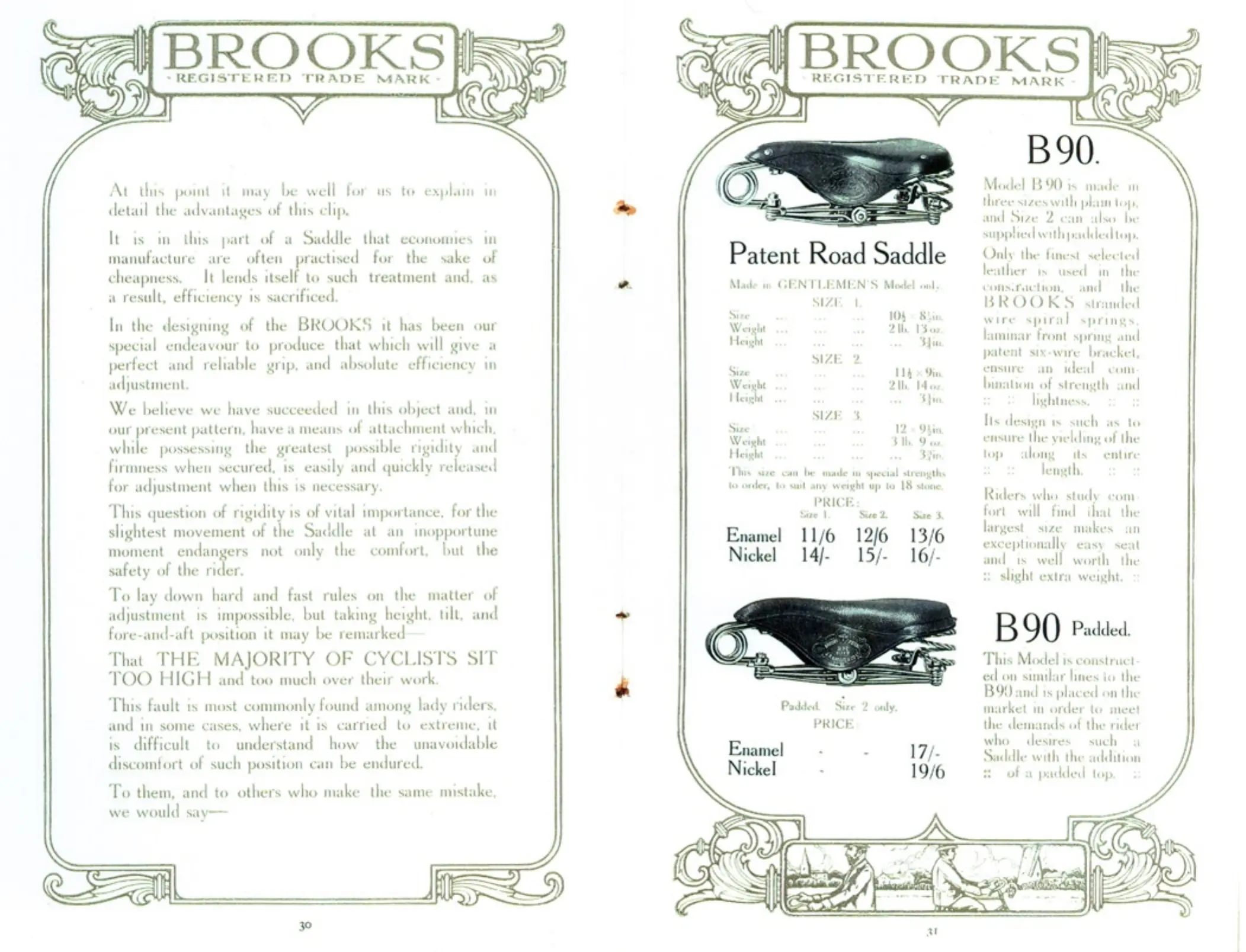
B 90.
Patent Road Saddle
Made in GENTLEMEN’S Model only.
SIZE 1.
Size … 10 1/2 x 8 1/2 in.
Weight … 2 lb. 13 oz.
Height … 3 1/4 in.
SIZE 2.
Size … 11 1/2 x 9 in.
Weight … 2 lb. 14 oz.
Height … 3 1/4 in.
SIZE 3.
Size … 12 x 9 1/2 in.
Weight … 3 lb. 9 oz.
Height … 3 3/4 in.
This size can be made in special strengths to order, to suit any weight up to 18 stone.
PRICE:
Size 1. Size 2. Size 3.
Enamel 11/6 12/6 13/6
Nickel 14/- 15/- 16/-
Model B 90 is made in three sizes with plain top, and Size 2 can also be supplied with padded top.
Only the finest selected leather is used in the construction, and the BROOKS stranded wire spiral springs, laminar front spring and patent six-wire bracket, ensure an ideal combination of strength and lightness.
Its design is such as to ensure the yielding of the top along its entire length.
Riders who study comfort will find that the largest size makes an exceptionally easy seat and is well worth the slight extra weight.
B 90 Padded.
Padded. Size 2 only.
PRICE:
Enamel 17/-
Nickel 19/6
This Model is constructed on similar lines to the B 90 and is placed on the market in order to meet the demands of the rider who desires such a Saddle with the addition of a padded top.
[Note on this page. The B 90 is the control model in this project’s finding about the B 28’s re-dimensioning. Its three sizes here, 10 and a half by 8 and a half, 11 and a half by 9, and 12 by 9 and a half inches, are identical to the 1914 and 1916 printings, to the fraction, so the measuring convention did not change across those six years. Its weights, however, are already climbing before the war: Sizes 2 and 3 gain more between 1910 and 1914 than they do between 1914 and 1916.]
[Printed page 32, verso. Letterpress within the Art Nouveau border.]
That the leg should never be absolutely straightened when pedalling; that if the slightest strain is felt when the pedal reaches its lowest point, the Saddle should be lowered.
In THE MATTER OF TILT, of course, this depends entirely on the position of the rider. The speed-man who adopts a stoop, should drop the peak and increase the tilt in this direction, according to the extent to which he leans over the bar. For the ordinary rider who adopts an upright position, the peak should invariably be slightly raised.
With regard to THE FORE-AND-AFT POSITION, this is controlled by the method of pedalling, and when the rider “ankles” well, and obtains the maximum of power before the pedal rises to the dead centre, a backward position will be found most advantageous, but, in such cases, it should be noted that as a more backward position is adopted, so the Saddle should be lowered. Where a rider is weak in ankle action, a forward position is essential.
A point never to be forgotten is that IMMUNITY FROM SADDLE PRESSURE can only be attained by carrying the weight on the broad part of the Saddle.
The peak distinctly must not carry that weight; it is not there for that purpose, and good design in any Saddle is only represented where, when properly adjusted on the machine, the peak is only felt to be an assistance to the rider, and causes no inconvenience from undue pressure.
[Printed page 33, recto. Two photographs within the Art Nouveau border, each of a saddle in side elevation with a coil spring assembly at the rear, with the model number and description in the outer column.]
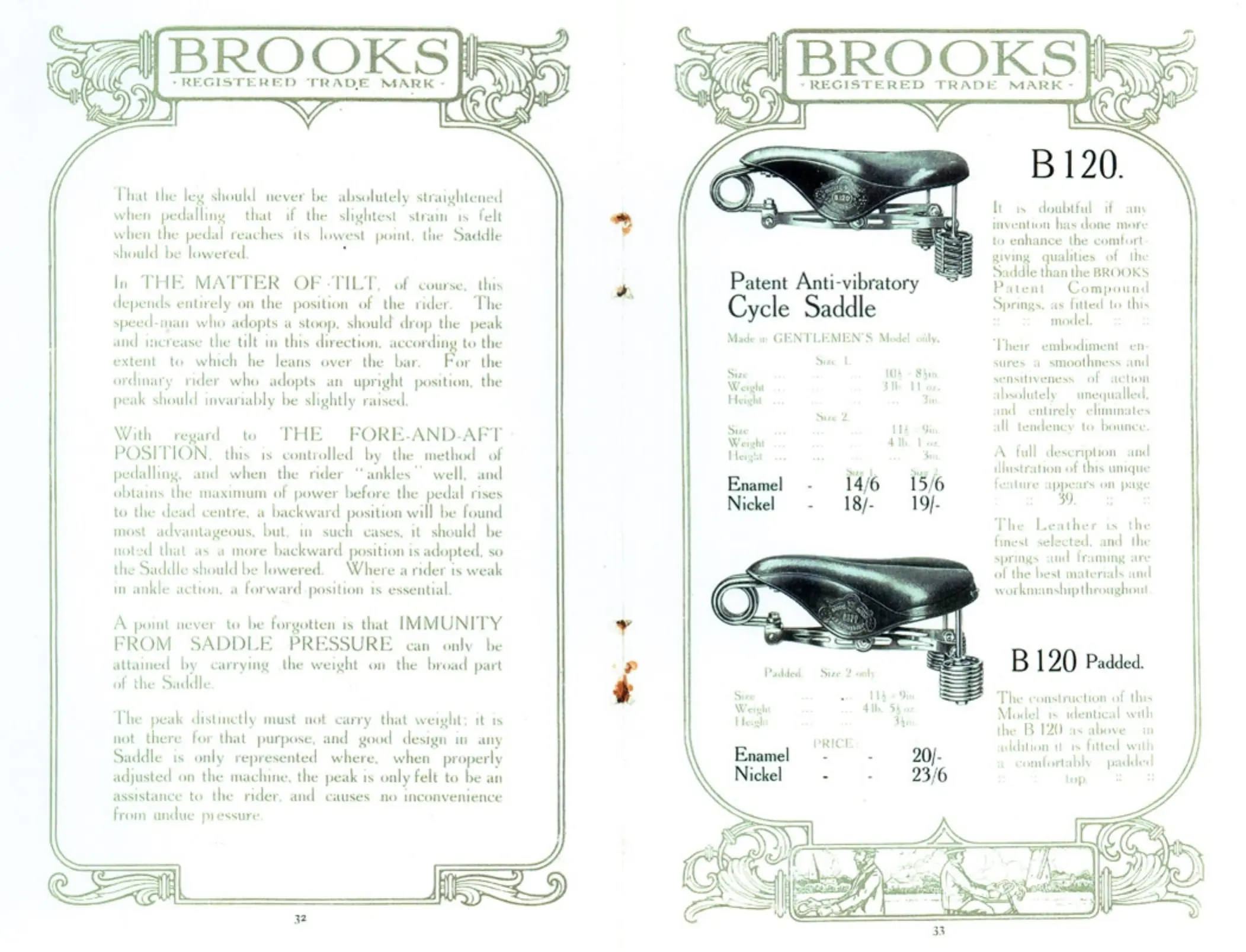
B 120.
Patent Anti-vibratory Cycle Saddle
Made in GENTLEMEN’S Model only.
SIZE 1.
Size … 10 1/2 x 8 1/2 in.
Weight … 3 lb. 11 oz.
Height … 3 in.
SIZE 2.
Size … 11 1/2 x 9 in.
Weight … 4 lb. 1 oz.
Height … 3 in.
Size 1. Size 2.
Enamel 14/6 15/6
Nickel 18/- 19/-
It is doubtful if any invention has done more to enhance the comfort-giving qualities of the Saddle than the BROOKS Patent Compound Springs, as fitted to this model.
Their embodiment ensures a smoothness and sensitiveness of action absolutely unequalled, and entirely eliminates all tendency to bounce.
A full description and illustration of this unique feature appears on page 39.
The Leather is the finest selected, and the springs and framing are of the best materials and workmanship throughout.
B 120 Padded.
Padded. Size 2 only.
Size … 11 1/2 x 9 in.
Weight … 4 lb. 5 1/2 oz.
Height … 3 1/2 in.
PRICE:
Enamel 20/-
Nickel 23/6
The construction of this Model is identical with the B 120 as above; in addition it is fitted with a comfortably padded top.
[Note on this page. The B 120 is the anti-vibratory flagship of the 1910 cycle range and it is sprung by the Patent Compound Springs, not by rubber buffers. Taken with printed page 38, which says every model of the anti-vibratory Saddles and Seats is fitted with those springs, this is the reason the rubber buffer is not the anti-vibration answer anywhere in the 1910 book.]
[Printed page 38, verso. Letterpress within the Art Nouveau border.]
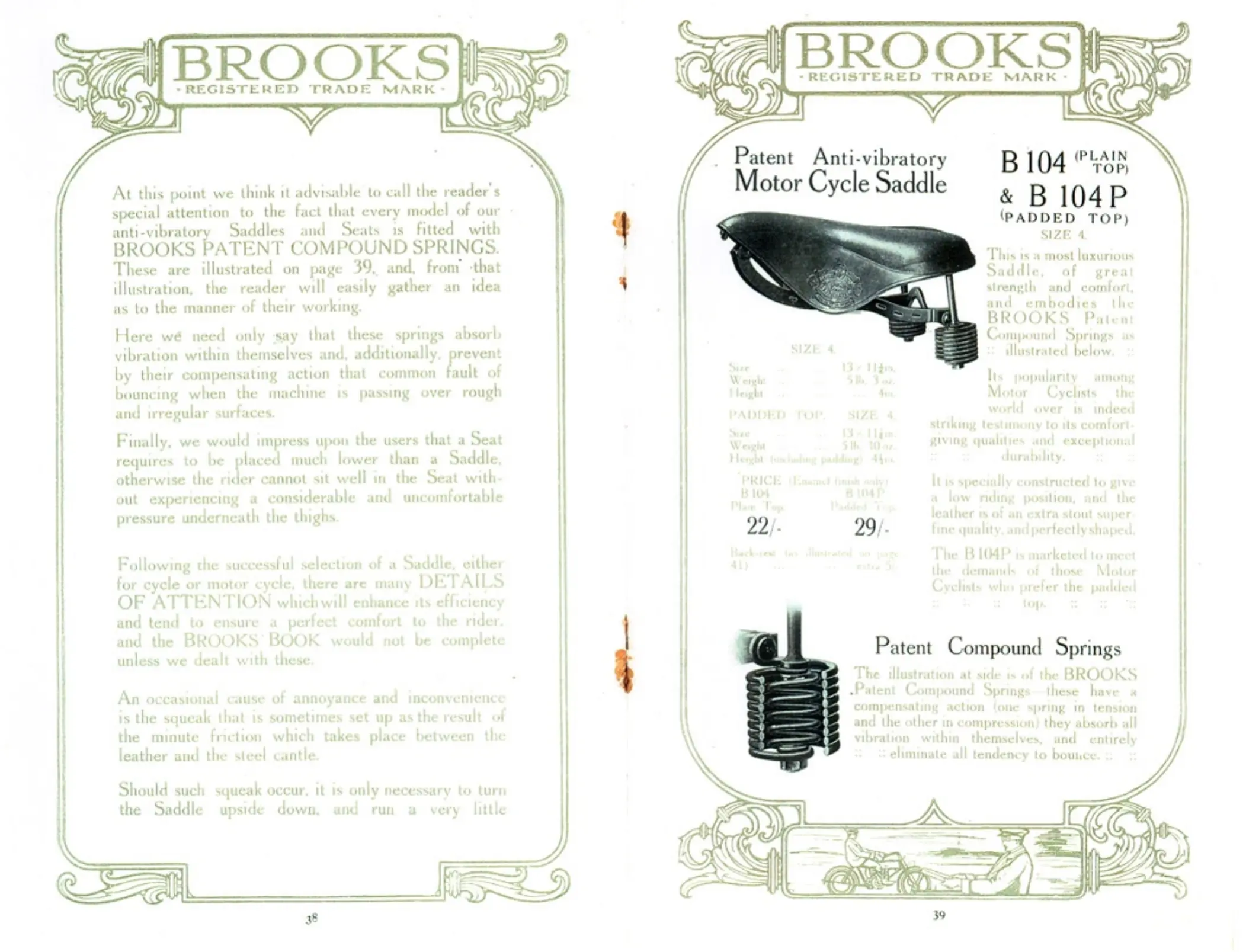
At this point we think it advisable to call the reader’s special attention to the fact that every model of our anti-vibratory Saddles and Seats is fitted with BROOKS PATENT COMPOUND SPRINGS. These are illustrated on page 39, and, from that illustration, the reader will easily gather an idea as to the manner of their working.
Here we need only say that these springs absorb vibration within themselves and, additionally, prevent by their compensating action that common fault of bouncing when the machine is passing over rough and irregular surfaces.
Finally, we would impress upon the users that a Seat requires to be placed much lower than a Saddle, otherwise the rider cannot sit well in the Seat without experiencing a considerable and uncomfortable pressure underneath the thighs.
Following the successful selection of a Saddle, either for cycle or motor cycle, there are many DETAILS OF ATTENTION which will enhance its efficiency and tend to ensure a perfect comfort to the rider, and the BROOKS BOOK would not be complete unless we dealt with these.
An occasional cause of annoyance and inconvenience is the squeak that is sometimes set up as the result of the minute friction which takes place between the leather and the steel cantle.
Should such squeak occur, it is only necessary to turn the Saddle upside down, and run a very little
[Printed page 39, recto. Two photographs within the Art Nouveau border, a motor saddle in side elevation above and a detail of the spring assembly below, with the model numbers and description in the outer column.]
B 104 (PLAIN TOP) & B 104 P (PADDED TOP)
SIZE 4.
Patent Anti-vibratory Motor Cycle Saddle
SIZE 4.
Size … 13 x 11 1/2 in.
Weight … 5 lbs. 3 oz.
Height … 4 in.
PADDED TOP. SIZE 4.
Size … 13 x 11 1/2 in.
Weight … 5 lb. 10 oz.
Height (including padding) 4 1/2 in.
PRICE (Enamel finish only):
B 104 Plain Top 22/-
B 104 P Padded Top 29/-
Back-rest (as illustrated on page 41) … extra 5/-
This is a most luxurious Saddle, of great strength and comfort, and embodies the BROOKS Patent Compound Springs as illustrated below.
Its popularity among Motor Cyclists the world over is indeed striking testimony to its comfort-giving qualities and exceptional durability.
It is specially constructed to give a low riding position, and the leather is of an extra stout superfine quality, and perfectly shaped.
The B 104 P is marketed to meet the demands of those Motor Cyclists who prefer the padded top.
Patent Compound Springs
The illustration at side is of the BROOKS Patent Compound Springs; these have a compensating action (one spring in tension and the other in compression) they absorb all vibration within themselves, and entirely eliminate all tendency to bounce.
[Note on this page. This is the clearest statement of the compound spring in the Brooks run held here, and it belongs with the 1905 book’s account of the B 120 being produced because the B 100 motor saddle succeeded. The motor-to-bicycle movement of technology that post 1111 describes is real, but it is the compound spring that made the journey, not the rubber buffer.]
[Printed page 44, verso. Letterpress within the Art Nouveau border.]
should be allowed to dry gradually. This process of drying must on no account be hastened by artificial means, as, if this is done, it will perish the nature of the leather and cause it to crack.
To neglect the leather, as many riders do, necessarily shortens THE LIFE OF THE SADDLE, and, leaving the top hard and unpliable, causes much discomfort.
A Saddle should never be ridden with the leather wet if this can be avoided, as nothing is more likely to spoil its shape and destroy its comfort-giving qualities.
IN THE PRECEDING PAGES we have endeavoured to treat the subjects with which our matter deals, in a manner which will not only be appreciated, but easily understood by all riders.
As we said at the commencement, the Saddle question is one of most vital importance, and our object has been to assist the cyclist in solving the many problems which it presents. In such connection, we would further commend to the reader’s careful consideration, the specifications of the many models illustrated throughout this list.
From among these we have no doubt that there are but few riders who will not be able to select a Saddle of perfect suitability; but to those few who may not find the exact article they require, we extend a very cordial invitation to enter into correspondence with us, and thus give us an opportunity of assisting them in solving their particular problem.
[Printed page 45, recto. One photograph within the Art Nouveau border, a saddle in side elevation, with the heading and specification set beside it.]
Patent Military Saddle
as adopted by H.M. War Office.
Size … 11 1/2 x 9 in.
Weight … 1 lb. 13 oz.
Height … 2 in.
PRICE, 11/6
All metal parts bronzed
No. 2 Military.
The Saddle here illustrated has been specially designed for Military use, and the fact that it is extensively adopted by H.M. War Office is ample proof that it possesses points of special and commanding merit.
The framing is of the BROOKS popular four-wire type, giving great strength, lightness and elasticity, all absolute essentials in any Saddle used for Military purposes.
The patent clip is particularly strong and capable of the finest adjustment.
The top is perfectly shaped, of the finest selected stout leather, and provides a large, firm, yet resilient seat.
The materials are of the finest quality, all metal parts are bronzed, and the workmanship throughout unequalled.
[Note on this page. As in 1908, the No. 2 stands alone: there is no No. 1 and no No. 3. The 1911 book, the next in the run, heads the same page No. 2 and No. 3 Military, so the No. 3 arrives between 1910 and 1911. The size, weight, height and price are identical to the 1908 No. 2; what changes is the finish wording, gun-browned in 1908 and bronzed here.]
[Printed page 72, verso, facing the plain green rear endpaper. A halftone photograph of a large corner factory building within the Art Nouveau border.]
THE BROOKS FACTORY
(Great Charles Street, Birmingham.)
Here are manufactured the World-famed BROOKS SADDLES and every other article included in the preceding pages.
Here also are produced-
THE BROOKS MOTOR EQUIPMENT SPECIALITIES.
THE BROOKS LEATHER GOODS.
THE BROOKS MAGNETO (Patented).
THE BROOKS PATENT SYNCHRONIZED SINGLE TREMBLER COIL.
In the interests of all of these we issue separate and special Lists, and will gladly forward a copy on request.
[Note on this page. The magneto and the trembler coil are ignition equipment, and Brooks as a maker of motor-cycle electrics is not otherwise recorded in the Ebykr archive. The reference to separate and special Lists also explains the shape of this collection, in which some years survive as a cyclist’s edition and some as a combined cycle and motor cycle book.]
 Brooks 1902 Catalog — Cycle Saddles and Accoutrements for 1902
 Brooks 1935 Advertisement — Specify and Insist, and Quality Cycle Saddles with Challenge and Kaydex
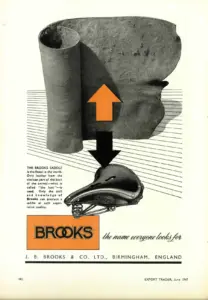 Brooks 1947 Advertisement — The Name Everyone Looks For (Export Trader)
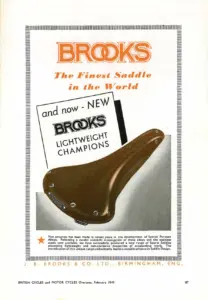 Brooks 1949 Advertisement — The New Lightweight Champions (British Cycles and Motor Cycles Overseas)
 Brooks chez A.F.C.O. — L’Officiel du cycle, 3 November 1951, Brooks Represented in France by AFCO
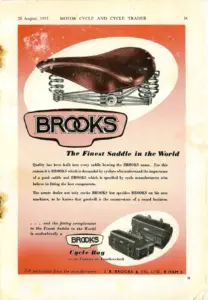 Brooks 1955 Advertisement — It’s the Saddle that Sells the Cycle (Motor Cycle and Cycle Trader)
Ebykr presents this material for research and education. If you hold rights to it or notice an ownership issue, please contact us and we will respond promptly.
The Ebykr Digest
New articles, timelines, catalog finds and registry activity — assembled from the archive once a month. Your address is never shared.
Double opt-in. One email per month. Unsubscribe at any time with one click.