About Ebykr
Ebykr celebrates classic and vintage lightweight bicycles through provocative imagery and opinion. Ride along with us.
About Ebykr
Ebykr celebrates classic and vintage lightweight bicycles through provocative imagery and opinion. Ride along with us.

Source: bulgier.net (Mark Bulgier's catalog archive), no scanner named for this folder; enlarged for Ebykr.
 Page 1
 Page 2
 Page 3
 Page 4
 Page 5
 Page 6
 Page 7
 Page 8
 Page 9
 Page 10
 Page 11
 Page 12
 Page 13
 Page 14
 Page 15
 Page 16
 Page 17
 Page 18
 Page 19
 Page 20
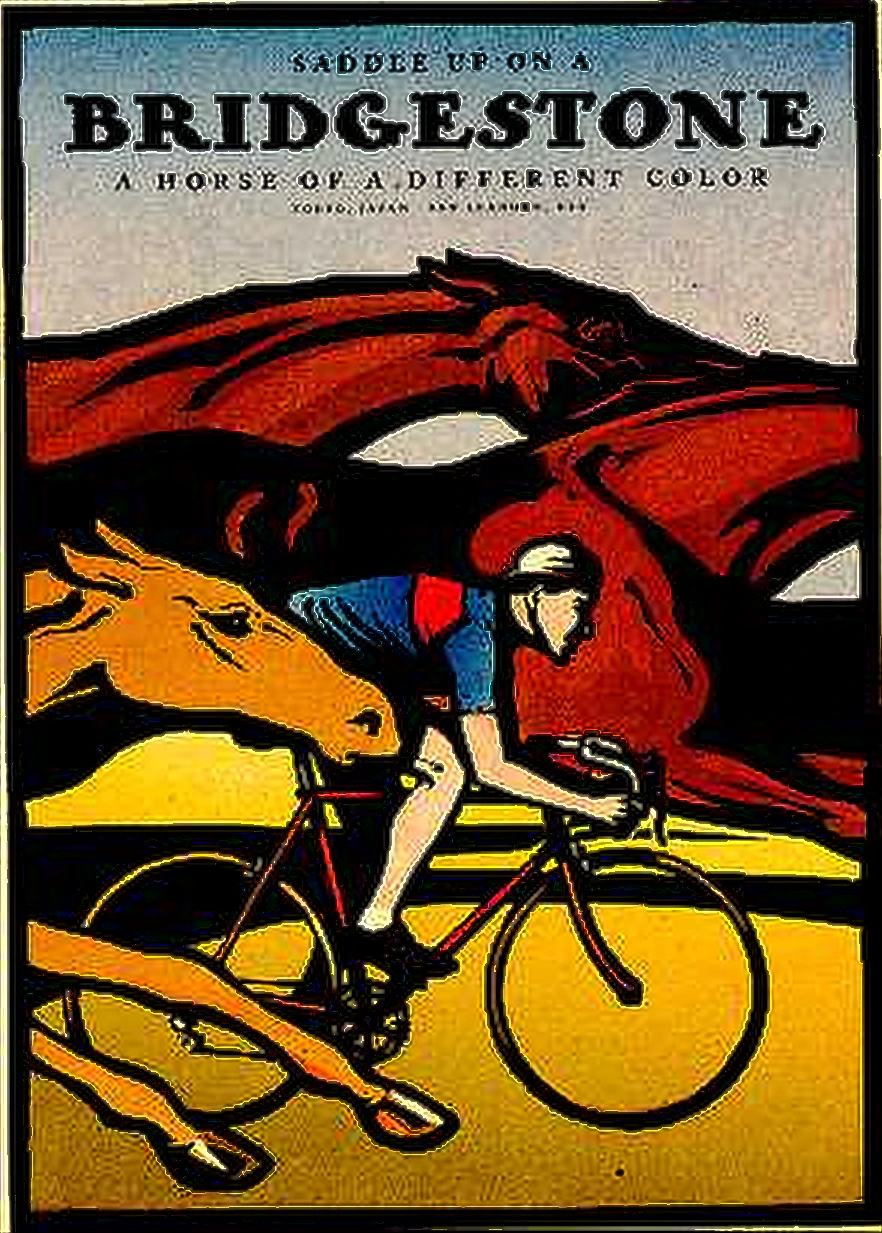 Page 21
| Marque | Bridgestone |
|---|---|
| Type | Catalog |
| Year | 1993 |
| Publisher | Bridgestone (United States) |
| Country | United States |
| Language | English |
| Pages | 21 |
| Source | bulgier.net (Mark Bulgier's catalog archive), no scanner named for this folder; enlarged for Ebykr. |
| Credit | Ebykr archive |
| Identifier | Permalink http://bulgier.net/pics/bike/Catalogs/Bridgestone-93/ |
| Transcription | Transcribed by eye |
Reference
Bridgestone (United States). The Bridgestone Bicycle Catalogue 1993: le BUBster, the RB, XO and MB Models, the Ritchey Mountain Bike Fork, Frame Geometry and Specifications. 1993. Ebykr, https://ebykr.com/library/bridgestone-bicycle-catalogue-1993/.
Wikipedia
{{cite book |title=The Bridgestone Bicycle Catalogue 1993: le BUBster, the RB, XO and MB Models, the Ritchey Mountain Bike Fork, Frame Geometry and Specifications |publisher=Bridgestone (United States) |date=1993 |url=https://ebykr.com/library/bridgestone-bicycle-catalogue-1993/ |via=Ebykr |access-date=}}THE BRIDGESTONE BICYCLE CATALOGUE 1993 HOW TO USE A QUICK RELEASE The Q/R lever operates a cam. Regulate tension with the opposite-side nut/cone. THE QUICK-RELEASE (Q/R) was invented by Italian bike racer Tullio Campagnolo, hit the market in 1930, and has since remained fundamentally unchanged. It is a simple, ingenious device that, like a set …
Twenty-one pages of “The Bridgestone Bicycle Catalogue 1993”: the lugged crowns and how to use a quick release, the RB-1 and RB-2 road models, the XO-1 and XO-2 and the MB-1 and MB-2 mountain models, le BUBster, frame geometry, the Ritchey fork, the specification and geometry tables and a poster.
— Page 1 —
THE BRIDGESTONE BICYCLE CATALOGUE 1993
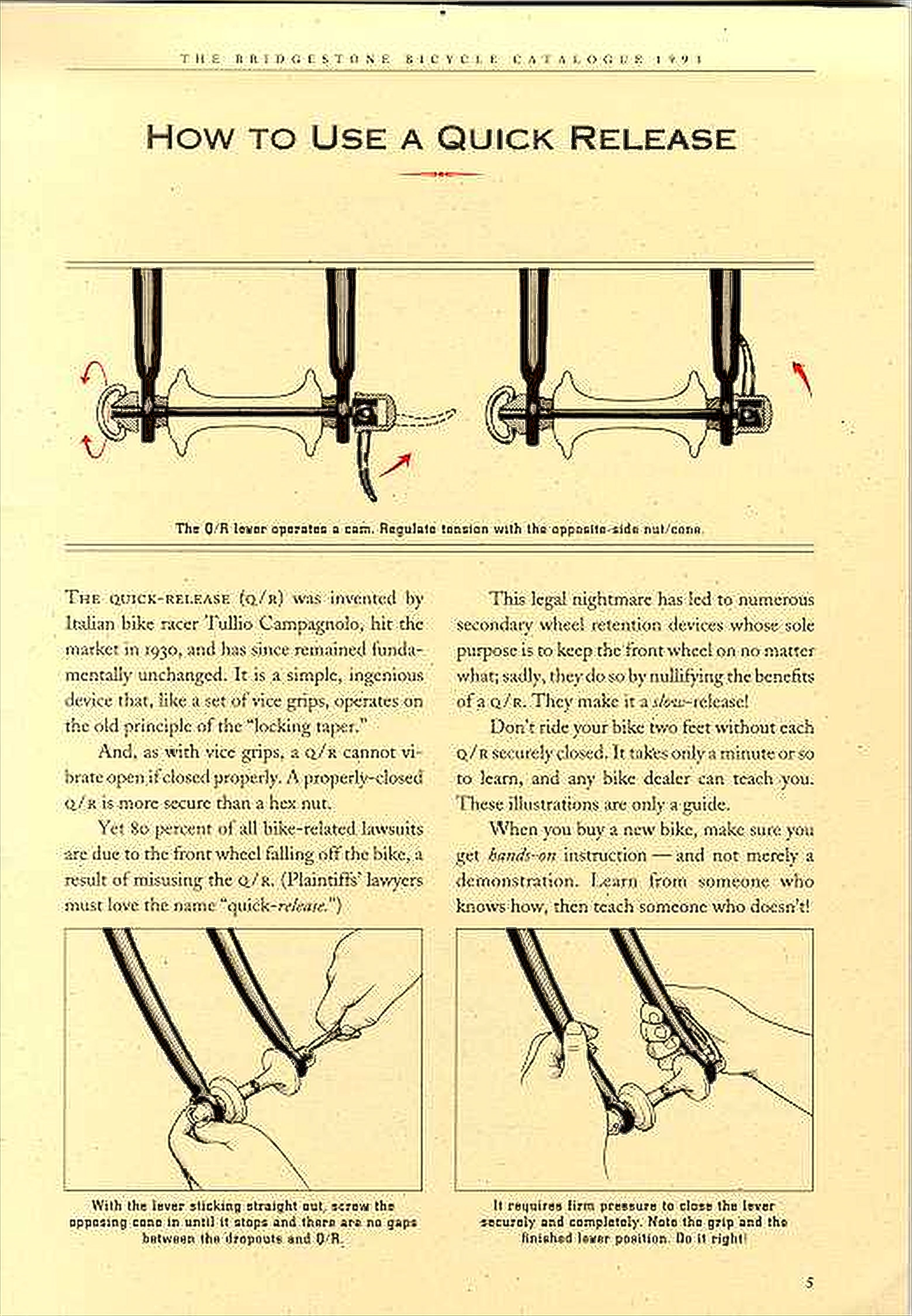
HOW TO USE A QUICK RELEASE
The Q/R lever operates a cam. Regulate tension with the opposite-side nut/cone.
THE QUICK-RELEASE (Q/R) was invented by Italian bike racer Tullio Campagnolo, hit the market in 1930, and has since remained fundamentally unchanged. It is a simple, ingenious device that, like a set of vice grips, operates on the old principle of the “locking taper.”
And, as with vice grips, a Q/R cannot vibrate open if closed properly. A properly-closed Q/R is more secure than a hex nut.
Yet 80 percent of all bike-related lawsuits are due to the front wheel falling off the bike, a result of misusing the Q/R. (Plaintiffs’ lawyers must love the name “quick-release.”)
This legal nightmare has led to numerous secondary wheel retention devices whose sole purpose is to keep the front wheel on no matter what; sadly, they do so by nullifying the benefits of a Q/R. They make it a slow-release!
Don’t ride your bike two feet without each Q/R securely closed. It takes only a minute or so to learn, and any bike dealer can teach you. These illustrations are only a guide.
When you buy a new bike, make sure you get hands-on instruction — and not merely a demonstration. Learn from someone who knows how, then teach someone who doesn’t!
With the lever sticking straight out, screw the opposing cone in until it stops and there are no gaps between the dropouts and Q/R.
It requires firm pressure to close the lever securely and completely. Note the grip and the finished lever position. Do it right!
5
[A page headed “How to Use a Quick Release” with two line drawings of a front hub and fork ends showing the quick release lever, two drawings of hands closing the lever, and a two column text. The drawings carry red arrows and the captions are set in a bold sans serif type.]
— Page 2 —
THE BRIDGESTONE BICYCLE CATALOGUE 1993
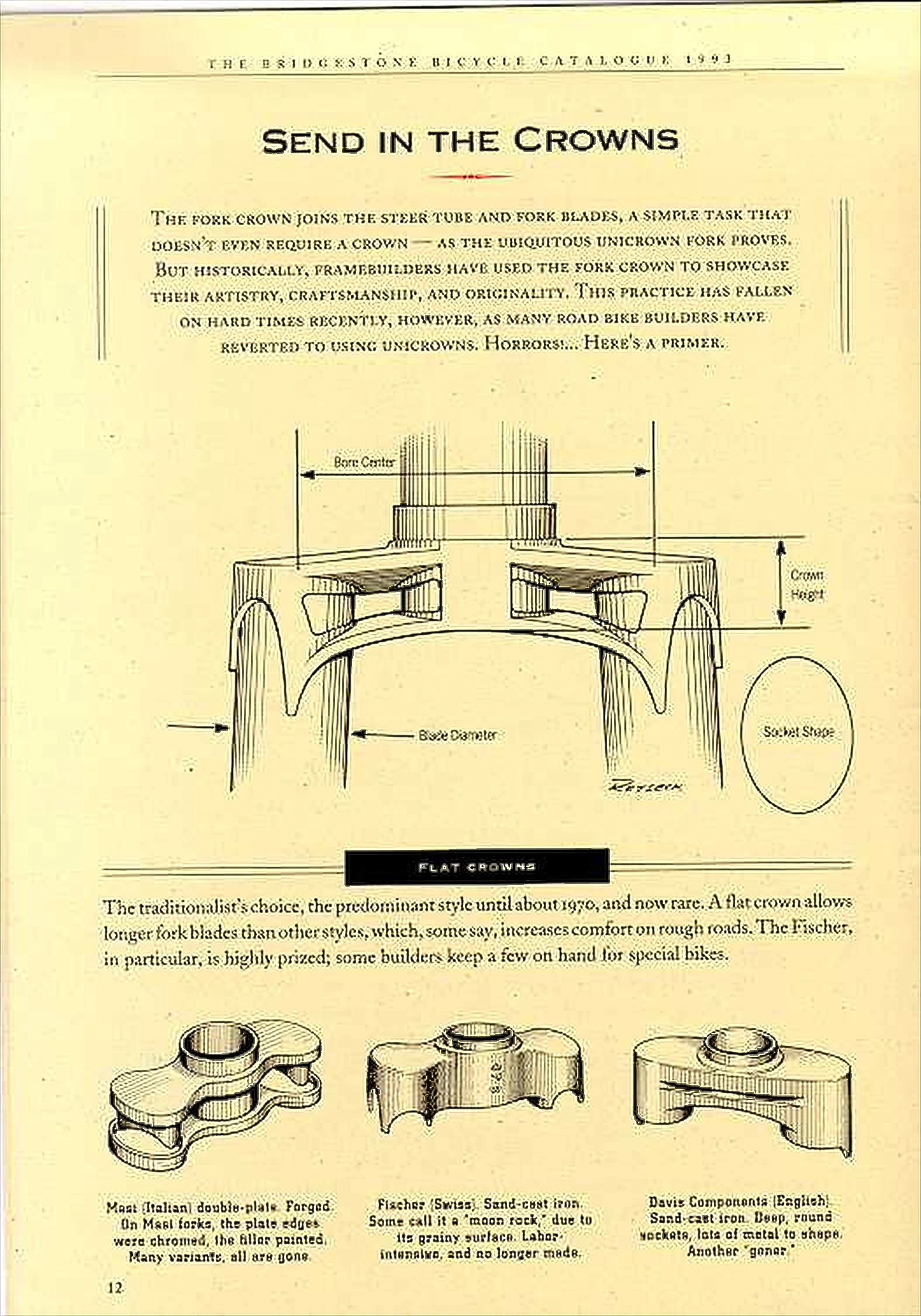
Send in the Crowns
The fork crown joins the steer tube and fork blades, a simple task that doesn’t even require a crown — as the ubiquitous unicrown fork proves. But historically, framebuilders have used the fork crown to showcase their artistry, craftsmanship, and originality. This practice has fallen on hard times recently, however, as many road bike builders have reverted to using unicrowns. Horrors!… Here’s a primer.
Callouts: Bore Center, Crown Height, Blade Diameter, Socket Shape
Flat Crowns
The traditionalist’s choice, the predominant style until about 1970, and now rare. A flat crown allows longer fork blades than other styles, which, some say, increases comfort on rough roads. The Fischer, in particular, is highly prized; some builders keep a few on hand for special bikes.
Masi (Italian) double-plate. Forged. On Masi forks, the plate edges were chromed, the filler painted. Many variants, all are gone.
Fischer (Swiss). Sand-cast iron. Some call it a “moon rock,” due to its grainy surface. Labor-intensive, and no longer made.
Davis Components (English). Sand-cast iron. Deep, round sockets, lots of metal to shape. Another “goner.”
12
[A fork crown drawing with callouts for bore center, crown height, blade diameter and socket shape, under the heading “Send in the Crowns”, followed by a “Flat Crowns” section with three drawings of Masi, Fischer and Davis Components crowns. A hand-lettered artist’s signature sits at the lower right of the large drawing.]
— Page 3 —
THE BRIDGESTONE BICYCLE CATALOGUE 1993
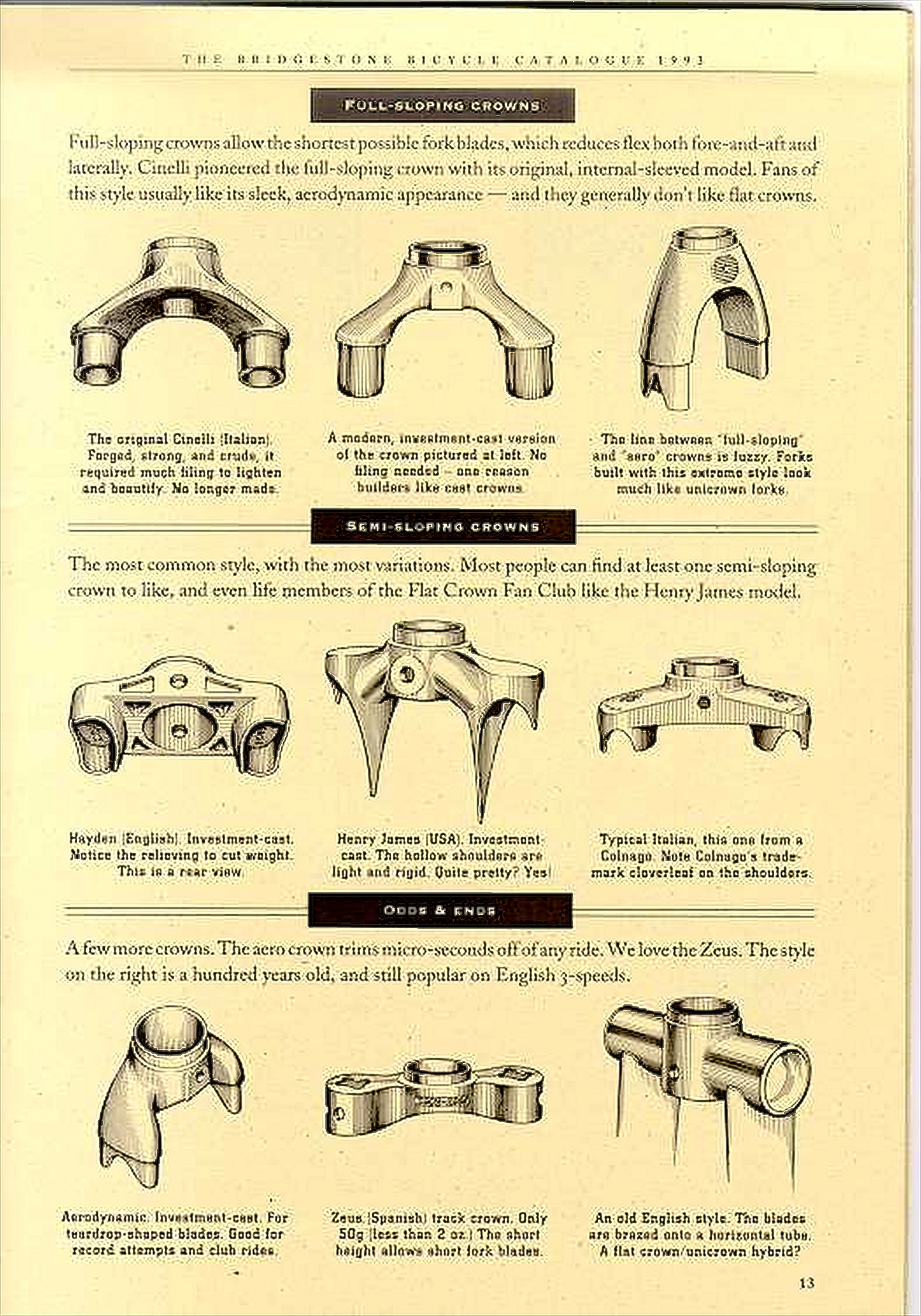
Full-sloping Crowns
Full-sloping crowns allow the shortest possible fork blades, which reduces flex both fore-and-aft and laterally. Cinelli pioneered the full-sloping crown with its original, internal-sleeved model. Fans of this style usually like its sleek, aerodynamic appearance — and they generally don’t like flat crowns.
The original Cinelli (Italian). Forged, strong, and crude, it required much filing to lighten and beautify. No longer made.
A modern, investment-cast version of the crown pictured at left. No filing needed — one reason builders like cast crowns.
The line between “full-sloping” and “aero” crowns is fuzzy. Forks built with this extreme style look much like unicrown forks.
Semi-sloping Crowns
The most common style, with the most variations. Most people can find at least one semi-sloping crown to like, and even life members of the Flat Crown Fan Club like the Henry James model.
Hayden (English). Investment-cast. Notice the relieving to cut weight. This is a rear view.
Henry James (USA). Investment-cast. The hollow shoulders are light and rigid. Quite pretty? Yes!
Typical Italian, this one from a Colnago. Note Colnago’s trademark cloverleaf on the shoulders.
Odds & Ends
A few more crowns. The aero crown trims micro-seconds off of any ride. We love the Zeus. The style on the right is a hundred years old, and still popular on English 3-speeds.
Aerodynamic. Investment-cast. For teardrop-shaped blades. Good for record attempts and club rides.
Zeus (Spanish) track crown. Only 50g (less than 2 oz.) The short height allows short fork blades.
An old English style. The blades are brazed onto a horizontal tube. A flat crown/unicrown hybrid?
13
[Nine drawings of fork crowns in three sections headed “Full-sloping Crowns”, “Semi-sloping Crowns” and “Odds & Ends”, each with a caption naming Cinelli, Hayden, Henry James, Colnago, Zeus and other crown styles.]
— Page 4 —
THE BRIDGESTONE BICYCLE CATALOGUE 1993
Which side are you on?
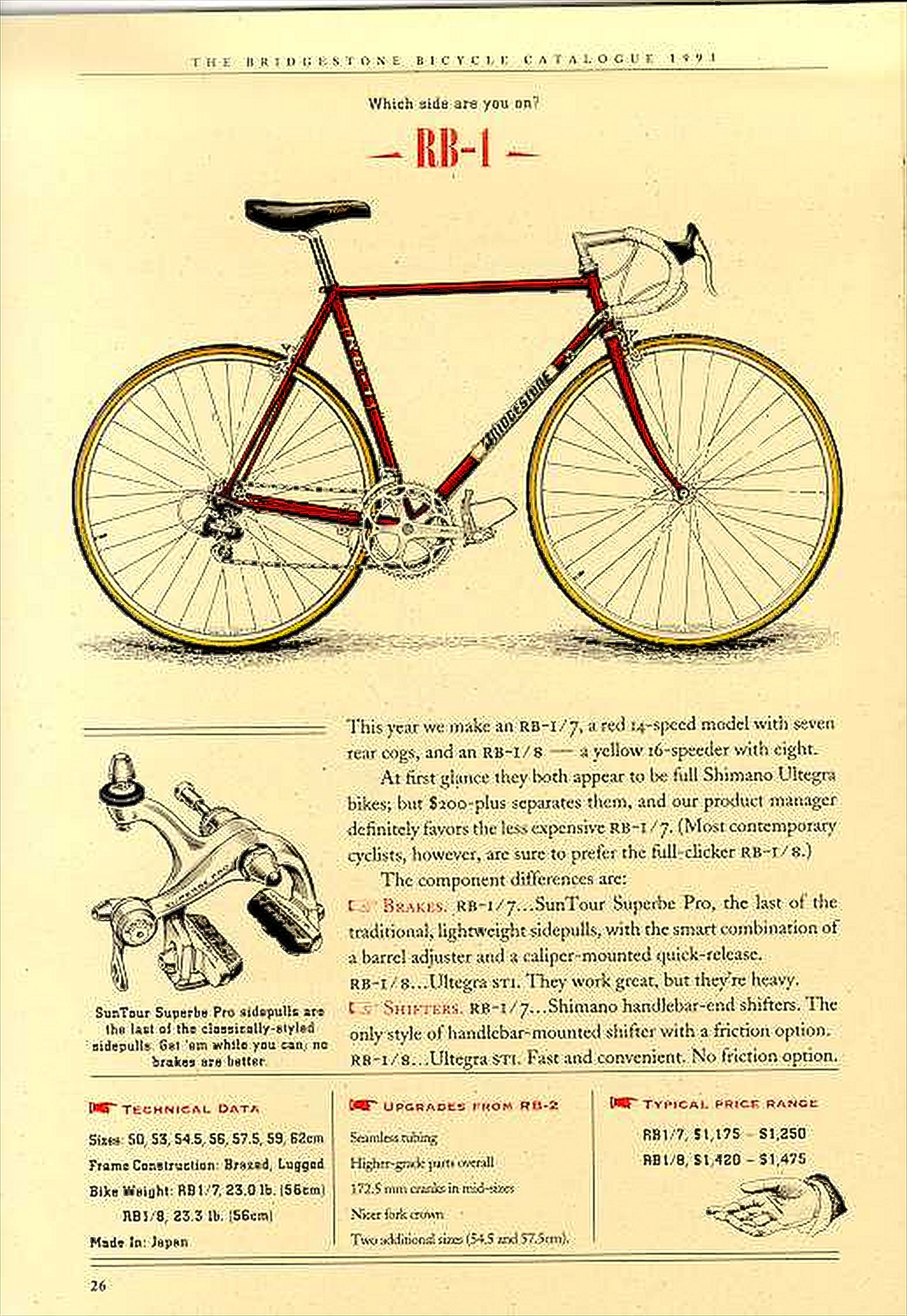
RB-1
This year we make an RB-1/7, a red 14-speed model with seven rear cogs, and an RB-1/8 — a yellow 16-speeder with eight.
At first glance they both appear to be full Shimano Ultegra bikes; but $200-plus separates them, and our product manager definitely favors the less expensive RB-1/7. (Most contemporary cyclists, however, are sure to prefer the full-clicker RB-1/8.)
The component differences are:
BRAKES. RB-1/7…SunTour Superbe Pro, the last of the traditional, lightweight sidepulls, with the smart combination of a barrel adjuster and a caliper-mounted quick-release.
RB-1/8…Ultegra STI. They work great, but they’re heavy.
SHIFTERS. RB-1/7…Shimano handlebar-end shifters. The only style of handlebar-mounted shifter with a friction option.
RB-1/8…Ultegra STI. Fast and convenient. No friction option.
SunTour Superbe Pro sidepulls are the last of the classically-styled sidepulls. Get ’em while you can; no brakes are better.
TECHNICAL DATA
Sizes: 50, 53, 54.5, 56, 57.5, 59, 62cm
Frame Construction: Brazed, Lugged
Bike Weight: RB1/7, 23.0 lb. (56cm)
RB1/8, 23.3 lb. (56cm)
Made In: Japan
UPGRADES FROM RB-2
Seamless tubing
Higher-grade parts overall
172.5 mm cranks in mid-sizes
Nicer fork crown
Two additional sizes (54.5 and 57.5cm).
TYPICAL PRICE RANGE
RB1/7, $1,175 – $1,250
RB1/8, $1,420 – $1,475
26
[The RB-1 road bicycle, red with yellow rims, in an engraving style drawing under the heading “Which side are you on?”, with a drawing of a SunTour Superbe Pro sidepull brake, a description of the RB-1/7 and RB-1/8 and boxes headed “Technical Data”, “Upgrades from RB-2” and “Typical Price Range”. The text is small and the Upgrades box is soft in the scan.]
— Page 5 —
THE BRIDGESTONE BICYCLE CATALOGUE 1993
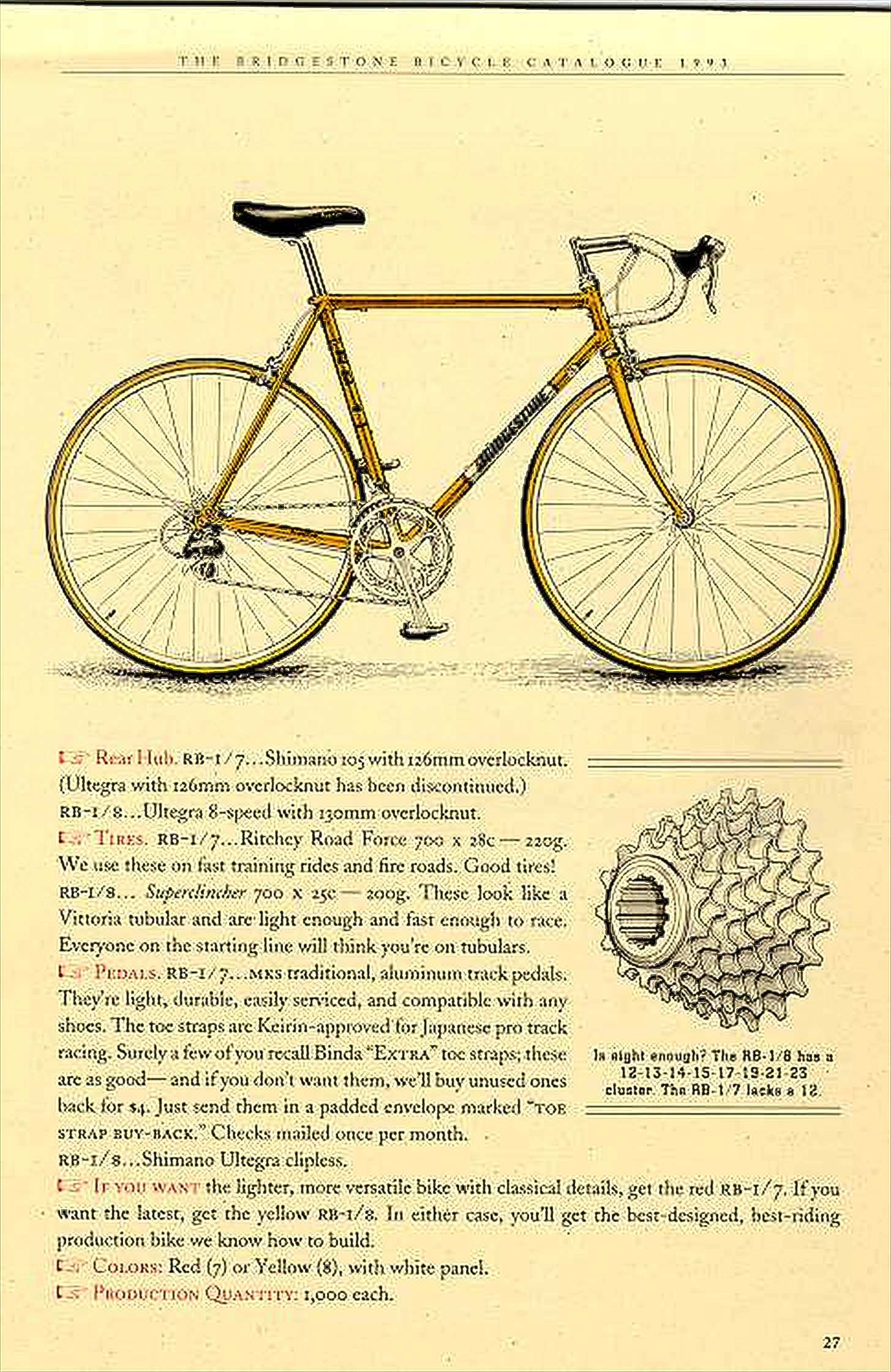
REAR HUB. RB-1/7…Shimano 105 with 126mm overlocknut. (Ultegra with 126mm overlocknut has been discontinued.)
RB-1/8…Ultegra 8-speed with 130mm overlocknut.
TIRES. RB-1/7…Ritchey Road Force 700 x 28c — 220g. We use these on fast training rides and fire roads. Good tires!
RB-1/8… Superclincher 700 x 25c — 200g. These look like a Vittoria tubular and are light enough and fast enough to race. Everyone on the starting line will think you’re on tubulars.
PEDALS. RB-1/7…MKS traditional, aluminum track pedals. They’re light, durable, easily serviced, and compatible with any shoes. The toe straps are Keirin-approved for Japanese pro track racing. Surely a few of you recall Binda “EXTRA” toe straps; these are as good— and if you don’t want them, we’ll buy unused ones back for $4. Just send them in a padded envelope marked “TOE STRAP BUY-BACK.” Checks mailed once per month.
RB-1/8…Shimano Ultegra clipless.
IF YOU WANT the lighter, more versatile bike with classical details, get the red RB-1/7. If you want the latest, get the yellow RB-1/8. In either case, you’ll get the best-designed, best-riding production bike we know how to build.
COLORS: Red (7) or Yellow (8), with white panel.
PRODUCTION QUANTITY: 1,000 each.
Is eight enough? The RB-1/8 has a 12-13-14-15-17-19-21-23 cluster. The RB-1/7 lacks a 12.
27
[The yellow RB-1/8 road bicycle in an engraving style drawing, with text on its rear hub, tires, pedals, colors and production quantity and a drawing of an eight speed freewheel cluster. The text is set in a serif type with small capital lead-ins and the caption in a bold sans serif type.]
— Page 6 —
THE BRIDGESTONE BICYCLE CATALOGUE 1993
A Road Bike, Too
RB-2
ALSO AVAILABLE IN RED
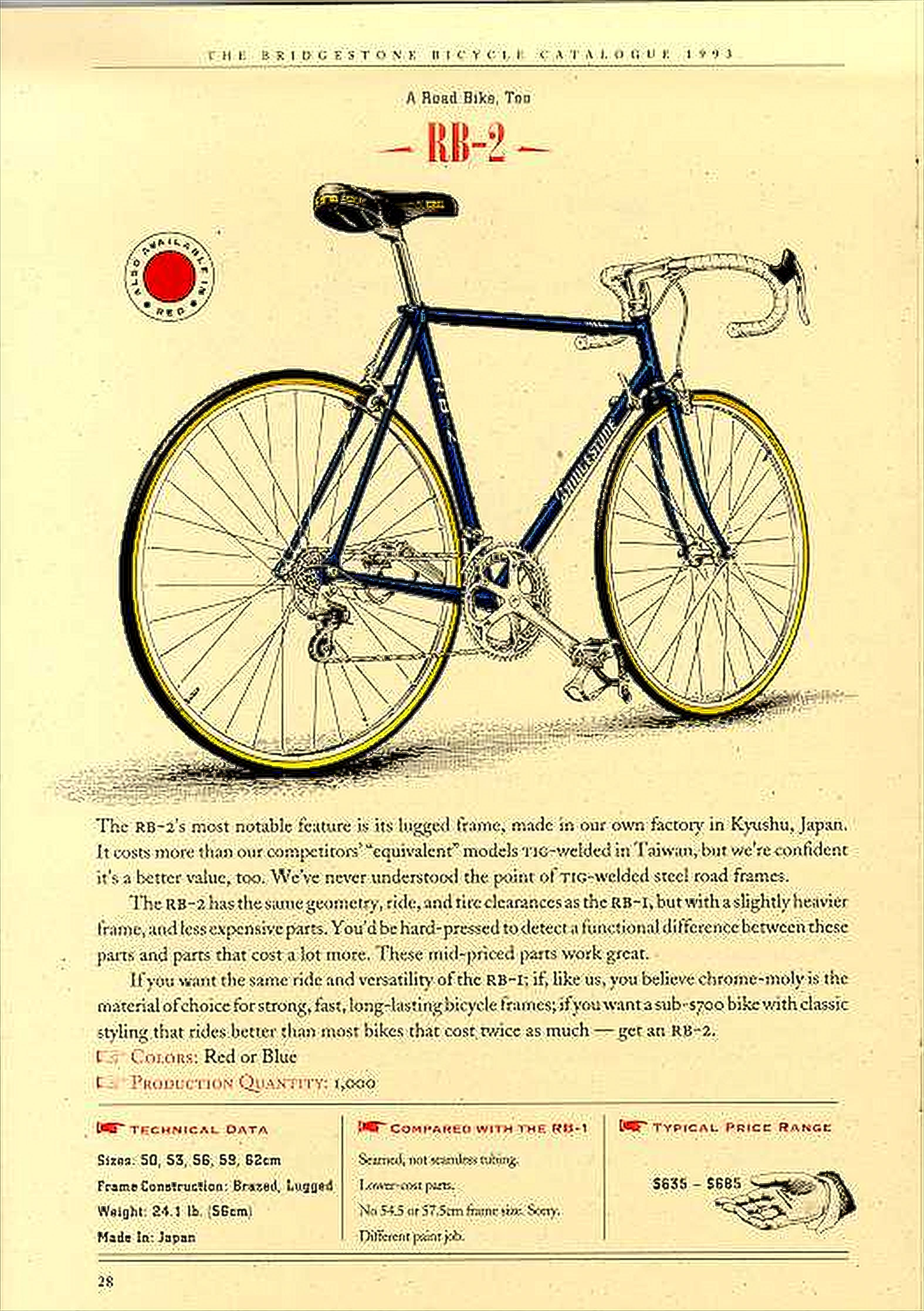
The RB-2’s most notable feature is its lugged frame, made in our own factory in Kyushu, Japan. It costs more than our competitors’ “equivalent” models TIG-welded in Taiwan, but we’re confident it’s a better value, too. We’ve never understood the point of TIG-welded steel road frames.
The RB-2 has the same geometry, ride, and tire clearances as the RB-1, but with a slightly heavier frame, and less expensive parts. You’d be hard-pressed to detect a functional difference between these parts and parts that cost a lot more. These mid-priced parts work great.
If you want the same ride and versatility of the RB-1; if, like us, you believe chrome-moly is the material of choice for strong, fast, long-lasting bicycle frames; if you want a sub-$700 bike with classic styling that rides better than most bikes that cost twice as much — get an RB-2.
COLORS: Red or Blue
PRODUCTION QUANTITY: 1,000
TECHNICAL DATA
Sizes: 50, 53, 56, 59, 62cm
Frame Construction: Brazed, Lugged
Weight: 24.1 lb. (56cm)
Made In: Japan
COMPARED WITH THE RB-1
Seamed, not seamless tubing.
Lower-cost parts.
No 54.5 or 57.5cm frame size. Sorry.
Different paint job.
TYPICAL PRICE RANGE
$635 – $685
28
[The RB-2 road bicycle, blue with yellow rims, in an engraving style drawing under the heading “A Road Bike, Too”, with a round red seal reading “Also available in red”, a description and boxes headed “Technical Data”, “Compared with the RB-1” and “Typical Price Range”. The small text in the boxes is soft in the scan.]
— Page 7 —
THE BRIDGESTONE BICYCLE CATALOGUE 1993
The Beloved Bridgestone Bicycle With The Bars Bashed By Bicycling
XO-1
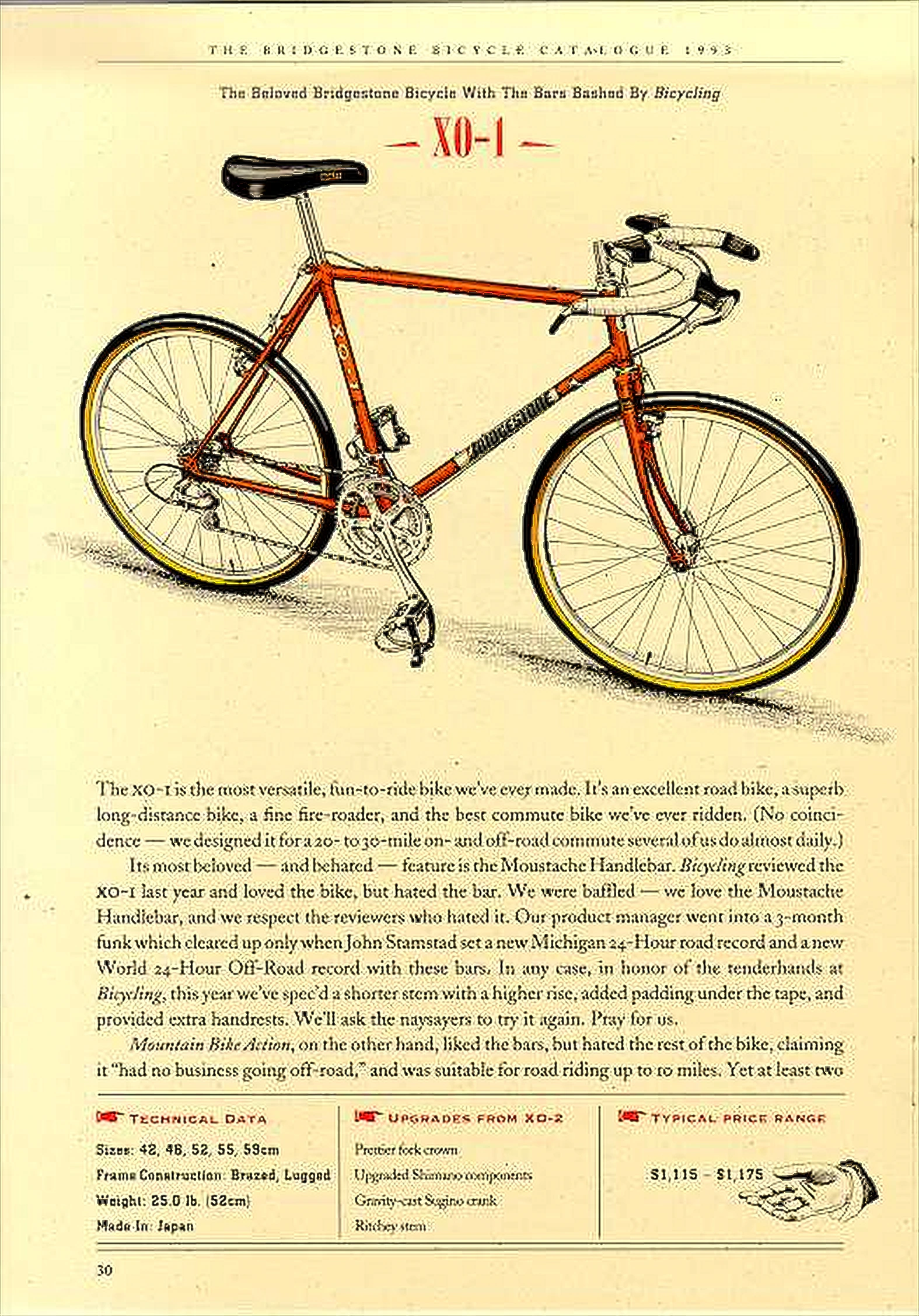
The XO-1 is the most versatile, fun-to-ride bike we’ve ever made. It’s an excellent road bike, a superb long-distance bike, a fine fire-roader, and the best commute bike we’ve ever ridden. (No coincidence — we designed it for a 20- to 30-mile on- and off-road commute several of us do almost daily.)
Its most beloved — and behated — feature is the Moustache Handlebar. Bicycling reviewed the XO-1 last year and loved the bike, but hated the bar. We were baffled — we love the Moustache Handlebar, and we respect the reviewers who hated it. Our product manager went into a 3-month funk which cleared up only when John Stamstad set a new Michigan 24-Hour road record and a new World 24-Hour Off-Road record with these bars. In any case, in honor of the tenderhands at Bicycling, this year we’ve spec’d a shorter stem with a higher rise, added padding under the tape, and provided extra handrests. We’ll ask the naysayers to try it again. Pray for us.
Mountain Bike Action, on the other hand, liked the bars, but hated the rest of the bike, claiming it “had no business going off-road,” and was suitable for road riding up to 10 miles. Yet at least two
TECHNICAL DATA
Sizes: 42, 46, 52, 55, 59cm
Frame Construction: Brazed, Lugged
Weight: 25.0 lb. (52cm)
Made In: Japan
UPGRADES FROM XO-2
Prettier fork crown
Upgraded Shimano components
Gravity-cast Sugino crank
Ritchey stem
TYPICAL PRICE RANGE
$1,115 – $1,175
30
[The XO-1 bicycle, orange with yellow rims and white handlebar tape, in an engraving style drawing under the heading “The Beloved Bridgestone Bicycle With The Bars Bashed By Bicycling”, with a description and boxes headed “Technical Data”, “Upgrades from XO-2” and “Typical Price Range”. The main text stops at the foot of the page in the middle of a sentence.]
— Page 8 —
THE BRIDGESTONE BICYCLE CATALOGUE 1993
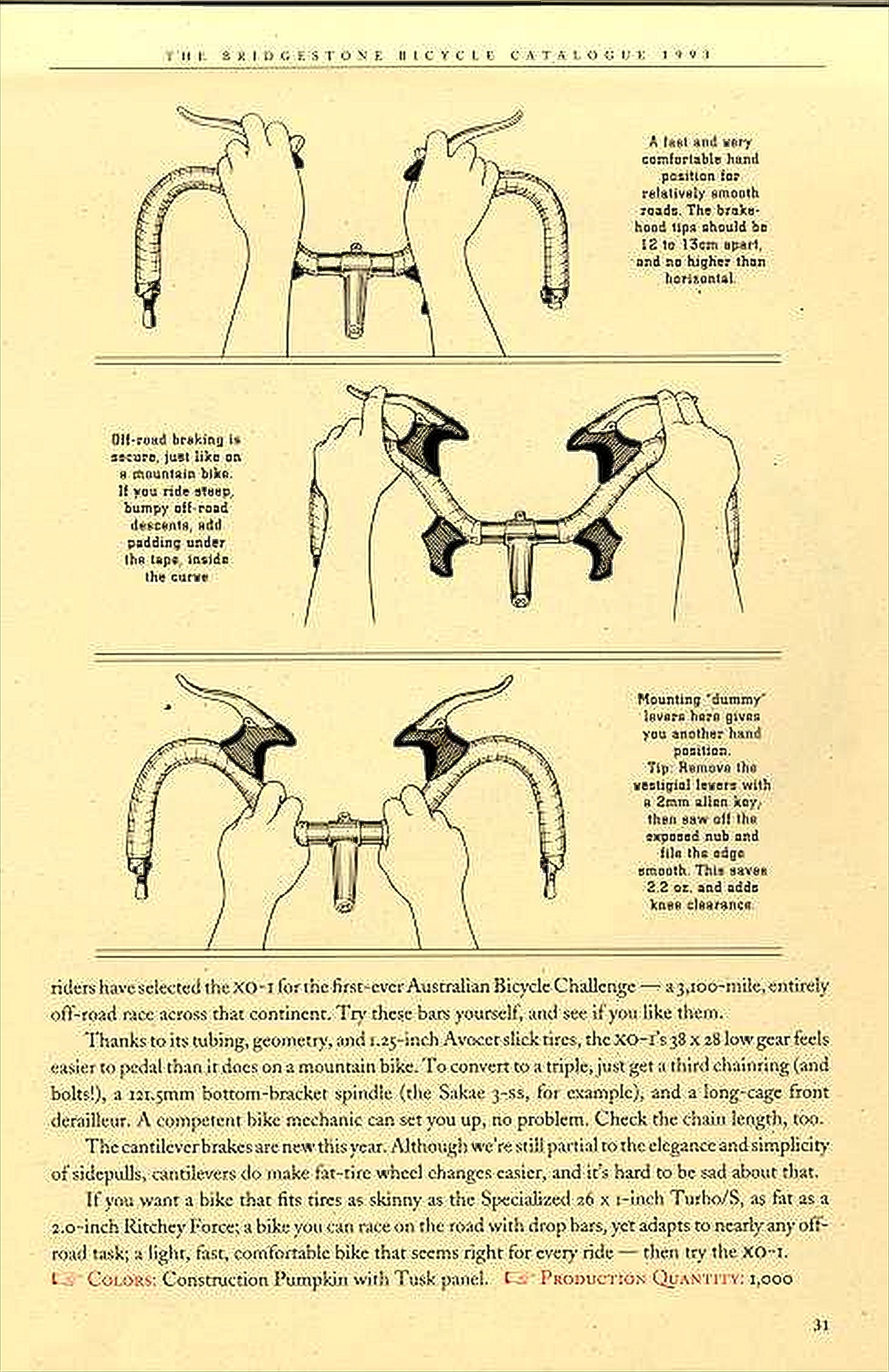
A fast and very comfortable hand position for relatively smooth roads. The brake-hood tips should be 12 to 13cm apart, and no higher than horizontal.
Off-road braking is secure, just like on a mountain bike. If you ride steep, bumpy off-road descents, add padding under the tape, inside the curve
Mounting “dummy” levers here gives you another hand position.
Tip: Remove the vestigial levers with a 2mm allen key, then saw off the exposed nub and file the edge smooth. This saves 2.2 oz. and adds knee clearance.
riders have selected the XO-1 for the first-ever Australian Bicycle Challenge — a 3,100-mile, entirely off-road race across that continent. Try these bars yourself, and see if you like them.
Thanks to its tubing, geometry, and 1.25-inch Avocet slick tires, the XO-1’s 38 x 28 low gear feels easier to pedal than it does on a mountain bike. To convert to a triple, just get a third chainring (and bolts!), a 121.5mm bottom-bracket spindle (the Sakae 3-ss, for example), and a long-cage front derailleur. A competent bike mechanic can set you up, no problem. Check the chain length, too.
The cantilever brakes are new this year. Although we’re still partial to the elegance and simplicity of sidepulls, cantilevers do make fat-tire wheel changes easier, and it’s hard to be sad about that.
If you want a bike that fits tires as skinny as the Specialized 26 x 1-inch Turbo/S, as fat as a 2.0-inch Ritchey Force; a bike you can race on the road with drop bars, yet adapts to nearly any off-road task; a light, fast, comfortable bike that seems right for every ride — then try the XO-1.
COLORS: Construction Pumpkin with Tusk panel. PRODUCTION QUANTITY: 1,000
31
[Three line drawings of a rider’s hands on the XO-1 moustache handlebar in different positions, each with a caption, above the continuation of the XO-1 text. The text begins in the middle of a sentence and the captions are set in a bold sans serif type.]
— Page 9 —
THE BRIDGESTONE BICYCLE CATALOGUE 1993
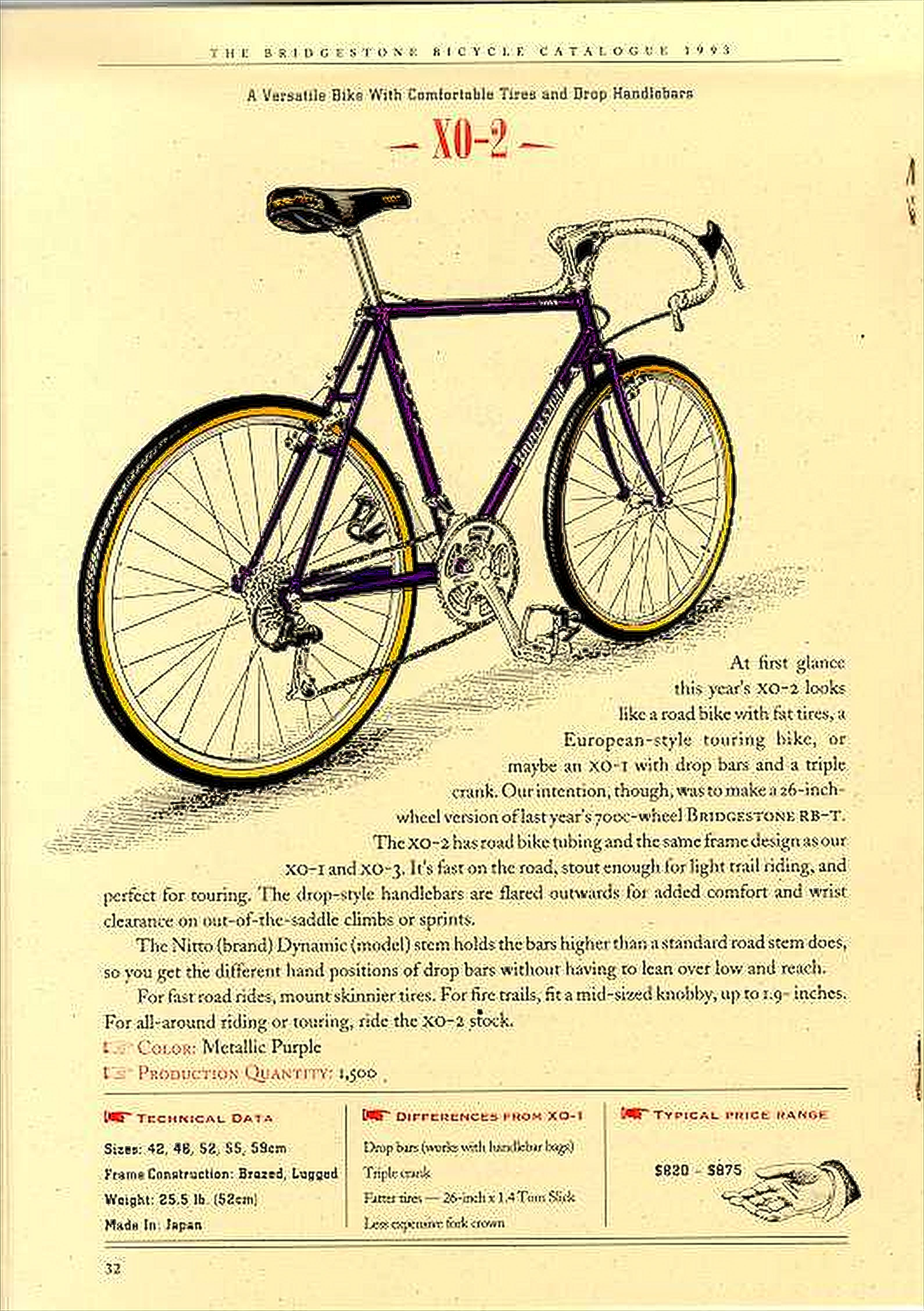
A Versatile Bike With Comfortable Tires and Drop Handlebars
XO-2
At first glance this year’s XO-2 looks like a road bike with fat tires, a European-style touring bike, or maybe an XO-1 with drop bars and a triple crank. Our intention, though, was to make a 26-inch-wheel version of last year’s 700c-wheel BRIDGESTONE RB-T.
The XO-2 has road bike tubing and the same frame design as our XO-1 and XO-3. It’s fast on the road, stout enough for light trail riding, and perfect for touring. The drop-style handlebars are flared outwards for added comfort and wrist clearance on out-of-the-saddle climbs or sprints.
The Nitto (brand) Dynamic (model) stem holds the bars higher than a standard road stem does, so you get the different hand positions of drop bars without having to lean over low and reach.
For fast road rides, mount skinnier tires. For fire trails, fit a mid-sized knobby, up to 1.9- inches. For all-around riding or touring, ride the XO-2 stock.
COLOR: Metallic Purple
PRODUCTION QUANTITY: 1,500
TECHNICAL DATA
Sizes: 42, 46, 52, 55, 59cm
Frame Construction: Brazed, Lugged
Weight: 25.5 lb. (52cm)
Made In: Japan
DIFFERENCES FROM XO-1
Drop bars (works with handlebar bags)
Triple crank
Fatter tires — 26-inch x 1.4 Tom Slick
Less expensive fork crown
TYPICAL PRICE RANGE
$820 – $875
32
[The XO-2 bicycle, purple with yellow rims and white handlebar tape, in an engraving style drawing under the heading “A Versatile Bike With Comfortable Tires and Drop Handlebars”, with a description set in short lines beside the front wheel and boxes headed “Technical Data”, “Differences from XO-1” and “Typical Price Range”. The small text in the Differences box is soft in the scan.]
— Page 10 —
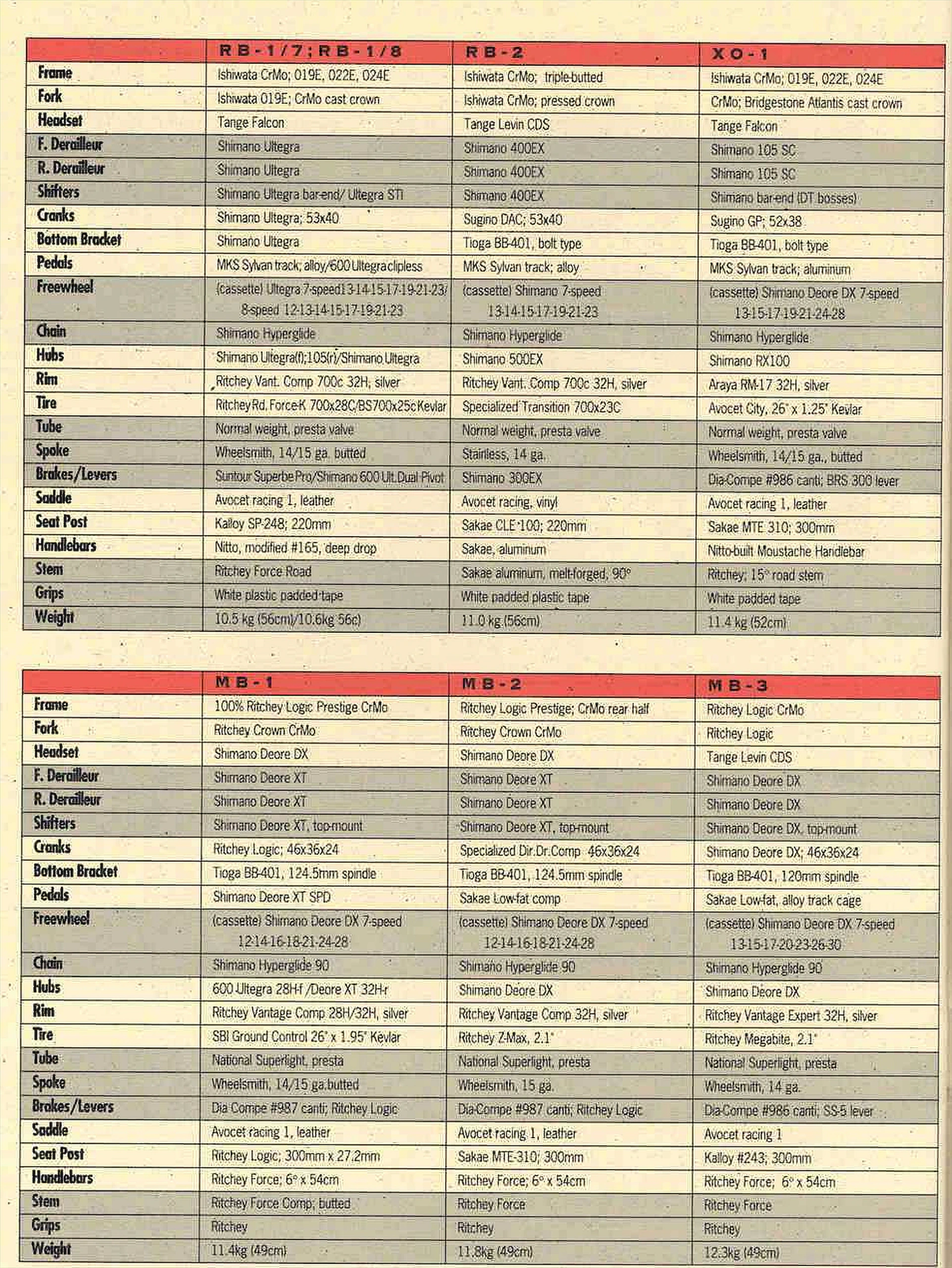
| RB-1/7; RB-1/8 | RB-2 | XO-1
Frame | Ishiwata CrMo; 019E, 022E, 024E | Ishiwata CrMo; triple-butted | Ishiwata CrMo; 019E, 022E, 024E
Fork | Ishiwata 019E; CrMo cast crown | Ishiwata CrMo; pressed crown | CrMo; Bridgestone Atlantis cast crown
Headset | Tange Falcon | Tange Levin CDS | Tange Falcon
F. Derailleur | Shimano Ultegra | Shimano 400EX | Shimano 105 SC
R. Derailleur | Shimano Ultegra | Shimano 400EX | Shimano 105 SC
Shifters | Shimano Ultegra bar-end/ Ultegra STI | Shimano 400EX | Shimano bar-end (DT bosses)
Cranks | Shimano Ultegra; 53×40 | Sugino DAC; 53×40 | Sugino GP; 52×38
Bottom Bracket | Shimano Ultegra | Tioga BB-401, bolt type | Tioga BB-401, bolt type
Pedals | MKS Sylvan track; alloy/600 Ultegra clipless | MKS Sylvan track; alloy | MKS Sylvan track; aluminum
Freewheel | (cassette) Ultegra 7-speed 13-14-15-17-19-21-23/ 8-speed 12-13-14-15-17-19-21-23 | (cassette) Shimano 7-speed 13-14-15-17-19-21-23 | (cassette) Shimano Deore DX 7-speed 13-15-17-19-21-24-28
Chain | Shimano Hyperglide | Shimano Hyperglide | Shimano Hyperglide
Hubs | Shimano Ultegra(f);105(r)/Shimano Ultegra | Shimano 500EX | Shimano RX100
Rim | Ritchey Vant. Comp 700c 32H, silver | Ritchey Vant. Comp 700c 32H, silver | Araya RM-17 32H, silver
Tire | Ritchey Rd. Force-K 700x28C/BS700x25c Kevlar | Specialized Transition 700x23C | Avocet City, 26″ x 1.25″ Kevlar
Tube | Normal weight, presta valve | Normal weight, presta valve | Normal weight, presta valve
Spoke | Wheelsmith, 14/15 ga. butted | Stainless, 14 ga. | Wheelsmith, 14/15 ga., butted
Brakes/Levers | Suntour Superbe Pro/Shimano 600 Ult. Dual Pivot | Shimano 300EX | Dia-Compe #986 canti; BRS 300 lever
Saddle | Avocet racing 1, leather | Avocet racing, vinyl | Avocet racing 1, leather
Seat Post | Kalloy SP-248; 220mm | Sakae CLE-100; 220mm | Sakae MTE 310; 300mm
Handlebars | Nitto, modified #165, deep drop | Sakae, aluminum | Nitto-built Moustache Handlebar
Stem | Ritchey Force Road | Sakae aluminum, melt-forged, 90° | Ritchey; 15° road stem
Grips | White plastic padded tape | White padded plastic tape | White padded tape
Weight | 10.5 kg (56cm)/10.6kg 56c) | 11.0 kg (56cm) | 11.4 kg (52cm)
| MB-1 | MB-2 | MB-3
Frame | 100% Ritchey Logic Prestige CrMo | Ritchey Logic Prestige; CrMo rear half | Ritchey Logic CrMo
Fork | Ritchey Crown CrMo | Ritchey Crown CrMo | Ritchey Logic
Headset | Shimano Deore DX | Shimano Deore DX | Tange Levin CDS
F. Derailleur | Shimano Deore XT | Shimano Deore XT | Shimano Deore DX
R. Derailleur | Shimano Deore XT | Shimano Deore XT | Shimano Deore DX
Shifters | Shimano Deore XT, top-mount | Shimano Deore XT, top-mount | Shimano Deore DX, top-mount
Cranks | Ritchey Logic; 46x36x24 | Specialized Dir.Dr.Comp 46x36x24 | Shimano Deore DX; 46x36x24
Bottom Bracket | Tioga BB-401, 124.5mm spindle | Tioga BB-401, 124.5mm spindle | Tioga BB-401, 120mm spindle
Pedals | Shimano Deore XT SPD | Sakae Low-fat comp | Sakae Low-fat, alloy track cage
Freewheel | (cassette) Shimano Deore DX 7-speed 12-14-16-18-21-24-28 | (cassette) Shimano Deore DX 7-speed 12-14-16-18-21-24-28 | (cassette) Shimano Deore DX 7-speed 13-15-17-20-23-26-30
Chain | Shimano Hyperglide 90 | Shimano Hyperglide 90 | Shimano Hyperglide 90
Hubs | 600 Ultegra 28H-f /Deore XT 32H-r | Shimano Deore DX | Shimano Deore DX
Rim | Ritchey Vantage Comp 28H/32H, silver | Ritchey Vantage Comp 32H, silver | Ritchey Vantage Expert 32H, silver
Tire | SBI Ground Control 26″ x 1.95″ Kevlar | Ritchey Z-Max, 2.1″ | Ritchey Megabite, 2.1″
Tube | National Superlight, presta | National Superlight, presta | National Superlight, presta
Spoke | Wheelsmith, 14/15 ga. butted | Wheelsmith, 15 ga. | Wheelsmith, 14 ga.
Brakes/Levers | Dia-Compe #987 canti; Ritchey Logic | Dia-Compe #987 canti; Ritchey Logic | Dia-Compe #986 canti; SS-5 lever
Saddle | Avocet racing 1, leather | Avocet racing 1, leather | Avocet racing 1
Seat Post | Ritchey Logic; 300mm x 27.2mm | Sakae MTE-310; 300mm | Kalloy #243; 300mm
Handlebars | Ritchey Force; 6° x 54cm | Ritchey Force; 6° x 54cm | Ritchey Force; 6° x 54cm
Stem | Ritchey Force Comp; butted | Ritchey Force | Ritchey Force
Grips | Ritchey | Ritchey | Ritchey
Weight | 11.4kg (49cm) | 11.8kg (49cm) | 12.3kg (49cm)
[Two specification tables with rows from Frame to Weight: the road bicycles RB-1/7;RB-1/8, RB-2 and XO-1 above, and the mountain bicycles MB-1, MB-2 and MB-3 below, in red-headed tables with alternate gray rows. No folio is printed.]
— Page 11 —
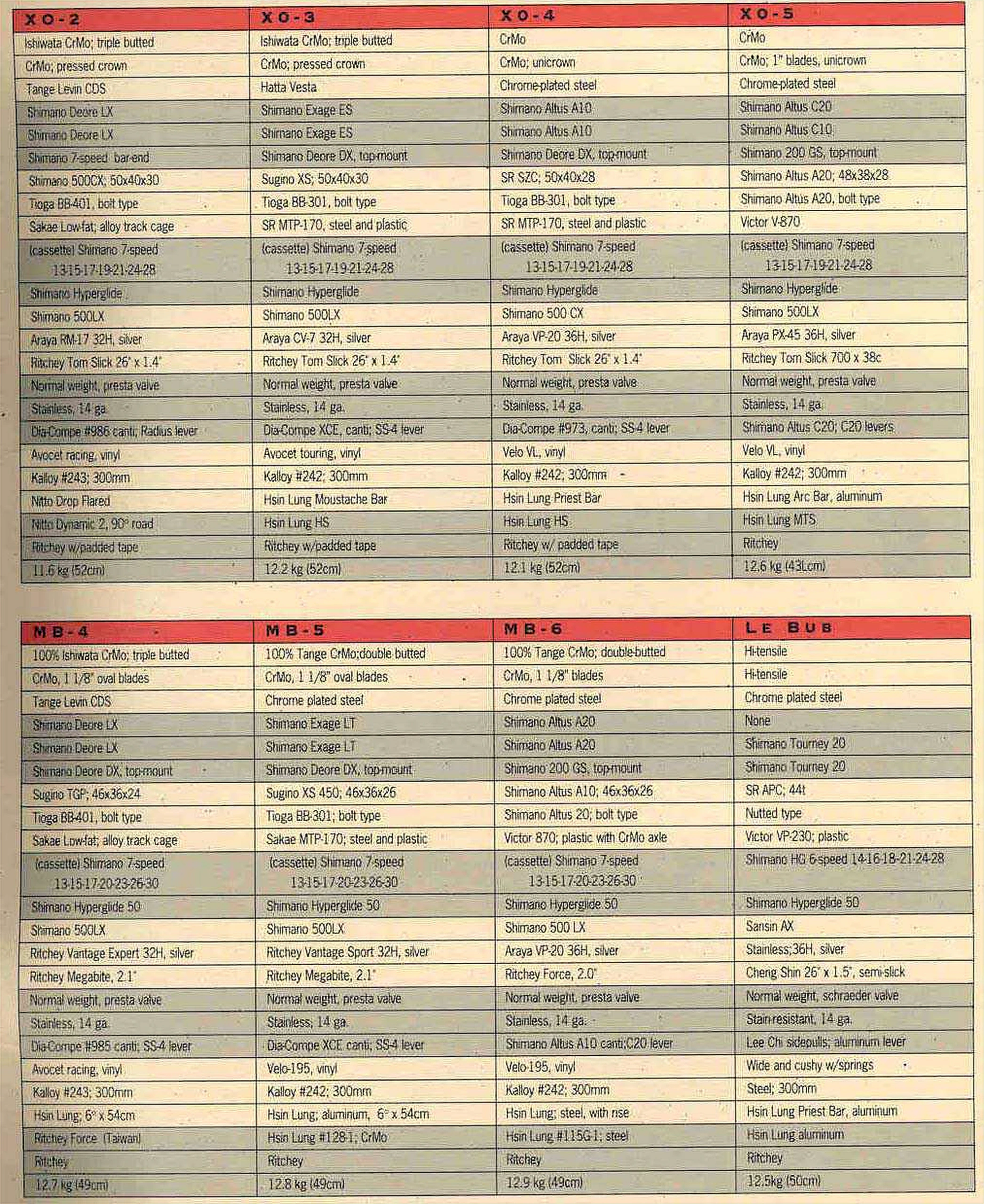
XO-2 | XO-3 | XO-4 | XO-5
Ishiwata CrMo; triple butted | Ishiwata CrMo; triple butted | CrMo | CrMo
CrMo; pressed crown | CrMo; pressed crown | CrMo; unicrown | CrMo; 1″ blades, unicrown
Tange Levin CDS | Hatta Vesta | Chrome-plated steel | Chrome-plated steel
Shimano Deore LX | Shimano Exage ES | Shimano Altus A10 | Shimano Altus C20
Shimano Deore LX | Shimano Exage ES | Shimano Altus A10 | Shimano Altus C10
Shimano 7-speed bar-end | Shimano Deore DX, top-mount | Shimano Deore DX, top-mount | Shimano 200 GS, top-mount
Shimano 500CX; 50x40x30 | Sugino XS; 50x40x30 | SR SZC; 50x40x28 | Shimano Altus A20; 48x38x28
Tioga BB-401, bolt type | Tioga BB-301, bolt type | Tioga BB-301, bolt type | Shimano Altus A20, bolt type
Sakae Low-fat; alloy track cage | SR MTP-170, steel and plastic | SR MTP-170, steel and plastic | Victor V-870
(cassette) Shimano 7-speed 13-15-17-19-21-24-28 | (cassette) Shimano 7-speed 13-15-17-19-21-24-28 | (cassette) Shimano 7-speed 13-15-17-19-21-24-28 | (cassette) Shimano 7-speed 13-15-17-19-21-24-28
Shimano Hyperglide | Shimano Hyperglide | Shimano Hyperglide | Shimano Hyperglide
Shimano 500LX | Shimano 500LX | Shimano 500 CX | Shimano 500LX
Araya RM-17 32H, silver | Araya CV-7 32H, silver | Araya VP-20 36H, silver | Araya PX-45 36H, silver
Ritchey Tom Slick 26″ x 1.4″ | Ritchey Tom Slick 26″ x 1.4″ | Ritchey Tom Slick 26″ x 1.4″ | Ritchey Tom Slick 700 x 38c
Normal weight, presta valve | Normal weight, presta valve | Normal weight, presta valve | Normal weight, presta valve
Stainless, 14 ga. | Stainless, 14 ga. | Stainless, 14 ga. | Stainless, 14 ga.
Dia-Compe #986 canti; Radius lever | Dia-Compe XCE, canti; SS-4 lever | Dia-Compe #973, canti; SS-4 lever | Shimano Altus C20; C20 levers
Avocet racing, vinyl | Avocet touring, vinyl | Velo VL, vinyl | Velo VL, vinyl
Kalloy #243; 300mm | Kalloy #242; 300mm | Kalloy #242; 300mm | Kalloy #242; 300mm
Nitto Drop Flared | Hsin Lung Moustache Bar | Hsin Lung Priest Bar | Hsin Lung Arc Bar, aluminum
Nitto Dynamic 2, 90° road | Hsin Lung HS | Hsin Lung HS | Hsin Lung MTS
Ritchey w/padded tape | Ritchey w/padded tape | Ritchey w/ padded tape | Ritchey
11.6 kg (52cm) | 12.2 kg (52cm) | 12.1 kg (52cm) | 12.6 kg (43[?]cm)
MB-4 | MB-5 | MB-6 | LE BUB
100% Ishiwata CrMo; triple butted | 100% Tange CrMo;double butted | 100% Tange CrMo; double-butted | Hi-tensile
CrMo, 1 1/8″ oval blades | CrMo, 1 1/8″ oval blades | CrMo, 1 1/8″ blades | Hi-tensile
Tange Levin CDS | Chrome plated steel | Chrome plated steel | Chrome plated steel
Shimano Deore LX | Shimano Exage LT | Shimano Altus A20 | None
Shimano Deore LX | Shimano Exage LT | Shimano Altus A20 | Shimano Tourney 20
Shimano Deore DX, top-mount | Shimano Deore DX, top-mount | Shimano 200 GS, top-mount | Shimano Tourney 20
Sugino TGP; 46x36x24 | Sugino XS 450; 46x36x26 | Shimano Altus A10; 46x36x26 | SR APC; 44t
Tioga BB-401, bolt type | Tioga BB-301, bolt type | Shimano Altus 20; bolt type | Nutted type
Sakae Low-fat; alloy track cage | Sakae MTP-170; steel and plastic | Victor 870; plastic with CrMo axle | Victor VP-230; plastic
(cassette) Shimano 7-speed 13-15-17-20-23-26-30 | (cassette) Shimano 7-speed 13-15-17-20-23-26-30 | (cassette) Shimano 7-speed 13-15-17-20-23-26-30 | Shimano HG 6-speed 14-16-18-21-24-28
Shimano Hyperglide 50 | Shimano Hyperglide 50 | Shimano Hyperglide 50 | Shimano Hyperglide 50
Shimano 500LX | Shimano 500LX | Shimano 500 LX | Sansin AX
Ritchey Vantage Expert 32H, silver | Ritchey Vantage Sport 32H, silver | Araya VP-20 36H, silver | Stainless;36H, silver
Ritchey Megabite, 2.1″ | Ritchey Megabite, 2.1″ | Ritchey Force, 2.0″ | Cheng Shin 26″ x 1.5″, semi-slick
Normal weight, presta valve | Normal weight, presta valve | Normal weight, presta valve | Normal weight, schraeder valve
Stainless, 14 ga. | Stainless, 14 ga. | Stainless, 14 ga. | Stain-resistant, 14 ga.
Dia-Compe #985 canti; SS-4 lever | Dia-Compe XCE canti; SS-4 lever | Shimano Altus A10 canti;C20 lever | Lee Chi sidepulls; aluminum lever
Avocet racing, vinyl | Velo-195, vinyl | Velo-195, vinyl | Wide and cushy w/springs
Kalloy #243; 300mm | Kalloy #242; 300mm | Kalloy #242; 300mm | Steel; 300mm
Hsin Lung; 6° x 54cm | Hsin Lung; aluminum, 6° x 54cm | Hsin Lung; steel, with rise | Hsin Lung Priest Bar, aluminum
Ritchey Force (Taiwan) | Hsin Lung #128-1; CrMo | Hsin Lung #115G-1; steel | Hsin Lung aluminum
Ritchey | Ritchey | Ritchey | Ritchey
12.7 kg (49cm) | 12.8 kg (49cm) | 12.9 kg (49cm) | 12.5kg (50cm)
[Two specification tables without row labels, in red-headed tables with alternate gray rows: the bicycles XO-2, XO-3, XO-4 and XO-5 above, and MB-4, MB-5, MB-6 and LE BUB below, each with 22 rows running from the frame to the weight. No folio is printed.]
— Page 12 —
THE BRIDGESTONE BICYCLE CATALOGUE 1993
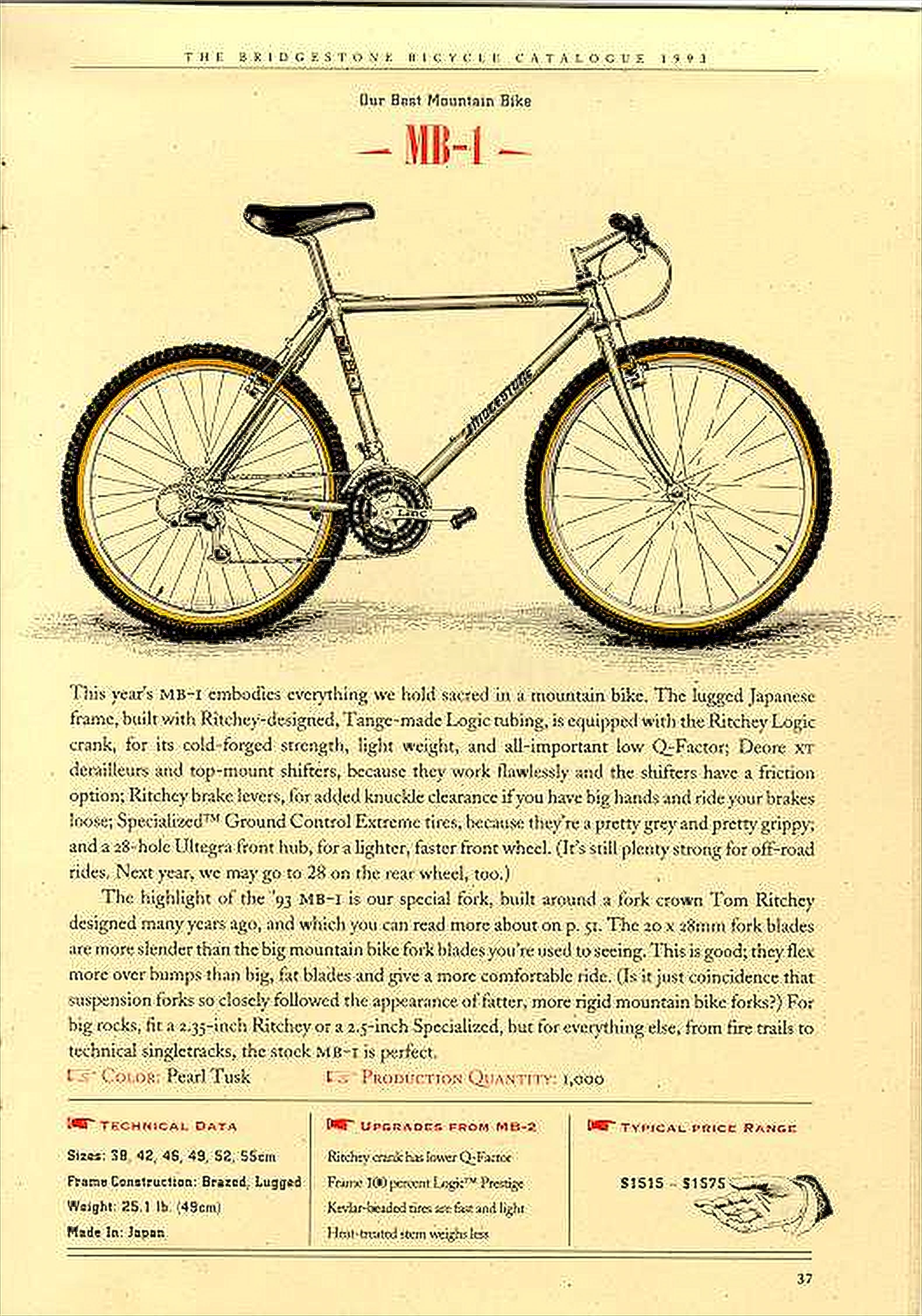
Our Best Mountain Bike
MB-1
This year’s MB-1 embodies everything we hold sacred in a mountain bike. The lugged Japanese frame, built with Ritchey-designed, Tange-made Logic tubing, is equipped with the Ritchey Logic crank, for its cold-forged strength, light weight, and all-important low Q-Factor; Deore XT derailleurs and top-mount shifters, because they work flawlessly and the shifters have a friction option; Ritchey brake levers, for added knuckle clearance if you have big hands and ride your brakes loose; Specialized™ Ground Control Extreme tires, because they’re a pretty grey and pretty grippy; and a 28-hole Ultegra front hub, for a lighter, faster front wheel. (It’s still plenty strong for off-road rides. Next year, we may go to 28 on the rear wheel, too.)
The highlight of the ’93 MB-1 is our special fork, built around a fork crown Tom Ritchey designed many years ago, and which you can read more about on p. 51. The 20 x 28mm fork blades are more slender than the big mountain bike fork blades you’re used to seeing. This is good; they flex more over bumps than big, fat blades and give a more comfortable ride. (Is it just coincidence that suspension forks so closely followed the appearance of fatter, more rigid mountain bike forks?) For big rocks, fit a 2.35-inch Ritchey or a 2.5-inch Specialized, but for everything else, from fire trails to technical singletracks, the stock MB-1 is perfect.
Color: Pearl Tusk
Production Quantity: 1,000
Technical Data
Sizes: 38, 42, 46, 49, 52, 55cm
Frame Construction: Brazed, Lugged
Weight: 25.1 lb. (49cm)
Made In: Japan
Upgrades from MB-2
Ritchey crank has lower Q-Factor
Frame 100 percent Logic™ Prestige
Kevlar-beaded tires are fast and light
Heat-treated stem weighs less
Typical Price Range
$1515 – $1575
37
[The MB-1 mountain bicycle, labeled “Our Best Mountain Bike”, in a large engraved-style illustration with its description, and boxes for technical data, upgrades from MB-2 and typical price range. A hand drawing sits beside the price range.]
— Page 13 —
THE BR[hidden]NE BICYCLE CATALOGUE 1993
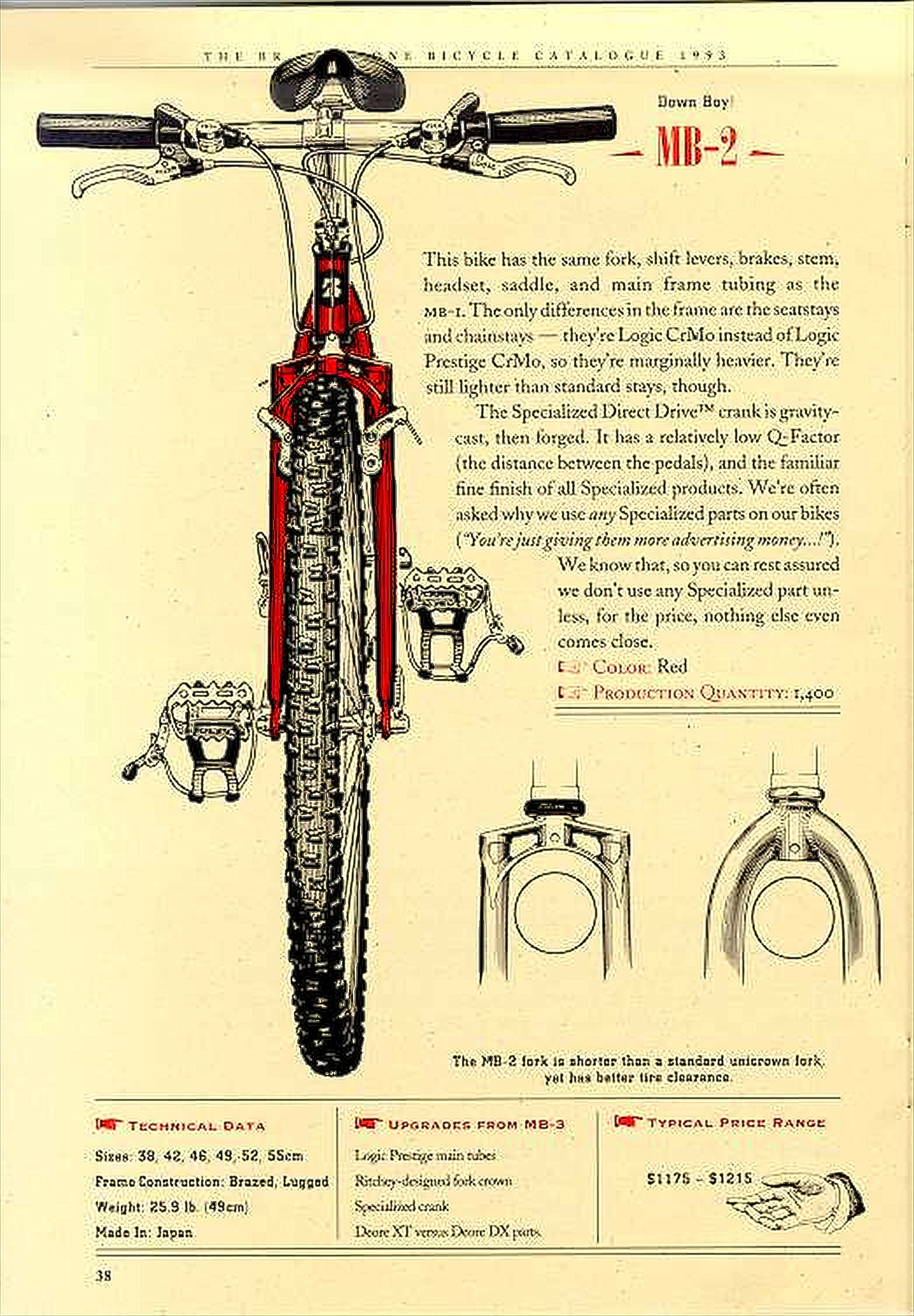
Down Boy!
MB-2
This bike has the same fork, shift levers, brakes, stem, headset, saddle, and main frame tubing as the MB-1. The only differences in the frame are the seatstays and chainstays — they’re Logic CrMo instead of Logic Prestige CrMo, so they’re marginally heavier. They’re still lighter than standard stays, though.
The Specialized Direct Drive™ crank is gravity-cast, then forged. It has a relatively low Q-Factor (the distance between the pedals), and the familiar fine finish of all Specialized products. We’re often asked why we use any Specialized parts on our bikes (“You’re just giving them more advertising money…!”).
We know that, so you can rest assured we don’t use any Specialized part unless, for the price, nothing else even comes close.
Color: Red
Production Quantity: 1,400
The MB-2 fork is shorter than a standard unicrown fork, yet has better tire clearance.
Technical Data
Sizes: 38, 42, 46, 49, 52, 55cm
Frame Construction: Brazed, Lugged
Weight: 25.9 lb. (49cm)
Made In: Japan
Upgrades from MB-3
Logic Prestige main tubes
Ritchey-designed fork crown
Specialized crank
Deore XT versus Deore DX parts
Typical Price Range
$1175 – $1215
38
[The MB-2 mountain bicycle in a large front-on illustration with handlebars, brake levers, a red fork and pedals, labeled “Down Boy!”, with its description and two drawings of fork crowns. Boxes give technical data, upgrades from MB-3 and typical price range, and a hand drawing sits beside the price range.]
— Page 14 —
THE BRIDGESTONE BICYCLE CATALOGUE 1993
The Bike America Needs
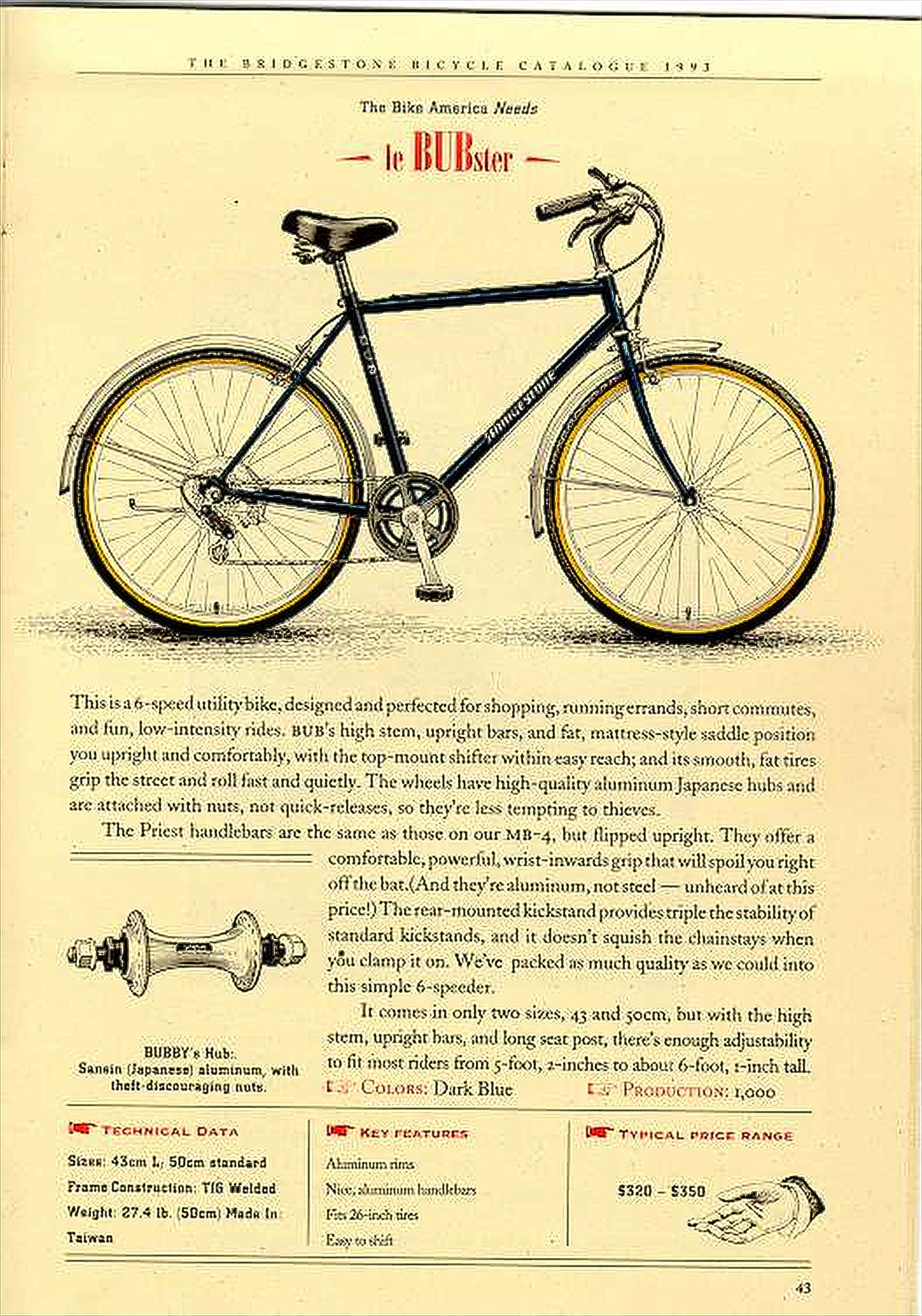
le BUBster
This is a 6-speed utility bike, designed and perfected for shopping, running errands, short commutes, and fun, low-intensity rides. BUB’s high stem, upright bars, and fat, mattress-style saddle position you upright and comfortably, with the top-mount shifter within easy reach; and its smooth, fat tires grip the street and roll fast and quietly. The wheels have high-quality aluminum Japanese hubs and are attached with nuts, not quick-releases, so they’re less tempting to thieves.
The Priest handlebars are the same as those on our MB-4, but flipped upright. They offer a comfortable, powerful, wrist-inwards grip that will spoil you right off the bat. (And they’re aluminum, not steel — unheard of at this price!) The rear-mounted kickstand provides triple the stability of standard kickstands, and it doesn’t squish the chainstays when you clamp it on. We’ve packed as much quality as we could into this simple 6-speeder.
It comes in only two sizes, 43 and 50cm, but with the high stem, upright bars, and long seat post, there’s enough adjustability to fit most riders from 5-foot, 2-inches to about 6-foot, 1-inch tall.
BUBBY’s Hub: Sansin (Japanese) aluminum, with theft-discouraging nuts.
Colors: Dark Blue
Production: 1,000
Technical Data
Sizes: 43cm L, 50cm standard
Frame Construction: TIG Welded
Weight: 27.4 lb. (50cm) Made In Taiwan
Key Features
Aluminum rims
Nice, aluminum handlebars
Fits 26-inch tires
Easy to shift
Typical Price Range
$320 – $350
43
[The “le BUBster” 6-speed utility bicycle in a large engraved-style illustration with fenders and upright handlebars, a drawing of its hub with a caption, and boxes for technical data, key features and typical price range. A hand drawing sits beside the price range.]
— Page 15 —
THE BRIDGESTONE BICYCLE CATALOGUE 1993
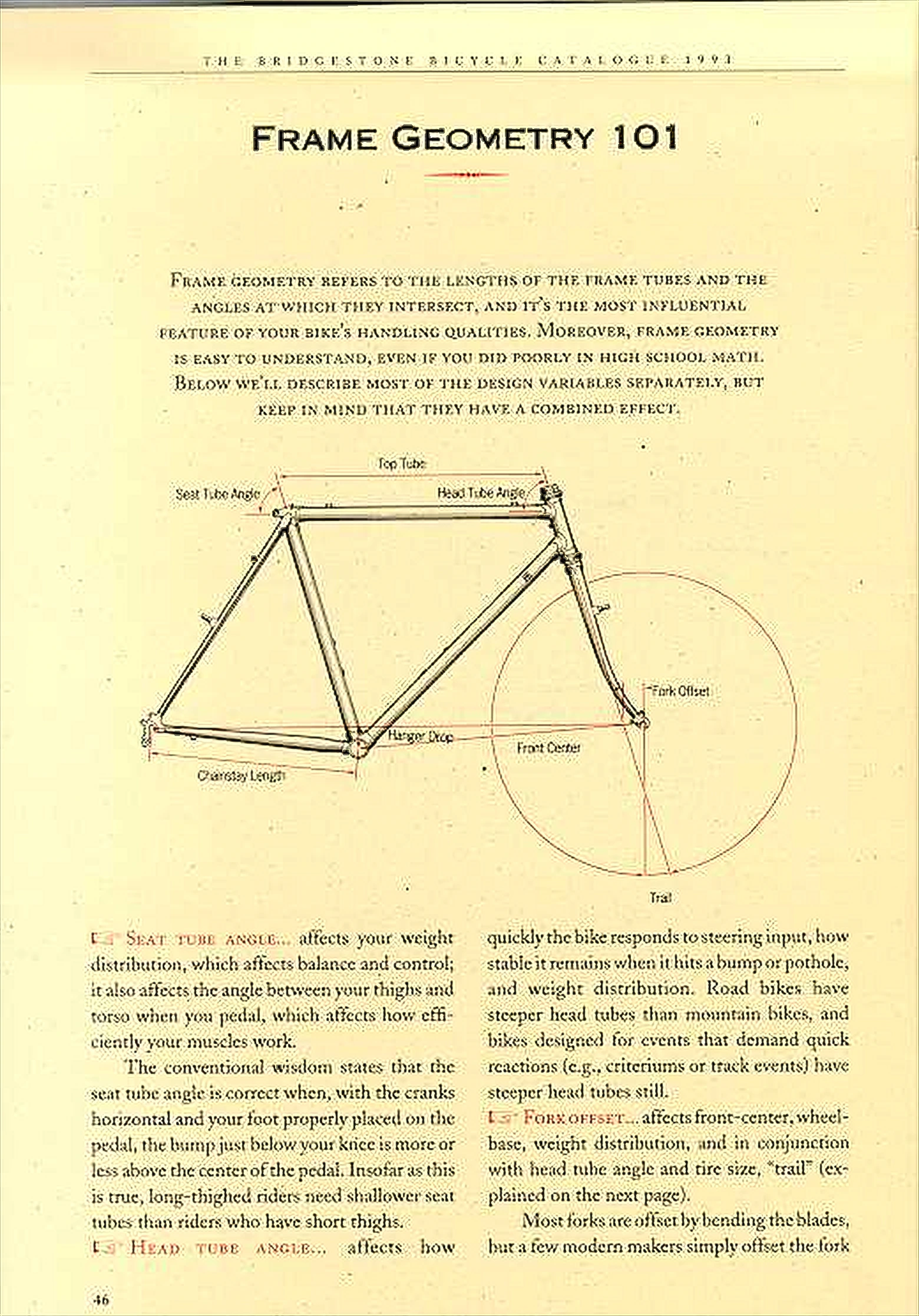
Frame Geometry 101
Frame geometry refers to the lengths of the frame tubes and the angles at which they intersect, and it’s the most influential feature of your bike’s handling qualities. Moreover, frame geometry is easy to understand, even if you did poorly in high school math. Below we’ll describe most of the design variables separately, but keep in mind that they have a combined effect.
Callouts: Top Tube, Seat Tube Angle, Head Tube Angle, Fork Offset, Hanger Drop, Front Center, Chainstay Length, Trail
Seat tube angle… affects your weight distribution, which affects balance and control; it also affects the angle between your thighs and torso when you pedal, which affects how efficiently your muscles work.
The conventional wisdom states that the seat tube angle is correct when, with the cranks horizontal and your foot properly placed on the pedal, the bump just below your knee is more or less above the center of the pedal. Insofar as this is true, long-thighed riders need shallower seat tubes than riders who have short thighs.
Head tube angle… affects how quickly the bike responds to steering input, how stable it remains when it hits a bump or pothole, and weight distribution. Road bikes have steeper head tubes than mountain bikes, and bikes designed for events that demand quick reactions (e.g., criteriums or track events) have steeper head tubes still.
Fork offset… affects front-center, wheelbase, weight distribution, and in conjunction with head tube angle and tire size, “trail” (explained on the next page).
Most forks are offset by bending the blades, but a few modern makers simply offset the fork
46
[A bare bicycle frame drawn in outline with labeled dimensions and angles, including top tube, seat tube angle, head tube angle, fork offset, front center, chainstay length and trail, under the heading “Frame Geometry 101”, with explanatory text in two columns.]
— Page 16 —
THE BRIDGESTONE BICYCLE CATALOGUE 1993
blades at the crown and keep the blades straight. This doesn’t affect handling, it probably affects shock absorption, and we can state in no uncertain terms that it makes traditionalists wince.
Trail… is the distance between the point at which the tire contacts the ground and the imaginary point at which the head tube angle intersects it. Most road bikes have between 1 ¼ and 2 ½ inches of trail; most mountain bikes have from 2 ¾ to 3 inches. More trail makes the bike easier to control at high speed and over bumps, but harder to control at low speeds.
With any given head tube, decreasing the fork offset increases trail; increasing the fork offset reduces it. (It’s hard to follow this without a diagram, which is why we’ve provided one.) In any case, it still takes a few weeks to absorb the concept of trail, so don’t be discouraged if you don’t fully comprehend it right off the bat.
Top tube length… along with seat tube angle and stem extension, determines the horizontal distance between the saddle and handlebars. This distance, in turn, affects weight distribution, the inclination of your torso as you pedal, and the workings of your muscles affected by these relationships. (For example, your butt muscles contribute more when your torso is below 45 degrees to horizontal than when it’s nearly vertical. That’s why track riders, criterium racers, and speed skaters generally have strong butts.)
Chainstay length… affects weight distribution, comfort, and traction. Long chainstays position the wheel farther behind you, improving comfort at the cost of traction. Short chainstays position the rear wheel more underneath you, improving traction at the cost of comfort.
Hanger drop… is the distance between the center of the wheels and the center of the bottom bracket (the “hanger”). It works in conjunction with wheel diameter to determine bottom-bracket height, which in turn affects chainwheel clearance over logs, and pedal cornering clearance. Conventional wisdom states that a lower bottom bracket makes bikes descend better, and we agree.
Front-center… the distance from the bottom bracket to the front dropout, is determined by the seat tube angle, top tube length, head tube angle, and fork offset. It influences weight distribution and pedal clearance at the front wheel. Some builders let front-center fall into place as a result of these dimensions; others “build to front-center,” determining one of the other dimensions by default.
Wheelbase… is the distance between the front and rear axles. Shorter wheelbases make a bike react faster; longer wheelbases add comfort and stability. Most frame designers specify the other aspects of the geometry first, and let the wheelbase fall where it may.
Designing a Frame is Easy
If you would like simple instructions to help you design a stick-figure frame, send an sase to the address listed on the back cover of this catalogue, attention: frame design. This process will teach you the variables and limitations all frame designers must work with — lessons which you can learn no other way. For example, you will learn why it’s hard to design a good small frame with large wheels; and how seat tube angle affects “effective” top tube length. You’ll need only simple tools, and graph paper.
47
[A page of two columns of text on trail, top tube length, chainstay length, hanger drop, front-center and wheelbase, with a boxed notice headed “Designing a Frame is Easy” at the foot. The text continues from the previous page and has no illustration.]
— Page 17 —
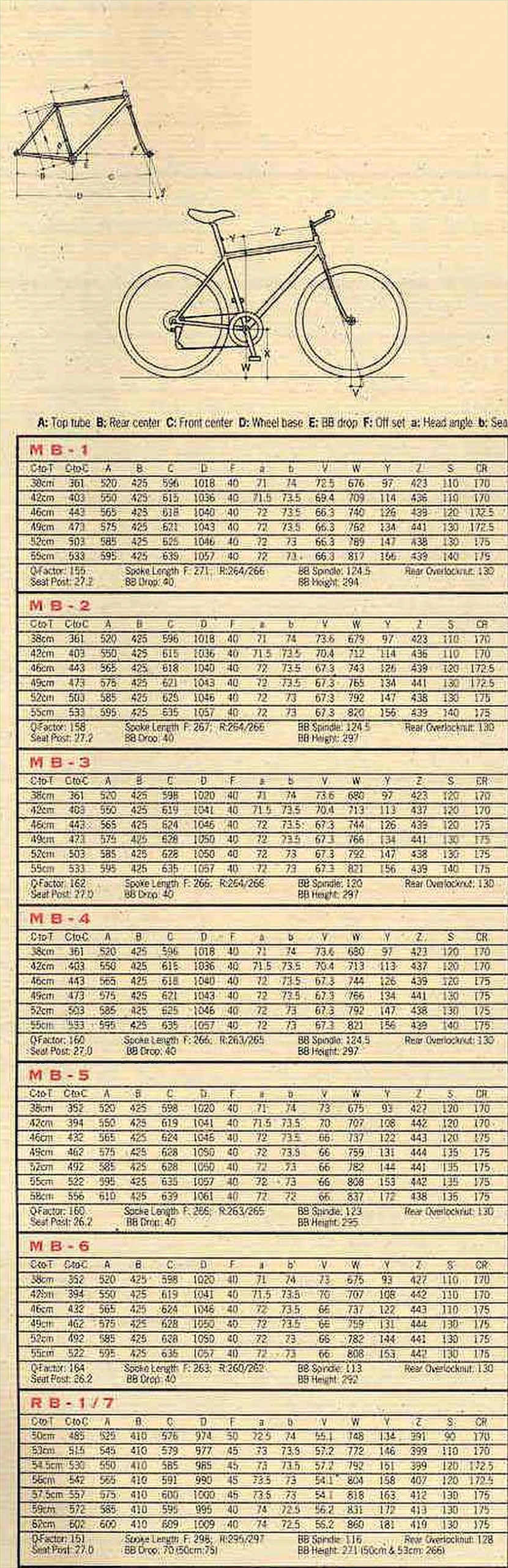
Callouts: A B C D E F a b
Callouts: V W X Y Z
A: Top tube B: Rear center C: Front center D: Wheel base E: BB drop F: Off set a: Head angle b: Sea [cut off]
MB-1
C-to-T | C-to-C | A | B | C | D | F | a | b | V | W | Y | Z | S | CR
38cm | 361 | 520 | 425 | 596 | 1018 | 40 | 71 | 74 | 72.5 | 676 | 97 | 423 | 110 | 170
42cm | 403 | 550 | 425 | 615 | 1036 | 40 | 71.5 | 73.5 | 69.4 | 709 | 114 | 436 | 110 | 170
46cm | 443 | 565 | 425 | 618 | 1040 | 40 | 72 | 73.5 | 66.3 | 740 | 126 | 439 | 120 | 172.5
49cm | 473 | 575 | 425 | 621 | 1043 | 40 | 72 | 73.5 | 66.3 | 762 | 134 | 441 | 130 | 172.5
52cm | 503 | 585 | 425 | 625[?] | 1046 | 40 | 72 | 73 | 66.3 | 789 | 147 | 438 | 130 | 175
55cm | 533 | 595 | 425 | 639[?] | 1057 | 40 | 72 | 73 | 66.3 | 817 | 156 | 439 | 140 | 175
Q-Factor: 155 Spoke Length F: 271; R:264/266 BB Spindle: 124.5 Rear Overlocknut: 130
Seat Post: 27.2 BB Drop: 40 BB Height: 294
MB-2
C-to-T | C-to-C | A | B | C | D | F | a | b | V | W | Y | Z | S | CR
38cm | 361 | 520 | 425 | 596 | 1018 | 40 | 71 | 74 | 73.6 | 679 | 97 | 423 | 110 | 170
42cm | 403 | 550 | 425 | 615 | 1036 | 40 | 71.5 | 73.5 | 70.4 | 712 | 114 | 436 | 110 | 170
46cm | 443 | 565 | 425 | 618 | 1040 | 40 | 72 | 73.5 | 67.3 | 743 | 126 | 439 | 120 | 172.5
49cm | 473 | 575 | 425 | 621 | 1043 | 40 | 72 | 73.5 | 67.3 | 765 | 134 | 441 | 130 | 172.5
52cm | 503 | 585 | 425 | 629[?] | 1046 | 40 | 72 | 73 | 67.3 | 792 | 147 | 438 | 130 | 175
55cm | 533 | 595 | 425 | 635 | 1057 | 40 | 72 | 73 | 67.3 | 820 | 156 | 439 | 140 | 175
Q-Factor: 158 Spoke Length F: 267; R:264/266 BB Spindle: 124.5 Rear Overlocknut: 130
Seat Post: 27.2 BB Drop: 40 BB Height: 297
MB-3
C-to-T | C-to-C | A | B | C | D | F | a | b | V | W | Y | Z | S | CR
38cm | 361 | 520 | 425 | 598 | 1020 | 40 | 71 | 74 | 73.6 | 680 | 97 | 423 | 120 | 170
42cm | 403 | 550 | 425 | 619 | 1041 | 40 | 71.5 | 73.5 | 70.4 | 713 | 113 | 437 | 120 | 170
46cm | 443 | 565 | 425 | 624 | 1046 | 40 | 72 | 73.5 | 67.3 | 744 | 126 | 439 | 120 | 175
49cm | 473 | 575 | 425 | 628 | 1050 | 40 | 72 | 73.5 | 67.3 | 766 | 134 | 441 | 130 | 175
52cm | 503 | 585 | 425 | 628 | 1050 | 40 | 72 | 73 | 67.3 | 792 | 147 | 438 | 130 | 175
55cm | 533 | 595 | 425 | 635 | 1057 | 40 | 72 | 73 | 67.3 | 821 | 156 | 439 | 140 | 175
Q-Factor: 162 Spoke Length F: 266; R:264/266 BB Spindle: 120 Rear Overlocknut: 130
Seat Post: 27.0 BB Drop: 40 BB Height: 297
MB-4
C-to-T | C-to-C | A | B | C | D | F | a | b | V | W | Y | Z | S | CR
38cm | 361 | 520 | 425 | 596 | 1018 | 40 | 71 | 74 | 73.6 | 680 | 97 | 423 | 120 | 170
42cm | 403 | 550 | 425 | 615 | 1036 | 40 | 71.5 | 73.5 | 70.4 | 713 | 113 | 437 | 120 | 170
46cm | 443 | 565 | 425 | 618 | 1040 | 40 | 72 | 73.5 | 67.3 | 744 | 126 | 439 | 120 | 175
49cm | 473 | 575 | 425 | 621 | 1043 | 40 | 72 | 73.5 | 67.3 | 766 | 134 | 441 | 130 | 175
52cm | 503 | 585 | 425 | 625 | 1046 | 40 | 72 | 73 | 67.3 | 792 | 147 | 438 | 130 | 175
55cm | 533 | 595 | 425 | 635 | 1057 | 40 | 72 | 73 | 67.3 | 821 | 156 | 439 | 140 | 175
Q-Factor: 160 Spoke Length F: 266; R:263/265 BB Spindle: 124.5 Rear Overlocknut: 130
Seat Post: 27.0 BB Drop: 40 BB Height: 297
MB-5
C-to-T | C-to-C | A | B | C | D | F | a | b | V | W | Y | Z | S | CR
38cm | 352 | 520 | 425 | 598 | 1020 | 40 | 71 | 74 | 73 | 675 | 93 | 427 | 120 | 170
42cm | 394 | 550 | 425 | 619 | 1041 | 40 | 71.5 | 73.5 | 70 | 707 | 108 | 442 | 120 | 170
46cm | 432 | 565 | 425 | 624 | 1046 | 40 | 72 | 73.5 | 66 | 737 | 122 | 443 | 120 | 175
49cm | 462 | 575 | 425 | 628 | 1050 | 40 | 72 | 73.5 | 66 | 759 | 131 | 444 | 135 | 175
52cm | 492 | 585 | 425 | 628 | 1050 | 40 | 72 | 73 | 66 | 782 | 144 | 441 | 135 | 175
55cm | 522 | 595 | 425 | 635 | 1057 | 40 | 72 | 73 | 66 | 808 | 153 | 442 | 135 | 175
58cm | 556 | 610 | 425 | 639 | 1061 | 40 | 72 | 72 | 66 | 837 | 172 | 438 | 135 | 175
Q-Factor: 160 Spoke Length F: 266; R:263/265 BB Spindle: 123 Rear Overlocknut: 130
Seat Post: 26.2 BB Drop: 40 BB Height: 295
MB-6
C-to-T | C-to-C | A | B | C | D | F | a | b | V | W | Y | Z | S | CR
38cm | 352 | 520 | 425 | 598 | 1020 | 40 | 71 | 74 | 73 | 675 | 93 | 427 | 110 | 170
42cm | 394 | 550 | 425 | 619 | 1041 | 40 | 71.5 | 73.5 | 70 | 707 | 108 | 442 | 120 | 170
46cm | 432 | 565 | 425 | 624 | 1046 | 40 | 72 | 73.5 | 66 | 737 | 122 | 443 | 110 | 175
49cm | 462 | 575 | 425 | 628 | 1050 | 40 | 72 | 73.5 | 66 | 759 | 131 | 444 | 130 | 175
52cm | 492 | 585 | 425 | 628 | 1050 | 40 | 72 | 73 | 66 | 782 | 144 | 441 | 130 | 175
55cm | 522 | 595 | 425 | 635 | 1057 | 40 | 72 | 73 | 66 | 808 | 153 | 442 | 130 | 175
Q-Factor: 164 Spoke Length F: 263; R:260/262 BB Spindle: 113 Rear Overlocknut: 130
Seat Post: 26.2 BB Drop: 40 BB Height: 292
RB-1/7
C-to-T | C-to-C | A | B | C | D | F | a | b | V | W | Y | Z | S | CR
50cm | 485 | 525 | 410 | 576 | 974 | 50 | 72.5 | 74 | 55.1 | 748 | 134 | 391 | 90 | 170
53cm | 515 | 545 | 410 | 579 | 977 | 45 | 73 | 73.5 | 57.2 | 772 | 146 | 399 | 110 | 170
54.5cm | 530 | 550 | 410 | 585 | 985 | 45 | 73 | 73.5 | 57.2 | 792 | 161 | 399 | 120 | 172.5
56cm | 542 | 565 | 410 | 591 | 990 | 45 | 73.5 | 73 | 54.1 | 804 | 158 | 407 | 120 | 172.5
57.5cm | 557 | 575 | 410 | 600 | 1000 | 45 | 73.5 | 73 | 54.1 | 818 | 163 | 412 | 130 | 175
59cm | 572 | 585 | 410 | 595 | 995 | 40 | 74 | 72.5 | 56.2 | 831 | 172 | 413 | 130 | 175
62cm | 602 | 600 | 410 | 609 | 1009 | 40 | 74 | 72.5 | 56.2 | 860 | 181 | 419 | 130 | 175
Q-Factor: 151 Spoke Length F: 298; R:295/297 BB Spindle: 116 Rear Overlocknut: 128
Seat Post: 27.0 BB Drop: 70 (50cm:75) BB Height: 271 (50cm & 53cm: 266)
[Line drawings of a bare frame and a complete bicycle above frame geometry charts for the MB-1 to MB-6 and RB-1/7 by frame size. The frame is lettered A to F, a and b, the bicycle V to Z, and the printed letter key is cut off at the right edge. The page carries no folio.]
— Page 18 —
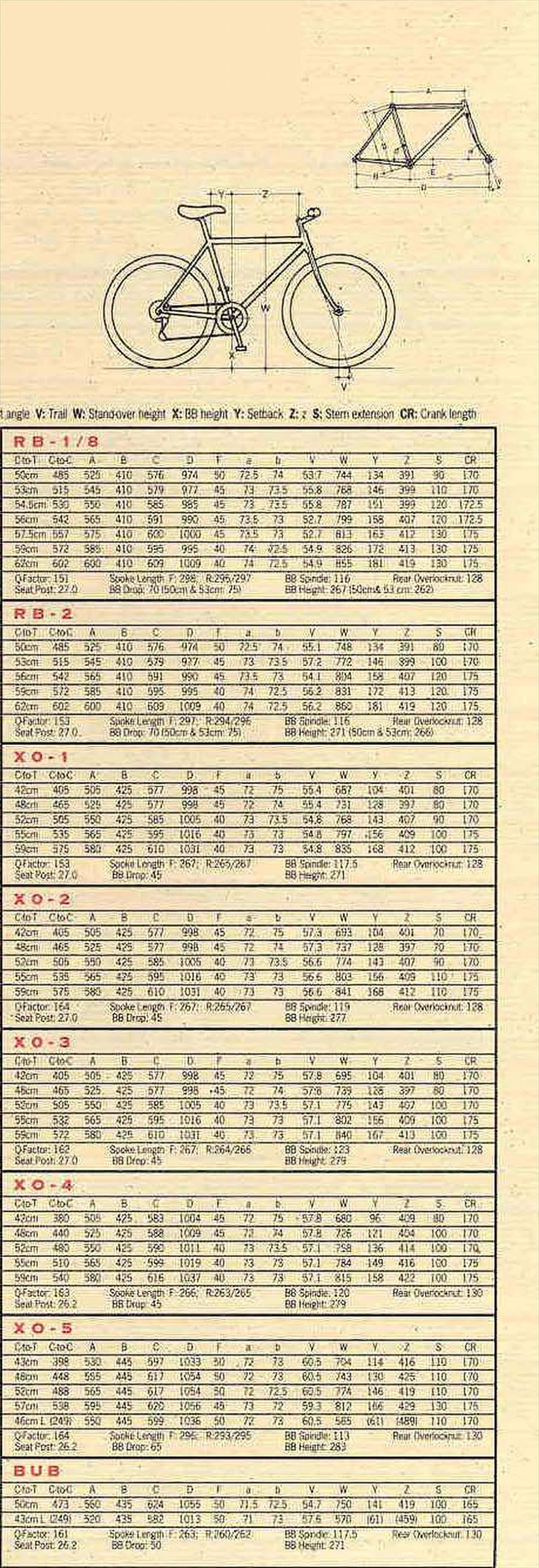
Callouts: A B C D E F a b
Callouts: V W X Y Z
[cut off]t angle V: Trail W: Stand-over height X: BB height Y: Setback Z: z S: Stem extension CR: Crank length
RB-1/8
C-to-T | C-to-C | A | B | C | D | F | a | b | V | W | Y | Z | S | CR
50cm | 485 | 525 | 410 | 576 | 974 | 50 | 72.5 | 74 | 53.7 | 744 | 134 | 391 | 90 | 170
53cm | 515 | 545 | 410 | 579 | 977 | 45 | 73 | 73.5 | 55.8 | 768 | 146 | 399 | 110 | 170
54.5cm | 530 | 550 | 410 | 585 | 985 | 45 | 73 | 73.5 | 55.8 | 787 | 151 | 399 | 120 | 172.5
56cm | 542 | 565 | 410 | 591 | 990 | 45 | 73.5 | 73 | 52.7 | 799 | 158 | 407 | 120 | 172.5
57.5cm | 557 | 575 | 410 | 600 | 1000 | 45 | 73.5 | 73 | 52.7 | 813 | 163 | 412 | 130 | 175
59cm | 572 | 585 | 410 | 595 | 995 | 40 | 74 | 72.5 | 54.9 | 826 | 172 | 413 | 130 | 175
62cm | 602 | 600 | 410 | 609 | 1009 | 40 | 74 | 72.5 | 54.9 | 855 | 181 | 419 | 130 | 175
Q-Factor: 151 Spoke Length F: 298; R:295/297 BB Spindle: 116 Rear Overlocknut: 128
Seat Post: 27.0 BB Drop: 70 (50cm & 53cm: 75) BB Height: 267 (50cm & 53 cm: 262)
RB-2
C-to-T | C-to-C | A | B | C | D | F | a | b | V | W | Y | Z | S | CR
50cm | 485 | 525 | 410 | 576 | 974 | 50 | 72.5 | 74 | 55.1 | 748 | 134 | 391 | 80 | 170
53cm | 515 | 545 | 410 | 579 | 977 | 45 | 73 | 73.5 | 57.2 | 772 | 146 | 399 | 100 | 170
56cm | 542 | 565 | 410 | 591 | 990 | 45 | 73.5 | 73 | 54.1 | 804 | 158 | 407 | 120 | 175
59cm | 572 | 585 | 410 | 595 | 995 | 40 | 74 | 72.5 | 56.2 | 831 | 172 | 413 | 120 | 175
62cm | 602 | 600 | 410 | 609 | 1009 | 40 | 74 | 72.5 | 56.2 | 860 | 181 | 419 | 120 | 175
Q-Factor: 153 Spoke Length F: 297; R:294/296 BB Spindle: 116 Rear Overlocknut: 128
Seat Post: 27.0 BB Drop: 70 (50cm & 53cm: 75) BB Height: 271 (50cm & 53cm: 266)
XO-1
C-to-T | C-to-C | A | B | C | D | F | a | b | V | W | Y | Z | S | CR
42cm | 405 | 505 | 425 | 577 | 998 | 45 | 72 | 75 | 55.4 | 687 | 104 | 401 | 80 | 170
48cm | 465 | 525 | 425 | 577 | 998 | 45 | 72 | 74 | 55.4 | 731 | 128 | 397 | 80 | 170
52cm | 505 | 550 | 425 | 585 | 1005 | 40 | 73 | 73.5 | 54.8 | 768 | 143 | 407 | 90 | 170
55cm | 535 | 565 | 425 | 595 | 1016 | 40 | 73 | 73 | 54.8 | 797 | 156 | 409 | 100 | 175
59cm | 575 | 580 | 425 | 610 | 1031 | 40 | 73 | 73 | 54.8 | 835 | 168 | 412 | 100 | 175
Q-Factor: 153 Spoke Length F: 267; R:265/267 BB Spindle: 117.5 Rear Overlocknut: 128
Seat Post: 27.0 BB Drop: 45 BB Height: 271
XO-2
C-to-T | C-to-C | A | B | C | D | F | a | b | V | W | Y | Z | S | CR
42cm | 405 | 505 | 425 | 577 | 998 | 45 | 72 | 75 | 57.3 | 693 | 104 | 401 | 70 | 170
48cm | 465 | 525 | 425 | 577 | 998 | 45 | 72 | 74 | 57.3 | 737 | 128 | 397 | 70 | 170
52cm | 505 | 550 | 425 | 585 | 1005 | 40 | 73 | 73.5 | 56.6 | 774 | 143 | 407 | 90 | 170
55cm | 535 | 565 | 425 | 595 | 1016 | 40 | 73 | 73 | 56.6 | 803 | 156 | 409 | 110 | 175
59cm | 575 | 580 | 425 | 610 | 1031 | 40 | 73 | 73 | 56.6 | 841 | 168 | 412 | 110 | 175
Q-Factor: 164 Spoke Length F: 267; R:265/267 BB Spindle: 119 Rear Overlocknut: 128
Seat Post: 27.0 BB Drop: 45 BB Height: 277
XO-3
C-to-T | C-to-C | A | B | C | D | F | a | b | V | W | Y | Z | S | CR
42cm | 405 | 505 | 425 | 577 | 998 | 45 | 72 | 75 | 57.8 | 695 | 104 | 401 | 80 | 170
48cm | 465 | 525 | 425 | 577 | 998 | 45 | 72 | 74 | 57.8 | 739 | 128 | 397 | 80 | 170
52cm | 505 | 550 | 425 | 585 | 1005 | 40 | 73 | 73.5 | 57.1 | 775 | 143 | 407 | 100 | 170
55cm | 532 | 565 | 425 | 595 | 1016 | 40 | 73 | 73 | 57.1 | 802 | 156 | 409 | 100 | 175
59cm | 572 | 580 | 425 | 610 | 1031 | 40 | 73 | 73 | 57.1 | 840 | 167 | 413 | 100 | 175
Q-Factor: 162 Spoke Length F: 267; R:264/266 BB Spindle: 123 Rear Overlocknut: 128
Seat Post: 27.0 BB Drop: 45 BB Height: 279
XO-4
C-to-T | C-to-C | A | B | C | D | F | a | b | V | W | Y | Z | S | CR
42cm | 380 | 505 | 425 | 583 | 1004 | 45 | 72 | 75 | 57.8 | 680 | 96 | 409 | 80 | 170
48cm | 440 | 525 | 425 | 588 | 1009 | 45 | 72 | 74 | 57.8 | 726 | 121 | 404 | 100 | 170
52cm | 480 | 550 | 425 | 590 | 1011 | 40 | 73 | 73.5 | 57.1 | 758 | 136 | 414 | 100 | 170
55cm | 510 | 565 | 425 | 599 | 1019 | 40 | 73 | 73 | 57.1 | 784 | 149 | 416 | 100 | 175
59cm | 540 | 580 | 425 | 616 | 1037 | 40 | 73 | 73 | 57.1 | 815 | 158 | 422 | 100 | 175
Q-Factor: 163 Spoke Length F: 266; R:263/265 BB Spindle: 120 Rear Overlocknut: 130
Seat Post: 26.2 BB Drop: 45 BB Height: 279
XO-5
C-to-T | C-to-C | A | B | C | D | F | a | b | V | W | Y | Z | S | CR
43cm | 398 | 530 | 445 | 597 | 1033 | 50 | 72 | 73 | 60.5 | 704 | 114 | 416 | 110 | 170
48cm | 448 | 555 | 445 | 617 | 1054 | 50 | 72 | 73 | 60.5 | 743 | 130 | 425 | 110 | 170
52cm | 488 | 565 | 445 | 617 | 1054 | 50 | 72 | 72.5 | 60.5 | 774 | 146 | 419 | 110 | 170
57cm | 538 | 595 | 445 | 620 | 1056 | 45 | 73 | 72 | 59.3 | 812 | 166 | 429 | 130 | 175
46cm L | (249) | 550 | 445 | 599 | 1036 | 50 | 72 | 73 | 60.5 | 585 | (61) | (489) | 110 | 170
Q-Factor: 164 Spoke Length F: 296; R:293/295 BB Spindle: 113 Rear Overlocknut: 130
Seat Post: 26.2 BB Drop: 65 BB Height: 283
BUB
C-to-T | C-to-C | A | B | C | D | F | a | b | V | W | Y | Z | S | CR
50cm | 473 | 560 | 435 | 624 | 1055 | 50 | 71.5 | 72.5 | 54.7 | 750 | 141 | 419 | 100 | 165
43cm L | (249) | 520 | 435 | 582 | 1013 | 50 | 71 | 73 | 57.6 | 570 | (61) | (459) | 100 | 165
Q-Factor: 161 Spoke Length F: 263; R:260/262 BB Spindle: 117.5 Rear Overlocknut: 130
Seat Post: 26.2 BB Drop: 50 BB Height: 271
[Line drawings of a bare frame and a complete bicycle above frame geometry charts for the RB-1/8, RB-2, XO-1 to XO-5 and BUB by frame size. The bicycle is lettered V to Z, and the printed letter key is cut off at the left edge. The page carries no folio.]
— Page 19 —
THE BRIDGESTONE BICYCLE CATALOGUE 1993
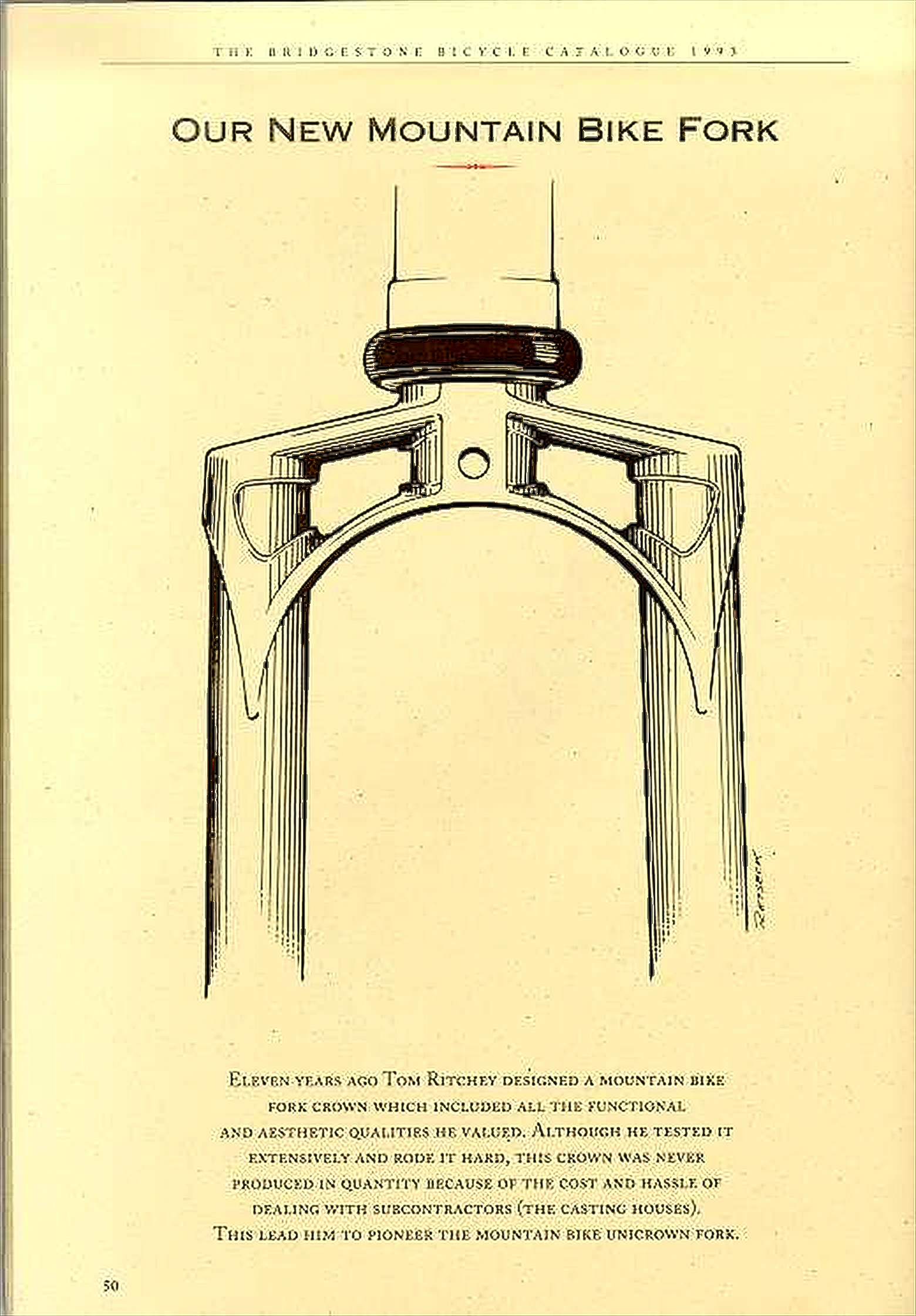
Our New Mountain Bike Fork
Eleven years ago Tom Ritchey designed a mountain bike fork crown which included all the functional and aesthetic qualities he valued. Although he tested it extensively and rode it hard, this crown was never produced in quantity because of the cost and hassle of dealing with subcontractors (the casting houses). This lead him to pioneer the mountain bike unicrown fork.
50
[A large pen-and-ink drawing of a mountain bike fork crown with the steering tube and headset above two fork blades, under the heading “Our New Mountain Bike Fork”. A small red ornament sits below the heading and a small vertical signature beside the right fork blade.]
— Page 20 —
THE BRIDGESTONE BICYCLE CATALOGUE 1993
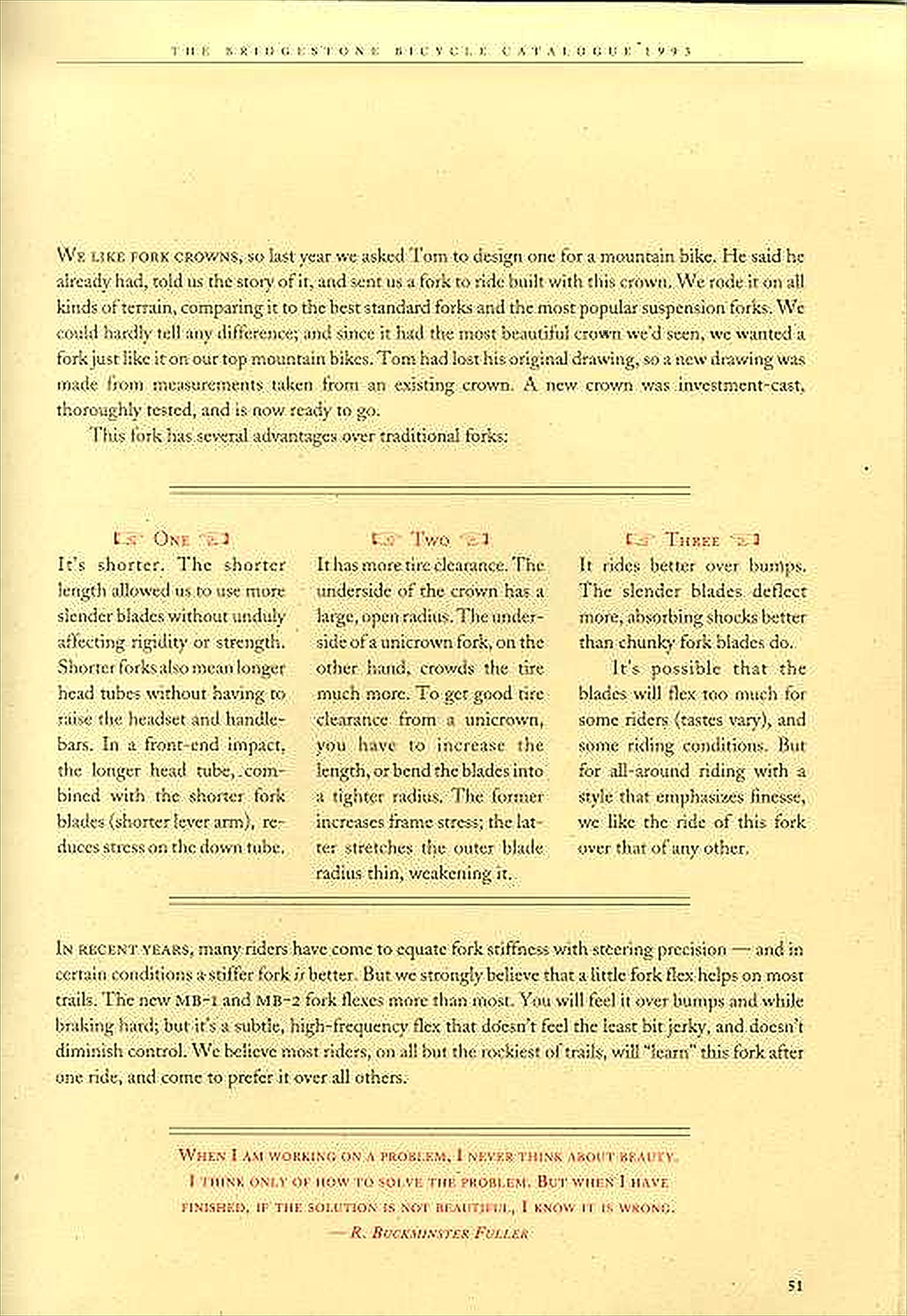
We like fork crowns, so last year we asked Tom to design one for a mountain bike. He said he already had, told us the story of it, and sent us a fork to ride built with this crown. We rode it on all kinds of terrain, comparing it to the best standard forks and the most popular suspension forks. We could hardly tell any difference; and since it had the most beautiful crown we’d seen, we wanted a fork just like it on our top mountain bikes. Tom had lost his original drawing, so a new drawing was made from measurements taken from an existing crown. A new crown was investment-cast, thoroughly tested, and is now ready to go.
This fork has several advantages over traditional forks:
One
It’s shorter. The shorter length allowed us to use more slender blades without unduly affecting rigidity or strength. Shorter forks also mean longer head tubes without having to raise the headset and handlebars. In a front-end impact, the longer head tube, combined with the shorter fork blades (shorter lever arm), reduces stress on the down tube.
Two
It has more tire clearance. The underside of the crown has a large, open radius. The underside of a unicrown fork, on the other hand, crowds the tire much more. To get good tire clearance from a unicrown, you have to increase the length, or bend the blades into a tighter radius. The former increases frame stress; the latter stretches the outer blade radius thin, weakening it.
Three
It rides better over bumps. The slender blades deflect more, absorbing shocks better than chunky fork blades do.
It’s possible that the blades will flex too much for some riders (tastes vary), and some riding conditions. But for all-around riding with a style that emphasizes finesse, we like the ride of this fork over that of any other.
In recent years, many riders have come to equate fork stiffness with steering precision — and in certain conditions a stiffer fork is better. But we strongly believe that a little fork flex helps on most trails. The new MB-1 and MB-2 fork flexes more than most. You will feel it over bumps and while braking hard; but it’s a subtle, high-frequency flex that doesn’t feel the least bit jerky, and doesn’t diminish control. We believe most riders, on all but the rockiest of trails, will “learn” this fork after one ride, and come to prefer it over all others.
When I am working on a problem, I never think about beauty. I think only of how to solve the problem. But when I have finished, if the solution is not beautiful, I know it is wrong.
— R. Buckminster Fuller
51
[A text page on the new mountain bike fork crown, with three columns headed One, Two and Three and a red quotation attributed to R. Buckminster Fuller. The column headings carry small red ornaments, and a paragraph discusses fork flex for the MB-1 and MB-2.]
— Page 21 —
SADDLE UP ON A
BRIDGESTONE
A HORSE OF A DIFFERENT COLOR
TOKYO, JAPAN · SAN LEANDRO[?], USA[?]
[A poster in flat colors headed “Bridgestone, a horse of a different color”, showing a racing cyclist on a road bicycle among several galloping horses. The small line of type under the title is very small and only partly legible; no folio is printed.]
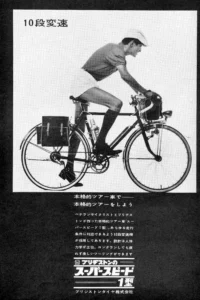 Bridgestone 1964 Advertisement — Super Speed Type 1 Ten-Speed Touring Bicycle
 Bridgestone 1965 Advertisement — The BS Mark Seen Most Often, Multi-Speed Bicycle Series
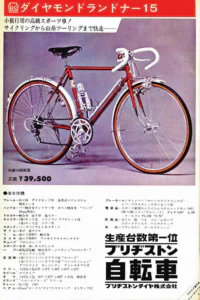 Bridgestone 1967 Advertisement — Diamond Randonneur 15 Touring Bicycle
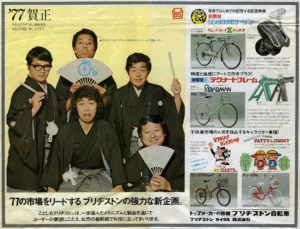 Bridgestone 1977 Advertisement — Synchro Memory Shift and Technart Frame New Year Range
Ebykr presents this material for research and education. If you hold rights to it or notice an ownership issue, please contact us and we will respond promptly.
The Ebykr Digest
New articles, timelines, catalog finds and registry activity — assembled from the archive once a month. Your address is never shared.
Double opt-in. One email per month. Unsubscribe at any time with one click.