About Ebykr
Ebykr celebrates classic and vintage lightweight bicycles through provocative imagery and opinion. Ride along with us.
About Ebykr
Ebykr celebrates classic and vintage lightweight bicycles through provocative imagery and opinion. Ride along with us.

Source: Gallica (Bibliothèque nationale de France), L'Officiel du cycle, du motocycle et du camping, 5 May 1951, N° 11, page 7; ark:/12148/bd6t54185542v. Source gallica.bnf.fr / BnF.
| Type | Review |
|---|---|
| Year | 1951 |
| Publisher | L'Officiel du cycle |
| Country | France |
| Language | French |
| Pages | 3 |
| Source | Gallica (Bibliothèque nationale de France), L'Officiel du cycle, du motocycle et du camping, 5 May 1951, N° 11, page 7; ark:/12148/bd6t54185542v. Source gallica.bnf.fr / BnF. |
| Credit | Ebykr archive; Bibliothèque nationale de France |
| Identifier | Gallica (BnF) ark:/12148/bd6t54185542v/f7 |
| Transcription | Headings and specifications transcribed; article text summarized |
Reference
"Après le raid Paris-Saïgon par un vélociste." L'Officiel du cycle, 5 May 1951. Ebykr, https://ebykr.com/library/lofficiel-du-cycle-1951-05-07-raid-paris-saigon-brans-carte/.
Wikipedia
{{cite magazine |title=Après le raid Paris-Saïgon par un vélociste |magazine=L'Officiel du cycle |date=5 May 1951 |language=French |url=https://ebykr.com/library/lofficiel-du-cycle-1951-05-07-raid-paris-saigon-brans-carte/ |via=Ebykr |access-date=}}APRÈS LE RAID PARIS-SAIGON PAR UN VÉLOCISTE * * * * * * PARIS FRANCE ITALIE Turin Milan Vérone Venise Lubliana Zagreb Belgrade YOUGOSLAVIE Nich Sofia Plovdiv BULGARIE Svilengrad Stamboul Ankara MER NOIRE M. CASPIENNE TURQUIE Adana Antioche Alep Homs Tripoli Beyrouth Damas Jérusalem Amman Ramadi Babylone Bagdad IRAK Kanaquin Kermanchah Kagan Hamadan Téhéran Damgham …
This is a magazine article, so its running text is summarized here rather than reproduced; the headline, byline, specifications and scores are transcribed as printed.
From L’Officiel du cycle, du motocycle et du camping, 5 May 1951, page 7: “Après le raid Paris-Saïgon par un vélociste”: Lionel Brans, a bicycle maker of Asnières, his long bicycle journey and its lessons. The title, headings, captions and lists are transcribed as printed; the text is summarized in Ebykr’s words, and the page images carry it in full.
— Page 1 —
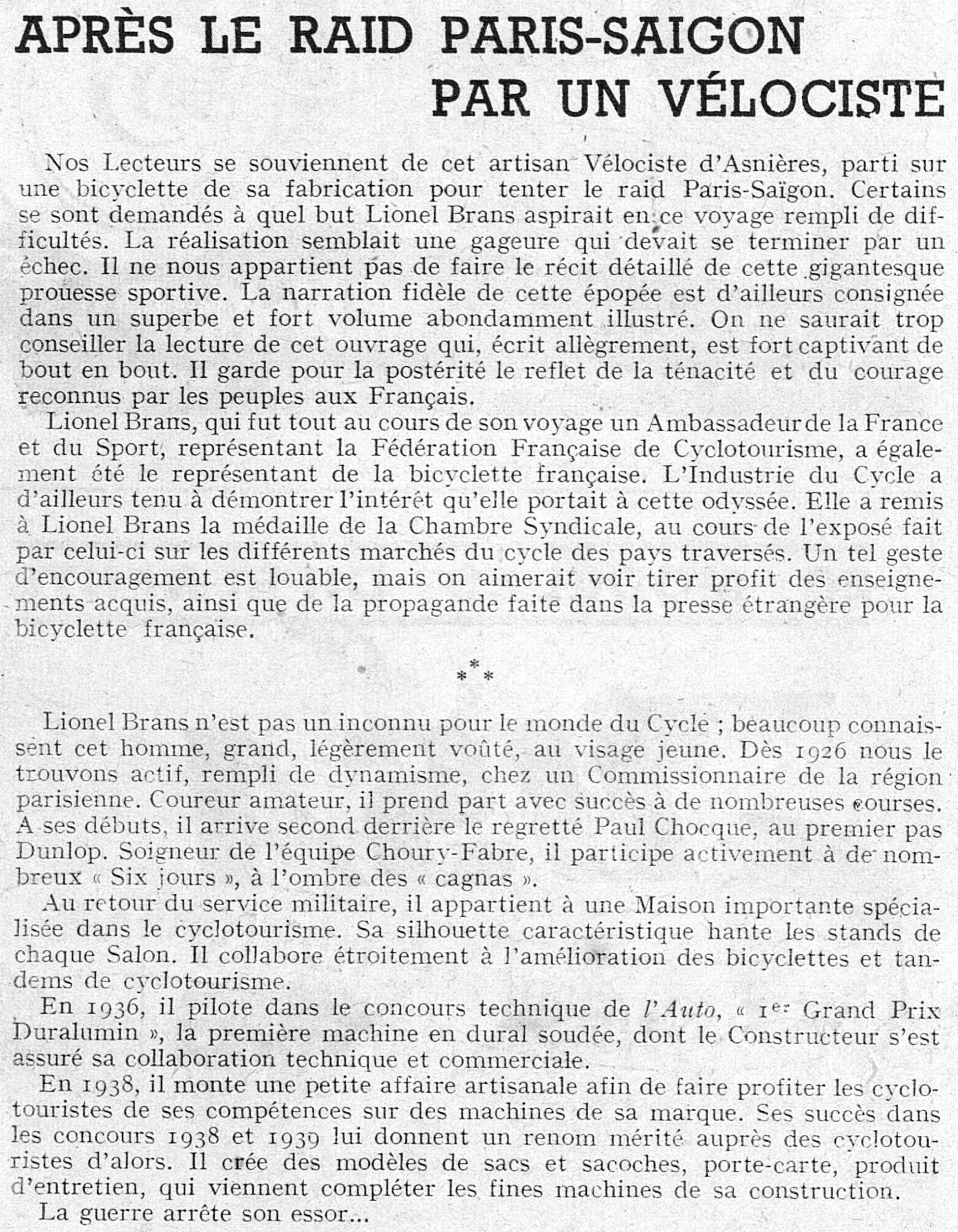
APRÈS LE RAID PARIS-SAIGON
PAR UN VÉLOCISTE
[Ebykr summary; the article’s text is not reproduced. The article recalls the artisan bicycle dealer of Asnières who set out on a machine of his own make to attempt the Paris-Saïgon raid, and says some readers wondered what Lionel Brans hoped to gain from so difficult a journey, which looked like a wager bound to end in failure. The journal says it will not tell the full story of this gigantic sporting feat, which is set down in a large, richly illustrated volume that it strongly recommends as lively and captivating from end to end and as a record of the tenacity and courage that peoples recognize in the French. Brans, an ambassador of France and of sport throughout the trip, represented the Fédération Française de Cyclotourisme and also French bicycles. The cycle industry showed its interest by handing him the medal of the Chambre Syndicale during his talk on the cycle markets of the countries he crossed. The author finds the gesture praiseworthy but would like to see the lessons learned and the publicity made in the foreign press turned to profit for the French bicycle.]
* * *
[Ebykr summary, after a three-star break. The article gives a career sketch. Brans is described as well known in the cycle world, tall, slightly stooped and young-faced. From 1926 he was active with a Paris-region commissionnaire, rode as an amateur racer with success and at the start finished second behind the late Paul Choque on a Dunlop first step. As a soigneur of the Choury-Fabre team he took part in many six-day races. After military service he joined an important firm specialized in cyclotouring, a familiar figure at each Salon, and worked closely on improving cyclotouring bicycles and tandems. In 1936 he piloted in the technical contest of L’Auto, the “1er Grand Prix Duralumin”, the first welded dural machine, whose builder secured his technical and commercial collaboration. In 1938 he set up a small artisan business to put his skill to work for cyclotourists on machines of his own marque; his successes in the 1938 and 1939 contests earned him a name among cyclotourists of the day, and he created models of bags, saddlebags, map holders and a maintenance product to complete his machines. The war stopped his progress.]
[An editorial page cut in justified seriffed text under a two-line headline set in heavy shaded slab-serif capitals, the second line pushed to the right margin. A three-star ornament divides the text into two sections. No drawing, signature or agency mark appears.]
— Page 2 —
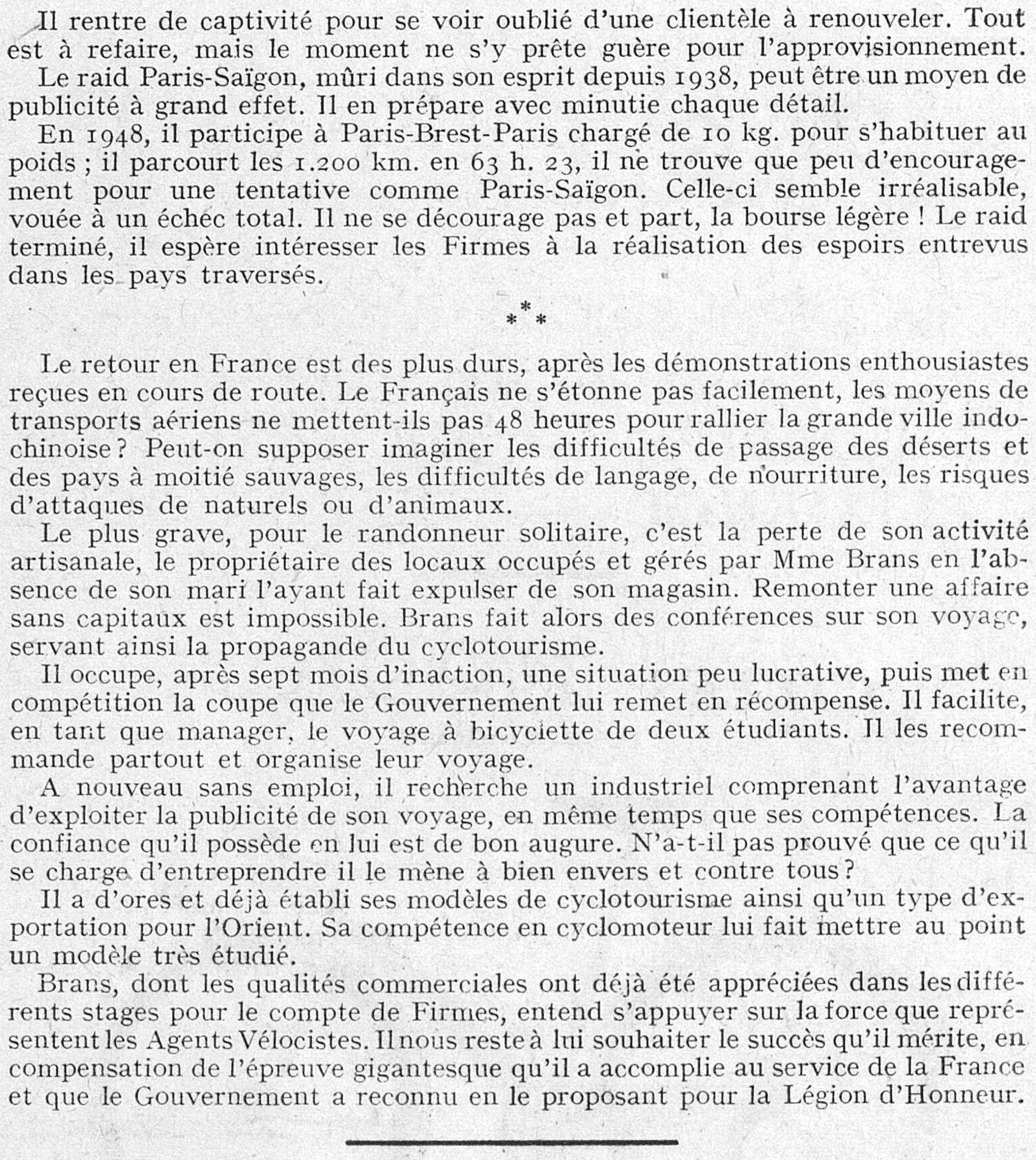
[Ebykr summary; the article’s text is not reproduced. Continuing the career sketch, Brans came home from captivity to find himself forgotten by a clientele that had to be won back; everything had to be rebuilt just when supplies were scarce. The Paris-Saïgon raid, ripened in his mind since 1938, could be a high-impact publicity device, and he prepared every detail with care. In 1948 he rode Paris-Brest-Paris carrying 10 kg. to get used to the weight, covering the 1.200 km. in 63 h. 23, and found little encouragement for an attempt like Paris-Saïgon, which seemed impossible and doomed to total failure. Undiscouraged, he set out with a light purse, hoping once the raid was over to interest firms in the hopes glimpsed in the countries crossed.]
* * *
[Ebykr summary, after a three-star break. The return to France was among the hardest after the enthusiastic welcomes received on the road: the French are not easily astonished, since air transport takes no more than 48 hours to reach the great Indochinese city, and few can imagine the difficulty of crossing deserts and half-wild countries, the problems of language and food and the risk of attacks by natives or animals. Worst for the solitary randonneur was the loss of his artisan trade, because the owner of the premises, run by Mme Brans in her husband’s absence, had had him expelled from his shop, and rebuilding a business without capital is impossible. Brans then gave lectures on his trip, serving the cause of cyclotouring. After seven months of idleness he took a poorly paid job, then entered in competition the cup that the Government gave him as a reward and as manager he eased the bicycle trip of two students, recommending them everywhere and organizing their journey. Out of work again, he is looking for an industrialist who understands the advantage of exploiting the publicity of his trip together with his skills, and the author takes the confidence he has in himself as a good omen, asking whether he has not proved that he carries through what he undertakes against all comers. He has already drawn up his cyclotouring models and an export type for the Orient, and his experience with the cyclomoteur has led him to develop a well-studied model. Brans, whose commercial qualities were already appreciated in various stages undertaken for firms, intends to lean on the strength that the Agents Vélocistes represent. The author closes by wishing him the success he deserves, in return for the gigantic ordeal he accomplished in the service of France, which the Government recognized by proposing him for the Légion d’Honneur.]
[An editorial page cut of justified seriffed text with no heading, drawing, signature or agency mark. A three-star ornament divides the text into two sections, and a short thick black rule closes the article at the foot, centered under the last line.]
— Page 3 —
PARIS
FRANCE
ITALIE
Turin
Milan
Vérone
Venise
Lubliana
Zagreb
Belgrade
YOUGOSLAVIE
Nich
Sofia
Plovdiv
BULGARIE
Svilengrad
Stamboul
Ankara
MER NOIRE
M. CASPIENNE
TURQUIE
Adana
Antioche
Alep
Homs
Tripoli
Beyrouth
Damas
Jérusalem
Amman
Ramadi
Babylone
Bagdad
IRAK
Kanaquin
Kermanchah
Kagan
Hamadan
Téhéran
Damgham
Chahroud
Sebsevar
Meched
IRAN
Hérat
Farah
Kandahar
AFGHANISTAN
Kaboul
Jallabad
KHAIBER PASS
Peschawar
Rawalpindi
Lahore
PAKISTAN
Ambala
Delhi
Manipuri
Benarès
HINDOUSTAN
CALCUTTA
Saïgon
Angkor
SAÏGON
INDOCHINE
MER MÉDITERRANÉE
MER D’OMAN
GOLFE DU BENGALE
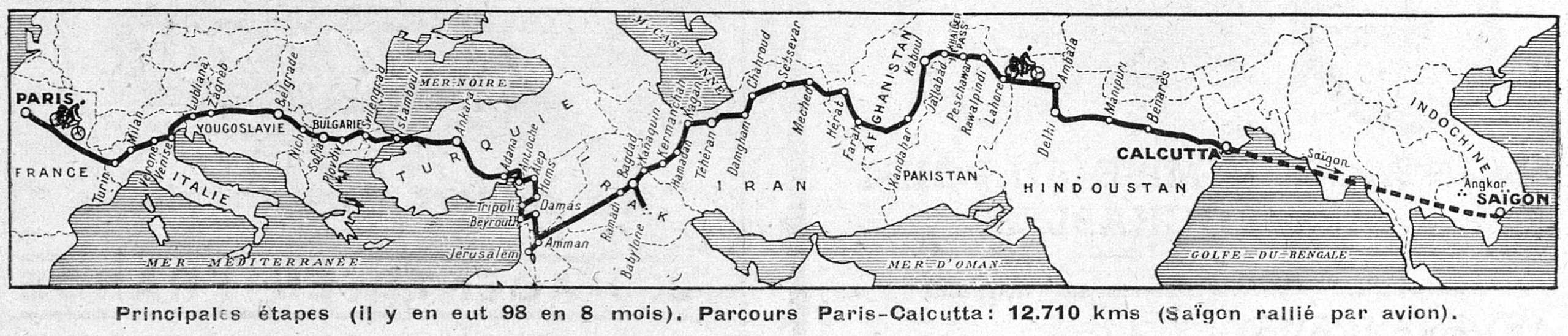
Principales étapes (il y en eut 98 en 8 mois). Parcours Paris-Calcutta: 12.710 kms (Saïgon rallié par avion).
[Ebykr summary; the map’s route is covered here in words. The route runs overland from Paris through Turin, Milan, Verona and Venice, then Ljubljana, Zagreb and Belgrade in Yugoslavia, through Bulgaria by Nich, Sofia and Plovdiv to Svilengrad, then Stamboul and Ankara in Turkey. It turns south by Adana, Antioch and Aleppo to Homs, Tripoli, Beirut and Damascus, reaches Jerusalem and Amman and crosses Iraq by Ramadi and Baghdad, with a short spur toward Babylon. It continues across Iran by Kermanshah, Hamadan, Tehran, Damghan, Shahrud and Sabzevar to Meshed, then through Herat, Farah and Kandahar in Afghanistan to Kabul, Jalalabad and the Khyber Pass and down through Peshawar, Rawalpindi and Lahore in Pakistan, then Ambala, Delhi, Manipur and Benares to Calcutta. From Calcutta a dashed line marked with an arrow and the word Saïgon shows the final leg to Saigon by air.]
[A ruled rectangular map in black and white spanning the full width of the cut, printed as a long strip. The land is drawn as an engraved outline with dashed dotted frontiers, the seas filled with fine horizontal hatching and lettered across in spaced italic capitals. Place names run along the route in slanted italic lettering; country names stand in spaced roman capitals, and the towns Paris, Calcutta and Saïgon are in bold capitals. A heavy black line with small open circles for stops traces the overland route from Paris at the upper left to Calcutta, then a heavy dashed line crosses the Bay of Bengal to Saïgon at the right. Two small black silhouettes of a cyclist on a bicycle are drawn on the line, one near Paris and one near Lahore, the second looking more like a rider on a motorized machine. The printed caption sits below the frame in bold sans-serif type, with the figure 12.710 in heavier weight. No signature or agency mark is visible.]
Ebykr presents this material for research and education. If you hold rights to it or notice an ownership issue, please contact us and we will respond promptly.
The Ebykr Digest
New articles, timelines, catalog finds and registry activity — assembled from the archive once a month. Your address is never shared.
Double opt-in. One email per month. Unsubscribe at any time with one click.