About Ebykr
Ebykr celebrates classic and vintage lightweight bicycles through provocative imagery and opinion. Ride along with us.
About Ebykr
Ebykr celebrates classic and vintage lightweight bicycles through provocative imagery and opinion. Ride along with us.

Source: National Cycle Archive, in partnership with the Veteran-Cycle Club.
| Marque | Accles & Pollock |
|---|---|
| Type | Catalog |
| Year | 1932 |
| Publisher | Accles & Pollock Limited |
| Country | England |
| Language | English |
| Pages | 2 |
| Source | National Cycle Archive, in partnership with the Veteran-Cycle Club. |
| Credit | National Cycle Archive, in partnership with the Veteran-Cycle Club |
| Transcription | Transcribed by eye |
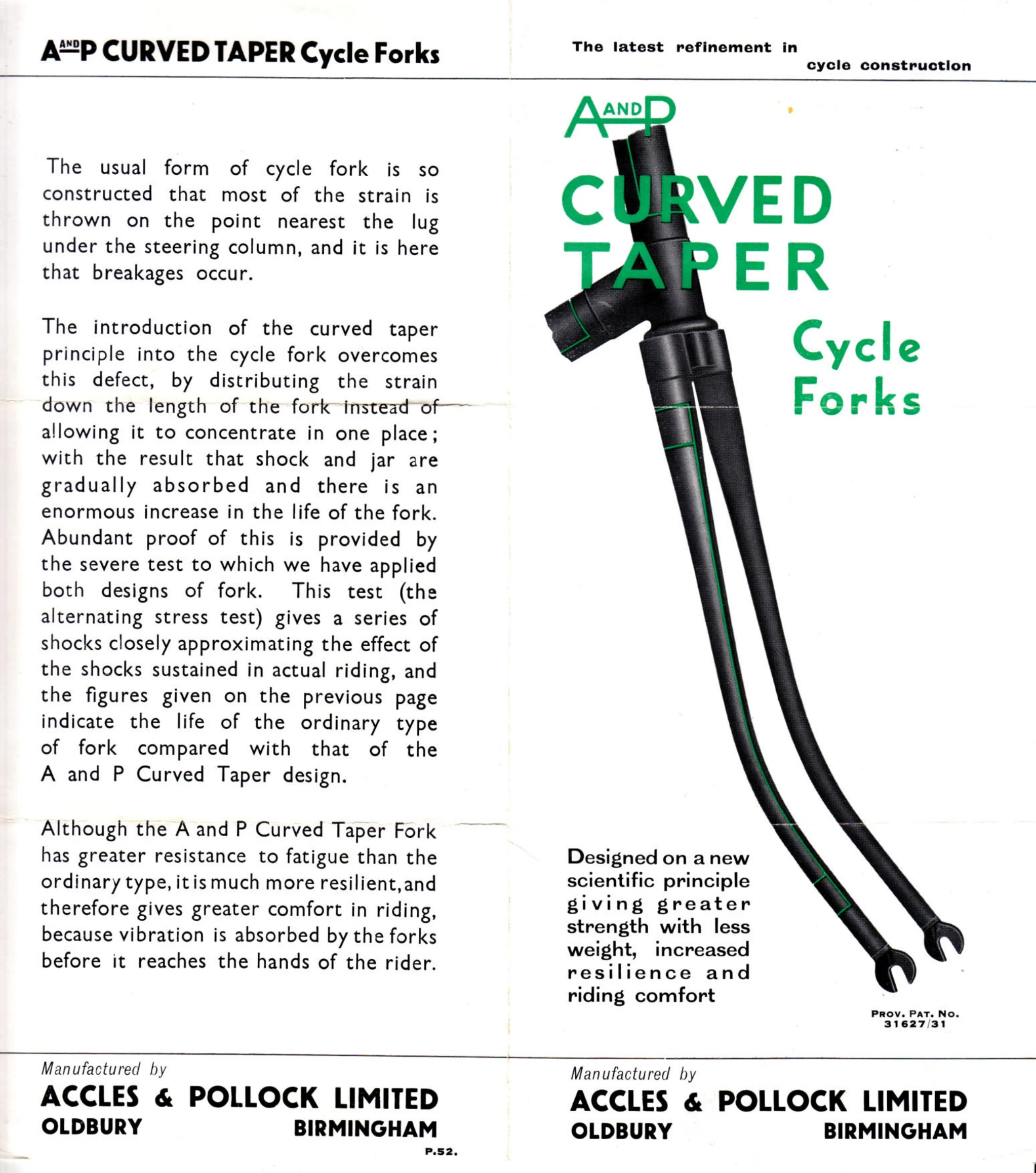
A and P CURVED TAPER Cycle Forks The latest refinement in cycle construction A and P CURVED TAPER Cycle Forks Designed on a new scientific principle giving greater strength with less weight, increased resilience and riding comfort PROV. PAT. NO. 31627/31 The usual form of cycle fork is so constructed that most of the strain …
A folded leaflet from Accles & Pollock Limited of Oldbury, Birmingham, introducing the A and P Curved Taper cycle fork. It is the oldest item in this group by some forty years and the only one not from Reynolds.
Dating. The leaflet is undated, but the front panel prints PROV. PAT. NO. 31627/31 — British provisional patent application 31627 of 1931. With the sheet describing the fork as the latest refinement in cycle construction and the most revolutionary change in cycle construction in recent years, a date of about 1932 follows. The panel also carries a reference mark, P.52.
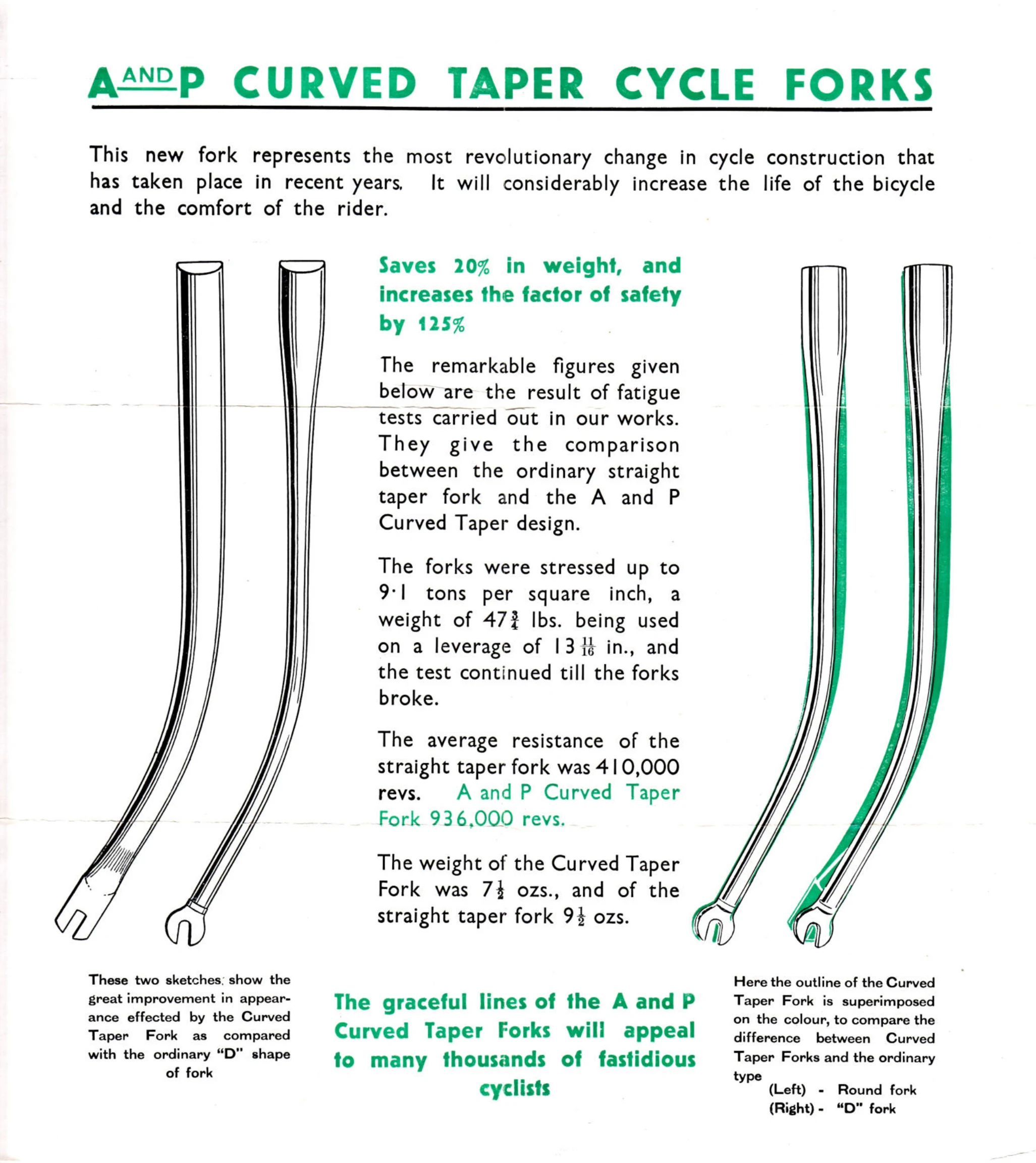
The argument is a fatigue argument, and unusually for trade literature the leaflet publishes the numbers behind it. Both fork types were stressed to 9.1 tons per square inch, with a weight of 47 and three quarter pounds on a leverage of 13 and eleven sixteenths of an inch, and the test run until the forks broke. The ordinary straight taper fork averaged 410,000 revolutions; the A and P Curved Taper fork reached 936,000. The curved fork weighed 7 and a half ounces against 9 and a half.
Those figures are worth checking, because they support the headline claims rather than contradicting them. 936,000 against 410,000 is an increase of about 128 per cent, which is the claimed 125 per cent improvement in the factor of safety. Seven and a half ounces against nine and a half is a saving of about 21 per cent, which is the claimed 20 per cent saving in weight. The leaflet is being straight with its reader.
The physical argument is the same one Reynolds makes about taper-gauge blades in the 1972 booklet elsewhere in this collection, reached from the other direction: an ordinary fork throws most of the strain onto the point nearest the lug under the steering column, and that is where it breaks. Distributing the strain down the length of the blade absorbs shock gradually, lengthens fork life and, because vibration is absorbed before it reaches the rider’s hands, makes the machine more comfortable.
A note on order. The source is a folded sheet. The first scanned face is the outer spread, carrying the front cover at the right and a closing text panel at the left; the second is the inner page with the test figures and the comparison drawings. The closing panel refers to figures given on the previous page, meaning the inner sheet, so the leaflet reads cover, then inner, then back panel. The faces are presented here in the order they were scanned.
The leaflet reached the Ebykr collection through the National Cycle Archive in partnership with the Veteran-Cycle Club, whose courtesy card is the first page of the source file. That card is not reproduced here.
[The outer spread. At the left, a text panel headed with the leaflet title. At the right, the front cover: a photograph of a complete fork with its steering column and crown, printed black with the curved taper picked out in green, under the title in green capitals.]
A and P CURVED TAPER Cycle Forks
The latest refinement in cycle construction
A and P CURVED TAPER Cycle Forks
Designed on a new scientific principle giving greater strength with less weight, increased resilience and riding comfort
PROV. PAT. NO. 31627/31
The usual form of cycle fork is so constructed that most of the strain is thrown on the point nearest the lug under the steering column, and it is here that breakages occur.
The introduction of the curved taper principle into the cycle fork overcomes this defect, by distributing the strain down the length of the fork instead of allowing it to concentrate in one place; with the result that shock and jar are gradually absorbed and there is an enormous increase in the life of the fork. Abundant proof of this is provided by the severe test to which we have applied both designs of fork. This test (the alternating stress test) gives a series of shocks closely approximating the effect of the shocks sustained in actual riding, and the figures given on the previous page indicate the life of the ordinary type of fork compared with that of the A and P Curved Taper design.
Although the A and P Curved Taper Fork has greater resistance to fatigue than the ordinary type, it is much more resilient, and therefore gives greater comfort in riding, because vibration is absorbed by the forks before it reaches the hands of the rider.
Manufactured by ACCLES & POLLOCK LIMITED, OLDBURY, BIRMINGHAM
P.52.
A and P CURVED TAPER CYCLE FORKS
This new fork represents the most revolutionary change in cycle construction that has taken place in recent years. It will considerably increase the life of the bicycle and the comfort of the rider.
Saves 20% in weight, and increases the factor of safety by 125%
The remarkable figures given below are the result of fatigue tests carried out in our works. They give the comparison between the ordinary straight taper fork and the A and P Curved Taper design.
The forks were stressed up to 9·1 tons per square inch, a weight of 47¾ lbs. being used on a leverage of 13 11/16 in., and the test continued till the forks broke.
The average resistance of the straight taper fork was 410,000 revs. A and P Curved Taper Fork 936,000 revs.
The weight of the Curved Taper Fork was 7½ ozs., and of the straight taper fork 9½ ozs.
[At the left, two outline drawings of fork blades.] These two sketches show the great improvement in appearance effected by the Curved Taper Fork as compared with the ordinary “D” shape of fork
The graceful lines of the A and P Curved Taper Forks will appeal to many thousands of fastidious cyclists
[At the right, two further drawings with a green form beneath the outline.] Here the outline of the Curved Taper Fork is superimposed on the colour, to compare the difference between Curved Taper Forks and the ordinary type
(Left) – Round fork
(Right) – “D” fork
Ebykr presents this material for research and education. If you hold rights to it or notice an ownership issue, please contact us and we will respond promptly.
The Ebykr Digest
New articles, timelines, catalog finds and registry activity — assembled from the archive once a month. Your address is never shared.
Double opt-in. One email per month. Unsubscribe at any time with one click.