About Ebykr
Ebykr celebrates classic and vintage lightweight bicycles through provocative imagery and opinion. Ride along with us.
About Ebykr
Ebykr celebrates classic and vintage lightweight bicycles through provocative imagery and opinion. Ride along with us.

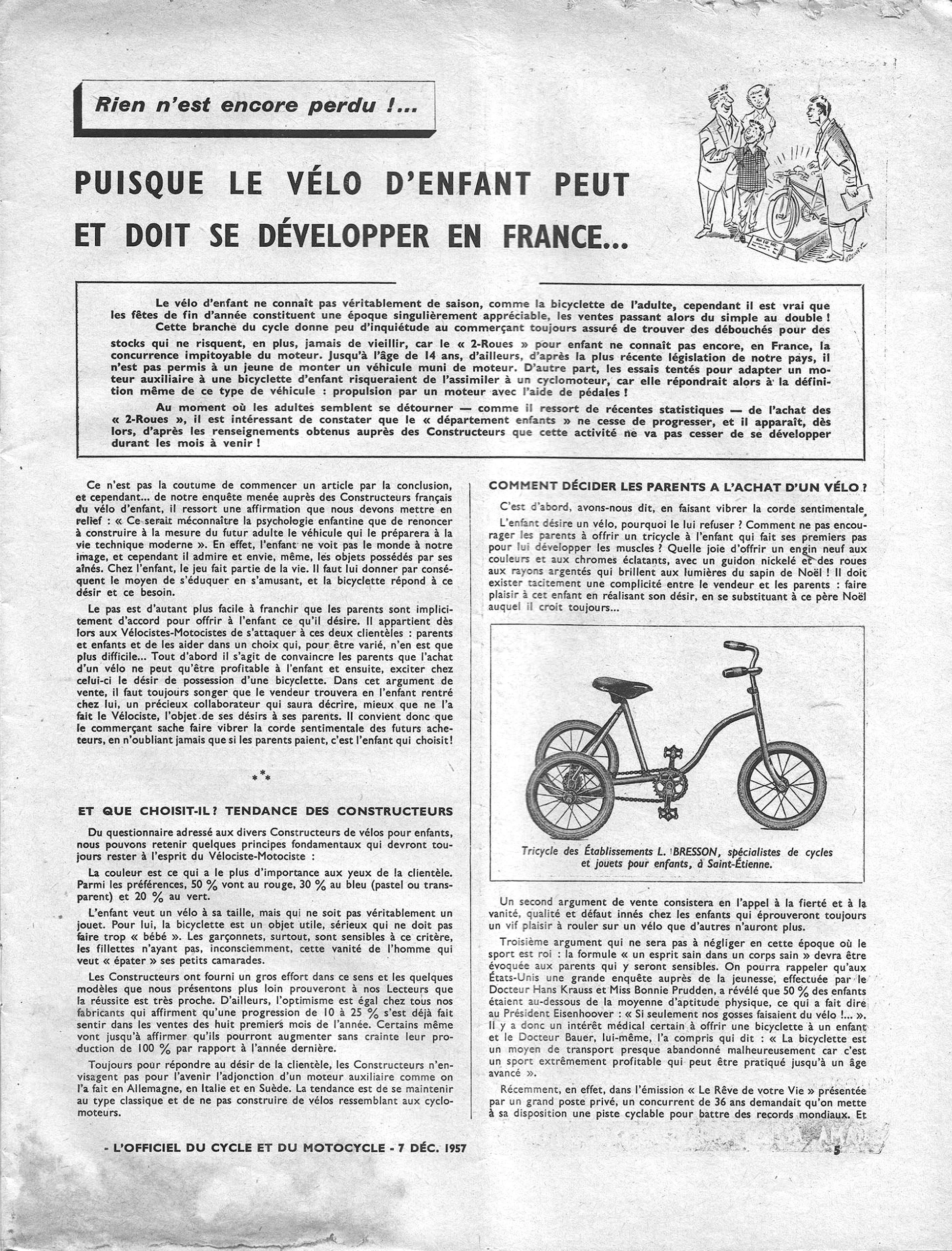
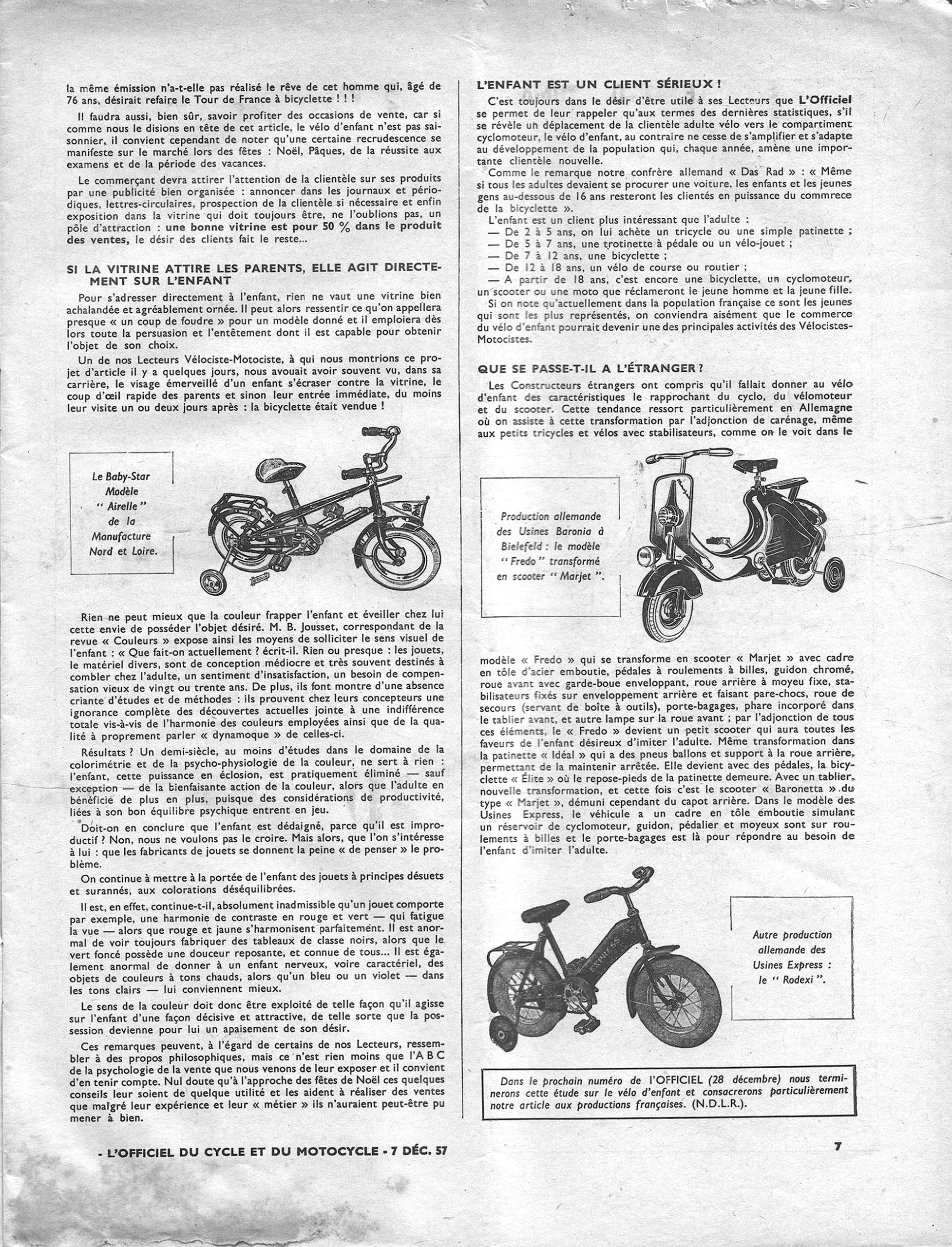
Source: L'Officiel du cycle, du motocycle et du camping, N° 25, 7 December 1957, pages 5 and 7; scan of the issue from Cycle Memory (Mémoire du Cycle), Collection privée F.
| Type | Review |
|---|---|
| Year | 1957 |
| Publisher | L'Officiel du cycle |
| Artist | Daniel Rebour |
| Country | France |
| Language | French |
| Pages | 2 |
| Source | L'Officiel du cycle, du motocycle et du camping, N° 25, 7 December 1957, pages 5 and 7; scan of the issue from Cycle Memory (Mémoire du Cycle), Collection privée F. |
| Credit | Ebykr archive |
| Identifier | Permalink https://cyclememory.org/fr/search-coll-list.php?collectionID=325&docID=B-1-0000001012 |
| Transcription | Headings and specifications transcribed; article text summarized |
Rien n’est encore perdu !... PUISQUE LE VÉLO D’ENFANT PEUT ET DOIT SE DÉVELOPPER EN FRANCE... COMMENT DÉCIDER LES PARENTS A L’ACHAT D’UN VÉLO ? ET QUE CHOISIT-IL ? TENDANCE DES CONSTRUCTEURS - L’OFFICIEL DU CYCLE ET DU MOTOCYCLE - 7 DÉC. 1957 — 5 — SI LA VITRINE ATTIRE LES PARENTS, ELLE AGIT DIRECTEMENT …
This is a magazine article, so its running text is summarized here rather than reproduced; the headline, byline, specifications and scores are transcribed as printed.
“Puisque le vélo d’enfant peut et doit se développer en France…”, L’Officiel du cycle, 7 December 1957, pages 5 and 7: how the dealer can sell children’s bicycles to parents and children, with a list of the machines a child wants at each age and the German makers’ scooter-styled children’s cycles, illustrated with a Bresson tricycle, the Baby-Star “Airelle” drawn by Daniel Rebour, the Baronia “Marjet” and the Express “Rodexi”. The headings and the age list are transcribed as printed; the text is summarized in Ebykr’s words, and the page images carry it in full.
— Page 1 —
Rien n’est encore perdu !…
PUISQUE LE VÉLO D’ENFANT PEUT ET DOIT SE DÉVELOPPER EN FRANCE…
COMMENT DÉCIDER LES PARENTS A L’ACHAT D’UN VÉLO ?
ET QUE CHOISIT-IL ? TENDANCE DES CONSTRUCTEURS
[Ebykr summary; the article’s text is not reproduced. A boxed introduction says that the child’s bicycle has no real season the way the adult’s does, but that the year-end holidays double its sales. The dealer can stock children’s machines without worry: they do not go out of date, and the child’s “2-Roues” faces no competition from the motor in France, since French law does not allow anyone under 14 to ride a motor vehicle, and fitting an auxiliary motor to a child’s bicycle would make it a cyclomoteur under the legal definition (propulsion by a motor with the help of pedals). While recent statistics show adults turning away from two-wheelers, the “département enfants” keeps growing, and the Constructeurs expect it to keep growing in the coming months. The article opens with the conclusion of its survey of the French makers of children’s bicycles: it would be a mistake not to build the child a vehicle on the scale of the future adult that prepares him for modern technical life. The child admires and envies what his elders own, learns through play, and the bicycle answers that need. Parents are already inclined to give the child what he wants, so the Vélocistes-Motocistes must work on two customers at once, parents and children: convince the parents that a bicycle can only do the child good, and stir the child’s wish to own one, since the child becomes the dealer’s best salesman at home. The parents pay, but the child chooses. Under its first heading, the article explains how to win the parents: appeal to sentiment, from the tricycle that helps a toddler’s first steps to a new machine with bright colors and chrome, a nickeled handlebar and silvered spokes under the Christmas tree, the dealer and the parents playing Father Christmas together. A second sales argument is the child’s pride and vanity in riding a bicycle others do not have. A third is health: an American survey of young people by Docteur Hans Krauss and Miss Bonnie Prudden found 50 % of children below the average in physical fitness, which drew a remark about children and cycling from Président Eisenhoover (so printed), and Docteur Bauer is cited as calling the bicycle a nearly abandoned but very healthy sport that can be practiced into old age. The page ends on a contestant aged 36 on the radio program “Le Rêve de votre Vie,” broadcast by a large private station, who asked for a cycle track to attack world records (the sentence runs on to page 7). Under the second heading, the makers’ answers to a questionnaire give the dealer some principles: color matters most to customers, with 50 % preferring red, 30 % blue (pastel or transparent) and 20 % green; the child wants a bicycle his size that is not a toy and does not look too babyish, boys above all; the makers have worked hard on this, report sales up 10 to 25 % in the first eight months of the year, and some expect to raise production by 100 % over the previous year. The makers do not plan to fit auxiliary motors as has been done in Germany, Italy and Sweden; the trend is to keep to the classic type and not build bicycles that look like cyclomoteurs. A boxed photograph shows a tricycle from the Établissements L. BRESSON of Saint-Étienne, makers of cycles and toys for children.]
[A pen drawing at the upper right shows a smiling father and mother with their son, in a checked shirt, before a dealer in a work coat, who presents a gleaming child’s bicycle standing on a display plinth with a small price card. A script signature, not legible at this resolution, sits on the ground line at the lower right of the drawing, beside the dealer’s foot. A boxed photograph in the right-hand column shows a child’s tricycle with a sloping curved frame, a sprung saddle, a high handlebar with grips, a chain drive to the rear axle and two rear wheels.]
– L’OFFICIEL DU CYCLE ET DU MOTOCYCLE – 7 DÉC. 1957
— 5 —
— Page 2 —
SI LA VITRINE ATTIRE LES PARENTS, ELLE AGIT DIRECTEMENT SUR L’ENFANT
L’ENFANT EST UN CLIENT SÉRIEUX !
L’enfant est un client plus intéressant que l’adulte :
— De 2 à 5 ans, on lui achète un tricycle ou une simple patinette ;
— De 5 à 7 ans, une trotinette à pédale ou un vélo-jouet ;
— De 7 à 12 ans, une bicyclette ;
— De 12 à 18 ans, un vélo de course ou routier ;
— A partir de 18 ans, c’est encore une bicyclette, un cyclomoteur, un scooter ou une moto que réclameront le jeune homme et la jeune fille.
QUE SE PASSE-T-IL A L’ÉTRANGER ?
(N.D.L.R.)
[Ebykr summary; the article’s text is not reproduced. (Continued from page 5.) The same radio program, the page goes on, granted the wish of a man aged 76 who wanted to ride the Tour de France route again by bicycle. The dealer must seize the sales seasons: the child’s bicycle is not seasonal, but sales rise at Noël, Pâques, exam successes and the holidays. He should advertise in newspapers and periodicals, send circulars, canvass customers and above all dress his shop window, which the article credits with 50 % of sales. Under the first heading, a well-stocked, attractive window speaks straight to the child, who falls for one model and then works on his parents; a Vélociste-Motociste reader who saw the draft says he has often watched a child press his face to the glass and the parents come in, then or a day or two later, to buy. Color is what strikes the child most: M. B. Jousset, correspondent of the review “Couleurs,” argues that toys and children’s goods are badly designed, often made to soothe adult frustrations, and ignore half a century of research in colorimetry and the psycho-physiology of color; that red and green together tire the eye while red and yellow harmonize, that dark green would be kinder than black for classroom boards, and that a nervous child should be given light blues or violets rather than warm tones. The article asks toy makers to think the problem through and the dealer to use color to win the child, calling these points the ABC of selling psychology before Noël. Under the second heading, L’Officiel reminds readers that while adult customers are moving from the bicycle to the cyclomoteur, the child’s bicycle keeps growing with the population. It quotes the German trade paper “Das Rad”: even if every adult bought a car, children and young people under 16 would remain the bicycle trade’s customers. The list gives the machine for each age group, and since the young are the largest part of the French population, the child’s bicycle could become one of the Vélocistes-Motocistes’ main lines. Under the third heading, foreign makers are giving children’s bicycles the look of the cyclo, the vélomoteur and the scooter, above all in Germany, where even small tricycles and bicycles with stabilizers get fairings. The Baronia “Fredo” becomes the scooter “Marjet”: a pressed-steel frame, ball-bearing pedals, a chromed handlebar, an enveloping front mudguard, a fixed-hub rear wheel, stabilizers mounted on the rear enclosure that act as bumpers, a spare wheel that serves as a toolbox, a carrier, a headlamp in the front apron and a second lamp on the front wheel. The patinette “Idéal,” with balloon tires and a stand on its rear wheel, becomes with pedals the bicycle “Élite,” keeping the scooter’s footrest, and with an apron the scooter “Baronetta” of the “Marjet” type, without the rear cowl. The Usines Express model has a pressed-steel frame imitating a cyclomoteur tank, with the handlebar, bottom bracket and hubs on ball bearings and a carrier. The captions name the Baby-Star Modèle “Airelle” of the Manufacture Nord et Loire; a German product of the Usines Baronia at Bielefeld, the model “Fredo” converted into the scooter “Marjet”; and another German product of the Usines Express, the “Rodexi.” A boxed editor’s note says the next issue of L’OFFICIEL (28 décembre) will finish this study of the child’s bicycle with an article on French products.]
[Two drawings and one photograph. Upper left, a drawing of the Baby-Star “Airelle,” a small child’s bicycle with a sprung saddle, a rear carrier, a basket on the handlebar, a chainguard and two stabilizer wheels; a ruled cartouche signature of the form Daniel Rebour used, a script name between ruled lines with crossing end strokes, sits on the ground below the bicycle between the stabilizer wheel and the pedal, too small at this resolution to read letter by letter. Right column, a drawing of the Baronia “Fredo” as the scooter “Marjet,” a child’s scooter-bodied cycle with a front apron carrying a lamp and a horn, a headlamp beside the front wheel, an enclosed rear end, a pillion pad and stabilizer wheels; a script word on the apron appears to read “Marjet.” Lower right, a photograph of the Express “Rodexi,” a fat-tired child’s bicycle with a deep pressed-steel frame lettered “EXPRESS,” a rear carrier and a stabilizer wheel. No other signature or monogram is visible.]
– L’OFFICIEL DU CYCLE ET DU MOTOCYCLE – 7 DÉC. 57
— 7 —
Ebykr presents this material for research and education. If you hold rights to it or notice an ownership issue, please contact us and we will respond promptly.
The Ebykr Digest
New articles, timelines, catalog finds and registry activity — assembled from the archive once a month. Your address is never shared.
Double opt-in. One email per month. Unsubscribe at any time with one click.